Angela merkel

Lost in translation: How Iain Duncan Smith shocked Angela Merkel

From our UK edition

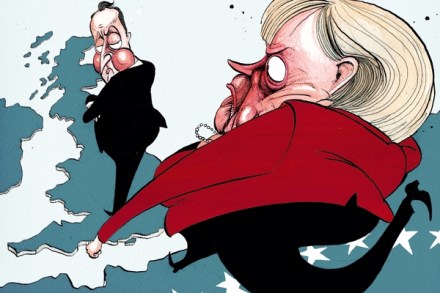
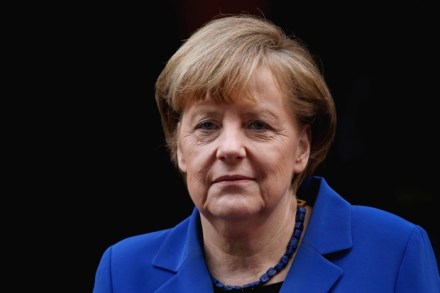
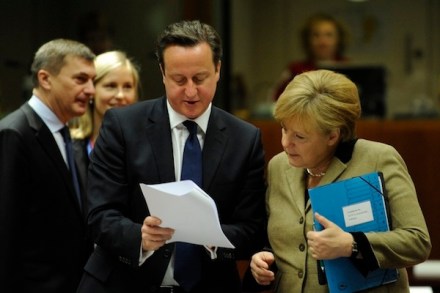
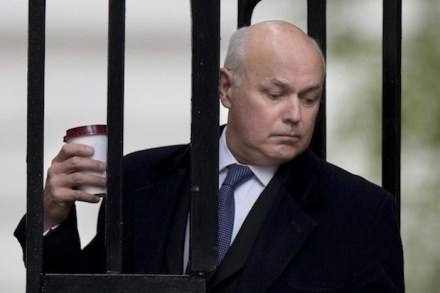
Angela Merkel is in London officially to talk about the G7 and unofficially to discuss David Cameron’s hopes for a reformed European Union that Britain can stay in. But while she’s here, she might want to ask after one of Cameron’s colleagues, Iain Duncan Smith. Duncan Smith likes to tell Tory constituency parties the tale of the time the pair attended a summit on benefits. Mostly the summit was attended by EU leaders, but Cameron sent IDS in his place. After sitting through a very long and dull speech from one of the delegates, Duncan Smith finally got his opportunity to speak. He began by saying how grateful he was it was his turn, and that he had almost lost the will to live by this point.
Will Merkel throw her diplomatic weight behind Cameron’s renegotiation strategy?

From our UK edition

Before today’s awful events in Paris, the meeting between David Cameron and Angela Merkel was going to be the big news of the day. The German Chancellor does not always observe the usual rules of neutrality when it comes to foreign elections. In 2012, she endorsed Nicolas Sarkozy in a joint TV interview, declaring that it was ‘natural’ to back a fellow Conservative. Now, there was no indication that Merkel was going to offer Cameron similar backing today. But senior Tories were keen to talk up what they were calling ‘das snub’, the fact that Merkel is not meeting with Miliband. (It is also worth remembering that in 2012, Miliband was busy attacking Cameron, Sarkozy and Merkel with his warnings about Camerkozy economics).

Labour only hurts itself by whinging in public

From our UK edition

Ed Miliband’s office has complained that no-one told them about Angela Merkel’s visit to London, which takes place tomorrow. They are apparently very irritated about no-one telling them, even though the Foreign Office isn’t required to flag up visits like this anyway. But worse than that, they were given warning: in the newspapers. Here are the first few paragraphs of a story published by the Times on 27 December, entitled ‘Merkel puts culture and G7 on agenda for visit’: ‘Angela Merkel will make Britain her first overseas visit of the year in a sign of the importance that she attaches to her relationship with David Cameron.

Germany is shackled in the immigration debate. But Britain isn’t so must lead the way

From our UK edition

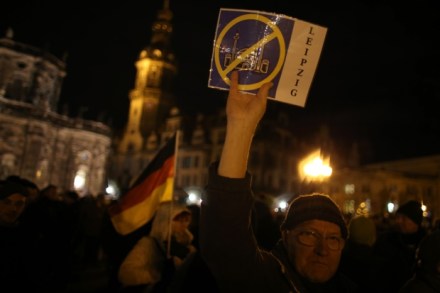
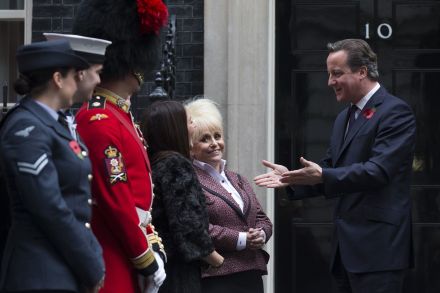
Today Angela Merkel will meet David Cameron in Downing Street. She will tell him what she can do – and what she cannot do – to help keep Britain in the EU. Yet she might like to begin by telling him what she plans to do to keep her own people behind the EU project, for in Germany the Eurofederalist consensus is being challenged like never before. In Germany, as in Britain, the most emotive issue is immigration. In Germany, as in Britain, people are scared to discuss this issue frankly, for fear of being branded racists. And now a new movement has emerged to fill this vacuum: Patriotische Europaer Gegen die Islamisierung des Abendlandes, aka Pegida – Patriotic Europeans Against the Islamisation of the West. Who are Pegida? What do they want?

Germany’s anti-Islamisation sentiment isn’t going to disappear any time soon

From our UK edition

Consider the odium Ukip attracts from right-thinking pundits – by which I obviously don’t mean right as in conservative – square it, and you’re getting close to the opprobrium that the anti-Islamisation movement, Pegida (Patriotic Europeans Against the Islamisation of the Occident), is attracting in Germany, not to mention outside it. For a group of demonstrators that number around 17,500 at the most in their most popular Monday gatherings in Dresden, it’s remarkable the breadth of the coalition against them: the churches, Angela Merkel ('there can be no place in Germany for religious hatred'), the employers federation leader, Ulrich Grillo ('we should welcome more refugees') and obviously every anti-racism group on the left.

Europeans no longer fear Germany. But do the Germans still fear themselves?

From our UK edition

In the old Death Strip between East and West Berlin, which runs through the centre of the city, there is a graveyard full of German war heroes and a few war criminals too. From the Red Baron to Reinhard Heydrich, the best and worst of the German military are buried here. There’s also a mass grave full of civilians, killed by Allied air raids, and a memorial to the 136 East Berliners who died trying to cross the Berlin Wall — which ran through this cemetery. The Death Strip is still an empty space. Germany has been marking two anniversaries this year — one a celebration, the other a painful duty. The 25th anniversary of the Mauerfall (as Germans call the fall of the Berlin Wall) is one of those rare events in German history about which they can feel unequivocally happy.

Portrait of the week | 6 November 2014

From our UK edition

Home Fiona Woolf, the Lord Mayor of London, resigned as the head of an inquiry into historical child sex abuse three months after Baroness Butler-Sloss, the former president of the family division of the High Court, resigned from the same appointment. Both had been criticised for having establishment links. ‘It is really going to be hard to find someone with no connections,’ Mrs Woolf said. ‘A hermit?’ Exploitation of vulnerable children has become the social norm in some parts of Greater Manchester, according to a report by Ann Coffey, the Labour MP for Stockport. The Serious Fraud Office opened a criminal investigation into accounting irregularities at Tesco.

What Angela Merkel really wants (it’s not good news for Dave)

From our UK edition

Angela Merkel is misunderstood. Last winter, when Russia moved to annex Crimea after the overthrow of Ukraine’s government, American officials put it about that the German Chancellor had described Russia’s leader Vladimir Putin as ‘living in another world’ and ‘out of touch with reality’. No evidence has emerged that she ever said any such thing. Europhiles in the press and in Westminster have now pulled the same trick on David Cameron. The Prime Minister has lately been ruminating about quotas for migrants from certain European Union countries. He complained last month when an unannounced £1.7 billion upward adjustment in Britain’s EU payment turned out to be triple the levy on anyone else.

The Spectator’s portrait of the week

From our UK edition

Home Fiona Woolf, the Lord Mayor of London, resigned as the head of an inquiry into historical child sex abuse three months after Baroness Butler-Sloss, the former president of the family division of the High Court, resigned from the same appointment. Both had been criticised for having establishment links. ‘It is really going to be hard to find someone with no connections,’ Mrs Woolf said. ‘A hermit?’ Exploitation of vulnerable children has become the social norm in some parts of Greater Manchester, according to a report by Ann Coffey, the Labour MP for Stockport. The Serious Fraud Office opened a criminal investigation into accounting irregularities at Tesco.

Carry on waffling about Europe, Dave – but do the EastEnders approve?

From our UK edition

Having perused the replies for my call to caption Ed Miliband and Mary Creagh, Mr S is sorry to say that there is no 'winner', nor even a 'favourite.' There is merely a non-honourable mention for the response that caused your correspondent to chortle so lustily that I spilled my tea and soaked my smoking jacket. So, for reader 'Samson', no prizes or accolades, but rather a stern gaze for his amusing submission, reposted below. Samson 'These earthlings are ever-displeased with me. Xinipemnan ijsdiih dhhjejndb ghty am I doing wrongly?

The bluffing game between Cameron and Merkel begins…

From our UK edition

We should all get used to reading stories about how Angela Merkel has warned David Cameron that if he persists with X, Y or Z she’ll no longer be able to support Britain staying in the EU. It is the nature of a negotiation that those involved in it will, at points, suggest that they will walk away if the other party continues to demand something. The skill is, obviously, to know whether the other person is bluffing or not. Now as Mats Persson points out, Merkel’s comments are not as definitive as they are being portrayed as in some places. But there is no getting round the fact that Merkel is determined to protect the principle of free movement while Cameron—ideally—would like to impose limits on it.

Europe will reconcile with Russia, and soon. It can’t afford not to

From our UK edition

After months of escalating tensions over Ukraine and talk of a new cold war, Russia and the West could soon reach a surprising rapprochement. The eurozone economy is suffering badly and sanctions against Russia are partly to blame. Winter is also upon us, and that reminds every-one Vladimir Putin still holds the cards when it comes to supplying gas. The clincher, though, is that Ukraine is heading towards financial meltdown. Unless an extremely large bailout is delivered soon, there will be a default, sending shockwaves through the global economy. That’s a risk nobody wants to take — least of all Washington, London or Berlin. Sanctions against Russia were always going to hit western Europe hard.

Tusk as European Council President is a mixed blessing for Cameron

From our UK edition

Donald Tusk, the Polish Prime Minister, has been appointed the new European Council President. Tonight, Tusk has had warm words about how imperative it is that Britain’s concerns about the EU are addressed. As Open Europe reports, he called the possibility of an EU without Britain a “black scenario.”   Tusk’s appointment is a mixed blessing for David Cameron. On the one hand, Tusk comes from a non-Eurozone country meaning that he’ll be sympathetic to Britain’s desire for single market protections for the Eurozone outs. The Ukraine crisis has also reminded the Poles of how important Britain is in terms of stiffening the EU approach towards Russia; meaning that Tusk genuinely would be loath to see Britain leave.

Germany’s forgotten war

From our UK edition

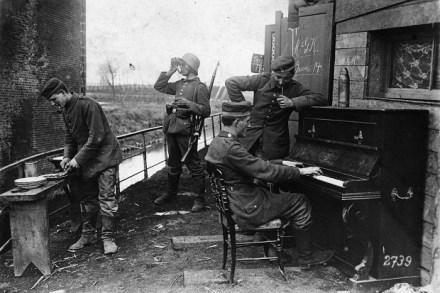
Britain is braced for the anniversary of the outbreak of world war one. Memorials and events are taking place across the country this weekend. Not so in Germany, where reticence reigns.  This week’s Spectator features a piece by Antonia Oettingen, a descendant of Karl Max von Lichnowsky, the Kaiser’s ambassador in London from 1912-1914. She explains why Germany is shy about the Great War. 'In 1912 Kaiser Wilhelm had an ambitious task for my great-great-great uncle Karl Max von Lichnowsky. He sent him to London to be our ambassador there, with orders to try to ensure Britain’s neutrality (at the very least, in cases of conflict with Russia and France).

US German relations nearing a post-war low

From our UK edition

In an era of Russian revanchism, the cracks in the US German relations are particularly concerning. Angela Merkel’s decision to announce the expulsion of the CIA’s Berlin station chief over the US’s recruitment of a German intelligence officer shows just how bad things have got. It is not just German elite opinion that is turning against the US. The Financial Times today reports that polling shows that Germans would prefer to increase ties with China than the US. Now, given that Beijing is an authoritarian government that would have no qualms about spying on anyone, this is not an entirely rational response. But it does reveal the poor state of the trans-Atlantic alliance.

Could Michael Howard be the next EU Commissioner?

From our UK edition

[audioplayer src="http://traffic.libsyn.com/spectator/TheViewFrom22_10_July_2014_v4.mp3" title="James Forsyth and Isabel Hardman discuss the EU Commissioner role" startat=732] Listen [/audioplayer]In recent weeks British government visitors to Berlin have been confronted with a persistent question: when will David Cameron make up his mind about who he’ll send to Brussels? Picking a European commissioner is a big decision: Tony Blair sent Peter Mandelson, who went on to become the EU trade commissioner. Gordon Brown nominated Cathy Ashton, who picked up the foreign affairs post. There is a tradition of Brits landing relatively big jobs — and, ergo, power and influence. But prime ministers need to send someone with enough heft and zest.

After being Junckered, the Cameron circle now fear for the renegotiation

From our UK edition

Getting Junckered was not an enjoyable experience for Downing Street. Not only has David Cameron lost his battle to stop the former Luxembourg PM becoming Commission President he has also discovered that Angela Merkel’s assurances to him can be trumped by her domestic political concerns. Considering how Merkel is the hinge on which Cameron’s renegotiation strategy turns, this is worrying for him. As I report in the Mail on Sunday, members of Cameron’s circle are now contemplating that the renegotiation might not deliver enough substantive change for the UK to stay in. As one of those who knows Cameron best puts it, ‘They might plump the cushions for us but the train isn’t slowing down and the points are still set the same way.

David Cameron is determined to fight Jean-Claude Juncker to the end

From our UK edition

The family photo at this week's EU summit will be a particularly awkward affair. EU leaders will have just come from listening to the last post at the Menin Gate, the memorial to the British and Commonwealth dead of the Ypres campaign, but they will know that they are about to have an unholy row over dinner as David Cameron tries to stop Jean-Claude Juncker from becoming President of the European Commission. Aware of how bad all this looks, the head of the EU Council, Herman Van Rompuy, has been busy trying to prevent a row at Ypres. Cameron and Van Rompuy had a 'full and frank' discussion about the matter today, Downing Street says. But Cameron is still determined to have this fight; he isn't backing down despite only having the Hungarians for allies.

The Conservatives may have damaged their chances of reforming Europe

From our UK edition

Although many MEPs believe that the European Parliament is the centre of the known political universe, in truth the goings on in Brussels and Strasbourg rarely trouble the attention of anyone who is not a dedicated EU geek. That said, the decision by the Conservatives' ECR group to admit the anti-euro Alternative für Deutschland party could have wider repercussions for Anglo-German relations, and therefore the prospects for Cameron's EU reform agenda. For those who are not familiar with AfD here is a potted history: the party was founded by German academics opposed to Merkel's Eurozone policies, specifically the bailouts. As it has grown, AfD has combined a more socially conservative policy agenda with populist rhetoric.

Cameron’s EU threats must be plausible; nobody likes a Prime Minister who cries wolf

From our UK edition

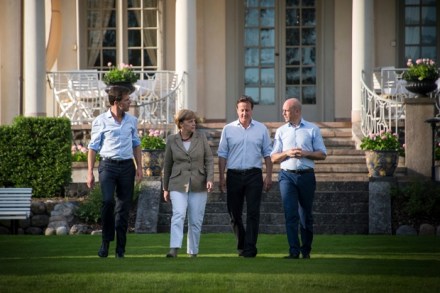
Angela Merkel is annoyed that David Cameron seems to be issuing threats to other European leaders in order to get what he wants. At a press conference concluding talks held by the centre-right EU leaders in Harpsund, the German Chancellor reiterated her support for Jean-Claude Juncker, and said: 'I made myself clear by saying that I am for Jean-Claude Juncker. But when I made that statement in Germany I also made the point that we act in a European spirit. We always do that because otherwise you would never reach a compromise. 'Thus we cannot just consign to the backburner the question of the European spirit. Threats are not part and parcel of that spirit. That is not part of the way in which we usually proceed.