A.a. milne

No fairytale: The Children, by Melissa Albert, reviewed

Who would be a child made famous by a book? A.A. Milne’s son, immortalised as the teddy-trailing Christopher Robin in the ‘Pooh’ books, became a global celebrity and was remorselessly bullied at school for the privilege. Alastair, the spoilt offspring who inspired Kenneth Grahame’s Mr Toad in The Wind in the Willows, felt moved to step in front of a train at university in return. And it is perhaps best for Alice Liddell that she never lived to read contemporary concerns about Lewis Carroll’s true motives for immortalising her in his Wonderland. This cost to children for enabling, even fuelling, an adult’s artistic ambition, is the starting point for the American YA author Melissa Albert’s first novel for adults, The Children.
The day ‘Hitler’ was captured in Tottenham

Given the way the world is right now, I am avoiding it in the main. For the sake of my mental wellbeing, I require less bad news and more fun company. Just as George V collected postage stamps and Rod Stewart collects toy trains, I have been collecting theatrical dames since the beginning of the 1970s when I first worked with Dame Peggy Ashcroft. It’s an odd hobby, but it has proved hugely rewarding. From Dame Flora Robson (who gave me a very useful book on window boxes when I bought my first flat) to Dame Joan Plowright (who bequeathed me her husband Laurence Olivier’s favourite sun hat, which I’ve worn with pride all summer), I have bagged more than 50 of them over the years. I recently had lunch with one of my favourites: Dame Eileen Atkins, 91.

A.A. Milne and the torturous task of writing

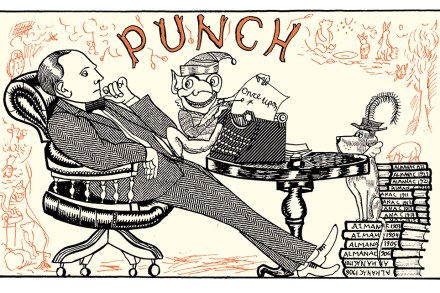
For those of us lucky enough to have been regular contributors to Punch magazine, April is a slightly crueller month than most, since it was on 8 April 32 years ago that the last edition collapsed, exhausted, on to the newspaper stands. By then it was way past its best, but in its day it had employed some of the very best brains in the business, led by some of the very best editors. I was lucky enough to be around when Alan Coren was in his prime. He led the magazine from the front, literally, and set a standard that the rest of us did our hardest to emulate, but rarely achieved. If ever.

The case for dodging cracks in the pavement

It is interesting to consider what would have happened if the Covid virus had emerged in 1921. Or 1821. Or 1521. There would have been no vaccine, for one thing. Treatment would mostly have been worse. In the 17th century we would have blamed the entire thing on Catholics. But in a few respects, bizarrely, we might have done better. For instance, miasma theory, although technically wrong, might have protected us better against airborne transmission than the early scientific consensus that the disease was spread via droplets on surfaces. A believer in miasma theory might have practised mask wearing (ideally with a large beak), indoor ventilation and outdoor gathering more assiduously than we did.