-
AAPL
213.43 (+0.29%)
-
BARC-LN
1205.7 (-1.46%)
-
NKE
94.05 (+0.39%)
-
CVX
152.67 (-1.00%)
-
CRM
230.27 (-2.34%)
-
INTC
30.5 (-0.87%)
-
DIS
100.16 (-0.67%)
-
DOW
55.79 (-0.82%)
Harris campaign chiefs give pathetic excuses for blowing $1 billion to lose election
After the Harris/Walz campaign blew over $1 billion, its top managers joined their first interview post-election on Pod Save America to explain what went wrong. Their excuses range from having less than 107 days instead of a year and a half, the fact that Harris wasn’t elected via the “traditional” route, the “political environment” — meaning Biden and Kamala’s poor approval ratings — along with Donald Trump, Donald Trump and Donald Trump.
“They don’t pretend to have all the answers here,” host Dan Pfeiffer started the podcast. “There’s way more to cover than we could possibly cover in one podcast.” Though you may struggle to believe it, the hour and thirty-five-minute interview only got worse from there. Jen O’Malley Dillon, Quentin Fulks, Stephanie Cutter and David Plouffe all tried very hard to dance around saying “we screwed up” and played the blame game instead. Supposedly they focused too much of their efforts on battleground states, claiming that “where she campaigned, we did way better than the rest of the country, and Donald Trump did worse.”
The most interesting bit of their game occurred around the fiftieth minute of the podcast when the campaign managers attempted to address how the money was spent. “We have to stop playing a different game as it relates to super PACs and the Republicans. Love our Democratic lawyers, I’m tired of it. They coordinate more than we do,” senior advisor David Plouffe started. As Cockburn noted previously, Kamala Harris’s campaign raised $195.8 million through super PACs in comparison to Trump’s $23.2 million.
“Having an ecosystem whether it’s on issues like reproductive health or climate or manufacturing or healthcare… I think that they tend to have more entities that are uh…” At this point, Plouffe seems about to admit that Republicans are better at unifying efforts and funds than Democrats. But he quickly pivots. “You know, to Stephanie’s point, clearly it is not legal what they’re doing, but we are at a disadvantage when our folks are playing by a different set of rules than they are.” The only “set of rules” Plouffe mentions is when Barack Obama couldn’t attend the super PAC events Mitt Romney could back in 2012.
It’s still unclear how being more coordinated with much less money — and even less cash from “dark-money” super PACs — is illegal. What is clear is that Republicans were much more “coordinated” this time around. “I think our side was completely mismatched when it came to the ecosystem of Trump and his super PACs and ours,” campaign manager Jen O’Malley Dillon finally admitted.
After Pfeiffer’s forty-five-ish minutes of easy questions, he pressed Dillon slightly, asking if Democrats going forward would use more of an ecosystem of super PACs instead of funneling all the money through one — “Future Forward.” Dillon responded inconclusively. “There are a lot of really important groups that do shit really well,” she mentioned. “And I also think that we should let people do what they do well, and help support them in that, and just have some coordination, and that would be my recommendation going forward.”
“We had a massive investment of staff, you know, 3,000 staff, hundreds and hundreds of offices in battleground states,” Dillon said in this same segment. “We had canvassers and people out knocking doors.”
In the first half of the interview, Pfeiffer asked about their approach to the campaign in terms of educating people about Trump. “I think the data is an incredibly faulty reading that what we should’ve done is just lift up Kamala Harris,” Plouffe concluded, after a long diatribe essentially admitting that the only way to overcome Trump’s high approval ratings from his first term is by scaring people with the terror of his second.
Other than the bit where the campaign execs blamed news outlets for giving Kamala “dumb” questions in interviews, Cockburn’s favorite line from the podcast was: “We put her on the Weather Channel. In part, because that’s where people were watching.”
“Real people heard in some way that we were not going to have interviews, which was both not true and also so counter to any kind of standard that was put on Trump,” Dillon mentioned. “On top of that, we would do an interview, and to Stephanie’s point,” — Stephanie Cutter made a lot of “points” — “the questions were small and processes—” Cutter: “Dumb, they were just dumb.” In light of Kamala’s multiple softball interviews and her CNN town hall where she couldn’t answer legitimate questions from undecided voters, this was quite the “point” from Cutter.
When pressed about why Kamala didn’t appear on The Joe Rogan Experience or lean into more podcasts, the campaign managers talked about Kamala’s limited time to campaign, and Walz’s role as the podcast king. “And the truth is, when Trump would go on these podcasts, the conversation wasn’t political,” Cutter, who oversaw messaging and communications for the campaign, said. “Call Her Daddy was a really important choice to make,” Dillon mentioned. And don’t even get Dillon started on how Trump got “no shit” from doing absolutely no traditional media, and they got “tons of shit that she wasn’t doing enough media.” Yet almost in the same breath, Cutter admitted that when Trump would book anything mainstream “they would cancel it.” Supposedly Walz was the podcast guy, as he covered the “politics-adjacent space” with “sports, hunting, fishing, running” and “football.” Yikes.
The podcast ended with a tiny bit of head-hanging — though not without many disclaimers — as they discussed how the Democratic Party could learn from their mistakes, getting back to those “bread and butter-type” issues that can strike home with the podcast bros.
“We’re losing the culture war,” Pfeiffer mentioned near the end. The hour-and-a-half interview demonstrated Cockburn exactly how right Pfeiffer was. As Dillon surmised in the most insightful line of the podcast: “You cannot put enough money into social media and digital advertising and paid programming to have the impact that organic reach has when people are empowered to speak in their own lives.”
The backlash to the managers’ lack of meaningful introspection has been vicious, naturally. “The rare cases where they speak in public shows how insular and controlling these people are, because you can see how fucking thin what they’re saying is,” one Harris aide told NOTUS’s Jasmine Wright. Ouch…
Why is a Labour MP calling for a blasphemy law?
Today at Prime Minister’s Questions, the Labour MP Tahir Ali asked: ‘Will the Prime Minister commit to introducing measures to prohibit the desecration of all religious texts and the prophets of the Abrahamic religions?’
Does Mr Ali think this is the most important issue currently facing the UK? Or, even more disturbingly, is this something that his constituents are calling for?
The fact that we have an MP from the governing party calling for blasphemy laws to be reinstated is part of a terrifying development in politics. It comes alongside a rise in sectarian voting, which has seen minority groups pitted against each other and a splintering of modern society.
Why, for example, did Mr Ali choose only to cite the Abrahamic religions? Would I still be free to say awful things about Ganesh or Vishnu in Mr Ali’s dream society as long as I didn’t criticise the Quran? If I were a British Hindu listening, I would start to feel increasingly concerned about Ali’s intentions.
Perhaps most concerning of all was the Prime Minister’s response to Ali’s question. Keir Starmer uttered a bland, robotic reply that, ‘Desecration is awful, and we are committed to tackling all forms of hatred and division, including Islamophobia.’
Desecration is, of course, a powerful emotion. It is a deeply engrained transgression that is a common feature of multiple times and cultures. Indeed, such is the visceral reaction to desecration that for many centuries there were laws on the British statute book banning people from denying the truth of Christianity.
Over time though, the idea that the criminal law should punish those who desecrate religion was swept away. Gradually the value of freedom of speech was recognised and then embraced as vital to all other freedoms.
Western societies came to accept the idea that while we should endeavour to be polite and genial where possible, we should also be free to offend and be offensive in an open society. This development – leading all the way up to the repeal of the UK’s blasphemy laws – has been crucial for scientific endeavour as well as political debate.
We shouldn’t take these ideas for granted. In the West recently there has been the attempt to create modern blasphemy codes, by attacking anyone who does not adhere to progressive dogmas.
And in many countries around the world, desecration is still punishable by death.
Pakistan, that oasis of good governance, has more prisoners on death row or in life imprisonment for blasphemy than anywhere else on Earth. A new law was passed there just last year further broadening these laws to include criticism of the Prophet Muhammad’s family, his wives and companions.
Extra-judicial enthusiasm for punishing blasphemers is rife in Pakistan: in February, dozens of men stormed a police station in Punjab to kidnap and lynch a man accused of desecrating the Quran. In August, a mob of hundreds attacked the Christian community of Jaranwala, after two Christians were accused of blasphemy.
Britain, unfortunately, has not been immune to blasphemy extremism. There is still a school teacher in hiding and fearing from his life from a baying mob and death threats because he showed an image of the prophet Mohammad in a class. Last year, a 14-year-old autistic boy received death threats after reportedly dropping a Quran in a corridor. This was followed by a Labour councillor stoking tensions by claiming that the book had been desecrated. But at least we do not yet have laws forbidding us from criticising religion – something that would undoubtedly change if Tahir Ali had his way.
Fifteen years ago, before his untimely death, Christopher Hitchens warned us about this. ‘Resist it while you still can,’ he said: ‘and before the right to complain is taken away from you which will be the next thing you will be told you can’t complain because you’re Islamophobic.’
Hitchens was right. Resist it while you can.
Badenoch admits Tory migration failures
Of all the issues which did it for the Conservatives in July 2024, no issue deterred life-long Tories more than the failure to control migration. So it was appropriate then that this subject formed the basis of Kemi Badenoch’s first major policy speech since her election as leader. Ahead of tomorrow’s release of migration statistics, she chose to deliver a mea culpa on behalf of her party, admitting at a hastily-assembled press conference that the Conservatives had previously got this issue wrong. The last administration ‘promised to bring numbers down,’ she said. ‘We did not deliver that promise’:
As the new party leader I want to acknowledge that we made mistakes. Yes, some of these problems are long standing – this is a collective failure of political leaders from all parties over decades – but on behalf of the Conservative party it is right that I as the new leader accept responsibility, and say truthfully we got this wrong.
Flanked by Chris Philp, the new shadow home secretary, Badenoch told journalists that she has instructed her team to develop new policies, including a strict numerical cap on net migration. ‘We will review every policy, treaty and part of our legal framework’, she pledged. ‘Including the ECHR and the Human Rights Act.’ She suggested in the Q&A that migrants could have their access to benefits limited and that some Home Office staff would be better suited to the charity sector. It had the Tories in the front row all nodding their heads along in agreement.
Winning over a wider audience will certainly take much more time. Having made her quasi-apology, the most interesting thing in Badenoch’s speech is what she did not say. There were frequent swipes at Labour throughout: unsurprising perhaps, given the Tory leader’s natural preference for being on the attack, rather than the defence. But there was not a single word about Reform or the four million voters who backed their cause. Badenoch’s framing of migration in binary terms is likely to be something we see more of in future, as she seeks to present her party as the only realistic alternative to Keir Starmer and Yvette Cooper.
The pessimist’s view of today’s event was put simply by one Reform source: ‘It was an announcement about an announcement.’ But an optimist might point to the auspices of the Centre for Policy Studies under which the event was held. Fifty years ago, it took time for Margaret Thatcher to formulate Stepping Stones and a workable agenda for supply-side reform. Badenoch has only been leader of the opposition for a matter of weeks; there are more than four years to go until the election. Her supporters will argue that today we saw the first steps on the long road back to Tory credibility on migration control.
Listen to more on Coffee House Shots:
Kemi Badenoch must get better at PMQs
Third time lucky for Kemi Badenoch. The Tory leader’s first two attempts to crush Keir Starmer at PMQs failed. Today she began by attacking the chancellor whose career is in quicksand and who admitted to the CBI that her smash-and-grab budget was so destructive that it mustn’t be repeated.
‘I’m not coming back for more borrowing or more taxes,’ said Rachel Reeves on Monday. Kemi asked Starmer to repeat that pledge in the house. Not a bad question. Starmer said he couldn’t write ‘five years of future budgets’ at the despatch box. Not a bad answer. Kemi’s team should have seen it coming.
She boasted that Starmer had made an embarrassing admission by failing to endorse Reeves’s pledge. Well, sort of. She then quoted the PMI index and asked why business confidence is crashing. Sir Keir ignored this and brought up to Kemi’s loose remark two weeks ago when she endorsed Labour’s investment pledges.
Other backbenchers did her job far better
‘They haven’t got a clue what they’re doing,’ said Sir Keir.
Kemi should have anticipated that rebuttal as well. Then she came to the farming crisis, an astonishing own-goal by Labour, but she only mentioned it in passing before moving to the issue of biscuits. Yes, biscuits. The boss of McVitie’s recently criticised Labour’s financial strategy and Kemi joked that business people are struggling to ‘digest the budget.’ No one laughed.
Continuing this bizarre routine, she described the deputy prime minister as a Ginger Nut which is probably the nicest thing Angela Rayner has ever been called. Is Kemi being paid to find cuddly nicknames for the cabinet? Finally, leaving it very late, she moved to the day’s big crisis, the threatened loss of 1,100 jobs at the Luton van works. Knowing this was a hopeless mission she walked straight into the trap she’d laid for herself. Starmer demolished her with facts.
‘The EV mandates at issue in this case were introduced by the last government,’ he said. ‘She was the business secretary who introduced them.’
Gales of laughter greeted this unremarkable comment. Kemi has achieved the impossible: she makes Starmer look like a cross between James bond and Noel Coward.
Other backbenchers did her job far better. The member for Gordon and Buchan, Harriet Cross, named a recently bereaved farmer, Sarah, whose holding is threatened by the chancellor’s tax-raid. Starmer lifeless eyes swivelled towards her.
‘I’m grateful to her for raising the case’, he said in his thin, anxious voice. ‘Send me the details and I’ll certainly have a look at it.’
Sure he will. Another file for the shredder. Stephen Flynn of the SNP suggested that Starmer might feature in ‘scam awareness’ week on the BBC. He declared that Labour ‘claims to protect pensioners only to pick their pockets.’
Well said. Why didn’t Kemi point that out? It’s not hard to sum up Labour’s objectives.
Send Granny to Narnia.
Put Farmer Giles on suicide watch.
Dump everyone else on benefits.
Labour’s Matt Western accidentally revealed why Starmer wants to freeze pensioners to death this winter. The cash is being sent to Ukraine to fix their energy infrastructure. Western lamented that the war with Russia has left 80 per cent of Ukraine’s grid ‘damaged and destroyed.’ (If Ed Miliband was in charge, the figure would be much higher). Western told us that ‘this important ally’ needs more power generators. OK. And what sort? He didn’t specify but diesel is the fuel of choice for portable generators. Sir Keir duly pledged £370 million ‘to support the energy sector in Ukraine.’ Which is astonishing. Our taxes are being used to heat homes in Ukraine while our pensioners endure hypothermia in their icy bungalows. And Ukrainians get toasty-warm fossil fuels but our citizens have to pay sky high bills for non-twirling windmills and feeble winter sunshine. The message is clear. Britons must emigrate to enjoy the benefits of their own taxes.
Daisy Cooper begged Sir Keir not to renovate any NHS buildings on her patch. She boasted that her local hospital has ‘eliminated 65-week waits’ and ‘met all three cancer standards’ despite the ‘terrible buildings’ which are ‘life expired.’ There is a plan to replace the old hospital but Cooper’s own statistics argue against it. A spanking new building is a distraction, clearly, and our NHS heroes can work miracles irrespective of their physical surroundings. The spirit of the Blitz will save the NHS. Thank you, Ms Cooper.
Flashback: Rachel Reeves’ battle for winter fuel allowance
It’s fuel poverty awareness day today. So what better time to reflect on Labour decision to pull payments for pensioners, just weeks after taking office? Ahead of the release of pension credit statistics tomorrow, Mr S has been doing some digging into the Chancellor’s past. And it seems that ‘Rachel Thieves’ – as her critics like to jibe – has not always been such an enemy of universal hand-outs for the elderly….
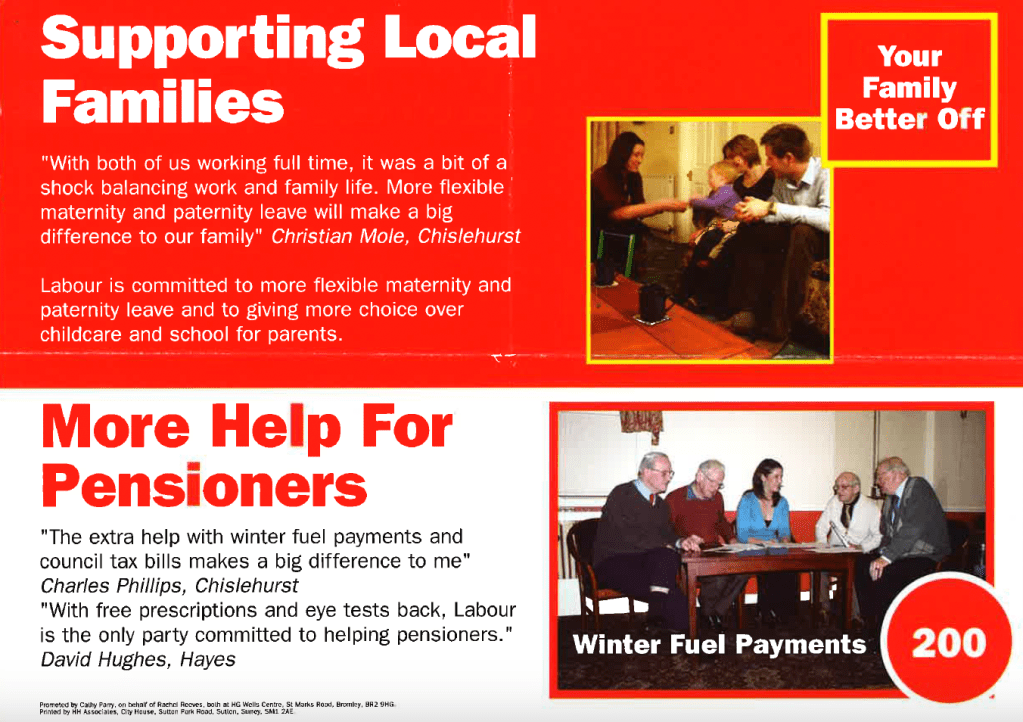
A recently-unearthed leaflet from the University of Bristol archives reveals that Rachel Reeves made winter fuel payments central to her very first election campaign. Reeves stood for Bromley and Chislehurst in 2005 and made ‘More Help for Pensioners’ one of her key priorities to voters in the Tory safe seat. It quoted one local resident claiming how ‘extra help with winter fuel payments and council tax bills makes a big difference to me.’
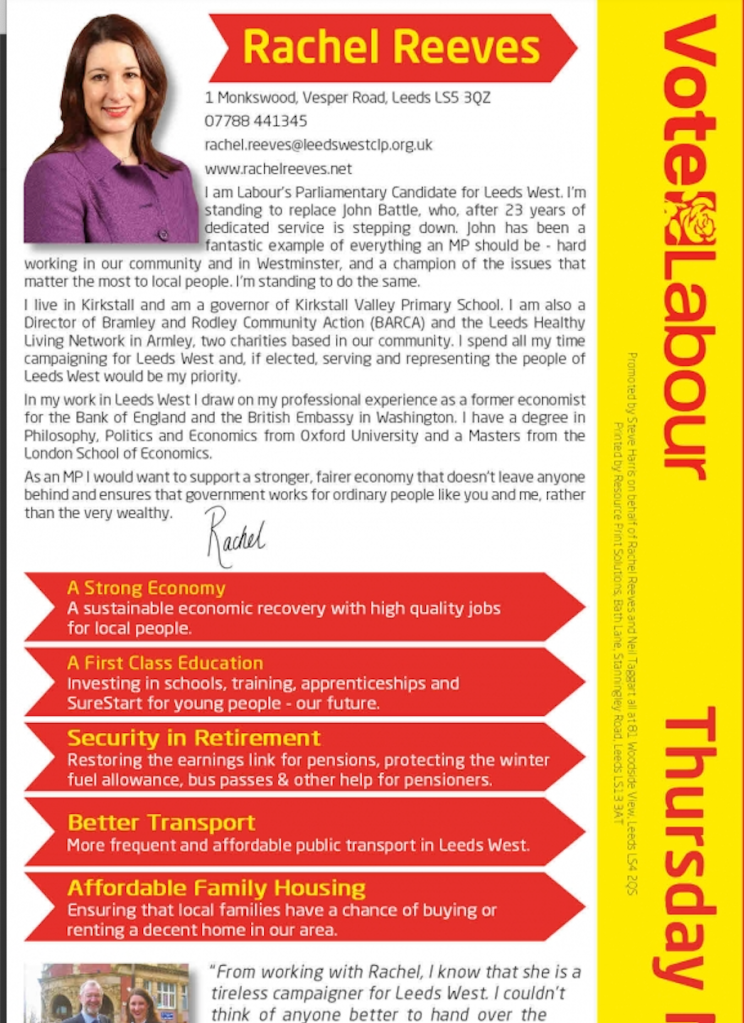
Having lost in 2005 – and then again in the 2006 by-election – Reeves then moved up to Leeds West, where she was elected at her third attempt in 2010. Amusingly, she again made winter fuel central to her campaign here, writing on leaflets about her promise to ensure ‘security in retirement’ by ‘protecting the winter fuel allowance.’ Richard Holden, Shadow Paymaster General told Mr S:
Even Saul on the road to Damascus didn’t see a conversion this dramatic. What would a young Rachel Reeves think of her own decisions as Chancellor?
Well, quite…
William Hague is the new Chancellor of Oxford
Congratulations to William Hague, who has today triumphed in the race to succeed Chris Patten and become the 168th Chancellor of Oxford. Hague, who topped the ballot at every stage, won the final run-off against Elish Angiolini by a margin of 1,600 votes. Former cabinet ministers Peter Mandelson and Dominic Grieve were both eliminated in the earlier rounds of voting. Jan Royall, the outgoing principal of Somerville College, finished third.
The result represents a belated victory for the ex-Tory leader over New Labour, 23 years after his landslide defeat at the hands of Tony Blair. Some commentators viewed the race as a straight party political fight between Mandelson and Hague. Yet even left-leaning dons confess to preferring a former foreign secretary to a Labour peer who twice had to resign from government.
In spite of the efforts of the university Labour club and Mandelson’s own impressive media game, he appears to boast more fans in Westminster than Oxford. He finished a distant fourth on 3,344 votes, with his Labour colleague Royall managing 4,662 in third. Perhaps he will be consoled by reports that he will shortly be named as the next Ambassador to Washington. His poor showing will at least please the outgoing Chancellor: Mandelson has called for Starmer to develop closer ties with China while Patten, Hong Kong’s former Governor, has repeatedly attacked Beijing.
Hague will now become a leading voice in debates on the future of British universities. In a statement he pledged that ‘I will dedicate myself in the coming years to serving the university I love’, adding ‘what happens at Oxford in the next decade is critical to the success of the UK’. As a member of the House of the Lords, he was the only candidate to vote in favour of the Higher Education (Freedom of Speech) Act, which Labour ministers have now chosen to pause.
Today’s result brings an end to a mammoth ten-month contest which has been dogged with controversy. Early plans for a candidate committee had to be binned after cries of a ‘stitch-up’. The resulting compromise produced 38 candidates, some of whom were palpably unsuited to the role. Turnout figures showed that only 24,000 – some 7 per cent – of Oxford’s estimated 350,000 graduates and staff members voted last week, despite the innovation of online ballots.
Similar rows will likely happen again the next time this contest is held, when Hague’s tenure ends in ten years’ time.
Private Eye’s shameful attack on Allison Pearson
What is the purpose of Private Eye? I know it’s supposed to be some kind of anti-establishment satirical magazine, boldly holding power to account and standing up for the little guy. But I must say I’m finding its response to the extraordinary police doorstepping of Telegraph columnist Allison Pearson rather puzzling.
You would think that this supposed thorn in the side of the powerful would sally out in defence of a fellow journalist being visited by the police because of something she posted online – not out of love for the journo in particular, but for the vital principle of free speech.
Should Pearson have had a notepad stashed in her dressing gown pocket just in case the cops came calling?
Sadly, however, it seems any such principles have fallen by the wayside. Private Eye’s fortnightly print schedule has finally got round to covering the Allison Pearson case and far from taking aim at the extraordinary overreach of Essex Police – say, by highlighting its woeful record of solving actual crimes – it has run a personal attack on Pearson herself. Pearson finds herself in the ‘Street of Shame’ column for allegedly ‘misreporting’ her encounter with police at her Essex home.
After plod came knocking earlier this month, Pearson and the Telegraph had reported that she stood accused of a ‘non-crime hate incident’ (NCHI), for a tweet the previous year. However, it later transpired she was under investigation for inciting racial hatred under the Public Order Act (a charge which has now been dropped entirely).
Private Eye‘s piece takes great issue with this discrepancy, essentially suggesting Pearson deliberately misled people. It sneers at her explanation: ‘Pearson, a journalist with 40 years’ experience, declared that she might have misheard the officers because she was “pretty shocked”.’ Instead, it insists this reflects her ‘characteristic grasp on factual accuracy’, as if she were just waiting for the police to visit so she could misrepresent the force.
It’s an extensive charge sheet against the conservative journalist, which Private Eye uses to write off the entire episode – yet its arguments scarcely stack up. For one thing, wouldn’t anyone, journalist or otherwise, be pretty shocked to have police turn up at their door on a Sunday morning? Should Pearson have had a notepad stashed in her dressing gown pocket just in case the cops came calling? It seems that in its dislike of Pearson, the magazine has forgotten the human element in all this. In any case, what is Pearson supposed to have gained by wrongly claiming she’d been accused of something else?
Private Eye gives much weight to a transcript released by Essex Police to dispute Pearson’s claims, which it says provides a ‘pretty comprehensive rebuttal’. The ‘transcript’ comprises just three lines spoken by an officer. Along with the force’s dubious assertion that ‘Essex Police supports free speech’, it clearly aims to present the police in a favourable light. An inquiring investigative magazine might be minded to ask why we haven’t been given the full transcript. Indeed, if the dispute is so cut and dry, why not release the bodycam footage, too?
In any case, whether or not Pearson reported what happened accurately, by using this minor factual discrepancy to rubbish the entire issue, Private Eye seems to be wilfully missing the wood for the trees. Whether it was an NCHI or anything else really shouldn’t matter – no one should be visited by the police over tweets, least of all Pearson. Numerous legal professionals have said her tweet came nowhere near the threshold for criminality, as proven by Essex police dropping the case. It’s nonsense to say that Pearson’s backers should have stopped defending her when it became clear she had been investigated for the far more serious offence of inciting racial hatred, for which the maximum penalty is seven years behind bars. Indeed, this fact makes her case more chilling, not less.
The Street of Shame continues to say that ‘there remains an important issue at the heart of all this’. Readers can probably think of some. Free speech, perhaps? The egregious waste of police time? The chilling effect on journalism? The fact that Essex Police upgraded Pearson’s case to a Gold Unit usually reserved for terror cases?
But none of those quite makes the cut. Instead, at last noting the outsize police resources devoted to this case, Private Eye asks: ‘Why, as with the shocking overreaction to the vigils for Sarah Everard in 2021, do the police appear to reserve their most heavy-handed action for cases in which they themselves are the ones being criticised?’ This may well be an issue. But it’s notable that Private Eye chooses an apparent instance of two-tier policing that’s three years old here. It’s almost as if it can’t bring itself to notice the more glaring recent examples of varying police priorities because it’s politically incorrect to do so.
In case you thought this anti-free speech line was an isolated incident, the same edition also carries a spoof piece justifying the police’s decision to knock on Pearson’s door:
We have woken up to an Orwellian, Kafka-esque nightmare dystopia where the police can just turn up, knock on your door in the middle of the day, and subject you to a polite request for a quiet word! And all because someone, somewhere, has taken offence at your tweet to your 189,000 followers – which was so innocent that you deleted it immediately, and then told the police you couldn’t remember what it was!
In its desire to make light of Pearson’s ordeal, Private Eye manages to turn her doorstepping by the police into ‘a request for a quiet word’. It then implies, contrary to mountains of evidence, that the only people who need fear a knock on the door by the police are those who have tweeted ‘libellous drivel and lazy misinformation online’ – in other words, people who probably deserved it. It also attempts to suggest the right is only concerned about Pearson’s case for cynical reasons. In fact, Pearson’s treatment has been labelled ‘Stasi-like’ by a Labour MP, criticised by old-school lefty Suzanne Moore, and even called out by Sir Keir Starmer himself.
In the end, it seems like only the ‘liberal’ left have been unable to see the Pearson case as a disturbing case of police overreach. Other to have taken aim at Pearson include ex-BBC hacks at The News Agents podcast, who have accused Pearson of a ‘persecution complex’, and the production company behind Have I Got News For You in a now-deleted tweet. A writer in the Guardian has called it a ‘non-scandal’ and cries that ‘“free speech” has been weaponised’.
These establishment figures may delude themselves that they’re speaking truth to power, but they share, as Niall Gooch noted earlier this year of Ian Hislop, a ‘concept of the Establishment [that] seems to be stuck in about 1952’. And that explains a lot. Only someone so out of touch with the reality of social power today could call themselves a liberal, yet see the police being sent to a journalist’s door and cheer it on.
Kemi Badenoch calls on Keir Starmer to resign at PMQs
Unconventional as ever, Kemi Badenoch used her third ever Prime Minister’s Questions as Conservative leader to call on Keir Starmer to resign. The Tory leader was half speaking in jest, telling the Prime Minister that ‘if he wants to know what Conservatives would do, he should resign and find out’. It was her latest riposte to Starmer claiming that Badenoch’s party didn’t have a ‘clue’ what to do and kept jumping on bandwagons. That was precisely the charge being levelled at Starmer just a few months ago, while he was busy accusing the then prime minister Rishi Sunak of not answering any of his questions. Once again today, Starmer didn’t answer many questions either.
🚨 NEW: Kemi Badenoch says Keir Starmer should resign and brings up the general election petition that has received 2.5 milion signatures
— Politics UK (@PolitlcsUK) November 27, 2024
Starmer: "She talks about a petition, there was a massive petition on 4 July" #PMQs pic.twitter.com/oePvyPqIxR
The PM refused to repeat Rachel Reeves’ pledge to the CBI on Monday that she was ‘not coming back with more borrowing or more taxes’. Badenoch said rather pointedly that ‘I knowing that telling the truth to this House is important to the Prime Minister’, and demanded he repeat that pledge now to MPs.
Starmer did not. He replied:
‘We set out our position at the Budget, that was just set out, we’re fixing the foundations, we’re dealing with the £22 billion black hole that they left. I’m not going to write the next five years of budgets here at this dispatch box. We said we wouldn’t hit the pay slips of working people, we’ve passed the Budget, invested in the future and we’ve kept that promise.’
Even in dodging the question, Starmer said something that is at best highly disputed: the Office for Budget Responsibility has said that three quarters of the National Insurance hike for employers will be passed onto their staff in the form of lower real wages. That sounds quite a lot like hitting a pay slip.
Anyway, Badenoch retorted that Starmer was ‘not fixing the foundations: he’s making everything worse’. She pointed out that Starmer had refused to repeat Reeves’ pledge and then asked about falling business confidence.
Once again today, Starmer didn’t answer many questions at PMQs
The Prime Minister repeated, slightly robotically, that ‘we’re fixing the foundations’, and then deflected to talking about what Badenoch would or wouldn’t be doing on the NI rises, prompting her suggestion that he resign.
She then listed ways in which the government was contradicting itself on supporting business, and mentioned the petition calling for a general election. Starmer carried on complaining that the Conservatives ‘couldn’t decide what their position was’, and added ‘we had a massive petition on 4 July in this country’.
The pair carried on sparring like this, with Badenoch pointing out that the Tory Budget earlier this year had not led to tractors blockading the streets of Whitehall. If Starmer had been a little more fleet of foot, he might have started talking about another Budget that had far worse effects than a march of farmers: Liz Truss’s mini-Budget, which he normally quite happily dines out on. He did, though, try to blame the closure of the Vauxhall plant in Luton on the last Conservative government, which introduced the electric vehicle mandates that the van manufacturers are blaming for their woes.
When Ed Davey asked his questions, Starmer avoided giving another important answer, which was on the National Insurance hike and hospices. The Lib Dem leader pegged this to Friday’s assisted dying vote, which he is against, and argued that whatever happened, the government needed to improve palliative care in this country. His question was a bit long and garbled, though, and allowed Starmer to avoid the point about whether hospices would be exempt from that tax rise. Unusually for this government, the rest of the session was not dominated by totally pointless questions from Labour backbenchers dressing up their desire for a promotion in some convoluted and wordy way of praising the Prime Minister. But it also didn’t give Starmer a huge amount of difficulty, other than when he stumbled over his words when defending the government’s reforms to inheritance tax for agricultural property. He said:
‘Obviously it’s important to bear in mind, in a typical case, which is parents passing to a child, the threshold is £3 million – er billion – er million, and that is why, as she knows, the vast majority of farms will be totally unaffected.’
Starmer, like most of us, often tellingly trips over his words on subjects he’s not fully comfortable with, whether it be the ‘return of the sausages – hostages’ or the threshold for inheritance tax, which presumably he fluffed because he wasn’t sure if it could be that low. Still, at least he tried to answer that question, unlike many that had come before.
Watch: Labour MP calls for blasphemy law
Oh dear. Tahir Ali is at it again. It was only ten months ago that he had to apologise after claiming at PMQs that Rishi Sunak had ‘the blood of thousands of innocent people on his hands’. But the controversies of the past don’t seem to have blunted the Honourable Member for Birmingham Hall Green and Moseley. For the Labour MP has today asked whether, er, he might consider the reintroduction of blasphemy laws. So much for a politics that treads more gently on people’s lives…
Ali asked Starmer ‘Will the Prime Minister commit to introducing measures to prohibit the desecration of all religious texts and the prophets of the Abrahamic religions?’ Alarmingly, Starmer refused to rule out the proposal, only saying that ‘desecration is awful and I think should be condemned across the House’ before insisting ‘we are committed to tackling all forms of hatred and division, including, of course, Islamophobia in all of its forms.’
Wonder if we will see such concern for the Batley school teacher in hiding eh?
Who should Labour target to ‘get Britain working’?
Labour talks of having the ‘bold ambition of an 80 per cent employment rate’. But who should they target to get there? The government published its white paper this week on ‘getting Britain working’ and tackling the growing health and disability benefits bill, which is forecast to hit £120 billion.
Figures slipped out by the Office for National Statistics today give more insight on which groups could perhaps be better targeted. These figures split out employment rates by parental status, and show that already more than 80 per cent of married (or cohabiting) mothers and 93 per cent of married (or cohabiting) fathers with dependent children are working. This doesn’t leave a huge amount of room for boosting the employment rate in a huge section of the population.
The groups below the 80 per cent target include men and women without kids that depend on them (72 per cent and 70 per cent). But the lowest employment rate is among the single parent group, which sits at just 66 per cent. So perhaps it’s this group that Work and Pensions Secretary Liz Kendall should be targeting. But, as the below graph shows, there has already been huge improvement in this group over the last three decades so any further gains would be very hard won.
To hit their 80 per cent target, Labour must get another 1.8 million people employed. There are more than 600,000 single parents not in work: that might be the place to start.
The advert that radicalised me
This is one of a series of posters that adorn the walls of Westminster Underground station, through which many MPs and aides travel to work. On Friday, MPs will be voting on whether or not to legalise assisted dying. The posters, funded by a campaign group called Dignity In Dying, present a series of individuals happily contemplating the prospect of ending their own lives. The vibe is feel-good, joyful and glossy, somewhere between a cosmetics brand and Kamala Harris ‘24. I think they are the creepiest ads I’ve ever seen.
When this bill was introduced a couple of months ago, I didn’t have much of an opinion on the issue. I’d read that things were getting pretty weird in Canada and the Netherlands, so I was wary. But the case for legalising euthanasia is undeniably powerful. Many people have experienced at first or second-hand situations in which the end of a person’s life becomes unbearable for the person themselves and for their loved ones. It seems only humane to give suffering people, in certain very limited situations – this bill applies only to terminally ill adults with six months or fewer to live – control over how to end their lives.
As the public debate unfolded, however, and opponents of the bill asked awkward questions of it, it became apparent to me that its supporters didn’t have convincing answers. Most pertinently, they couldn’t explain how weak and vulnerable people won’t be persuaded that it’s their duty to do the right thing, by a conspiracy, articulated or otherwise, of over-stretched healthcare staff and exhausted relatives. All the supporters have offered is an insistence on the primacy of individual choice, emotional stories, and aspersions on their opponents. The first two are important to consider, but you surely have to go further than when it comes to such a momentous change.
If the pro-bill arguments are thin it’s not just because they haven’t nailed the legislative details, but because they haven’t been forced to think the issue through before. For instance, they too easily dismiss the concern that this bill puts us on a ‘slippery slope’ to more state-sanctioned killing. They appeal to the legislative process, as if that is what counts. Regardless of parliamentary process, if you don’t like the vision of the future a certain law implies, it’s perfectly OK – it’s necessary – to say no, we’re not going one more inch down that slick path.
Those who don’t think that slippery slopes exist, or who believe that everything branded ‘progress’ is automatically good, might review the seemingly unobjectionable Gender Recognition Act of 2004 and ask themselves how we ended up, in 2024, with the highest judges in the land ponderously debating the definition of a woman. More immediately, they could ask whether passing this bill makes it more or less likely that future legislators will come round to the philosopher A.C. Grayling’s view that the six month period should be extended or abolished – so that, for instance, depressed people can be helped to end their own lives. Grayling might be out of line with the bill’s sponsors on the detail, but he is perfectly in line with them on the principle.
It’s jarring to see an MP endorse sentiments like this: ‘If you don’t like the idea of assisted dying, don’t seek medical assistance to arrange your own death. If liberal democracy means anything it is this: that every individual should be free to live their life in the way they want, so long as doing so does not harm other people or interfere with their freedom to live their lives as they want.’ No, liberal democracy does not mean everything in society is like shopping – if you don’t like it here, go down the street. Contrary to this almost Randian faith in the maximisation of individual freedom, democracy entails recognising that our personal choices are always enmeshed in networks of social connection and obligation, whether we want them to be or not, and that lawmakers have to consider societies as systems, not just groups of individuals. (In other circumstances, many of the same MPs recognise these truths to a fault. You can advertise euthanasia on the Tube, but not cheese).
I don’t ever want to live under a state that facilitates the death of its own citizens
Obligations to protect the vulnerable weigh against individual freedom. In this particular contest I want the law firmly and unequivocally on the side of life over death. In theory at least, liberal democracies, unlike brutal autocracies or theocratic death-cults, place the highest value on human life. I can’t believe that supporters of the bill think it’s a good idea to use the analogy of pets being put out of their misery. Doing so suggests that they don’t view human life as special at all.
Questions of process to one side, the bedrock principle is that I don’t ever want to live under a state that facilitates the death of its own citizens. No, I don’t want to open that question up at all. Similarly, I’d be opposed to capital punishment even if we could be sure there will be no false convictions, which we obviously can’t (although in both cases, the problems with the process derive from the flawed principle).
We should all admit there are no solutions here, only trade-offs, and the trade-offs are awful, because the facts of death and illness and suffering are awful. Opposing the bill means accepting that some people will suffer for months more than they otherwise would, no matter how good their palliative care is. That brutal truth must be admitted and confronted, at least confronted as much those of us who aren’t actually undergoing the suffering can do so.
I haven’t heard the bill’s opponents deny this, however. I have heard the bill’s supporters deny or avoid the trade-off they are proposing. They pretend there will be no cases of coercion, when of course there will be, human nature and the state of our public services being what they are. The most honest argument for the bill – even if it’s not one I buy – is a utilitarian one: that the injustice and cruelty thus perpetrated will be outweighed by the suffering prevented.
But it’s always hard to make utilitarian arguments persuasive because they seem so mechanical and inhuman. Unthinking emotionalism and the avoidance of uncomfortable truths make for better rhetoric, which is why this bill may well pass on Friday. Although I was already leaning against it, intellectually, it was those grotesque ads which really crystallised how I have come to feel about assisted dying. State-managed death is being wrapped up as self-fulfilment. I don’t feel good about that. I feel sick.
How might the religious views of MPs influence their vote? Listen to the latest episode of The Spectator’s religion podcast Holy Smoke, with Damian Thompson, Isabel Hardman, Rabbi Dr Jonathan Romain and Martin Vickers MP:
Michel Barnier has brought France to the verge of collapse
A new Anglo-Saxon barbarism has entered the French political language: ‘government shutdown.’ There is excited talk of civil servants not being paid. Tax uncollected. The collapse of medical reimbursements. Supposedly this will bring France to its senses and voters will quietly accept increased taxes and cuts to public services.
The French government teeters on the verge of collapse. Prime Minister Michel Barnier, 73, acclaimed genius of the Brexit negotiations, had one job: to deliver a budget. He failed. His text isn’t acceptable to the National Assembly. He is now desperately threatening to force it through, under an emergency decree. But if he does he will be brought down in a vote of censure in which the left and the forces of Marine Le Pen will unite – and then what?
Michel Barnier, acclaimed genius of the Brexit negotiations, had one job: to deliver a budget. He failed
Perhaps unfortunately, a government shutdown seems an overblown threat, as the government prepares to raid French bank accounts, for the taxe foncière. But the prime minister is currently on the thinnest of ice. He was brought in as a technocrat, a master of dossiers. He is as dull as an omelette without salt. A ski instructor snorts a contemptuous political rival.
He has slides, decks, all the numbers. But what he’s selling, nobody’s buying. Hundreds of amendments have been hung on his budget bill, hundreds discarded. The finest minds of the finance ministry have been applied. I wrote here of his plan. That was six weeks ago. We still have no budget.
Barnier insists that there will be one, and it is essential. But he’s a leader without followers. Macron is openly contemptuous of the prime minister and is going around Paris saying he expects the government to collapse sooner rather than later.
Barnier was initially welcomed by French voters as a Monsieur Normal, a grown-up, parachuted in to restore stability after the president’s strange and unexplained dissolution of the National Assembly in June. But really, he’s past it. Why did he imagine taking this job was a good idea? His failure is inevitable in a country faced with the alarming prospect of living within its means.
Will the lights go out on the Eiffel Tower? Will the blinds go down at the Post Office? It’s never open anyway. Obviously the idea of a shutdown, just like they have in America, has civil servants in a panic. Much as a little more vacation might be appealing, who wants to be judged non-essential?
Will there be a budget by Christmas? If not, what are the practical implications? By Barnier’s own rhetoric this is not simply a budget to pay the schoolteachers and so on. It was supposed to be the budget when France finally bites the bullet and starts paying back the €3.2 trillion debt it owes, while curbing the country’s astronomical 6 per cent deficit, about which the EU tries not to make too much of a fuss.
There are the usual warnings of financial market turmoil and France can’t really go bankrupt but it does seem that the French have not learned from previous great national Ponzi schemes such as the Money Mania of 1719.
Over in the Elysée, what will Macron do next? It looks like his authority has vanished but he still has moves to play. Without a government and with no new Assembly elections possible until June 2025, he could declare an emergency and simply rule by decree for six or seven months.
I have raised this before as a constitutional possibility. I don’t see Macron resigning. He has too high an opinion of himself. Might he rather fancy being a de facto dictator for a while? He certainly revels in transgression. I doubt, however, that he’ll want the aggravation.
Into this entropic political situation enters Marine Le Pen. Appropriately, as a breeder of Bengals, she has become the political version of Schrödinger’s cat.
She could save the government if she wants to, although she probably doesn’t, and could well be the next president of France. With the centre struggling, perhaps winning a runoff against Jean-Luc Mélenchon in 2027, Marine Le Pen could be handed the keys to the fleet of presidential jets and the launch codes for the force de frappe.
Or she could be in jail and disqualified from office, for alleged embezzlement of the European Parliament by employing party functionaries from European Parliament budgets. The trial ended this week. We’re now waiting for the judges to rule. The maximum penalty is demanded by prosecutors – three years in prison and disqualification from public office. This smells like lawfare since many of the events concerned occurred 20 years ago. That the parliament is used as a piggy bank by its members is meanwhile as shocking as gambling at Rick’s Café.
WATCH: Kamala’s blundering, bizarre farewell message
Farewell, Kamala Harris. It’s been a brutal month for the outgoing vice president. Following her devastating loss on November 5, the failed nominee has been subjected to days of vicious briefing and revelations about her dreadful campaign. Whether it was spending millions on celebrity appearances or getting rejected by the Hot Ones podcast, the Democratic bid of 2024 will be remembered for all the wrong reasons.
But for those who fear that Kamala’s loss means an end to her infamous gaffes: don’t despair! There are already reports that the defeated VP now plans to run for California governor. Nixon, without the charm, if you will. Well, if anyone can make Gavin Newsom look like a statesman, it’s surely the woman who coined such aphorisms as “A friend in need is a friend in need.”
And, for comedy lovers everywhere, there was one final treat on Tuesday. The Democrats’ Twitter/X account posted a post-recorded thank-you video for her supporters — excerpted from a Zoom call with grassroots activists earlier in the day — in which she managed to stutter and stumble her way through thirty seconds of words:
I just have to remind you, don’t let anybody take your power from you. You have the same power that you did before November 5, and you have the same purpose that you did. And you have the same ability to engage and inspire. So don’t ever let anybody or any circumstance take your power from you.
The reaction on social media was brutal: “Who made the decision to post this out of context clip,” wondered Yashar Ali. “No video like this would ever have been released by a politician who is not hated by her staff,” wrote National Review’s Dan McLaughlin. “Yeah this would have killed on Rogan. Massive error keeping her off,” tweeted @AliceFromQueens. “I’d read a 5,000 word article on how this got approved for release,” wrote Ben Williamson. “I’ve never been more convinced her entire staff hates her than I am right now,” tweeted the Washington Examiner’s Tiana Lowe Doescher. “Shame on her staff for releasing this. This is embarrassing,” wrote Meghan McCain. “Also why would she let herself be filmed in this state?!”
Others chose to question the VP’s sobriety, after she’d just returned to Washington from a week of in Hawaii. “Channeling the drunk aunt who’s a total mess but chases you down after every holiday dinner to give you unwanted life advice on your way out the door,” tweeted Buck Sexton. “This should have been done with her holding a glass of Chardonnay and a Virginia Slims,” wrote Spectator contributing editor Stephen L. Miller. “Me in the mirror before going out to my hometown bar tomorrow,” offered the Daily Wire‘s Tim Rice. “Absolutely, that’s some deep stuff to think about, umm hey why don’t you let me keep your car keys and I’ll call you an Uber,” wrote David Burge.
Cockburn, for what it’s worth, was reminded of all those awful clips from the Wicked press junket. You know, the ones in which the two lead actresses and various interviewers blather on in trite platitudes, overwhelmed with faux-emotion. To borrow from Marshall McLuhan, perhaps, as with the Democratic campaign this year, the lack of a message is the message?
A keeper: ENO’s new The Elixir of Love reviewed
There was some light booing on the first night of English National Opera’s The Elixir of Love, but it was the good kind – the friendly kind, aimed not at the baritone Dan D’Souza but his character, the caddish charmer Belcore. In other words, it was what opera snobs call ‘pantomime booing’, and which, as a peculiarly British phenomenon, they affect to deplore. If it happened in Munich or Milan they’d brandish it as evidence of an advanced opera-going culture – proof that an audience has been so completely transported by a performance that they’re reluctant to step out of its world. But any singer who’s remotely familiar with British theatrical traditions knows that it’s a compliment, and D’Souza beamed. It had been a thoroughly good-natured evening all round.
Dunking on The Elixir of Love would be like slapping a puppy
Which was as it should be, because The Elixir of Love is pure operatic romcom. Donizetti is out to charm and entertain and so is ENO, though at times Harry Fehr’s production – updated to rural England during the second world war – tries slightly too hard. Adina (Rhian Lois) owns a stately home where a battalion of land girls has been billeted.
Belcore and his military pals are moustachioed flyboys from a nearby RAF base, and Dulcamara (Brandon Cedel) is a spiv in a striped suit. Skies are blue, haircuts are distinctly non-regulation and if the set-up seems a little too neat to be true we can relax because the first thing we see is a huge animated TV screen. This isn’t real wartime, apparently, but a Dad’s Army-style sitcom, allowing the whole concept to have its Victoria sponge and eat it.
Well, ENO needs to replenish its store cupboard of bankable, revivable standard rep. Fehr’s Elixir looks pleasant (designs are by Nicky Shaw) and there’s plenty of scope for personalisation by future casts. Working against it is ENO’s old enemy, the Coliseum stage, which is so big that it takes a long time for the comedy to come to a simmer. (It never really comes to a boil – it isn’t that kind of opera buffa.) Certainly – and this is hardly unknown on opening nights – it seemed to motor along rather more convincingly after the interval. You could almost feel the audience warming up.
In fairness, the conductor Teresa Riveiro Bohm had found the mood and pace from the start – bouncy, svelte, with neatly turned corners – and the cast is very likeable. D’Souza brought a hint of camp to Belcore (his aides brought rather more than a hint) and sang with a handsome swagger.
Cedel, meanwhile, cheerfully runs away with the show – a big sunny transatlantic presence who never let his patter get out of control and was barely cynical at all. Vocally, he clicked particularly nicely with Lois’s flame-headed, Mitford-adjacent heiress, whose crestfallen tenderness in Act Two (earlier, we’d seen her shredding a bunch of flowers and dispatching a teddy bear with extreme prejudice) was touching and genuinely sweet.
Lois can really float a quiet, expressive phrase; and as Nemorino, Thomas Atkins had hidden reserves too – plangent and shapely in ‘Una furtiva lagrima’ (a basic entry requirement in this role) but capable of scaling the heavens, or at least, the upper balcony, with some tingly top-notes as his character evolved from pullover-wearing underdog to all-in romantic hero. ‘A concoction that’s impossible not to love’ declares ENO’s publicity, and dunking on The Elixir of Love would be like slapping a puppy. You want feel-good? This is feel-good. I suspect we’ll be seeing it again.
Just a word about Hampstead Garden Opera’s production of Eugene Onegin. The Jacksons Lane theatre is pretty basic – really just a studio space – and Eleanor Burke’s staging was upfront and raw, placing the action amid vodka-swilling north London teens and in doing so, honouring Tchaikovsky’s own wish that Onegin should be an opera for, as well as about, the young.
Hasmik Harutunyan (Tatyana), Matthew Curtis (Lensky) and Jolyon Loy (a very relatable and modern Onegin) all sang and acted with thrilling directness, in a venue that gave them nowhere to hide. It was the sort of night that made you want to go out and drag in an opera-sceptic, just to watch their prejudices being blasted away at storm force.
Oliver Cope conducted a rich-sounding 12-piece orchestra, using an arrangement created by Jonathan Lyness for Mid Wales Opera a few years back. HGO operates very effectively without public subsidy, but MWO can’t. Rural Powys is not Hampstead, and MWO is still struggling in the face of ideologically motivated defunding by the Welsh Arts Council. Yet Eugene Onegin is possible in Highgate now because it was done in Hereford then. The Arts Council of England prates about the supposed lack of a joined-up ‘ecology’ in UK opera. I wonder if they sent anyone to see either production?
‘When a work lands the excitement is physical’: William Kentridge interviewed
Watching William Kentridge’s film Self-Portrait as a Coffee-Pot is like being submerged inside his mind, inside the coffee pot maybe. There’s so much going on both visually and intellectually that there’s no room at all for a viewer’s own feeble thoughts.
‘When a work lands the excitement is physical, like biting into chocolate. You feel it in your salivary glands’
Superficially, the film is a look inside the South African artist’s studio and an invitation to watch him work. Over four-and-a-half hours and nine themed episodes you see him making his familiar expressive drawings in charcoal and ink, but this studio is also a stage; there’s dance, puppetry, dips into history, astronomy, philosophy. ‘I wanted to try and make something that was not a documentary and that wasn’t fiction,’ he says, and he has. It’s utterly absorbing – and also funny.
Not long after the film begins, Kentridge bifurcates. His single self, heavy-set, nearly 70, silver-haired, dressed in his usual white shirt and grey trousers, becomes two life-size Kentridges who pace the studio, explaining the work, bickering with each other.
‘What are we doing here, after all these decades in the studio?’ asks Kentridge One to Kentridge Two. ‘What are we thinking?’
The result of this is that when the real Kentridge appears on my laptop screen, and throughout our conversation, I find myself half expecting other Kentridges to pop up behind him and join in.
And I don’t like to think about what they’d say to my first question. Some of the images and motifs in Self-Portrait as a Coffee-Pot are familiar from Kentridge’s past work: the rhinos and coffee pots, the rising water, little swimming fish. Do they have specific meanings for him? ‘The motifs are familiar?’ says Kentridge, nonplussed, ‘There’s always a hope that there are going to be new images, new motifs…’ I backpedal quickly: ‘Well, there’s lots of new images of course, but…’ He laughs. ‘You hope for new images and then you realise that you’ve drawn another damn rhinoceros! Actually in one of the episodes I say I’ve drawn 500 rhinoceroses but I’ve never drawn a hippopotamus. And then last week I was looking through some old images and there was a hippopotamus! And I was certain I hadn’t.’
Self-Portrait as a Coffee-Pot was made during the pandemic. The project of bringing a viewer into his studio and explaining his process had interested Kentridge for a while, but it was lockdown that provided the opportunity. And Walter Scott Murch, who worked on Apocalypse Now and all three Godfathers agreed to be consultant editor.
Did Covid make him anxious at all? ‘No not at all! Part of my feeling was: “Welcome to the world.”’ What does he mean? ‘South Africa is a relatively violent country, so the calmness which exists in Europe and North America, or seems to with the middle classes, the expectation of a kind of imperviousness to the world, was completely shaken as Covid came in. Suddenly people realised they were vulnerable, they couldn’t rely on science, no one knew what to advise. Well – this is how most people live!’
To understand Kentridge, says every piece ever written about him, you need to understand South Africa, where he was born and still lives. His parents were lawyers during the apartheid era. Sydney Kentridge represented Nelson Mandela and defended Steve Biko’s family after he died in custody. He (Sydney) is David Lammy’s all-time hero, as it happens.
In episode six of Self-Portrait, entitled ‘A Harvest of Devotion’, Kentridge directs two dancers as they work on a way of expressing the conflicted feelings of the African soldiers who fought in the first world war. They march, then fall backwards, make a stuttering, half-forced salute. ‘I’d known the story of a revolt in Nyasaland [Malawi],’ Kentridge says. ‘They said, “Why should we go and take part in this white man’s war, why should we do it?” But in Senegal, there were African leaders who demanded the right to take part in the war. First the French said no black soldiers could take part and then the leaders demanded the right to offer what they called “a harvest of devotion” and be allowed to go and die for France.’
When he saw the footage of the dancers’ tortured movements, Kentridge tells me, he thought, ‘now we have the emotional heart of the project’. Is there always a moment in a work that he sees as the heart? ‘Yes, it’s something you can’t define. It’s not about cleverness, it’s not about intelligence, it’s a different sense of that that holds you, that you feel immediately.’
In the Self-Portrait as a Coffee-Pot, the studio is enclosed, but now, peering at my screen, it seems to open up into Kentridge’s office, with a view of the vast window in front of which he now sits. ‘If you are filming you need to control the light, so we built a wall,’ says Kentridge. ‘But also I wanted a sense of being stuck inside. I wanted the claustrophobia. But the garden is beautiful outside, it’s spectacular I think. I could take you for a walk while we talk?’
Kentridge’s garden – the paved paths and palm trees – bobs by and I try to imagine how he manages the great mass of ideas and images that seem to orbit him ceaselessly: 19th-century astrophysics and Greek mythology, the nature of memory and self, his own history, African history.
‘The world is fragmented,’ he says in the film. ‘These fragments are allowed to swirl around the studio, then rearranged and sent back out into the world as a drawing, a film, a story. It’s a place of undoing certainties. Or allowing for a kind of provisionality.’
‘The world is fragmented. These fragments are allowed to swirl around the studio’
But how do you know which fragments fit together? What does it feel like when they do, when you know it’s going to work as a piece of art? ‘Oh, when it lands it is a very physical excitement.’ He says. ‘It’s almost like … You know when you are about to take a bite of a piece of chocolate and you can feel it in your salivary glands? Or it is almost like a sweating, there is a kind of charge and you want to do it straight away.’
Kentridge has every right to take himself very seriously. He’s one of the most admired artists working today. But it’s because he doesn’t that all these thoughts can weave around each other so well – and why for a viewer, all these weighty subjects never seem ponderous. Even the two Kentridge compères of Self-Portrait as a Coffee-Pot have a sort of levity and poise, the grace of an old-fashioned cinematic duo, Laurel and Hardy, Kentridge and Kentridge – though that sounds like an undertaker.
In episode five, ‘As If’, the Kentridges are not bickering but making art together, putting torn pieces of paper into a collage depicting the limbs and body of a horse which then, with just a few tiny changes, becomes all manner of familiar horses from Pegasus to Goya’s tightrope-walking horse. It’s delightful, magical, until a third Kentridge arrives and says scornfully, ‘Look at them. Like six-year-olds. It’s pathetic.’

It’s the only moment in the studio that I find jarring, that dislodged me from my full Kentrige immersion. What’s Kentridge Three’s problem? The real (I think) artist says: ‘There are two guys, middle-aged… actually not middle aged, elderly guys – nearly 70! – playing with bits of wood the way my four-year-old granddaughter does.’
Is that his father talking, the heroic Sydney? ‘My father’s scepticism of my whole project is much stronger in my head than my mother’s wholehearted acceptance of it.’ He didn’t want him to be an artist? ‘Well, 30, 40 years ago maybe there was some tension – but none now. I can joke about it. When I was asked to give the Norton Lectures at Harvard, the Slade Lectures in Oxford, I phoned to tell him and his comment was, “Well, do you have anything to say?” I said, well, you understand it is a great honour to be invited to give these Norton Lectures and he said, “Yes, I understand and you have that honour. You don’t have to accept. You’ve been invited, that’s the honour, you don’t have to accept.” Which in fact is how I started the lectures, I started the lectures with that story because it’s been a long time and it’s fine now. It’s all fine now.’
There’s a simple explanation for Calin Georgescu’s ‘shock’ triumph in Romania
On a bus journey in Transylvania last summer, I got talking to a young Romanian man who works in Yorkshire and who had been back home visiting his relatives. He told me how hard it had become for Romanians, particularly elderly people like his grandmother, to make ends meet with inflation so high. He blamed the war in Ukraine for the massive spike in energy prices and said that the conflict ‘needs to end soon’. With times so hard, he told me that some people were becoming resentful of handouts to Ukrainian refugees. I thought of my bus conversation when I saw the BBC report that a ‘Far-right, pro-Russian candidate’ had taken a ‘surprise lead in Romania’s presidential election’.
Georgescu wasn’t even the most fancied ‘nationalist’ candidate
The reaction in western liberal-elite circles to the success of the ‘ultranationalist’ Calin Georgescu in the first round of voting this weekend has been one of shock and horror, with much clutching of pearls.
For a start, Georgescu – who won almost 23 per cent of the vote – wasn’t even the most fancied ‘nationalist’ candidate; that was George Simion of the Alliance for the Union of Romanians. But Simion only got 13.8 per cent.
Georgescu left Simion’s Alliance for the Union of Romanians (AUR) in 2022 after controversial comments he made about the two leaders of the Romanian Iron Guard, and stood as an independent this time. He was given little, or no chance. Polls in October put Georgescu on 0.4 per cent of the vote; even in November, he was predicted to get only 5.4 per cent. But the ‘man from nowhere’, who fought his campaign mainly on TikTok, stunned everyone. Cue the inevitable calls that somehow Russia fixed the election, which always occur when someone who’s not approved by the liberal elite wins an election. Georgescu has indeed hailed Vladimir Putin as a ‘man who loves his country’ and campaigned on a Nato and EU-sceptic platform. He has called, like Trump, for the Ukraine war to end swiftly, and opposes any more military aid to Kiev. But until any hard evidence comes to light, claims that the Kremlin was behind his success, should be dismissed as just sour grapes.
What Georgescu did, and did brilliantly, was to directly address the concerns of ordinary Romanians and that’s why he won. Unlike other candidates, he was bold enough to make the link between the continuance of the war on its borders and Romania’s economic hardships. Although inflation has fallen, from a peak of 16.76 per cent in November 2022, to around 5 per cent today, it is still the highest in the EU. The at-risk-of-poverty rate is the highest in the EU too.
It’s all very well to be dismissive of calls for a negotiated settlement to end the war in Ukraine when you’re a well-off Eurocrat flying across the continent to various think-tank conferences and can cope easily with the ‘collateral damage’ of sky-high energy bills, which you can probably claim on expenses. But when you’re an elderly pensioner in a country where winters can be incredibly severe, it’s a different story altogether.
Georgescu tapped into this disconnect. He said he was standing ‘for those who feel they do not matter, and actually matter the most’. Romania’s farmers are among that number. They’ve had a particularly hard time of it of late, with a terrible drought this summer. They’ve also been hit badly by cheap Ukrainian grain imports coming through the Black Sea port of Constanta. A key part of Georgescu’s plan is to reduce imports and give more support to agriculture.
While other politicians seem focused primarily on Ukraine, and pledging loyalty to supra-national organisations like the EU and Nato, Georgescu made it clear that his sole concern was Romania. Does that make him ‘far right’? If so, what a strange world we live in.
The more one looks behind the shock/horror headlines the more understandable his success becomes. As has been the trend throughout 2024, candidates of the incumbent parties fared poorly. Since 2021, Romania has been governed by a ‘grand coalition’ of the Social Democratic Party (PSD) and the National Liberal Party (PNL). Neither of their candidates made it through to the second-round. In one sense, the eclipse of the PSD and PNL candidates was predictable as it follows continental trends, but a protest vote against the governing parties could have ended up going elsewhere and not necessarily with Georgescu. But what he did was speak, unapologetically, the language of the country’s forgotten millions. That language is Christianity. Romania is the most religious country I have ever visited in Europe. There are churches – usually beautiful ones – everywhere. More than 80 per cent of its population identify as Orthodox Christians, and around 5 per cent as Roman Catholics.
What he did was speak, unapologetically, the language of the country’s forgotten millions
Family ties are perhaps stronger here than anywhere else in the EU. Parents and grandparents, children and grandchildren come before everything else. Georgescu, a devout Orthodox Christian himself, recognises this, which explains why he did so well. In his book ‘Behind the Curtain: Travels in Eastern European football‘ Jonathan Wilson tells the moving story of what happened when a 27-year-old footballer called Florin Piturca died suddenly in 1978. His father, a cobbler named Maximilian, was so distraught he spent nearly all the money he had building a tomb where he could sleep next to his son in the cemetery. He slept there every night until his death in 1994, even defying a demolition order from the Ceausescus. As he lay dying he said: ‘I have waited for this day for a long time. I am very happy that soon I will see my son again’.
Sophisticated western liberals of a certain stamp would no doubt scoff at such a tale of simple devotion, but the hysterical over-reaction to Georgescu’s win only shows the cultural differences that now exist between elite voices in western discourse and the more devout, family-orientated eastern half of Europe.
Straight away after it was confirmed that Georgescu had topped the poll, we were informed, in an echo of Hillary Clinton’s infamous ‘basket of deplorables’ comment, that it was ‘uneducated’ Romanians who had voted for him. Again, behold the irony, those who claim the loudest their support for ‘democracy’ are the ones who reach for the insult book whenever a democratic result goes the wrong way. It is clear that, in the name of ‘democratic values’, the naughty Romanians weren’t meant to vote the way they did.
In the second round, due to take place on 8 December, expect ‘democratic forces’ to come out strongly in support of the neo-liberal ‘reformist’ second-placed candidate Elena Lasconi, a former television presenter and a strong supporter of the EU and Nato. Lasconi herself has said that Romania now faces an ‘existential fight’ for its democracy. But she could have a hard job stopping her opponent. Left-wing supporters of the PSD, particularly elderly ones, are more likely to vote for Georgescu with his populist economic message. And Georgescu is also likely to get most of the votes of those who voted for George Simion (13.86 per cent) in the first round.
Combine social conservatism, patriotism and love of country with economic populism and prioritise on cost of living, bread and butter issues over ‘political correctness’ and ultra-woke identity politics, and you’re on to a winning formula. It has worked well for Viktor Orban in Hungary and for Robert Fico in Slovakia, both of whom also want the Ukraine war to end swiftly, and it has worked well for Georgescu in Romania.
‘There’s no East or West, there’s only Romania’, he said on Monday. ‘We remain committed to European values, but we need to be committed to us and our families, to our children, to our ancestors’. ‘Insular Christian nationalism’ as it has been called in a Guardian editorial, isn’t a threat to democracy. It’s actually democracy in practice.
Watch: Kamala’s bizarre farewell message
Farewell, Kamala Harris. It’s been a brutal fortnight for the outgoing Vice President. Following her devastating loss on 5 November, the failed nominee has been subjected to days of vicious briefing and revelations about her dreadful campaign. Whether it was spending millions on celebrity endorsements or getting rejected by the ‘Hot Ones’ podcast, the Democrat bid of 2024 will be remembered for all the wrong reasons.
But for those who fear that Kamala’s loss means an end to her infamous gaffes: don’t despair! There are already reports that the defeated VP now plans to run for California Governor. Nixon, without the charm, if you will. Well, if anyone can make Gavin Newsom look like a statesman, it’s surely the woman who coined such aphorisms as ‘A friend in need is a friend in need.’
And, for comedy lovers everywhere, there was one final treat last night. The Democrats’ Twitter/X account posted a post-recorded thank-you video for her supporters in which she managed to stutter and stumble her way through 30 seconds of words:
I just have to remind you, don’t let anybody take your power from you. You have the same power that you did before Nov. 5, and you have the same purpose that you did. And you have the same ability to engage and inspire. So don’t ever let anybody or any circumstance take your power from you.
In the words of one writer: ‘No video like this would ever have been released by a politician who is not hated by her staff.’
Shutting Smithfield shows a reckless disregard for London’s history
Virtually every aspect of London has changed beyond recognition in the past nine hundred years, but there has been one certainty: Smithfield Market, the city’s most famous and longest established meat market. Now even this great feature of London life looks set to be no more. The City of London Corporation has voted to withdraw support for Smithfield and Billingsgate fish market, meaning that the two markets will close permanently from 2028. The decision shows a reckless disregard for London’s history.
Now even this great feature of London life looks set to be no more
A market was first reported existing at Smithfield in 1133, and it gradually expanded in reputation, size and noise over the next seven hundred years. Charles Dickens wrote of it in Oliver Twist that: “It was market morning. The ground was covered, nearly ankle-deep, with filth and mire… the bleating of sheep, the grunting and squeaking of pigs… the shouts, oaths and quarrelling on all sides… rendered it a stunning and bewildering scene.”
Yesterday saw a similarly stunning and bewildering scene; the City of London Corporation held a shadowy private vote, from which members of the public and journalists were excluded, in which they ratified their decision not to move the market to a planned new site in Dagenham and confirmed their earlier intent not to continue Smithfield’s existence as a meat market. Its traders, who supply many of the country’s best restaurants, will be handsomely compensated and bought out of their leases – which, in some cases, have been handed down from one family member to another. It is estimated that this will cost the Corporation more than £300 million, before the market is finally closed.
When the market closes for good, its fate, presumably, is for it to become another part of London’s much-lamented past. Part of the Smithfield site has been earmarked for the new premises of the Museum of London. Presumably, future visitors will walk around the museum and marvel at the way in which, once upon a time, carefully selected parts of dead animals were sold by farmers and butchers to chefs, restaurateurs and even the odd hardy member of the public, who was happy to visit the market in its nocturnal opening hours of midnight until 7am before enjoying an early morning breakfast and a pint at one of the (increasingly few) surviving pubs nearby.
It has been suggested that, as our carnivorous habits fall into decline, there is no longer any need for a specialised meat market such as Smithfield. Perhaps it will do us all good to find vegan substitutes somewhere else, probably in some hipster enclave of Stoke Newington or similar. But this isn’t good enough. Smithfield is not just a commercial enterprise, it’s an authentic part of traditional London. This history is disappearing rapidly year by year. Instead, London is being homogenised into a bland, identikit global city that features the same shops, entertainment outlets and brand names as any other major urban centre. The decision to shut Smithfield is nothing less than a desecration of London’s individual history and traditions.
People will care, of course. There will be an outcry, and probably a petition. The City of London Corporation will put out a press release or two, and count the days off until 2028, when this is no longer their responsibility. But the game is now up, unless a miracle of some kind happens.
Shutting Smithfield is a tragedy, not just for discerning carnivores who actually care about the provenance and welfare of the meat that they eat, but for anyone who has personal or emotional investment in a city that is being sold off to the highest bidder piece by piece. Moving the market to Dagenham would have, at least, been something, but with this option off the table, another slice of tradition has been besmirched. London will forever be poorer for its absence.
EV craze is killing our car industry
It is hard to see where all of Ed Miliband’s ‘green jobs’ are coming from, but we are certainly losing existing manufacturing jobs. Net zero has just claimed a very significant scalp. Stellantis, the parent company of Vauxhall, has said that it plans to close its plant at Luton, where it makes the Vivaro van, at the cost of 1,100 jobs (although some work will be transferred to its other UK plant at Ellesmere Port).
This has been coming for months; Stellantis chief executive Carlos Tavares warned earlier this year that the Zero Emissions Vehicle (ZEV) mandate is making car-making unviable in Britain.
Net zero has just claimed a very significant scalp
Here is the problem: ZEV obliges manufacturers to make sure that 22 per cent of the cars they sell in Britain over the course of this year are purely electric models. This is a proportion that rises steadily every year until it reaches 80 per cent by 2035 (or 70 per cent for vans). If manufacturers fail, they will be fined £15,000 for every petrol or diesel car with which they breach the limit. The trouble is, as I warned here a year ago, a few weeks before ZEV came into force, the market is nowhere near ready for such a sharp increase in the supply of electric vehicles.
At the time, sales of EVs had stalled at around one-sixth of the market. Since then, they have hardly budged. Between January and October, according to the Society of Motor Manufacturers and Traders, EVs made up 18.1 per cent of sales. That is in spite of carmakers offering big discounts on electric models as well as deferring sales of petrol and diesel cars until January. Motorists – especially private ones – are refusing to play ball with the government’s targets, and as a result, some very large fines are looming. The situation for many is more desperate than the overall figure suggests, because some makers, such as Tesla, only sell EVs.
The current government – which was not responsible for this particular piece of green legislation – says it is listening. Last week, Business Secretary Jonathan Reynolds met Stellantis and other carmakers. But there is no sign yet of any relaxation of the targets. The closure announcement of Luton has perhaps been timed to apply pressure on the government.
Two observations demand to be made. Firstly, the car industry itself is partly to blame for its current predicament. When the ZEV targets were consulted on in March last year, Stellantis was all in favour. Its senior vice-president and group managing director, Paul Willcox, declared: ‘Stellantis is fully committed to achieving 100 per cent electric new car and van sales in the UK and Europe by 2030. This is true across all of our brands including Vauxhall, Peugeot, Fiat and Citroën, so we fully support the UK government’s ambitions.’
Secondly, there is a very big irony. Brexit, Remainers warned, would lead to car manufacturers withdrawing from Britain. That may very well be what ends up happening, but for a very different reason than Remainers could have imagined – in fact, than anyone could have imagined. Car manufacturers have learned to live with greater friction in trade between Britain and the EU. What no one foresaw, however, was that a Britain freed from EU regulatory control would choose to introduce tougher net-zero targets than those in the EU. Were it not for Brexit, the ZEV couldn’t exist; Britain would be tied to the looser EU target of ending the manufacture of petrol and diesel cars by 2035. Brexit Britain, Remainers claimed, would become a deregulated hellhole. Instead, in this respect, the opposite has happened – we are losing a chunk of our car industry because a Conservative government decided to impose harsher regulations than our European neighbours.
The unforgivable bias of Hilary Mantel’s Wolf Hall
Anyone watching The Mirror and the Light – the BBC adaptation of the final part of Hilary Mantel’s Wolf Hall trilogy – can admire the performances of Damian Lewis as Henry VIII, and Mark Rylance as Mantel’s hero Thomas Cromwell. But no one should confuse them with real history. The late Dame Hilary was a classic case of an artist letting her personal background and education slant her presentation of the historical record. Mantel had an awfully strict Roman Catholic upbringing and allowed her suffering at the hands of school nuns to dictate the way she saw the English 16th-century Reformation. She came to believe that ‘no respectable person’ could be an observant Catholic.
Mantel should not be allowed to get away with her deification of Cromwell
As a result, she despised St Thomas More, the Catholic martyr executed by Henry for refusing to accept the breakaway Church of England, and she hero-worshipped Cromwell, the thug who destroyed More, dissolved the monasteries, and confiscated their wealth to enrich both Henry and himself. Therefore, both readers of Mantel’s novels and viewers of the TV version get a thoroughly distorted vision of our history, in which the Catholic players like More and Timothy Spall’s Duke of Norfolk are presented as cardboard cut-out baddies, and Cromwell is seen as an essentially upright figure bravely battling a corrupt and evil institution.
I am no Catholic apologist, and in most of the epic religious struggles of the 16th and 17th centuries, I find myself instinctively siding with the Protestants. They were, after all, the patriotic embodiment of an emerging England: a liberty-loving island of the blessed fighting against obscurantist Catholic continental oppression. Nevertheless, despite my Protestant sympathies, Mantel should not be allowed to get away with her deification of Cromwell, a career civil servant with no strong religious principles of his own, who rose from obscurity simply because he efficiently executed the king’s desire for a divorce and the pillaging of the religious houses.
The Wolf Hall trilogy is seen by some as a necessary corrective to Robert Bolt’s 1960s play and film A Man For All Seasons, starring Paul Scofield, which idolised More in a way diametrically different to Mantel’s rosy view of Cromwell. I am familiar with this drama as I once trod the boards at Liverpool’s Everyman Theatre during my brief, inglorious career as a thespian, where I was cast as the villainous Richard Rich, Cromwell’s slimy sidekick. For Bolt, Cromwell is the beast who fatally entraps the saintly More, and he ignores the historical reality of St Thomas as a Catholic bigot who maintained a private torture chamber for Protestant heretics in his Chelsea house.
So Bolt, in his play, is as historically tendentious as Mantel. Like Mantel, Bolt was a youthful communist (at least until wealth came his way with his play and his successful film screenplays) and anachronistically identified his conscience-stricken Tudor hero with his own activism as a militant CND member.
Contrary to Bolt’s and Mantel’s po-faced views, the English Reformation took the course that it did because Henry wished to get his ulcerated leg over the comely body of the Protestant-minded Anne Boleyn, divorcing his Catholic first wife, Katherine of Aragon, in the process. Henry, who had been awarded the title ‘Defender of the Faith’ by the Pope for his fidelity to Catholicism, remained sincerely Catholic in his theological beliefs until his dying day in 1547. For him, the Reformation was simply a convenient means of getting his end away with Anne to secure a male heir, and his hands on the Church’s loot.
Mantel was a bog-standard middle-class leftie who had been a member of the Young Communists League and transposed her own banal beliefs into the very different world of 16th-century Tudor politics. In doing so, she gives us a misleading picture of the Tudor world, saturated with her own misbegotten opinions. But her idiotic ideology comes over most nakedly, not in her Tudor tales, but in her notably nasty story The Assassination of Margaret Thatcher.
Published in 2014, a year after the former Prime Minister’s actual death, this spiteful little piece – which the Daily Mail described as a ‘warped fantasy’ – imagines an IRA sniper murdering the PM in 1983, with the aid of the story’s narrator, clearly a mouthpiece for the author herself. (Mantel confessed to her own ‘boiling detestation’ of Thatcher.) So vicious was Mantel’s view of her target that even her usual cheerleaders gave the story a cool reception, with the Guardian’s reviewer finding it a ‘disappointing’ rant. Mantel’s partisan politics and her almost demented hatred of Thatcher infect her fiction in too obvious ways that seriously detract from her novels’ other undoubted merits.
Thatcher was not the only prominent woman to incur the lash of Mantel’s spite: she compared Katherine Middleton, before her marriage to Prince William, to a ‘shop-floor mannequin’; a spurt of bitchiness that incurred even the disapproval of the then Labour leader Ed Miliband. We can find excuses for Mantel’s bitterness in her childhood. Nonetheless, she still allowed her personal political positions and prejudices to warp her art. So much the pity for both her readers and her legacy.