-
AAPL
213.43 (+0.29%)
-
BARC-LN
1205.7 (-1.46%)
-
NKE
94.05 (+0.39%)
-
CVX
152.67 (-1.00%)
-
CRM
230.27 (-2.34%)
-
INTC
30.5 (-0.87%)
-
DIS
100.16 (-0.67%)
-
DOW
55.79 (-0.82%)
Can the India-Pakistan ceasefire hold?
The cold-blooded killing of unarmed tourists by terrorists in Indian administered Kashmir has horrified not only Indians but people all over the world. The conviction in India that Pakistan was somehow or the other behind this attack, led it to strike at nine sites in Pakistan which it regarded as ‘terrorist camps’. Pakistan, in turn, attacked the military bases from where it believed the attacks on its territory had come and, given that these are two nuclear powers, the whole situation seemed to be escalating alarmingly.
Pakistan will have to take some responsibility for dismantling Islamist extremist organisations
The ceasefire, therefore, that both the USA and Pakistan agree was brokered by the former (India has a different spin on it), and which seems to be holding, has come as huge relief to residents on both sides of the border. The question now is what is to happen after the guns have stopped firing? Will this be just another standing away from arms for the time being or will it be followed, as President Donald Trump wishes, by talks on substantive issues dividing the two countries?
One of the first matters to be agreed will have to do with the withdrawal of troops from borders and other kinds of disengagement from a ‘war footing’ of the armed forces of both sides. This is important to do so that conflict cannot flare up again. From Pakistan’s point of view, the reactivation of the Indus Basin Water Treaty of 1960, which divides up the waters of the Indus and its tributaries between the two nations, is an existential issue. Agreed under the aegis of the World Bank, it has been an international model for water sharing, even for countries where there has been a history of conflict. Its unilateral suspension by India at the beginning of the recent action, has come as an unpleasant surprise to the government and people of Pakistan and was seen by them as an ‘act of war’ in itself. It must be a priority for the World Bank and the United Nations to secure its reactivation.
Whatever the rights and wrongs of the present situation, Pakistan will have to take some responsibility for dismantling Islamist extremist organisations which have taken root in its soil. Many of them arose when western and gulf powers were looking for ways to confront and destabilise the Soviet presence in Afghanistan. The creation of these bodies (including what later on became the Taliban) certainly brought down the Soviet-supported socialist government in that country but it also brought about a network of extremist organisations within Pakistan itself and, indeed, in the region as a whole.
These organisations are not only a threat to India but to the national fabric of Pakistan itself, not least to groups like the Shi’a and the Ahmadiyya, as well as to non-Muslim minorities such as the Christians and Hindus. Both India and Pakistan will need to provide cast iron and internationally verifiable guarantees that they will not foment religious or nationalist terrorism in the territories of the other. Such an agreement is vital as a confidence building measure and also to prevent a similar flare up in the future.
The casus belli for conflict between the two nations has most often been the dispute over Jammu and Kashmir. The background to this is that, at the time of partition, the Hindu Maharaja acceded to India, while the largely Muslim population wanted the territory to go to Pakistan. The resulting war between the two nascent states was halted by a UN-backed ceasefire, with the territory divided between the two along a ‘Line of Control’. All parties promised the people of Kashmir a referendum under UN supervision to determine their future. This has never taken place. There has been some change in the demographics of Kashmir but the Muslim population, as a whole, still wishes either integration with Pakistan or independence.
If President Trump is serious about the US using its good offices to bring the two countries around a negotiating table, some realities on the ground will have to be taken into consideration. The first one is that hitherto India has always refused international mediation in resolving the dispute. All the signals are that it will do so again. It has to be asked, however, whether facilitation is the same thing as mediation. After the 1965 war between the two, the Soviet Union was able to bring the two together at Tashkent. This resulted in a breaking down of barriers and an agreement to resolve the Kashmir dispute peacefully. Will India agree to a similar role for the USA? The claim that all issues between India and Pakistan can be resolved bilaterally is not borne out by nearly 80 years of history.
The temptation for the international community is to urge a solution such that the ‘Line of Control’ becomes a border between Pakistani administered and Indian administered Kashmir. From the Pakistan point of view, this would release enormous resources for much needed education, health and social welfare programmes which are, at present, being spent on defence. It does not, however, take account of the wishes of the Kashmiri people. India is unwilling to yield on this matter, because many there feel a spiritual link with Kashmir and because of the fear of encouraging other separatist movements in East Punjab, North East India and even the South. If negotiations are to succeed, however, there will have to be some ‘give’ on either side. The Line of Control may have to be adjusted and there may need to be some population movement to take account of where people want to be. No one can predict the outcome of such talks but experience has shown that ‘jaw-jaw’ is surely better than ‘war-war’!
One other matter, which should be of some concern to the international community, and which should be discussed, is that of the use of nuclear weapons, whether conventional or tactical. It should be possible to achieve an agreement on ‘no first use’ of either kind by either of the parties. This would be a security boon for the region as a whole and may provide a model which can be used elsewhere.
The recent armed conflict has certainly caused suffering for ordinary people on both sides of the border, but the situation can also be seen as an opportunity to resolve long standing differences and disputes, preferably with international facilitation but, if not, then bilaterally. Let us hope and pray, for the sake of ordinary people in both countries, that the opportunity will not be wasted but seized with both hands by all sides to the conflict.
The rise of the liberal Caesars
The triumph of Mark Carney in the Canadian election has turned what seemed like a series of local flukes into a global trend. The political mainstream has begun to despair of its own leaders, and now feels compelled to parachute in stately ex-mandarins of a slick, personalist style – figures who seem to stand above the factions. Call them “liberal Caesars.”
Carney is only the latest example. He joins the former banker and technocrat outside hire Emmanuel Macron, the ex-NATO chief Jens Stoltenberg installed as Norway’s finance minister, the statesman emeritus and top eurocrat Donald Tusk in Poland, the former spy-chief Dick Schoof of the Netherlands, the dour ex-chief prosecutor Keir Starmer – each are, in their own way, a sign of an essential loss of faith in civilian politics.
There is now a standard procedure for floating these kinds of figures. One or both of the mainstream parties collapses. Popular challengers begin to circle. Just when all seems lost, an unassuming ex-bureaucrat appears – often with unnerving speed – as a candidate of national unity. Policies, talking points, slogans, placards – all seem to have been prepped well in advance; and our candidate turns out to be not so unassuming as previously thought, now carrying themselves with a new swagger. There then comes a brief, seemingly mandatory burlesque about hidden sexual powers – from the Times of London alone: “Keir Starmer has turbocharged my arousal levels. I feel fruity” and “Mark Carney’s back! Let’s hear it for the (sexy) older man.”
These figures are chosen precisely because they are “above politics.” The act needs to be kept up, even in office. Keir Starmer, for example, has always been baffled by the internal lore of Britain’s Labour party and seems to think it’s somewhat below him to get up to speed; the current French President, meanwhile, has been keeping up an exasperated Mr. Smith Goes to Washington routine for about eight years. Puffed up beyond all reason, there’s a baroque self-seriousness that you don’t get with ordinary politicians. This is a strident, though not particularly ideological, style that aims to get a handle on an uncertain age through strength of résumé alone.
They have a tendency towards grandiosity that you don’t see with populists – who, in office, are on some level aware that they’re still in an insurgent position. It didn’t take long for Macron to start to compare himself to the thunder god Jupiter; and Keir Starmer has pictures of himself taken of a kind that, ten years ago, would have gotten any politician laughed out the room. People like Nigel Farage and Donald Trump make oppositional jibes at their foes; but with these figures it’s not entirely clear what they think the theoretical basis for dissent even is. Opponents are a “rot” that have reduced the nation to “rubble and ruin,” and are guilty of fomenting civil war. Mainstream politics becomes synonymous with themselves alone – Canada’s Liberals had all but collapsed before Carney’s arrival, and when Macron’s term runs out all bets are off.
Liberal Caesarism is now seen as the default fix to any problem. Time and again the first recourse has not been to new policies, but to new personalities – oddly grave ones. Of the major western countries not currently under populist governance, only Spain, Germany and the Antipodes are not making use of some neophyte ex-spy or financier.
Next to these figures, the current generation of populists can look startlingly normal. Giorgia Meloni, Viktor Orbán and Marine Le Pen all came to power as civilian politicians, doing the hard yards on the stump and in the debating chamber.
How to explain this new imperial style? The status quo has been running on emergency powers for over half a decade. Russia, Covid, supposed mass malfeasance in high office – anything that can bring about some general rallying to established institutions and a suspension of ordinary politics. It’s not a surprise that we now find it leaning more and more, not on the old parliamentary processes, but on transient charismatic authority.
Charismatic authority – but to what end? No one quite knows. There’s a cosmic pointlessness to these kinds of figures. The whole advantage of the personalist style lies in its reforming potential, its ability to cut some Gordian Knots. That was certainly the case with, say, FDR. But the new liberal Caesars are incapable of doing so. It’s just not who they are. These people – after all – came to power to defend a system under which courts and NGOs get the final say over how we live. Their role is grandiose but by the same token ceremonial: even if they don’t know it, their purpose is to win an election, look stately and distinguished, and let the unreformed system trundle on beneath them.
Every year or so there’s a hubbub in the British press about Macron’s latest big speech. At last, it’s said, the President is about to make good on the Jupiterian stagecraft by slashing the bureaucracy, or reforming the state pension, or uniting the Eurozone as a federal state. Nothing ever comes of it – much to Macron’s chagrin – because these figures are meant to be gilded bollards, not executives.
In this regard Starmer seems to know his role better than most. He has few if any settled beliefs, but he does very much believe in Prime Minister Keir Starmer. According to recent reports, he spent much of his first few weeks in Downing Street watching soccer on TV. Unlike his restless cousin Macron, Starmer knows what he’s there for: to be an imposing equestrian statue, and little else. What the Carney, Keir and Macron style seems to add up to is personalism and leader-worship with few actual policies, sustained largely by bluster and hot air. Now, doesn’t that criticism sound familiar?
Leo XIV’s papacy is off to a surprisingly promising start
Rome
In the days before the conclave that elected Pope Leo XIV, traditionalist Catholics were so worried about interference from evil spirits that, according to reliable sources, they arranged for a priest to conduct what’s known as a ‘minor exorcism’ outside the walls of the Vatican.
Such ceremonies, which typically involve the sprinkling of holy water mixed with blessed salt, aren’t such a big deal as the major exorcisms of a demon from a person; they are blessings intended to remove Satan’s influence from places where it may occur. But the fact that some clergy in Rome thought the Sistine Chapel might be one of those places reveals the depth of the wounds inflicted on the Church during the turbulent reign of Pope Francis.
Even hard-bitten traditionalists are expressing puzzled delight at his gestures in their direction
Can the new Pope, an American elected after just four ballots, heal those wounds? It’s hard to say because, compared with other cardinals, Robert Francis Prevost kept such a low profile – ‘not exactly a household name, even in the Vatican,’ as one Roman source puts it.
Raised in Chicago, he spent most of his career as an Augustinian missionary and bishop in Peru before being catapulted by Francis into one of the top jobs in the Curia: Prefect of the Dicastery for Bishops, the Pope’s chief adviser on episcopal appointments. That was as recently as 2023, so he didn’t have much time to establish his profile – and he didn’t seem to want to.
Rumour had it that two other candidates had already turned down the post, not wanting to be chewed out by the irascible Francis for putting forward the wrong names and then being ignored. And, indeed, this seems to have been what happened to Bob Prevost, who was frozen out of major decisions such as the appointment to Washington of Cardinal Robert McElroy, a hardline liberal favourite of disgraced ex-cardinal Theodore McCarrick.
There was surprise, therefore, when a few months ago an unlikely duo of cardinals started lobbying for the mild-mannered Prevost to become the next pope. They were the retired Oscar Maradiaga of Honduras, a leftist confidant of Francis with a reputation for corruption and anti-Semitism, and Christophe Pierre, the doctrinally orthodox nuncio to the United States. The two men didn’t have much in common apart from being well-connected. People who had written off Prevost as a risk-averse bureaucrat began asking what was so special about him.
The investigative Catholic website The Pillar said Prevost was a cardinal ‘in the mould of Francis’ but with the bonus of a ‘now-desired western approach to management and governance’. Yet he was also facing allegations of mishandling two sex abuse scandals. Three sisters in his former diocese of Chiclayo, Peru, accused him of failing to take action against two priests accused of abuse. Also, back in 2000, when Prevost was Augustinian provincial superior in Chicago, he allowed a priest suspected of sexually abusing children to live in a house half a block from a parish elementary school.
Campaigners for abuse victims – angered by Prevost’s claim to have followed correct procedures in the Peruvian case and his refusal to comment on the Chicago allegations – declared him unsuitable to be pope. The consensus was that, like the ‘Asian Francis’ Cardinal Luis Antonio Tagle, hit by reports that he had run up gambling debts in Manila, Prevost had just seen his chances go up in smoke.
But then we heard the words ‘Habemus papam. Eminentissimum ac reverendissimum Dominum Robertum Franciscum Sanctae Romane Ecclesiae Cardinalem…’ Vatican-watchers didn’t have to wait for the surname, because only one cardinal was called Robert Francis. But why on earth had the 133 electors rushed to elect a colourless American fighting off claims that he mishandled sex scandals?
Reactions from different factions varied widely. Liberals professed relief that Francis’s reforming legacy would be preserved, though most of them had preferred other candidates. Clerical careerists who had been promised advancement by the shamelessly ambitious Cardinal Pietro Parolin, the Vatican’s Secretary of State, tried to hide their disappointment. Many traditionalists were in despair and drew little comfort from the fact that the new Vicar of Christ appeared on the loggia of St Peter’s dressed in the traditional garments ditched by Francis and had chosen the name Leo, associated with illiberal popes. Within minutes, tweets surfaced in which Prevost had attacked the immigration policies of the Donald Trump administration. Surely this was really Francis II?
A week later, however, moods have changed. The liberals are feeling queasy, having discovered that Leo opposes ‘the homosexual lifestyle’, the adoption of children by same-sex couples and the trans lobby’s creation of ‘genders that don’t exist’. Meanwhile, even hard-bitten traditionalists are expressing puzzled delight at his gestures in their direction.
For one thing, the new Pope clearly loves Latin. On Sunday he led a crowd of 100,000 in St Peter’s Square in the Regina Caeli, a 12th-century antiphon to the Blessed Virgin. In fact he sang it, which takes some balls when you consider that it’s full of perilously high notes and he was basically singing solo because the audience didn’t know it.
Two days before, at a Mass for cardinals in the Sistine Chapel, the Pope read the Eucharistic Prayer in fluent and elegant Latin. But it was his homily that stunned traditionalists and other orthodox Catholics with its uncompromising focus on Jesus Christ and its assertion of papal authority.
‘Now that God, through your vote, has called me to succeed the first of the Apostles, He entrusts this treasure to me so that, with his help, I may be a faithful steward of it for the good of the entire Mystical Body of the Church; so that she may become ever more a city set on a hill, an ark of salvation sailing through the waves of history.’ Protestants winced. Perhaps it occurred to them that Pope Leo XIII, whose social teaching inspired Prevost’s choice of name, was also the pope who declared Anglican orders ‘utterly null and void’.
The new Leo was careful to pay tribute to Pope Francis, who ‘taught us so often’ to bear joyful witness to the Christian faith. But, judging by his homily, he does not share his predecessor’s view that ‘all religions are paths to God… like different languages that express the divine’.
Francis said that last September, in a shockingly banal address to young people in Singapore. It was 1,000 words long, and not one of those words was ‘Jesus’ or ‘Christ’. Never before had a pope flirted so carelessly with indifferentism, the belief that all religions are equal. It’s an idea particularly abhorrent to African and Asian bishops – and here, perhaps, we have a clue as to why, according to a credible report, there was a ‘stampede’ of voters from the developing world towards Prevost after it became clear that the frontrunners Parolin and the Hungarian conservative Peter Erdo could not achieve a two-thirds majority.
In that crucial homily last Friday, Leo described Christ as ‘the only Saviour’ of mankind and accused some Christians of adopting a ‘practical atheism’ that reduces Jesus to ‘a kind of charismatic leader or superman’. If, as seems likely, Cardinal Prevost had expressed this sort of passion in the pre-conclave meetings, and in a rumoured meeting with the strictly orthodox Cardinal Raymond Burke, then – taking into account his long years of working with the poor in Latin America – it’s less surprising that the conclave voted for him not only decisively but quickly.
And there is another factor too. Pope Leo holds a doctorate in canon law from the Pontifical University of St Thomas Aquinas in Rome. This is very significant, because one of the worst features of Francis’s 12-year reign was his willingness to disregard the laws of the Church, sometimes in order to protect his friends who had been accused or convicted of sexual assaults of the utmost depravity. Admittedly, Leo has himself been accused of failure in this area. But – and this is a difficult point to make – there is a difference between isolated instances of negligence of the sort that many bishops, including Pope John Paul II, have been guilty of, and Francis’s unprecedented harbouring of sex criminals.
Pope Leo is too intelligent not to realise that the expressions of joy at his election now echoing round the Vatican are motivated in part by relief at the end of the unpredictable, disorientating and sometimes sinister reign of his predecessor.
There are aspects of Francis’s pontificate, such as its emphasis on the agony of displaced migrants, that he can legitimately embrace. There are others that he must repudiate, in actions if not words – beginning with swiftly laicising Fr Marko Rupnik, who has been accused of the sexual assault of many young women, including nuns. His influence at the court of Pope Francis was little short of diabolical.
The omens are encouraging. During his Mass for the cardinals, Leo XIV produced the outline of an unambiguously Catholic manifesto in language of startling clarity. And he did so in the Sistine Chapel. Is it too much to hope that, at least on a metaphorical level, the exorcism was successful?
Abolishing the care worker visa is a mistake
For years I worked as an NHS manager, seeing first-hand the consequences of Britain’s broken social care system spill over into hospitals. Elderly patients, who no longer required medical care, were frequently marooned on wards because there was no one to support them at home. Behind every delayed operation or jammed A&E corridor was the same bottleneck: a care sector too understaffed to function.
The government’s decision this week to abolish the care worker visa may please Labour strategists wary of Reform, but it’s incomplete. Ministers are killing off a flawed solution without putting anything in its place. The plan, set out in a white paper, is to move the UK away from dependency on overseas care workers by establishing Fair Pay Agreements – a form of collective bargaining intended to improve pay and conditions for British carers. It is meant to attract domestic workers back into the sector.
To keep costs sustainable, many care homes will undoubtedly turn to the black market for labour to stay afloat
However, local councils will have to bear the financial burden. Many have already been pushed to the point of bankruptcy by social care costs. To keep costs sustainable, following the change, many care homes will undoubtedly now turn to the black market for labour to stay afloat.
The government has not got a serious plan to build a domestic workforce. There’s been no reckoning with how unattractive Brits find care work and no appetite for radical change, such as cutting university places or reshaping the labour market, that would make their plan feasible.
Yes, the care visa process was flawed. In the two years to December 2024, 470 care companies had their licences to sponsor workers revoked for serious compliance breaches. Migrant workers were recruited under false pretences and charged illegal fees. In some cases, they were dumped without work on arrival. But the majority of overseas care workers have been able to work in reasonable, if somewhat difficult, conditions. What replaces it will be worse, as the system becomes even more reliant on the black market.
The Home Office’s independent investigation from last year has already identified rising levels of labour exploitation within the care sector. The abolition of the legal visa route, which for all its faults vetted, documented and theoretically protected workers, will worsen this situation. Illegal workers are less likely to complain, more likely to accept abuse and are harder to trace. The whole enterprise becomes more precarious and more dangerous. In trying to clamp down on exploitation, we may be about to engineer more of it.
It’s one thing to close a failing scheme. It’s quite another to do so without replacing it. If you’re going to take away the flawed mechanism propping up the sector, you need a plan for what comes next. That’s the real scandal: not that the care visa is going, but that no alternative is being created.
Care providers will be left with rising demand, unfillable vacancies and no legal way to recruit. The end result won’t be a care system that’s cleaner or more ethical, but one that’s harder to regulate.
The UK doesn’t have enough people willing to work in social care. The latest Skills for Care figures show that there are more than 130,000 vacancies in England (about 8.3 per cent of the sector). This is a modest improvement on the vacancy rate at the height of the crisis – which reached 10.7 per cent in 2021/22 – and the change was brought about almost entirely by international recruitment. In 2023 more than 58,000 foreign care workers were hired under the now-doomed visa route. Now they’re gone, who fills the gap?
The government insists British workers will. But that confidence is misplaced. Wages in care remain low, often lower than supermarket work. Conditions are poor, with limited training and career progression. The job itself is demanding and thankless.
Creating a domestic care workforce requires far more than tinkering around the edges. It would mean reshaping the UK’s entire approach to education and labour-market participation. These are difficult, politically toxic choices. If the government wanted to build a large, stable labour pool to staff care homes and deliver personal care, it would need to begin by drastically reducing the number of people going to university.
Every year, hundreds of thousands of school leavers go into debt to take up degree courses that offer little wage premium or vocational value. They do so because successive governments, Labour and Conservative alike, have insisted that higher education is the route to personal advancement.
Sectors like care, meanwhile, have been left to pick from a shrinking pool of domestic workers and an expanding pool of reluctant international conscripts.
If the university intake were halved and young people were channelled into vocational routes such as care, we might begin to see a viable alternative to mass immigration in low-wage sectors. Yet that would require a great deal of political will and ideological clarity. It would mean taking on the university sector, which has become as bloated and protected as the NHS.
The government has chosen the worst of all worlds: it is ending the compromise without adopting the alternative. It’s curing a limp by cutting off a leg. This approach may satisfy headline writers for a week or two, but the consequences will last far longer. And they will not be felt by ministers in Westminster, but by patients waiting to be discharged, families trying to arrange care for their parents, and the invisible, overworked staff who prop the system up.
Man and machine
The other day, a top computer chess engine demolished the world no. 2 Hikaru Nakamura in a series of online blitz games by a 14-2 margin. Nothing unusual in that; computers have played at superhuman levels for decades now, to the point where scoring two points out of 16 counts as an achievement. But those games were also played with knight odds for Nakamura! His opponent, an online chess-playing bot named ‘LeelaKnightOdds’, has been specially tuned to play with a knight missing from the start position. It was adapted from ‘Leela Chess Zero’ (aka LCZero), an open source project based on the ideas behind the AlphaZero engine described in papers by Google DeepMind in 2017.
Despite this chasm between man and machine, there remains scope for machines to improve, as shown by the following game. Stockfish, another top engine, evaluated the position below as essentially a certain win for White. And why not? Kingside attack, rook for bishop and pawn, and the h6 pawn is about to fall. Leela was more phlegmatic, so to speak, since it foresaw a beautiful resource. (Stockfish ultimately won this match, so evidently it also has strengths which Leela lacks).
Stockfish–Leela Chess Zero
Classical Cup 4, Match 11, Game 15, April 2025
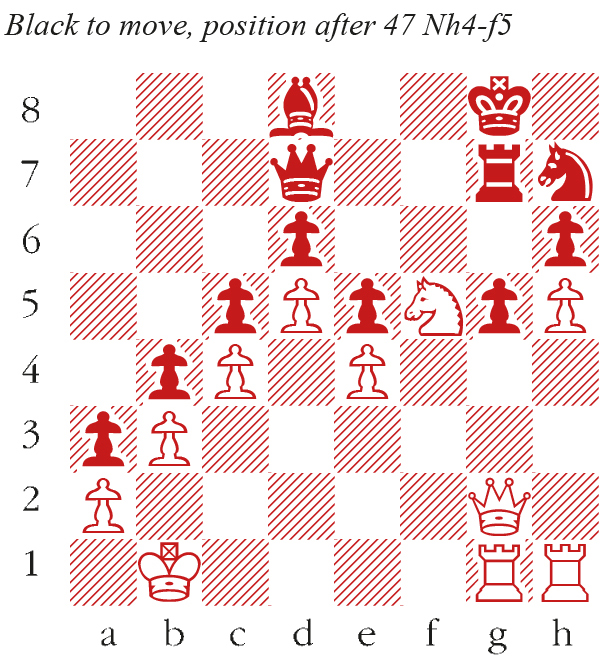
47…Qxf5!! 48 exf5 Bf6 49 Kc1 Kf8 50 Kd1 Re7 Humans can readily perceive what Stockfish could not. Black has a fortress, as there are no entry points for White’s major pieces. In the next 32 moves, the rooks came to e1 and e4, and the queen came to f3. Leela moves its king to d8 and knight to f8. (Moves omitted.) 83 Rxe5 Rxe5 84 Rxe5 Bxe5 85 f6 Kc7 86 Qf5 Kb7 87 f7 Bg7 88 Qe4 Be5 The rook sacrifice was the only try, but the fortress holds, as all the queen’s entry squares are covered. Draw agreed after 132 moves.
Below is a classic example from human play. Hazai’s last move, 45…Qa7-b6, sacrifices his queen for a knight to erect a fortress.
Arshak Petrosian–Laszlo Hazai
6th International Jnr Tournament, Schilde, 1970

46 Nxb6+? Analysis shows that White could win by delaying this. cxb6 47 h4 Or h5-h4 seals the kingside shut for ever. 47…gxh4 48 Qd2 If this queen could emerge on h3, White would easily win, but Hazai has it covered. 48…h3! 49 gxh3 Else Black advances h3-h3 49…h4 Now the fortress is watertight. 50 Kb3 Kb7 51 Ka4 Ka7 52 Qg2 Kb7 53 Qb2 Ka7 54 Qc2 Kb7 55 Qc3 Ka7 White cannot try to win with 56 Qxa5+ with the bishop still alive on g3. So draw agreed.
No. 850
White to play and draw. The conclusion of an endgame study composed by Frédéric Lazard in 1946. Which move allows White to salvage a draw from this position? Email answers to chess@spectator.co.uk by Monday 19 May. There is a prize of a £20 John Lewis voucher for the first correct answer out of a hat. Please include a postal address and allow six weeks for prize delivery.
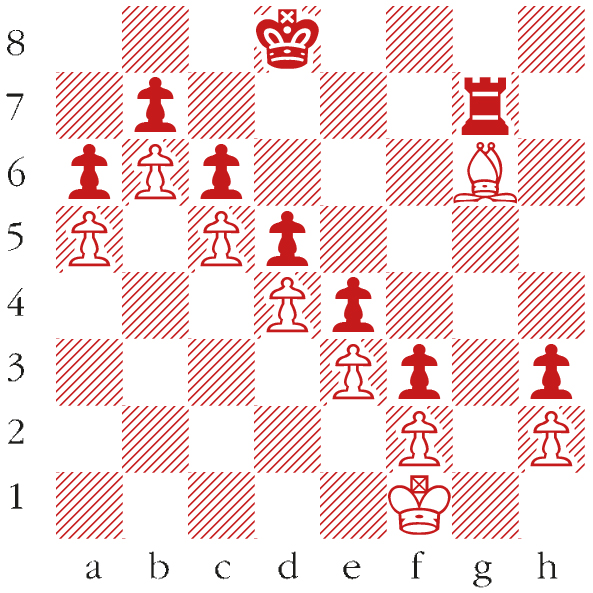
Last week’s solution 1 Qxc8+! and Tal resigned because 1…Bxc8 2 Re8 is mate
Last week’s winner Robert Fortune, Barnet, London N12
Spectator Competition: That’s your cue
Competition 3399 called for a traditional bedtime story updated for the 21st century.We’re tight on space, so I’ll pause just to give a special mention to Ross Haggart before awarding the £25 vouchers to those below.
‘The sky is falling!’ cried Chicken-Licken. Ducky-Lucky, thinking this might be fake news, waddled off to do some fact-checking. But Henny-Penny had reliable information from Humpy-Trumpy and Q-Anonny on ticky-tocky that Crooked Hillary-Clillary, helped by five gee-gees all the way from China, was planning to bring down the sky, in order to distract from her other naughty conspiracies. Goosey-Loosey was very kind. She felt that Chicken-Licken needed help. ‘How are you really?’ she asked him a hundred times. She thought he was ‘catastrophising’ due to unresolved emotional issues and suggested to him a course of mindfulness and Ceeby-Teeby. Turkey-Lurkey blamed climate change (which Henny-Penny told him was a big porky pie). The King blamed the previous king for leaving them with a huge 22 million miles wide black hole, into which the sky was falling. Clever Holey-Moley said nothing but ran and dug for cover – just in time.
David Silverman
Once upon a time there were three little property developers, whose mother sent them out into the world to seek their fortune. The first little developer built his house with straw – but the Big Bad Council huffed, and it puffed, and it said that straw failed the fire safety regulations, so he went bust. The second little developer built his house from sticks – but the Big Bad Council huffed, and it puffed, and it prosecuted him for destroying a woodland habitat, so he went to prison. The third little developer built his house from nasty cheap bricks. While the Big Bad Council was huffing and puffing away, up rode the brave knight Sir Keir and said ‘No one votes Labour here – build what you like!’ So the third little developer built 100,000 brick houses in the greenbelt, became a millionaire Labour donor and lived very happily ever after.
Tom Adam
The Duckling flapped their grey feathers and looked round their playground. You’re Ugly! one of their playmates shouted and the others joined in: Ugly! Ugly!
No, said Duckling, That’s body-shaming, that is. I’m calling you out. They felt hurt but they were a Duckling who knew wrong from right and that the Playleader would help.
When the others had it explained to them that body-shaming was a hate crime, the Duckling felt empowered. Yes! they squawked. But inside, although they had tried to be forgiving and process what had happened, they knew that for the sake of their mental health their future would be elsewhere.
So Duckling set out on their journey in life mindful that they might be called ugly again. But when they came to a swan’s nest they were welcomed warmly and told they were beautiful. Thank you, Duckling said, Being kind makes it a better world.
D.A. Prince
The hare was making fun of the tortoise for being slow and lazy. ‘You were doing WFH before anyone even thought of it,’ he said. ‘And as for quiet quitting, where you’re concerned who could even tell?’ Offended, the tortoise challenged the hare to a race. The hare won by a mile, but the adjudicators felt it was the taking part that counted and awarded both animals a ‘participation medal’.
The hare, finding this intolerable, took the adjudicators to an employment tribunal and eventually received substantial compensation.
The tortoise reacted to this setback by self-identifying as a cheetah and challenging the hare to a rematch. Sadly, this plan also failed. The hare, it emerged, had applied for a Motability grant on the grounds of neurodiversity (‘I’m a March hare, after all,’ he’d explained). He used the grant to acquire a nippy VW Golf and this time won by two miles.
Joseph Houlihan
Generative AI, I’ve this bedtime story idea: please finesse it for success. Elements of story comprise: trio of porcine real estate developers. Their modish ideas about environmentally friendly building materials. A Wolf of above average size and capacity for presenting moral challenge. His incantatory threat and actuation protocol focusing in particular on lupine lung capacity and designed for multiple strands of appetite satiation. Initial success of approach when deployed against straw house and occupant. Subsequent success upon deployment against house of sticks and occupant. Natural anticipation of success prior to engagement with brick house and porcine occupant. Confounding of expectation when bricks prove permeable on account of having been designed to allow ingress and habitation by swifts. Completed story to be delivered to my offspring in vocabulary appropriate to whatever their ages and genders currently are using voice sample from this instruction. Notify responses, if any, to my inbox.
Adrian Fry
Once upon a neurodivergent-affirming time Princess Gwyneth – cursed by a wicked fairy wielding a rogue spindle (violating H&S protocols) – fell into a non-consensual sleep. A century later, Prince Charming (he/they), a TEDx-famous gerontophile with a Level 2 Consent Certificate, smitten with the 116-year-old princess, kissed them awake. Gwyneth sued for boundary violations while the Prince cited their resting ‘yes face’ as implied consent. The case ignited media debates and cancel culture erupted. The Palace, freshly woke, pledged allegiance to Sleep Justice. After restorative co-counselling, and a viral TED-talk (‘Love in the Time of Coma’), Gwyneth launched a podcast (Woke and Woken), sponsored by ethical vaginal-sourced collagen serum. The couple curated an intentional love space, monetised their trauma, and partnered sustainably, but soon after, citing irreconcilable differences, the Princess distanced theirself from the Prince, who was deplatformed. They stated: ‘We’ve consciously uncoupled, with ever-after implications, and I’m developing a mindfulness app.’
Ralph Goldswain
No. 3402: Quirk related
Recently we ran a poem about someone who liked to cook a meal, then drop it on the floor. You’re invited to submit a poem or passage about an unusual predilection (150 words/16 lines max, printable). Please send entries to competition@spectator.co.uk by 28 May.
2703: Eeeesy does it
The unclued lights share a common feature, while two trios from among the clued Down solutions do so to a lesser extent. Ignore an acute accent.
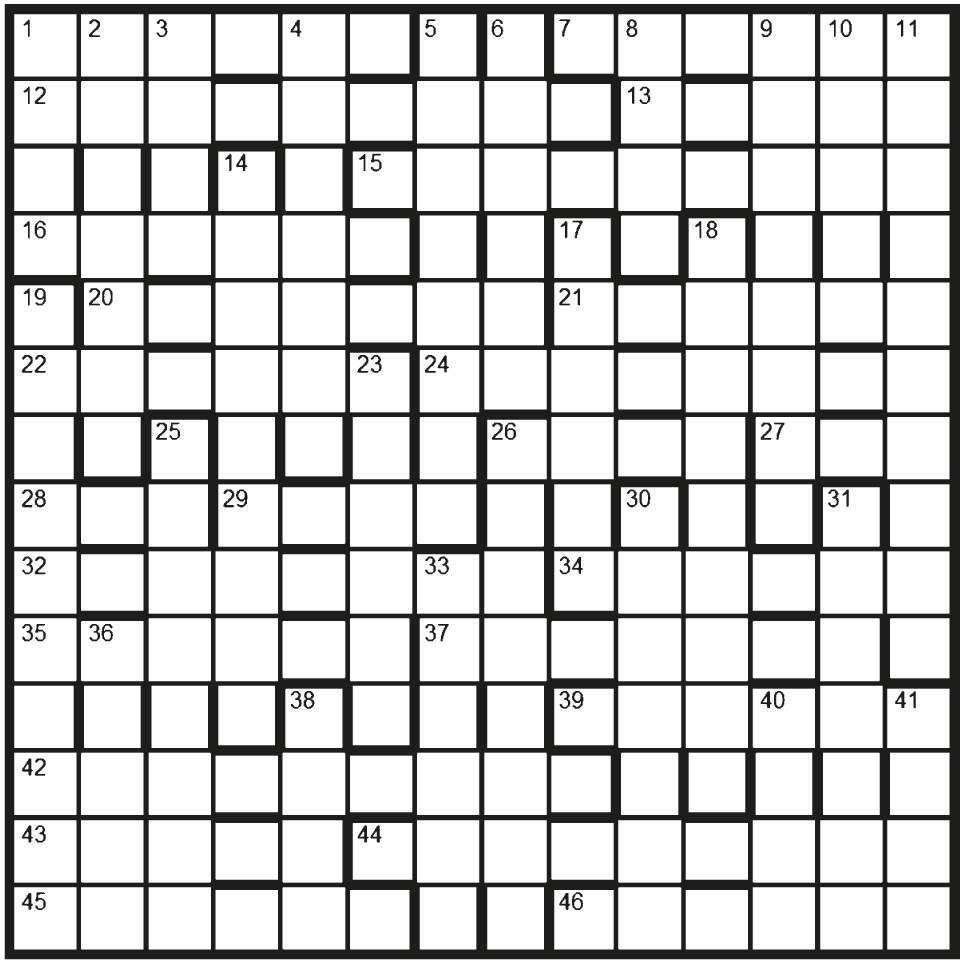
Across
1 Give confidence when not at sea, reportedly (6)
7 Tolerated, having cut through undergrowth and fouled (6)
13 River horse, so to speak (5)
16 County not right accepting vice inspection (6)
21 This girl lost her head during nuclear power plant disaster (6)
22 Variety of sandstone produces vintage Merlot, say (3,3)
24 Tinted visor certainly owned during middle of week (8)
26 High point is getting married in a church (4)
27 Ballpoint brand with blue ink cap, for starters (3)
28 Grass turned over in the Chinese way (3)
29 Rowdy Aussie party at arbour, now and again on time (4)
35 French forces Doc into 8 (6)
37 I go nuts arranging day trips (7)
39 Are sections of bone found here in Italy? (6)
43 Salvo possible but not rounds (5)
46 Take in Sartre novel (6)
Down
1 Fliers at the very heart of the parody (4)
2 Developments as the briny calms down, we hear (7)
3 Insinuation that Sri Lanka upset Richards, for starters (4)
4 Fails to keep a promise – at bridge? (7)
5 32 spilt drinks here at county show (4)
6 Some pray elsewhere, upsetting church founder (6)
8 Barriers regularly holding Olympian (4)
9 Two chancellors take to one vegetable (8)
10 You grab people, turning up hostile (5)
17 One that’s cold to walk over (3,3)
19 Left large hound at site of steelworks (4,6)
23 Difficult times in nameless township in NW Sutherland (6)
25 Mathematical principles for dealing with fumarole (8)
26 Use paper crumpled in France to a certain extent (1,3,4)
30 Mac’s salmon spear removed half the dace from county town (7)
31 Abbey’s wild geese oddly missing, as well (7)
33 Why one may have had a dry old Christmas (6)
36 Female bird in here, eventually (5)
38 Opening of motet points to lyre’s middle string (4)
40 Pipe carrying water to sides of hothouse (4)
41 It borders this little land and former ferry point across the Severn (4)
Download a printable version here.
A first prize of a £30 John Lewis voucher and two runners-up prizes of £20 vouchers for the first correct solutions opened on 2 June. Please scan or photograph entries and email them (including the crossword number in the subject field) to crosswords@spectator.co.uk, or post to: Crossword 2703, The Spectator, 22 Old Queen Street, London SW1H 9HP.
2700: Tracking far north – solution
The unclued lights are stations on the Far North railway line from Inverness to Thurso and Wick.
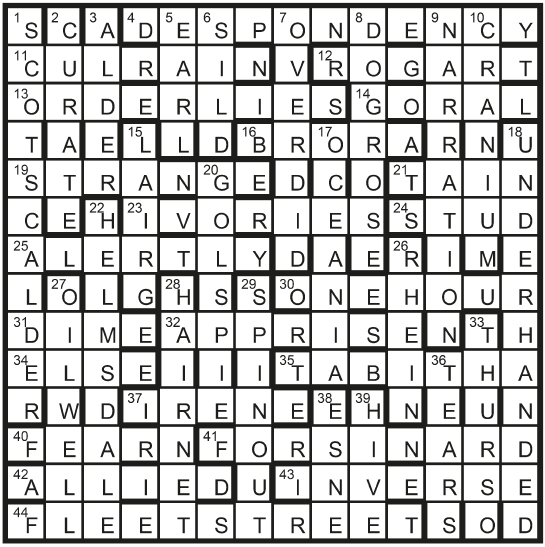
First prize Lesley Gibbons, Twickenham
Runners-up Peter Dean, London W8; David Carpenter, Sutton Coldfield
The left is finally accepting immigration control
When it comes to immigration, Keir Starmer has been ‘on a journey’. As a young barrister, he authored a review in which he argued that all immigration law was ‘racist’. As a new Labour backbencher, he called legislation to make renting to illegal immigrants a criminal offence ‘everyday racism’. While running for his party’s leadership, he demanded an ‘immigration system based on compassion and dignity’, pledged to ‘defend free movement’ and backed a letter objecting to the deportation of 50 Jamaican criminals, including burglars and rapists.
The white paper explicitly rejects the reigning Whitehall orthodoxy that immigration brings growth
Unveiling the government’s immigration white paper this week, however, Starmer announced that not only is ‘the idea that immigration should be controlled’ a ‘core value’ of the Labour party, but that it’s also something he’s long believed in. If Britain doesn’t reduce immigration, he said, we’re on track to become an ‘island of strangers’ – language robust enough for one former Labour MP to compare him to Enoch Powell.
The invocation of Powell’s name has long been used to police the borders of the immigration debate. But 57 years on from his inflammatory intervention, it is high time to consider migration as coolly and rationally as other public policy questions without attributing wicked prejudice to those who express concern.
Labour’s white paper has been in the works for a while. But its launch came less than a fortnight after Reform UK’s triumph at the local elections and the Runcorn and Helsby by-election – Labour’s 16th safest seat. Starmer’s proposals to (among other things) restrict settlement rights for some new migrants, pause the recruitment of overseas care workers and improve English tests for would-be citizens must be seen in the light of Reform’s advance. The views of those who voted Reform deserve as much respect as anybody else’s. When democratic discontent is dismissed as the ill-bred atavism of the uneducated and unscrupulous, public anger only grows.
The public has repeatedly voted for lower immigration. That was what they were promised in 2010, 2015, 2016, 2017 and 2019. Yet numbers have surged to new highs. Astonishingly, 3.8 per cent of the UK population have arrived since 2021. Successive governments have also failed to stop the tens of thousands crossing the Channel in small boats. Voters have had enough. This week, 50 per cent told YouGov that immigration is one of the country’s major issues – the highest level since June 2016.
Parties on the right understand nations can’t survive without borders and any change, whether demographic or cultural, needs to be managed with care. But parties on the left have good reason to want to control migration too. Labour figures such as the trade unionist Paul Embery, the philosopher Lord Glasman and the new MP for Pendle and Clitheroe, Jonathan Hinder, all understand that migration disproportionately affects the poorest in society by depressing wages, increasing pressure on public services, driving up rents and straining social solidarity.
For these ‘Blue Labour’ politicians, migration control is a precondition of rebuilding an economy centred on higher wages, stable communities and reindustrialisation. That vision stands in opposition to the whims of international capital and its demand for cheap labour. Starmer’s white paper, by explicitly rejecting the reigning Whitehall orthodoxy that immigration brings growth, is an endorsement of the Blue Labour analysis. And all the better for it.
Critics of Starmer from the left have deployed highly emotional language to imply his motives are impure or that he’s denying Britain’s history as a nation of immigrants. We cannot make a window of Keir Starmer’s soul, but responding to public concern can hardly be an immoral act for a prime minister. And Britain’s island story is much more one of population stability than huge churn. Indeed, Britain was historically a country of emigration, not immigration. In the 25 years before New Labour’s election, net migration was 68,000; in the 25 years afterwards, it was 5.9 million.
The real test for the Prime Minister is not one of motive or morality but effectiveness. Since Starmer entered No. 10, record numbers are crossing the Channel in small boats: 12,699 people have made the journey so far this year – up 33 per cent on 2024 – bringing the total to almost 36,000 since the election. Having scrapped the previous government’s Rwanda deterrent, the PM’s quest to ‘smash the gangs’ has so far proved fruitless. While he pledges to reform the use of Article 8 of the European Convention on Human Rights to block deportations on the grounds of the right to a family life, few doubt that activist lawyers will find exciting new ways to stop removals.
That is why the Tories are right to demand that proposed legislation be strengthened to oust human-rights provisions which frustrate effective migration control. The borders we need to police are those around our island, not those around a vital debate.
Portrait of the week: Immigration pledges, trade agreements and a new pope
Home
Sir Keir Starmer, the Prime Minister, said, ‘We risk becoming an island of strangers’ as the government published a white paper, Restoring Control Over the Immigration System. He stood by his words but ‘completely rejected’ suggestions that they echoed Enoch Powell’s phrase ‘strangers in their own country’ from his 1968 speech. The white paper said care workers would no longer be recruited from overseas. Migrants would have to wait ten years to apply to settle in Britain, instead of qualifying after five. Adult dependents would have to show basic English language skills. A tax on universities’ income from foreign students could also be introduced. A migrant died in a fire on a small boat trying to reach England; another 891 did reach England in the seven days to 12 May, bringing the year’s total to 12,407. The Sun reported that the Southport killer, Axel Rudakubana, 18, had thrown boiling water over a prison officer in Belmarsh jail. A Lambeth council low-traffic neighbourhood scheme in Dulwich was ruled unlawful by the High Court. Half the London Underground was halted in a power cut associated with a fire at the same electricity substation at Maida Vale that caught fire a fortnight ago. A man was arrested in connection with a fire that damaged the front door of Mr Starmer’s north London house.
Britain agreed a framework to reduce American import taxes on a set number of British cars and allow some steel and aluminium into America tariff-free. But a 10 per cent tariff would remain on most British goods. The government said US hormone-treated beef would still be prevented from entering the UK. The Bank of England cut interest rates from 4.5 to 4.25 per cent. Payrolled employees fell by 53,000 (0.2 per cent) in the first quarter of 2025, according to the Office for National Statistics. The head of the ONS, Sir Ian Diamond, resigned for health reasons. The Assisted Dying for Terminally Ill Adults (Scotland) Bill passed its first stage. Without competitive tender, the new contract to run Scotland’s west coast ferry services was awarded by the Scottish government to the publicly owned CalMac. A man from Billericay caught a 105lb carp in Lake Balaton, Hungary.
A jury found Daniel Graham, 39, from Carlisle, and Adam Carruthers, 32, from Wigton, guilty of cutting down the renowned Sycamore Gap tree on Hadrian’s Wall. Peter Sullivan, 68, who has spent 38 years in prison for the murder of a woman, and was called ‘The Beast of Birkenhead’, had his conviction quashed by the Court of Appeal thanks to new DNA evidence. Patrick Spencer MP, 37, was charged with two counts of sexual assault after an incident at the Groucho Club in August 2023 (allegations he denies); he had the Tory whip suspended. Marks & Spencer revealed that customers’ data was stolen in last month’s cyber attack. The new chief of MI6 is to be a woman.
Abroad
The heads of government of Britain, France, Germany and Poland visited Kyiv to meet President Volodymyr Zelensky and called on Russia to begin a 30-day unconditional ceasefire from 12 May. Mr Starmer said that President Donald Trump of America, who had spoken on the telephone, was ‘absolutely clear that this is a demand that must be met’. Late that night President Vladimir Putin of Russia called on television for ‘direct talks’ with Ukraine on 15 May in Istanbul. After Mr Trump posted, ‘HAVE THE MEETING, NOW!!!’, Mr Zelensky declared: ‘I will be waiting for Putin in Türkiye on Thursday. Personally.’ Xi Jinping, the ruler of China, sat next to Mr Putin for the Victory Day parade in Red Square. China and America agreed reduced levels of tariffs for 90 days.
India and Pakistan began a ceasefire announced by Mr Trump after days in which each side made missile strikes. The world was worried because both countries possess nuclear arms. Port Sudan underwent a week of drone attacks. In Afghanistan, the Taliban banned chess.
Cardinal Robert Prevost, 69, an American missionary with US and Peruvian citizenship, was elected Pope, becoming Leo XIV. Hamas released an Israeli-American hostage, Edan Alexander, on the eve of a visit to the Middle East by Mr Trump, who signed a $142 billion arms deal with Saudi Arabia, where he also met President Ahmed al-Sharaa of Syria and lifted US sanctions against his country. The Federal Reserve kept interest rates unchanged. Nissan said it would cut another 11,000 jobs, bringing its layoffs to 20,000 in the past year. CSH
Can the British film industry survive Trump’s tariffs?
On the road with a new book, I recently spoke at a literary luncheon hosted by the Cambridge Festival. What could be more civilised than food, wine and conversations about murder with a charming audience… but this is one of many festivals that lost its funding thanks to the organisers of Hay-on-Wye and Edinburgh pulling out of their sponsorship deal with Baillie Gifford, a unilateral decision that has endangered the entire landscape of literary festivals. Cambridge, Wigtown, Stratford and Henley all ended up losing their funding when Baillie Gifford, not surprisingly, decided to call it a day.
And what exactly has been gained? The pressure group Fossil Free Books may be preening itself. ‘Solidarity with Palestine and climate justice are inextricably linked,’ they claimed as they targeted Baillie Gifford on these two fronts, although personally I don’t see the connection, and certainly neither Benjamin Netanyahu nor Donald Trump have changed their policies because they’ve been unable to get their books signed by their favourite authors. I do have some sympathy for Hay-on-Wye, which faced ‘possible decimation’ if it didn’t capitulate, but shooting yourself in the foot is never a good way to improve the way you walk.
The subject of AI came up at Cambridge as it does almost every time I speak these days, but I’m firmly of the view that it’s a misnomer. Artificial Intelligence? I know that sounds like a brilliant short premise for a sci-fi novel but I’d say Advanced Imitation would be closer to the mark. I have yet to see a single poem or piece of prose, one painting or photograph created by AI that has a spark of true originality or, in the literal sense, genius. Even so, we still have every reason to fear this new technology. Just as Google has largely replaced intellectual curiosity – why be curious when the answer to every question is in the palm of your hand? – how long will it be before people decide that an ersatz, second-rate version of a writer, and one that is effectively free, is a reasonable replacement for the writer themselves?
I remember slipping into the Old Vic as a teenager with a crumpled tenner and walking out two hours later, convinced I’d seen something close to magic. Theatre, when it works, is a living, breathing mystery – it draws you in, leaves you breathless, makes you think. But now too many are locked out before the curtain even rises. Yes, costs are high. Sets don’t build themselves. But producers need to take a leaf from playwrights they celebrate and, above all, be fair. Make room for young people. For families. For those who might fall in love with theatre, if only they could afford to get in.
You see what I mean? The last paragraph was written by ChatGPT: I asked it to produce 100 words about theatre tickets in my style and, although it’s true I have always loved the Old Vic and it’s possible a ‘crumpled tenner’ might have been in my back pocket when I was a teenager, such a phrase has never been in my lexicon. The paragraph sounds authoritative but it’s quite facile. ‘Sets don’t build themselves’ is how my grandmother might have talked, and do producers celebrate playwrights? Are playwrights always fair? If I became breathless in a theatre, I’d expect St John’s Ambulance to remove me quickly. And how did producers, who take huge risks, become the villains of the piece? I think there’s something inexpressibly naff and superficial about this AI version of myself. I also asked it to do Rod Liddle and, trust me, that was even worse.
We are halfway through shooting Marble Hall Murders, the third in the series that began with Magpie Murders and although it is set in London, we are shooting in Ireland, which offers tax incentives and brilliant crews. The 100 per cent tariffs Donald Trump announced on films made outside the USA are not just a financial disaster but an artistic one. Take the Star Wars series, which has been filmed in ten countries so far, including the UK, Tunisia, Norway, Iceland and the UAE. Foreign locations provide new horizons – quite literally – for audiences that may have seen enough of LA, New York and Miami. Tom Cruise being chased through Paris or Daniel Craig through London may be foreign but that’s what makes it exciting.
So what’s the future? Will films made abroad even be allowed into American cinemas? Will American audiences see only American films, set in America, about American themes? It could be a death sentence for studios in the UK and Ireland, and I can’t say it looks too good for writers like myself either. Although I suppose I can always be replaced by AI.
Richard Ellmann: the man and his masks
Richard Ellmann’s acclaimed life of James Joyce was published in 1959, with a revised and expanded edition appearing in 1982. The first edition, the work of an ambitious young American academic, received what Ellmann’s editor at Oxford University Press described as ‘the most ecstatic reaction I have seen to any book I have known anything about’. Ellmann’s work would ‘fix Joyce’s image for a generation’ wrote Frank Kermode in The Spectator, a prediction described by Zachary Leader as ‘if anything, too cautious’.
By the time of the second edition, Ellmann had become a lionised Oxford don and the image of Joyce he had fixed was starting to chafe. Post-structuralism was now challenging traditional approaches to literature and biography was regarded by English departments as an inferior form of fiction. Nonetheless, it was impossible to ignore or avoid Ellmann’s James Joyce. The road to Joyce was via Ellmann. His magnum opus had contributed to what one reviewer described as a ‘critical and methodological paralysis’ in Joyce studies.
Ellmann’s Joyce is a wise, balanced and utterly compelling biography of the ‘masterpiece’ that ignited Joyce studies and introduced the Irish modernist to the general reader. It is also an account of pre- and post-war English departments, a golden age of academic brilliance and a rare moment when biography, at its best, was considered an art form. In addition to outlining the construction of James Joyce, Leader discusses its impact, weighs up its legacy, quotes generously from its strongest and weakest passages and mounts a defence of Ellmann’s interpretative methods.
Ulysses, according to Ellmann, was a work of autobiography. Every character had a flesh and blood original, and everything said or thought by Leopold Bloom on Thursday 16 June 1904, had been said or thought by Joyce himself. ‘The life of the mind, so far as Joyce himself led it, is allowed to amount to very little,’ concluded Ellmann’s enemy Hugh Kenner. It was Ellmann who ‘authorised the bad habit’ of blending life and art, wrote Denis Donoghue. ‘He made it respectable for lesser biographers to assume… that if something is in the novels it must have happened.’
Leader’s sources come from the Richard Ellmann Papers at the University of Tulsa, 450 boxes of notes, drafts, manuscripts and correspondence, including a lifetime of letters to and from Ellmann’s parents detailing every personal and professional decision he ever made. To cut a swathe through this forest and balance the focus, Leader divides his book into two halves. In the first, ‘The Biographer’, he explores ‘the sort of person Ellmann was, and how he came to be such a person’, tracking his progress up to the age of 34, when the research for James Joyce began.
Ellmann was born in Highland Park, Michigan, in 1918. His father’s family were Jews from Romania and his mother’s were Jews from Ukraine. He married a Catholic and had no attachment to his family faith. There was never any question, however, given the scale of his parents’ ambitions for him and determination to interfere in every aspect of his life, that ‘Dick’ would succeed at whatever he chose to do. After graduating from high school ‘fourth in a class of 326, with an average school grade of 98 out of 100’ (Leader, like Ellmann, homes in on the details), he studied English literature at Yale, published his poetry in leading magazines, and worked at the Office of the Coordination of Information during the war.
He was at his happiest when snowed under by letters, notes, drafts, diaries and transcripts of interviews, and it was the indexing and classifying of secret documents that taught Ellmann the skills he would need in the Joyce archives. During a wartime visit to Dublin, he introduced himself to W.B. Yeats’s widow, who gave him access to the treasure trove of papers which allowed him, aged 30, to turn his PhD into his first book, Yeats: The Man and the Masks. These same personal skills later earned him the trust of the Joyce family. After a brief spell at Harvard, Ellmann took a job in the English department at Northwestern University in Evanston, Illinois, where he stayed for the next 17 years. Here, as the departmental star, he was given the time and funding to begin his work on Joyce.
In part two, ‘The Biography’, Leader describes the making of the book. ‘I am endeavouring to treat Joyce’s life with some of the same fullness that he treats Bloom’s life,’ Ellmann explained to a colleague. ‘The initial and determining act of judgment in Joyce’s work,’ he argued, ‘is the justification of the commonplace.’ In emulation of his subject, Ellmann ‘minutely documented’, as Leader puts it, ‘Joyce’s everyday activities and routines’. His ability to enter his subject’s mind on an ordinary afternoon was, for most of Ellmann’s readers, a sign of his brilliance. But Kenner was less impressed: ‘Much energy has gone into chronicling the shillings various men lent Joyce, how many, on what date, and whether they were repaid.’
For writers without the backing of a university, Ellmann might come across as pampered and indulged. Where in his story is the struggle, the self-doubt, the despair at not finding a publisher? Getting ahead, however, was not always as easy as it looked. Ellmann was Jewish for starters, and drawn to 20th-century literature when the Harvard and Yale curricula stopped with the Victorians. Plus he had monster parents breathing down his neck and Kenner snapping at his ankles. Despite being an outsider with an interest in rogue literature, Ellmann nevertheless wrote the books he wanted to write with maximum support from literary estates and a lifetime’s supply of research grants, fellowships, awards, pay rises and promotions. No sooner had he delivered James Joyce than he was handed a year’s paid holiday to recover from his labours.
It was his wife, Mary, also a Yale graduate (her PhD was on Tennyson), who needed the holiday. In 1956, while Ellmann was following Joyce’s footsteps in Europe, Mary – the real genius of the couple, according to their daughters – was at home with the toddlers. ‘I will never again live in this house by myself,’ she wrote to her husband. Pregnant during a summer of staggering heat, after putting the children to bed she trawled through Ellmann’s mountain of post:
I cannot bear it. I feel myself being destroyed… I live in constant horrified contemplation of my own life. I am half sick, alone and burdened with stupid, monotonous work.
Ellmann’s response was to extend his stay abroad.
Mary’s letters take us to the heart of women’s lives in the 1950s. It wasn’t until 1969, when her eldest child had left home, that she wrote her own masterpiece, a brilliantly witty and furious diatribe against female stereotypes called Thinking About Women. No sooner had her book appeared than Ellmann was offered an Oxford professorship. Mary and their daughters wanted to stay in America, but Ellmann was not thinking about women. Being in England would make the research for his next biography, a life of Oscar Wilde, easier. Mary now ruptured a blood vessel in her brain which left her paralysed down her left side and wheelchair-bound for the rest of her life. ‘It is sometimes said that stress can bring on an aneurism,’ Leader drily comments.
When it came to Joyce’s own selfishness and neglect of his family, Ellmann gave his subject an easy ride. It was as if, says the Irish scholar Declan Kiberd, he agreed with Dr Johnson that ‘a good artist cannot be a bad man’. Leader has no such illusions about Ellmann, a writer driven, like Joyce, by rocket-fuelled ambition and steely self-belief. It is the biography he has come to praise, not the biographer. Despite being seen by his parents as ‘tender minded’ and ‘fragile’, Ellmann evolved, as Leader elegantly puts it, ‘from a mild man’ to ‘a man with a mild manner’. Ellmann’s Joyce is a powerful portrait of the man, and also the masks.
The problem with Pascal’s wager
Blaise Pascal resists definition. During a short life (he died in 1662, aged 39) he invented the calculator, laid the foundations for probability theory and created the first public transport system. He was also an austere Catholic, whose call for a return to strict Augustinian doctrines put him outside the religious mainstream. As a philosopher, he is remembered today for his ‘wager’ argument – a challenge to atheists, framed as a cosmic gamble.
As Graham Tomlin shows in this lively, conversational biography, Pascal worked in threes, often steering a course between extremes. As a Catholic, he refused to commit to the new sect of Jansenism, but also abhorred the Jesuits’ ideological flexibility; politically, he could sound revolutionary one minute, conservative the next; and as a philosopher he was pulled in opposite directions by reason and scepticism. He is most relevant to 21st-century readers, argues Tomlin, as a thinker who combined the piety of the Middle Ages with the scientific zeal of the Enlightenment, thus refuting the modern idea that religion and science are incompatible.
Pascal distinguished between what he called the physical and metaphysical worlds – respectively, the domains of science and faith. The routes to knowledge in each, he argued, were radically different: experiment and reason in the former, love and faith in the latter. Tomlin suggests that, had this distinction been observed by later critics of religion, beginning with the Scottish sceptic David Hume (1711-76), atheism might not be as prevalent as it is today. According to this view, the blistering attacks made on religion by atheists such as Richard Dawkins and Sam Harris rest on a fundamental error – that religious beliefs should be assessed by the same criteria as scientific hypotheses.
Pascal formulated many of his ideas by reacting to the two French thinkers who interested – and irritated – him the most: the 16th-century sceptic (and nominal Catholic) Michel de Montaigne and his own contemporary René Descartes. He respected Montaigne for forcing reason to ‘step down from the lofty height of excellence which it has aggregated to itself’, but ultimately found his scepticism corrosive and superficial. Tomlin presents Montaigne as the philosopher of the bonnes hommes of 17th-century France: louche, culturally Catholic gentlemen more interested in parties and hunting than philosophical reflection. Their modern-day equivalent, writes Tomlin, is found in ‘the sociable, popular type, the regular at the golf club, with a phone full of friends and contacts, confident and suave, who rarely casts a thought towards God or his own mortality’. Pascal was baffled by such nonchalance, unable to understand why the prospect of death didn’t propel everyone into looking for answers to life’s most important questions.
For those who take the wager, Pascalian faith is by no means the easy option
His search for intellectual certainty aligned him with Descartes, whom he met briefly in 1647 (it didn’t go well, mainly because Pascal was ill, as he often was). Descartes had shut himself in a room and reasoned his way to God, in the process coining his famous maxim Cogito ergo sum (‘I think, therefore I am’). But just as Pascal resisted the full extent of Montaigne’s scepticism, he thought Descartes relied too much on reason. By conjuring a deity only accessible through cognition he had, as Tomlin puts it, ‘hollowed out the heart of Christianity’. Pascal’s God was personal, not abstract. On the night of 23 November 1654, the inventor of the calculator and probability theory wept with joy at what he believed to be a sustained encounter with the Christian God. Pascal recorded the experience in a poem entitled ‘Memorial’, the manuscript of which was found sewn into his jacket lining after his death.
He hoped his wager might open the hearts of some non-believers, perhaps enough to prime them for the kind of transcendent experience that had deepened his own faith. Presented in a posthumously published collection of musings entitled Pensées, the gambit can be summarised as follows. It is rational, says Pascal, for the non-believer to bet that God exists. If he’s wrong, nothing is lost; but if he’s right, an eternity of bliss awaits: zero loss, huge gain. If the non-believer persists in his atheism, how-ever, he gains nothing in this life and suffers forever in the afterlife – zero gain, massive loss. At a time when most defenders of Christianity were trying to show how rational religion was, the wager was a bold, counterintuitive approach to apologetics. But Tomlin doesn’t quite give its serious flaws the attention they demand.
It is perhaps unfair to criticise Pascal for failing to explore a third option. In 17th-century France, suspension of belief about God was as rare as atheism; and the notion of ‘agnosticism’ as a rigorous creed rather than a cop-out wasn’t developed until the late 1800s. But it is ironic that a thinker who so often preferred a middle course insisted that, in this matter, we had to choose between two extremes. For those who take the wager, Pascalian faith is by no means the easy option, requiring as it does an ascetic lifestyle, denial of the self and constant prayer. As presented to us in this exhilarating biography, Pascal still has the power to inspire and challenge readers of all spiritual persuasions, especially those who are popular at the local golf club.
The Kurds have finally given in to Erdogan

Paul Wood has narrated this article for you to listen to.
All wars end, one way or another. One of the longest wars in the Middle East, between Turkey and Kurdish separatists, may finally be over. After 40 years of bitter struggle, the Kurdistan Workers’ party, the PKK, has declared that it will disarm and disband. It’s an achievement, of a sort, for the PKK’s imprisoned founder, Abdullah Ocalan: he might become a free man. It’s a triumph for Turkey’s leader Recep Tayyip Erdogan: he might become President for life. The Kurds have adjusted to a new reality in the region. From Ankara to Riyadh, the chess pieces are shifting and the board might end up looking very different. This might even be accomplished without blood being spilled.
The PKK is designated as a terrorist group by Britain and many other western nations. The announcement that it would give up its guns was made at its party congress this week. Middle-aged men and women stood in rows wearing dark-green camouflage uniforms with the Kurds’ traditional broad sash at the waist. They looked dejected – vaguely at attention, but with shoulders slumped. They were acting in the knowledge that the PKK had suffered a military defeat, no longer able to mount effective attacks inside Turkey. There have been ceasefires and peace talks before, but this time the PKK is promising to transform into a purely political organisation. The question is whether they’ll carry with them the fighters who remain in mountain camps in Iraq and bases in Syria. Will there be a Real PKK?
The PKK has been edging towards this decisive break for months, pushed along by its lost leader, Ocalan. To his followers, he is known as ‘Apo’, ‘uncle’ in Kurdish. Uncle Abdullah’s handsome face – with dark, bushy eyebrows and a thick moustache – is everywhere the PKK is found: his portrait in homes and barracks and stuck in car windows; on patches sewn on soldiers’ uniforms; on flags that sometimes have no other symbol. He is the Wizard of Oz, his image, thoughts and views – his utopian ideology – dominating the organisation from the jail cell that’s been his home for a quarter of a century. In February, he issued a statement saying: ‘There is no alternative to democracy.’
The Turkish media call Ocalan a ‘baby killer’. He likes to describe himself as the Kurdish Nelson Mandela, a leader who enter-ed jail as a convicted terrorist but who turned to peaceful politics. (Mandela returned the favour by saying: ‘I am part of the Kurdish struggle.’) He was arrested in Nairobi in 1999 by Turkish special forces, helped by the CIA, and was paraded in front of TV cameras looking dazed and confused. There were claims he had been drugged and tortured. Then he was sent to Imrali prison, on an island near the coast of Istanbul. The authorities removed all the other prisoners, and he was left in solitary confinement for 23 hours a day, guarded by more than a thousand Turkish troops. As his lawyers put it, Imrali was ‘a prison with one single cell for one single prisoner’. It was ‘isolation within isolation’.
Abdullah Ocalan went into prison a Maoist guerrilla leader; he may emerge a Lib Dem councillor
Ocalan’s rare critics inside the PKK have said he was broken by his incarceration. He did move steadily away from the things he once stood for: an independent Kurdish state and the armed struggle to achieve it. But this was part of a long ideological journey, far stranger than the one Mandela made.
Ocalan was born in eastern Turkey around 75 years ago (there is no birth certificate). He has spoken of ‘overwhelming unhappiness’ in his upbringing. His father was a peasant farmer, poor even by local standards, a weak man, mocked by other villagers and publicly humiliated by Ocalan’s mother for being un-able to support the family. She was a fierce, angry woman, and when Ocalan ran home crying after being beaten by some older boys, she threw him out and told him to come back when he had got his revenge. Ocalan has said he learned the uses of violence in childhood: ‘I cracked the heads of many children… I became the attacker.’
This may be too obvious a psychological explanation for how a ‘shy’ boy grew up to become the leader of militant Kurdish nationalism in Turkey. But his upbringing certainly shaped his politics in other ways. Ocalan was upset when a younger sister, Havva, was ‘lost’ to an arranged marriage, traded for a dowry that included a few sacks of wheat. He later called such marriages a kind of death for women and PKK-run territory would become an oasis of female equality. He learned communist revolutionary politics as a student at Ankara University in the late 1960s. He dropped out and, a few years later, founded the PKK at a meeting attended by only a couple of dozen activists. They would take on the might of the Turkish army and drench the country in blood.
By the time of his arrest, however, Ocalan was moving away from Marxism–Leninism. During the long hours in his cell, he read every book written by an obscure American philosopher named Murray Bookchin, who lived in rural Vermont. Bookchin was in his eighties, by some accounts a grouchy old man who wore braces and had rows of pens in his top pocket. He’d spent a lifetime as an anarcho-syndicalist and radical ecologist, and he developed a theory of face-to-face democracy called ‘libertarian municipalism’. Ocalan adopted it: the Turkish state wouldn’t matter if the Kurds could run their lives through local councils, which he said should adopt Green politics. He went into prison a Maoist guerrilla leader; he may emerge a Lib Dem councillor.
But Ocalan has held these positions for years. Some accuse President Erdogan of reaching an understanding with him only now that he needs Kurdish votes to let him change the constitution and stay in office. Professor Christopher Phillips, who has written about the PKK’s long war, told me there were many opportunities to make peace throughout Erdogan’s time in government, but he always abandoned the effort. Dialogue with the PKK was driven by ‘cynical’ domestic political calculations, he said. The biggest outcome of the ‘seismic’ Kurdish decision might be to keep Erdogan in power for another decade.
All that may be true, but whatever Erdogan’s motives, he’s allowed the PKK an opening to end a conflict that has cost perhaps 100,000 lives. Turkey is also making peace with Syria now that it’s in Sunni Muslim hands. Donald Trump, meanwhile, is in the region, negotiating a grand bargain involving Iran, the Houthis, Saudi Arabia, Qatar and even the Israelis. Like Erdogan, the leaders of all these countries see any deal as a means to keep their grip on power. Every-one may be doing the right thing for the wrong reasons, but this is still a rare moment for optimism in the Middle East.
Should you be arrested for reading The Spectator?
Regular readers will know that I have an obsession with home burglaries. Specifically those occasions when a burglar goes into a British home, helps himself to the contents of the household and finds that the last people on his case are the British police. Scanning some recent burglary statistics, I was struck again by the almost miraculous failures of force after force.
Take Kent Police. In a recent breakdown of crime statistics, the force managed a career high. In one of the areas where they are meant to have oversight, there were 123 home burglaries. Of those 123 burglaries, they managed a great, round zero in their detection rate of the burglars. Or 0.0 per cent as it comes up, slightly forlornly, on the stats chart, presumably to differentiate it from those majestic years in which Kent Police may find themselves capable of locating, say, 0.1 per cent of culprits.
A report from 2023 dug into some of the possible reasons for this. His Majesty’s Inspectorate of Constabulary (HMIC) not only found that the number of crimes solved by Kent Police is ‘unacceptably low’ but that there are ‘areas for improvement’. One such area was their record of responding to the public. As of March 2023, the force did not have a call switchboard for the public to dial when they are victims of a crime. Almost exactly a third (33.4 per cent) of calls went unanswered, because they use a system which puts callers to the non-emergency number straight through to what is called ‘a call handler’, who then never calls them back. Responding to these problems, Deputy Chief Constable Peter Ayling said: ‘We acknowledge there are areas where improvements could be made and are being made.’
Even if you are one of the lucky people who gets your call picked up, it doesn’t matter, because the only thing less likely than your call being picked up by them is that they will do anything about it. Just about the only thing Kent Police have been praised for in recent HMIC reports is their innovative use of ‘emotional support dogs’ for vulnerable victims.
But then I looked at the front page of the Telegraph this past weekend and read the story of Julian Foulkes. As it happens, he is a retired special constable. The newspaper revealed that, in November 2023 Foulkes was visited at his home in Kent by a bevy of local police. Six officers came to his door, handcuffed him on his doorstep and then searched his home. The cause of this was that Mr Foulkes had written a post on X (formerly Twitter) concerning the hate marches that were then going on every weekend in London and other cities.
The only thing less likely than your call being picked up by Kent Police is that they will do anything about it
Foulkes responded to a post by a participant in these marches who was threatening to sue the then home secretary, Suella Braverman, for correctly identifying the hatred in question. In a post seen by a grand total of 26 people – most of whom were presumably members of Kent Police – Foulkes replied that given the recent storming of an airport in Dagestan by people hunting for Jewish passengers, things in Britain looked like they would soon be ‘one step away from storming Heathrow looking for Jewish arrivals’. No member of the public reported the tweet to the police – but that didn’t stop a specialist unit, which is apparently meant to be focused on terrorism and extremism, from investigating. Officers arrived at Foulkes’s front door the next morning.
Armed with batons and pepper spray, the police asked Foulkes to identify himself, then said they were arresting him ‘on suspicion of an offence under the Malicious Communications Act’. For more than an hour, officers searched the 71-year old’s house, even rummaging through his wife’s underwear drawer. After looking through newspaper clippings relating to the death of Foulkes’s daughter in a hit-and-run incident, they went to the kitchen, where they commented on an ‘odd list’ of items, identifying bleach, foil and gloves. Foulkes explained to Kent’s finest that this was not because he is some master bombmaker, but because, more prosaically, his wife is a hairdresser.
Foulkes was driven to Medway police station. He was booked in, finger-printed, photographed and had his DNA taken. After many hours in detention he was released on bail. A week later he was forced to return to Medway police station to be issued a caution. As a distraught Foulkes told the Telegraph, he didn’t agree that anything he had done warranted this, but was so intimidated that ‘I felt I had no choice’. The police had succeeded in beating down someone who had given over a decade of his own life to the force. Imagine what they could do to the rest of us.
This is of interest for many reasons, most of which do not need to be interpreted or extrapolated for readers here. But one thing that especially bothers me is that the police bodycam footage shows them rifling through Foulkes’s bookcases for evidence of wrong-think. One idiot policeman performing this task finds that Foulkes has a copy of my international bestseller The War on the West on his shelves. Showing that Mr Foulkes has exceptional taste in reading materials, there were also copies of The Spectator in his home. One suspicious police officer flags up these things as signs of extremism – as ‘very Brexity things’. Which goes to show that members of the Kent Police dawn-raid squad not only can’t read, but can’t think either. Even if a book of mine on issues wholly unrelated to the EU and some parts of this magazine were ‘Brexity’, that would only mean they reflected the majority views of the British public.
But ah – the British public. Who is meant to care about them? Surely all we are fit for is to be harassed in our homes for non-crimes, and given emotional support animals after actual crimes. I would say that heads should roll, but Kent Police might misread that – and besides, they never do roll, do they?
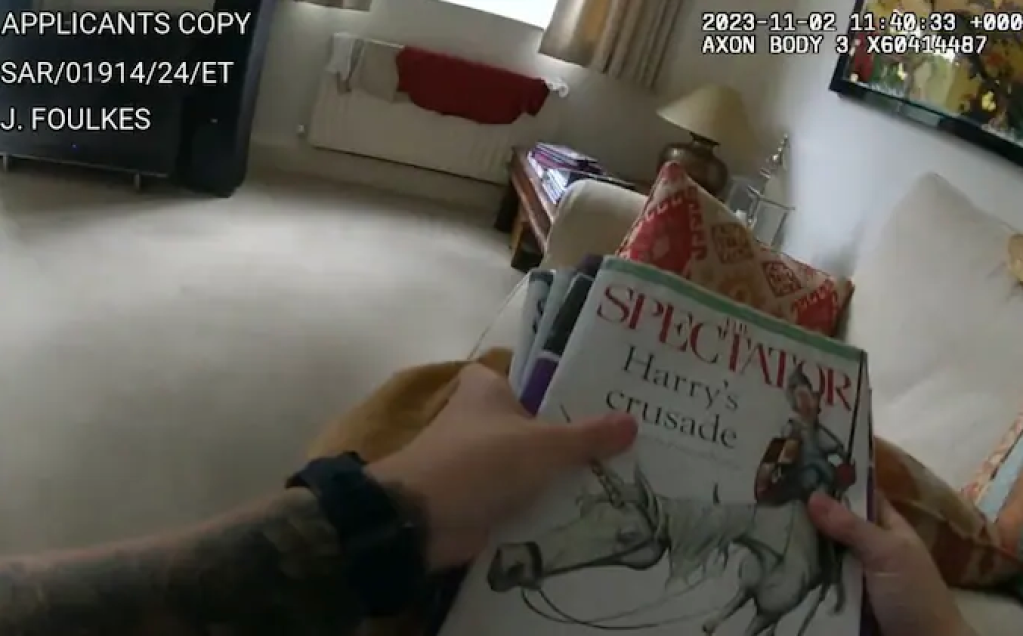
Death comes to the Chelsea Flower Show
Susannah Jowitt has narrated this article for you to listen to.
It’s a matter of life and death at the Chelsea Flower Show this year. No murders are planned as far as we know, but there will be gravestones and even a coffin. This is to be a celebration of death.
The Royal Horticultural Society’s annual Flower Show will include funeral flowers in the Grand Pavilion for the first time since it moved to Chelsea in 1913. The display is being put together by the Farewell FlowersDirectory and, I’m told, there will be no tightly wired whorls of white carnations spelling out ‘LOVE YOU MUM’.
Instead, passers-by will be left thinking of country churchyards, wild grasses and meadow flowers; species like campions, cornflowers and cow parsley. The display includes a willow casket filled with the kinds of flowers you’d see in British hedgerows, held by upturned birch branches. Everything on the stand will decay naturally: no floral foam, no plastic or imported flowers taped into dishes and wired together, no micro-plastics to go into landfill. Looped along a twine rope will be tags printed with the words: ‘I’d like my funeral to be…’
Many of those involved have had to answer that question for family members. Georgie Newbery, a flower farmer from Somerset, is one of those building the display. She lost her brother to brain cancer 15 years ago. ‘For his funeral, we all brought flowers from our own gardens,’ she says. ‘He is buried in a woodland glade outside Glasgow with flowers from our mother’s garden, his own, mine and his mother-in-law’s planted above him.’
Georgie wants us to talk about death, not scurry past it. ‘My brother died in the same year as five of my friends. I was pregnant with my daughter, so I feel I didn’t really deal with their deaths. When my friend’s daughter died a couple of years ago, we gathered around my table, creating flower arrangements for her coffin, talking about her as we did so, listening to music that she loved, going over the memories that would be polished into funeral speeches. That day was one of the greatest privileges of my life – being involved helped me remember all those other people who I’ve loved and have died. That sense of storytelling is such a simple but powerful way to grieve.’
There is a willow casket filled with flowers you’d see in British hedgerows, held by birch branches
‘So much about funerals has become a production line,’ says Gill Hodgson, who started the Farewell Flowers Directory a year ago. ‘Funerals are just part of the death admin, simply going along with traditions of wearing black, buttoning up, getting it over and done with.’ She wants to change that. The company has brought together British florists who offer people planning funerals more than just catalogue flowers.
Part of the reason for her focus on flowers is that Gill worries that we’re losing a connection to death, a sense that it’s natural and inevitable. ‘Funeral directors are usually wonderful, sympathetic people, but too often they just want to shepherd a shell-shocked grieving person through the process as painlessly as possible. This can inadvertently take away from the element of choice, of remembering the uniqueness of the person at the heart of a funeral. We want to give that choice back, restore the feeling that death is natural, that it is a moment to pay homage to that life.’
So are we finally losing our squeamishness about death, our need to cover it up with the anonymity of process? In a recent Co-op survey, 68 per cent of those polled thought that funerals should be a celebration of a person’s life, with tears, music and laughter – not confined to gloom and solemnity.
In a strange way, grief can be joyful. Many of us will recognise Georgie’s story about the death of her friend’s daughter. When done well, grief means talking about a person, what they meant to us, why we loved them. Others have noticed this desire for something more than Victorian stiffness. Poppy’s Funerals in Tooting offers more colourful, sometimes bonkers send-offs. It has organised horses wearing gold unicorn horns, leopardskin hearses, a stuffed pet parrot, a mushroom-shaped coffin, and others made of cardboard, scrawled over with loving messages from those left behind.
‘It’s not about the spectacular,’ says Poppy Mardall, a trained art historian who left Christie’s to bring art and meaning to the monochrome world of death. ‘It’s about giving families the opportunity to have a funeral that is meaningful to them. It’s about having that conversation.’ Which is what the display at the Chelsea Flower Show is about too. We all eventually wilt and die. Death is inevitable and, sometimes, it can also be joyful.
My son took drugs – and they were mine
The weekend before last, I came home from walking the dog at about noon to find Caroline asleep in bed. This was surprising for three reasons. She’d been up and about when I left the house. She’s not one for taking naps. And her mother was coming to lunch. ‘Are you all right?’ I asked, prodding her awake. ‘No,’ she said. ‘I felt a headache coming on, took some Nurofen and suddenly started feeling incredibly dizzy. So I decided to lie down for a few minutes and then fell asleep.’
I wasn’t too worried because she does occasionally suffer from dizziness, usually accompanied by a migraine. So I made lunch while her mother went to a chemist and bought Caroline some travel sickness pills that she thought would help. They didn’t, but I did some googling and discovered that a large portion of McDonald’s fries accompanied by a 16oz beaker of Coca-Cola is a good migraine cure, thanks to the high doses of salt and caffeine. That was a step too far for Caroline, so I bought her a large packet of ready salted crisps and made her a strong cup of coffee. They did make her feel slightly better and the following day she was up and about again.
Fast forward to this Saturday, and almost exactly the same thing happened, only this time the patient was my 17-year-old son Freddie. I returned from a dog-walk to find him crashed out on the garden furniture. I woke him to ask if he was OK and he said he’d suddenly come over with an urge to lie down and now felt a bit delirious. When he got up, he said the ground beneath his feet felt as if it was rolling, like the deck of a ship. What was going on? Had Caroline been suffering from some weird, vertiginous virus that she’d passed on to Freddie?
‘I came back from the gym and my back was hurting so Mum gave me a couple of Nurofen,’ he said. ‘Do you think I could be allergic?’
The penny began to drop. I went upstairs to the bathroom and found the bottle of Nurofen by the sink. Sure enough, it was the one I keep beside my bed, but instead of painkillers, I’d been using it to store some loose sleeping pills. Caroline had found the bottle the week before and taken what she thought were two Nurofen, when in fact they were two 10mg tablets of zopiclone. No wonder she’d fallen asleep. She’d then repeated the same mistake when Freddie had complained of back pain.
‘How could you be such an idiot?’ I asked her. ‘You’ve roofied our son.’ ‘What?’ she said. ‘How was I supposed to know you’d replaced the Nurofen with sleeping pills? This is entirely your fault.’ ‘My fault? They look absolutely nothing like Nurofen. Nurofen are sugar-coated, like Smarties, and they’ve got the word “Nurofen” written on them. These are quite obviously sleeping pills.’
I asked him if he was all right. ‘Funnily enough, it’s quite a nice feeling,’ he said
‘Obvious to a pillhead like you, maybe, but I had no idea. They were in a jar labelled Nurofen, for fuck’s sake.’ ‘But didn’t you realise you’d taken sleeping pills last weekend when you suddenly fell asleep in the middle of the day?’ ‘No. I thought I had a migraine.’
Round and round we went, while our teenage son wandered about the kitchen in a daze, bumping into furniture. When we remembered him, we raced downstairs and asked him if he was all right. ‘Funnily enough, it’s quite a nice feeling,’ he said, using the island to prop himself up. ‘D’you think it would help if I had a beer?’ ‘Emphatically not,’ I replied. ‘Happy now?’ asked Caroline. ‘You’ve turned our son into a drug addict. He’ll be homeless within 12 months.’ ‘I didn’t give him the drugs!’
The annoying thing is Freddie has his A-levels in a few weeks and this was his first weekend of ‘study leave’. Caroline and I had told him he had to spend at least four hours a day revising, a regime which was supposed to begin that Saturday. But he wouldn’t get very far going through past papers in physics, maths and divinity in a drug-addled haze. What if he now gets straight Es? He’ll blame his parents for dosing him up on downers.
‘Here,’ I said to Freddie, handing him a bag of crisps. ‘Eat these while I make you a double espresso.’ After several cups, he began to feel better and was able to join us for supper with two friends, although he didn’t do any work that evening. I’ve now removed the zopiclone from the Nurofen bottle, put them in a Tupperware box and stuck a label on it saying ‘Sleeping pills’. I’ve taken the precaution of hiding it just in case Freddie has acquired a taste for them. Caroline is still convinced I bear sole responsibility for the unfortunate episode.
The Battle for Britain | 17 May 2025
How emotions shape our decision-making
Ask any estate agent: most potential house buyers arrive with a detailed list of criteria for their new home, only to end up buying a property which meets almost none of them. The same is true of dating – few of us are married to people chosen on the basis of an initial checklist. Henry VIII tried this approach and it didn’t turn out well.
You could dismiss this as mere whimsicality. However, the seeming messiness of such decision-making – the fact we refine our preferences in response to what we find available – is what makes consumer capitalism much more innovative than the faux-rational capitalism practised by large organisations. By demanding a problem be defined precisely and inflexibly before you are allowed to solve it, you close the door to more creative solutions. In reality, few breakthroughs emerge as the endpoint of a linear process. Our right-brained messiness in decision-making is an evolved virtue, not an inherited vice.
In advertising, B2C (business to consumer) is what you do when you advertise to an individual consumer – typically a person who will be paying for and using the product or service themselves (think shampoo). B2B (business to business) is when a business sells goods to other businesses. The general assumption is B2C is designed to appeal to the emotions whereas B2B exists to make a rational appeal to the business buyer’s inner accountant.
This is not true. Both kinds of decision are emotional – all decisions are. But the emotions are wildly different. Put simply, a consumer buying a new car is trying to minimise the risk of personal regret, whereas a bureaucrat choosing a supplier is trying to minimise the risk of personal blame. ‘No one ever got fired for buying IBM.’
Often the former mindset is more intelligent than the latter. The consumer mindset is focused on the outcome and on possibilities. The bureaucratic mindset is more concerned with defending its reasoning than on solving a problem; it hence prizes procedural neatness over end results, preferring small, measurable cost-savings over effectiveness. In a bureaucracy, the blame-averse box-ticker cares only for his own area of responsibility, not the system as a whole. Quantification bias rules. And the self-serving need to justify every procurement decision through like-for-like comparison-metrics prevents innovative suppliers being even considered.
Finance and procurement departments stop you buying anything interesting, HR departments stop you hiring anyone interesting
Most innovations do not submit to easy comparison. An example: the iPhone would never have been adopted if its only market were businesses. The first iPhone paid for its loveliness with appalling battery life – it barely survived to lunchtime. Consumers were willing to accept this trade-off by finding work-arounds – carrying chargers into work. Yet there is no chance that the first iPhone would have met the battery-life requirements of a corporate purchasing department. They would have renewed their contract with Nokia or BlackBerry, confident in their self-justificatory numbers – battery life can be reduced to a number; ease of use cannot.
Interestingly most entrepreneurs are distinguished by decision-making styles that avoid this faux-rational folly. They know anything new or interesting defies easy categorisation. But the bureaucratic urge to codify everything for purposes of blame-avoidance wins out. It leads to a world where finance and procurement departments stop you buying anything interesting, HR departments stop you hiring anyone interesting and compliance departments stop you trying anything interesting.
The political right dreamed of a public sector that looked more like the private sector. Spreadsheet-led decision-making has given us the complete opposite – a private sector which thinks and acts like a bureaucracy.