-
AAPL
213.43 (+0.29%)
-
BARC-LN
1205.7 (-1.46%)
-
NKE
94.05 (+0.39%)
-
CVX
152.67 (-1.00%)
-
CRM
230.27 (-2.34%)
-
INTC
30.5 (-0.87%)
-
DIS
100.16 (-0.67%)
-
DOW
55.79 (-0.82%)
The UK and India sign their trade deal – at last
The UK has finally signed a free-trade deal with India after three-and-a-half years of negotiation. The agreement will open up trade for cars, whisky, clothing and food products, with ministers claiming it will boost the British economy by £4.8 billion. For Keir Starmer, it offers much-needed economic and political good news. For Indian prime minister Narendra Modi, it shows that the £3 trillion Indian economy is willing to shake off its protectionist tradition and open up to international investors.
The trade deal is an all-too-rare example of Labour getting things right in opposition
The trade deal is an all-too-rare example of Labour getting things right in opposition. Jonathan Reynolds, the Trade Secretary, met with his Indian counterpart, Piyush Goyal, in February last year. He made it clear that Labour would support the Conservative government if it finalised a trade deal with India – and would pick up the negotiations after the election if it didn’t. Despite much ground being covered, Rishi Sunak could not succeed where Boris Johnson and Liz Truss failed and get the talks over the line by July 2024. At that point, Reynolds took over, wrapping up the deal in just 12 months.
Talks have been protracted for multiple reasons. India’s average tariff rate is 13 per cent, compared with the UK’s 1.5 per cent. Immigration has previously been a major sticking point, according to Kemi Badenoch, with today’s deal facilitating some 1,800 annual extra visas for Indian yogis, chefs and musicians. Then there was the exemption on national insurance contributions: a subject of some controversy back in May. Today’s agreement means staff from Indian companies who are temporarily transferred to the UK, and staff from British firms who are temporarily working in India, will only pay social security contributions in their home country, rather than in both places. The UK already has similar reciprocal ‘double contribution convention’ agreements with 17 other countries including the EU and the US. But that reaction was one reason why few in London and New Delhi expected this deal to be done so soon.
The best testament to Labour’s success is evidenced in the reaction of the opposition. In his reaction, Andrew Griffith, the shadow business secretary, admitted today’s agreement is ‘a step in the right direction’ – before claiming that Labour’s Employment Rights’ Bill will outweigh any potential wins. For the government, securing this deal offers a winning narrative. Starmer will cite it as proof that hard work and careful planning can produce results in office. It also can help build relations between his party and British Indians, following the 2019 outcry over Jeremy Corbyn’s perceived support for Pakistan over Kashmir.
BBC apologises to Rupert Lowe over Rape Gang Inquiry report
Another day, another drama over at the Beeb. The BBC has apologised to ex-Reform MP Rupert Lowe and his Rape Gang Inquiry, acknowledging that it should have given the parliamentarian more time to respond to reports that he was being probed for not registering donations in time.
Lowe was cleared of breaching MP rules
In a statement released on its website, the corporation described how it ran an article on the investigation by parliament’s standards watchdog into whether Lowe had not registered donations in time and therefore breached the MPs code of conduct. It noted:
The BBC approached Mr Lowe for comment and published an article reporting the investigation before receiving his reply, which was judged appropriate since the fact of an investigation was in the public domain.
Although the story was accurate and BBC guidance allows some latitude on the time offered for right of reply in certain circumstances around contemporaneous reporting, the article also included additional details about the donations being related to a crowdfunder in support of a national inquiry into gang-based sexual exploitation across the UK, known as the Rape Gang Inquiry.
These were details about the investigation which had not been released by Parliament’s standards commissioner.
The article was updated within the hour to include a response from the Rape Gang Inquiry, but we accept that we should have given Rupert Lowe more time to respond.
As it happens, Lowe was cleared of breaching MP rules. Parliament’s standards commissioner found he still had time to declare more than £600,000 raised via a crowdfunder to support an inquiry into gang-based sexual exploitation across the UK. The Greater Yarmouth politician slammed the complaint against him as a ‘malicious attempt to shut me down’ and insisted at the time that he would be complaining to the Beeb over the way it covered the story. Who’s laughing now?
Watch: Green party leader struggles to say he likes rival
All is not well in the Green party. Adrian Ramsay is standing for re-election in the party’s leadership contest this summer – against the party’s deputy leader Zack Polanski. The rivalry appears to be more than professional though, as demonstrated during yesterday’s leadership debate on Iain Dale’s LBC show.
As the election looms, the pair went head-to-head to thrash out their positions – but on a rather simple point, Ramsay seemed stumped. Reading out a comment from a caller, Dale said: ‘Good grief, are these two the best they have? Their contempt and dislike for each other is barely contained.’ Turning to the current party leader, he asked: ‘Do you like him?’
AR: We’ve worked together…
ID: Do you like him? Yes or no?
AR: I’ve enjoyed working with Zach over the last few years, of course.
Polanksi was quick to bite back, remarking: ‘Ouch! I really like Adrian so that does hurt.’
Dale turned back to Ramsay: ‘I mean that’s quite something. You can’t even bring yourself to say you like Zack Polanski.’ The party leader tried again, but his second attempt wasn’t much better: ‘Zack is a valued colleague. Absolutely.’ He went on:
I’m saying that I want us to have an effective green party. We’re debating. This is this is a professional debate. As Zack has just said. That’s the important thing. And if you ask me, do I like Zack? I’ll say yes. If you ask me do I like you? I’ll say yes.
‘This is vicious,’ Polanksi commented. You can say that again! No love lost there, eh?
Watch the clip here:
The Epping migrant delusion
The origin of the story of the Emperor’s New Clothes is difficult to pin down: could it be 19th century Denmark or 14th century Spain, 13th century India or the 500s BC in Greece? Perhaps the fact that all of these cultures and times are viable options confirms the truth of it: never underestimate the capacity of those in power to believe their own nonsense.
One of the inherent problems with the government’s strategy to ‘educate’ people out of their concerns about immigration is that the narrative it requires is based on myth, not history
British politics is an excellent example of this. I’m fascinated by Angela Rayner’s words – leaked from a cabinet meeting in the midst of the Epping hotel fiasco – about needing to ‘repair the social fabric’ and foster ‘better integration’. She’s not wrong, but the fact that something so self-evidently true even needs to be said at cabinet is telling. Surely no one who hasn’t been in a coma for the last 25 years would need reminding of this. It was redolent of one of Basil Fawlty’s better put-downs to his wife; ‘Next contestant: Sybil Fawlty from Torquay, special subject the bleeding obvious’.
You detect a belief, in some quarters of government, that people are somehow imagining the problems around them. Indeed, Rayner went on to add that ‘while Britain was a successful multi-ethnic, multi-faith country, the government had to show it had a plan to address people’s concerns and provide opportunities for everyone to flourish.’ Given that she also warned of civil unrest and a summer of rioting in the same breath, to return instantly to ‘diversity is our strength’ platitudinous slop seems to require a certain cognitive dissonance.
One of the inherent problems with the government’s strategy to ‘educate’ people out of their concerns about immigration is that the narrative it requires is based on myth, not history. ‘The Windrush built Stonehenge, Paddington abolished slavery, Nye Bevan created the world in six days’ brand of legends which are now peddled as the official narrative of the country’s past simply don’t stand up to any meaningful tests of fact. All this further undermines governmental attempts to allay concerns about migration. This constant construction and promotion of easily disprovable myth only embeds the idea that the powers that be are either dangerously deluded or maliciously dishonest.
Whenever the issue is raised of enormous numbers of people arriving in the country, in defiance of public opinion and often with beliefs, values and practices that are at direct odds with the norms of this country, we are treated to a lecture by our leaders replete with nebulous platitudes and sometimes a bit of football chat. Football appears to be Keir Starmer’s only cultural touchstone; he claims not to have a favourite book and never to have experienced a dream, he exhibits no knowledge of history prior to the tail-end of the Clement Attlee government. Is it any wonder that this man is incapable of communicating a deeper narrative of Britain beyond his Dalek-like squawks of ‘R’NHS’? These are people who, when faced with an overboiling pot, choose to put a lid on it rather than turn down the stove. They have no idea how truly divided and angry the country is, nor how ill-equipped they are to deal with it.
The government’s latest plan appears to be shuffling asylum seekers from hotel to hotel, or from hotel into private rented accommodation, and hope no one will notice – while MPs congratulate themselves for getting the numbers down. This tendency isn’t just limited to politicians either. Having initially denied it, Essex police have now admitted that they escorted a left-wing rent-a-mob to the protest against illegal immigration outside the Bell Hotel in Epping. Since the Southport murders, an entire team of civil servants has been tasked with monitoring people’s personal comms on social media. Never does it apparently occur to them that public anger might be rooted in real, tangible things. They fundamentally see this as a matter of information containment or – among the even more naïve – education of the masses, rather than policy.
There is still a Blair era idea – courtesy of Alastair Campbell – that you can simply ‘manage’ the news, and people will feel better. In practice that means that if enough lies are repeated, enough platitudes spouted and enough protests cracked down on then eventually the headlines will change. Ironically, this attitude is doing more to ‘whip up unrest’ than any Facebook post by some outraged Essex nan. Indeed elsewhere, the government is very much compounding the anger with its lack of transparency. Whether it is the prolonged obfuscation over its new Islamophobia definition, continuing delays with a grooming gang inquiry (last week, Jess Phillips confirmed that it has yet even to appoint a chairman), or just the clear evidence of two-tier justice across all aspects of policing – which you can now expect a ticking-off for noticing.
Whether it was Denmark or India or Spain, nothing is clearer than the fact that we now have an emperor’s new clothes situation in Britain today. Our leaders strut around naked and then have the audacity to criticise the dress and deportment of the plebs down below. In short, if anything is bringing the nation to boiling point, it is this.
The doctor will kill you now
It’s the stuff of nightmares. You wake up on a cold metal table, fully conscious but unable to move or communicate as masked figures prep you for some unknown procedure – it turns out to be your last. This isn’t the plot of a Criminal Minds episode, but quite possibly a far too common reality in an American medical system that seeks to harvest organs from donors who are very much alive. It’s the latest example of modern progressive institutions committing harm in the name of help.
A recent New York Times investigation revealed the disturbing lengths procurement agencies go to retrieve organs. Historically, organ donation occurred only from patients declared brain-dead, an “irreversible state.” That changed in the 1990s when agencies began harvesting organs from patients experiencing “circulatory death,” a state that the Times characterized as a subjective “medical judgment call.” Sometimes, the patient could still recover.
The investigation showed that both hospital workers and grieving families come under intense pressure from the agencies, which are driven partly by federal compulsion to increase procurement. As a result, more and more patients have “endured premature or bungled attempts to retrieve their organs.” A total of 55 medical workers in 19 states reported that they’d seen “at least one disturbing case of donation after circulatory death.” Despite growing evidence of malpractice, the transplant system has largely been left to police itself.”
It’s easy to decry this lack of humanity and the utter failure of institutional safeguards. How can one justify saving a life if it requires taking another from someone who can and sometimes does recover? But if you’ve paid any attention to America’s legacy institutions over the past decade, this comes as no surprise. The organ-transplant system is the perfect encapsulation of modern progressive institutions: a niche industry driven by do-gooderism, so much so that extreme moral belief in the mission leads to actual grievous harm.
At the individual level, this requires institutional cogs embracing a willful blindness to collateral damage. We saw this most clearly during Covid, when abstract notions of “safety” drove health bureaucrats to double down on ineffective and outright harmful practices. It didn’t matter that seniors died alone, that children were psychologically damaged or that countless livelihoods were ruined – the covidcrats felt justified under the terms of their own moral parameters; it was all for the greater good.
The same dynamic is playing out in the transplant industry. People join to “save lives,” and their institutional mission begins to blur into a moral crusade. Within their narrow parameters, saving lives is measured in the raw number of organs harvested, and so too their own sense of goodness. Accounting for collateral damage detracts not only from their mission, but from their own sense of self, and any lives lost in the process become, in Stalin’s words, a mere statistic – a morally justified obstacle on the road to absolute good.
Institutions inevitably fall apart when they’re driven by an ineffective sentimentality that’s nevertheless utterly sure of itself; that’s a major reason why public trust in US institutions hovers critically low.
So, to keep the house of cards from crumbling entirely, there must be an obsessive level of institutional gatekeeping, which despite a veneer of credentialism is merely meant to prevent outside accountability. This too became painfully clear during Covid, as the medical establishment withheld countervailing data from the public, insisting they weren’t qualified to have an opinion while maligning dissenting voices within their own ranks.
We can see this instinct in the transplant industry as well. It’s no surprise that few of the nation’s 55 organ-procurement organizations spoke to the Times for the story; they mostly fell back on pablum that deflected any possible malfeasance solely to the “hospital team” while insisting any negative portrayal is “inaccurate.” It seems we’re just one public-relations strategy meeting away from a joint statement on the harm of disinformation.
Internal data on possible safety lapses remains closely guarded. The mother of one botched transplant patient didn’t learn the truth of what happened to her daughter until she spoke with the Times over a year later. Still, it’s impossible to know whether circulatory death patients feel pain or distress in their final moments, and after years of incentivizing this behavior, the federal government is only recently beginning to play an oversight role.
It’s an institutional instinct to close ranks in the face of scrutiny, but it’s one that’s ultimately self-defeating. One bad incident can lead to a whirlwind news cycle, leading people to remove themselves from the transplant registry entirely. But transparency and accountability remain the only way to recover trust; owning up to a few bad incidents over the years would certainly have had less of a negative impact than this news story is now having. And it will be a much tougher road back for the agencies.
Step aside Zohran, Eric Adams can make things cheap too!
Democratic mayoral nominee Zohran Mamdani has declared that in his New York City, buses will be free, childcare will be free, rent will be frozen and government-run grocery stores will light up the crime-riddled horizon. Cockburn thinks current Mayor Eric Adams, now running as an Independent, must have read Zohran’s free-stuff-for-New-Yorkers list and spotted a hole: WiFi.
In a press conference yesterday, Adams was joined by the city’s office of Housing Preservation and Development to announce their new $3.25 million plan to provide free WiFi to low-income New Yorkers in 35 government-subsidized buildings. “Liberty Link will deliver free and low cost internet to 2,200 households across the Bronx and Upper Manhattan. . . . Today, we’re bringing Section 8 online,” the Mayor said.
Then he walked over to a four-foot grey box with three lightbulbs protruding from its front. He flipped a switch on the back, and the thing lit up and made the same sound as a 1980s pinball machine. Adams resumed his spot at the podium and said, “Nothing like a good prop.”
Adams’s announcement comes after his appearance on the New York Post‘s podcast yesterday, in which he said again that almost all of Zohran’s socialist promises are unattainable. Adams said, “I truly believe the worst thing you can do as New Yorkers are struggling is to make broken promises,” referencing his opponent’s promise to raise income tax for the top 1 percent of New Yorkers. “He can’t raise the income tax, so he’s making these false promises,” Adams said.
The Mayor also took a moment to thank President Trump for taking control of the border. “When the migrant and asylum-seekers crisis came to the city, we received over 237,000 migrants. . . . At its peak, we were receiving 4,000 a week.” Adams took several trips to DC during the crisis to ask then-President Biden to send the migrants elsewhere. In an interview with Tucker Carlson from January, Adams said Grandpa Joe’s only advice for him was to “be a good Democrat.”
“We’re now down to less than 100 migrant asylum seekers coming into our city a week, and that’s due to the security of the border. The Trump administration secured the border, and because of that, you’re not seeing the thousands of people coming in. And it has been a real relief for our city. As you stated, it cost us $7.7 billion,” Adams said.
It appears as though Adams is settling well into his Independent persona, trying to appeal to everyone. He’s showing Democrats he’s all about welfare, and he’s showing Republicans he’s still a fiscally responsible, America First kind of guy. Cockburn can’t help wondering if Adams is trying to channel some of Elon Musk’s energy by naming “Liberty Link” so suspiciously close to Starlink.
Currently, Zohran is polling 12 points ahead of Andrew Cuomo (now running as an Independent), 22 points ahead of Adams and 17 points ahead of Republican nominee Curtis Sliwa. New York City’s mayoral election is still a little over three months out, set for November 4. Cockburn can hardly wait.
James O’Brien’s apology isn’t enough
When the story of how the British media responded to the October 7 atrocities is told, there will be a number of villains. High up on the list will be James O’Brien. The LBC host is smugness personified most of the time, but gets even higher on his horse whenever Israel is the topic, which it is frequently. Obviously.
James O’Brien is smugness personified, but gets even higher on his horse whenever Israel is the topic
Things reached a new low this week. On Tuesday, O’Brien read out a text from someone called ‘Chris’. This person said his Jewish wife had, as a child, attended something called ‘Shabbat School’. There she was taught that one Jewish life was worth thousands of Arab lives and other racist, dehumanising concepts.
‘There is a danger perhaps,’ O’Brien said in his very serious voice, ‘that we only ever hear one side of the dehumanisation and propaganda processes.’
The problem, of course, is that Shabbat School is not real. No Jew has, to my knowledge, ever even used the phrase ‘Shabbat School’.
Jews do many things on a Shabbat – the day of rest observed from sunset on Friday until sunset on Saturday – including going to synagogue and visiting friends and family. They do not go to school.
Indeed, Jews are not meant to do anything resembling work on Shabbat, including writing, making teaching or attending classes rather difficult. Consequently, children mostly go for their Jewish education on a Sunday morning.
I remember attending these Cheder classes. We were taught by earnest, religious young women how to read Hebrew and about the festivals, but mostly we counted down the minutes until we could go home again.
Some more liberal denominations do now offer Jewish education on a Saturday morning, allowing parents to sit in the synagogue service undisturbed. Does it seem likely that those teaching in such communities would be comparing Arabs to cockroaches, as the nonsensical text message claimed was happening?
All this should have been an immediate red flag to both O’Brien and his producers. That it wasn’t appears to suggest how keen that show is to air things that are anti-Israel and, ultimately, anti-Jewish.
To make matters worse, the clip of O’Brien reading this message was pushed out on LBC’s official X channel. It was later removed, but by that point the damage was well and truly done.
A big-name host on national radio had aired a blood libel against the Jews, seemingly without questioning the information in front of him. That blood libel was spread on social media, where it was probably seen by more people than ever tuned into the original broadcast. It all puts Jews in the UK in danger at a time when simply sitting in a Kosher restaurant can be enough to get you harassed and attacked.
Karen Pollock, Chief Executive of the Holocaust Educational Trust, told me: ‘These comments are absolutely vile and it beggars belief that they were read out on air when they are clearly false and obviously antisemitic.’
Reflecting on her personal experience, Pollock explained: ‘I attended a Jewish primary school, Hebrew classes as a child and was immersed in Jewish education. Not once did I hear such vile assertions about another group of people – and I have never heard of anyone else hearing it either. I cannot believe James O’Brien and LBC thought it appropriate to promote this hatred.’
Meanwhile, Andrew Gilbert, a vice president of leading communal organisation the Board of Deputies, called on O’Brien to be taken off air. He’s right. This should not have been a matter of ‘deputy heads will roll’, with his producers taking the flak. While they certainly have questions to answer, O’Brien is the ultimate arbiter of what gets read out on air and he should not have been allowed back on the radio the following day.
This being the UK in 2025, he was. Having avoided sanction, it wasn’t until nearly two hours into his show yesterday that O’Brien said sorry. The LBC host said he regretted ‘taking those unsubstantiated claims (in the text) at face value’. His apology is too little, too late.
Over the last twenty months, Jews have endured torrents of hatred from all manner of media outlets. We couldn’t even watch clips from a music festival without being bombarded with hate. This week was the nadir though. A well thought of and seemingly intelligent host read out, and took at face value, a message that would have made Goebbels proud. He then kept his job. It’s a disgrace.
The High Court’s war on truth
In Lewis Carroll’s Through the Looking-Glass, Humpty-Dumpty tells Alice: ‘When I use a word, it means just what I choose it to mean – neither more nor less.’ The assertion is intentionally absurd. If every-one adopted their own idiosyncratic lexical definitions, language wouldn’t function, and we’d all blither unintelligibly in a Tower of Babel. But then, Humpty missed his calling as a British High Court judge. Sitting on the bench rather than a wall, the big egghead might never have had that great fall.
Contorting once-standard vocabulary whose meaning we recently all agreed upon is commonplace on the left
During this Afghanistan data leak scandal, we’ve learned that Afghans deemed at risk of Taliban retaliation for collaborating with British troops have been allowed not only to resettle in Britain but to bring along as many as 22 ‘additional family members’ (AFMs). The Ministry of Defence believes the ‘vast majority’ of 2022’s preposterously profuse 100,000 claims to have worked with British armed forces were bogus. Obliged to house the purportedly endangered and their relatives, the MoD restricted AFMs at first to spouses and children. Yet UK-resident Afghans sued the Foreign Office in the hopes of importing fellow nationals with no legal or blood connection to them. One petitioner pleaded before an imaginative High Court judge, Mrs Justice Yip, who has a future as a postmodernist in her nearest philosophy department. (AI explains that the ‘yips’ are ‘characterised by a sudden inability to execute a familiar and previously mastered skill’ – in this instance competent jurisprudence.)
‘The term “family member”,’ her ruling states, ‘does not have any fixed meaning in law or in common usage. Indeed, the word “family” may mean different things to different people and in different contexts. There may be cultural considerations… there is no requirement for a blood or legal connection.’ This novel lingual latitude greatly expanded the population of AFMs covertly airlifted to the UK.
Funnily enough, the Oxford Desk Dictionary at my elbow doesn’t identify ‘family’ as ‘a word with absolutely no meaning’, for a word with no meaning isn’t apt to appear in a dictionary. Page 276 also says nothing about ‘family’ meaning whatever different people choose it to mean, because a dictionary doesn’t have Carroll’s sense of humour. Instead, it is shockingly specific: ‘1. Set of parents and children, or of relations. 2. Descendants of a common ancestor.’ Though perhaps Mrs Justice Yip would countenance the third definition, ‘brotherhood of persons or nations united by political or religious ties’, as that definition potentially encompasses billions of people and would therefore mean that our Afghani petitioner could bring just about anybody to Britain. Which, thanks to her ruling, appears to be the case.
This is important because – sorry to state the obvious – laws and regulations are drafted in words. Government can only function if language functions. MPs vote on bills written in words that must mean roughly the same thing to every other MP. Citizens are told what laws to follow in words as well. Yet if judges may subsequently interpret legal text like Humpty-Dumpty, there are no laws. The whole set-up falls apart. We’re ruled by arbitrary court decrees, which are not bound by the Oxford Desk Dictionary or any other staid reference book insisting that words mean something in particular. Through the Looking-Glass ceases to be a satire and becomes a primer. Language joins truth – my truth – as capricious, mutable, mercurial and subjective.
Presumably, then, maybe to you a law against ‘theft’ prohibits taking other people’s stuff. But maybe to me ‘theft’ means crossing the street against a red light, so you can’t put me in jail for lifting your laptop.
Surprise – Justice Yip’s ruling acknowledges the European Convention on Human Rights (ECHR), the basis of so many similar decisions deeming ‘asylum seekers’ legitimate and impervious to deportation regardless of their nonexistent persecution or their criminality. The ECHR is itself notoriously vague, broad and flabbily written. It’s this lexical blobbiness that enables judges to regard it as a ‘living document’, whose scope can expand without limit and whose meaning can be twisted to suit a judge’s whim on a given day.
The nebulous ‘right to family life’ has proven especially elastic, even preventing candidates for deportation from being separated from their pets – and the provision grows only more usefully ambiguous now that ‘family’ refers to people to whom you have no connection. I gather the ECHR was never intended to be the basis of adjudication in the first place. But then, pleas from countless pundits such as yours truly for Britain to please withdraw from this catastrophic charter for crooks and charlatans fall without fail on deaf political ears.
Contorting once-standard vocabulary whose meaning we recently all agreed upon is a commonplace technique on the left. Aside from its secondary definition (the proportion of a property whose debts are paid off), ‘equity’ in my 1997 Oxford Desk Dictionary means ‘fairness’. And who could oppose fairness? Except that, thanks to the wokesters, equity now means ‘achieving an equal outcome’, aka Marxism. ‘Inclusion’ means exclusion. ‘Gender’ used to be a synonym for sex and otherwise only applied to grammar; now it’s a sensation of wearing a frock or growing a beard in your head. Most famously, of course, ‘woman’ now means ‘man’.
The lesson here? Not only should parliament renounce the ECHR, but lawmakers must routinely draft all legislation as plainly and simply as possible, nailing its purpose down so that activist judges cannot conveniently misunderstand complex syntactic constructions such as ‘dog’ and ‘go’. Parliament might also pass a bill obliging these postmodernist adjudicators to rule in accordance with words as they are understood by ordinary people – some of whom may be stumped by ‘eschatology’, but none of whom scratch their heads over the meaning of ‘family member’. The bill could even cite a reference book to which these befuddled jurists might resort when confused by challenging vocabulary (‘a’, ‘an’ and ‘the’ come to mind) whose precise meaning might be obscured by ‘cultural considerations’. I’d be willing to loan out my Oxford Desk Dictionary for a good cause.
The Donald and the art of golf diplomacy
In 1969, one of the great acts of sportsmanship occurred at Royal Birkdale golf club in Southport, when the Ryder Cup came down to the last green. Britain’s Tony Jacklin had a three-foot putt to halve the final match with Jack Nicklaus and make the score 16-16, but the American picked up Jacklin’s marker and said he was happy to share the spoils. ‘I don’t think you would have missed,’ he said, ‘but I didn’t want to give you the chance.’
The gesture was immortalised in the naming of a Florida golf course, the Concession, which has just been awarded the next three senior PGA Championships, one of the majors. I suspect that Donald Trump, who owns three courses in that state, might regard Nicklaus as a loser. The coat of arms for Trump’s latest course in Scotland has the motto Numquam Concedere (‘never let them have a gimme’, to paraphrase) and the emblem of an eagle clutching two balls. Subtle.
One thing about Trump’s visit to Aberdeenshire is that he will have a GREAT opening round
Police and protestors are ready for Trump’s visit to Aberdeenshire this weekend, where he will open the course at Menie, which is due to be named the MacLeod after his mother and has, the family boasts, ‘the largest sand dunes in Scotland’. That might trigger environmentalists, since the ancient links has lost its Site of Special Scientific Interest status as a result of Trump’s development.
Sir Keir Starmer is expected to travel north during the visit to bend a knee and watch Trump drive, since the way to the President’s heart is by admiring his swing. One of the things Trump would most like the Prime Minister to bring as a gift is the right to host the Open Championship, which was held last week at Royal Portrush in Northern Ireland. When Trump bought the Turnberry course in Ayrshire in 2014, it was with the expectation that the Open would follow.
The R&A, which organises the Open, initially made positive noises and it is believed the course had been earmarked to host the tournament in 2020. Turnberry is undeniably a magnificent course, rated the eighth finest outside the US by Golf Digest, and it has hosted four excellent Opens including in 1977, when Nicklaus slugged it out for four days with Tom Watson, and the Open in 2009, when Watson almost won again at the age of 59. It would be a more than worthy venue.
Then Trump decided to become president, and his controversial comments made people feel uneasy. In 2015, Peter Dawson, the outgoing chief executive of the R&A, said that a bit of time should pass before returning to Turnberry.
His successor, Martin Slumbers, took a harder line, saying it could not be held there because the focus would be on the course’s owner rather than the golfers. This came after the PGA of America removed the 2022 PGA Championship from Trump’s Bedminster course in New Jersey following the attack on the Capitol in 2021.
Since then, the position against giving Trump an Open has become more nuanced. Mark Darbon, the new R&A chief executive, says he would ‘love’ the Open to return to Turnberry but while he has discussed it recently with Eric Trump, Donald’s son, there are ‘logistical challenges’. The course is in the middle of nowhere and the transport links and hotel accommodation can’t cope. Only 120,000 could attend Turnberry in 2009, while 280,000 came to Portrush. Sorry Donald, nothing personal.
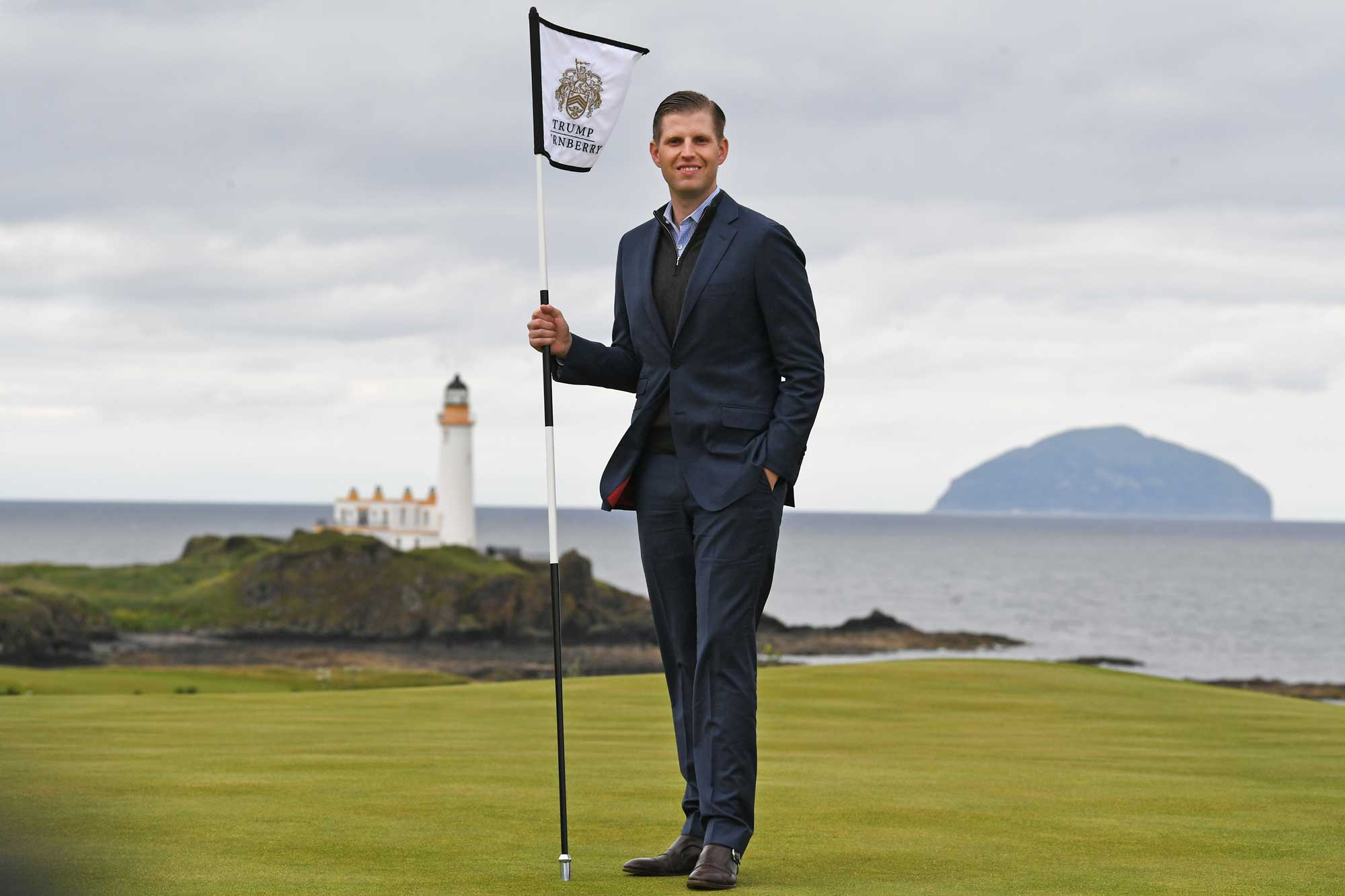
A feasibility study, that old favourite for kicking things into the long grass (and the rough can be very long at the Open), has been commissioned to ease the political pressure. If that fails, they can fall back on Sir Humphrey’s ‘in the fullness of time’ tactic. The next two Opens have been allocated – Birkdale in 2026 and St Andrews in 2027 – and it is believed that Muirfield in East Lothian, which last hosted an Open in 2013, will be given 2028 as the reward for agreeing to allow women members. The last time three successive Opens were held in Scotland was 1893, so that means we’re looking at 2030, when Trump will be 84 and (presumably) no longer in the White House.
This may be nudged back even further if there are difficult scenes at the Ryder Cup in late September, to be held in Bethpage, New York, where the fans are notoriously raucous. Trump will surely be there on the tee, a week after his state visit to Britain, having missed the chance to host a Ryder Cup in his first term. It was to be at Whistling Straits, Wisconsin, in 2020, a few weeks before he fought re-election, but was postponed by the pandemic. A US win might have swayed the election for him. He will not miss this Ryder Cup but if it is a rowdy one – expect no sporting concessions this time – the R&A may find a new reason to delay a decision.
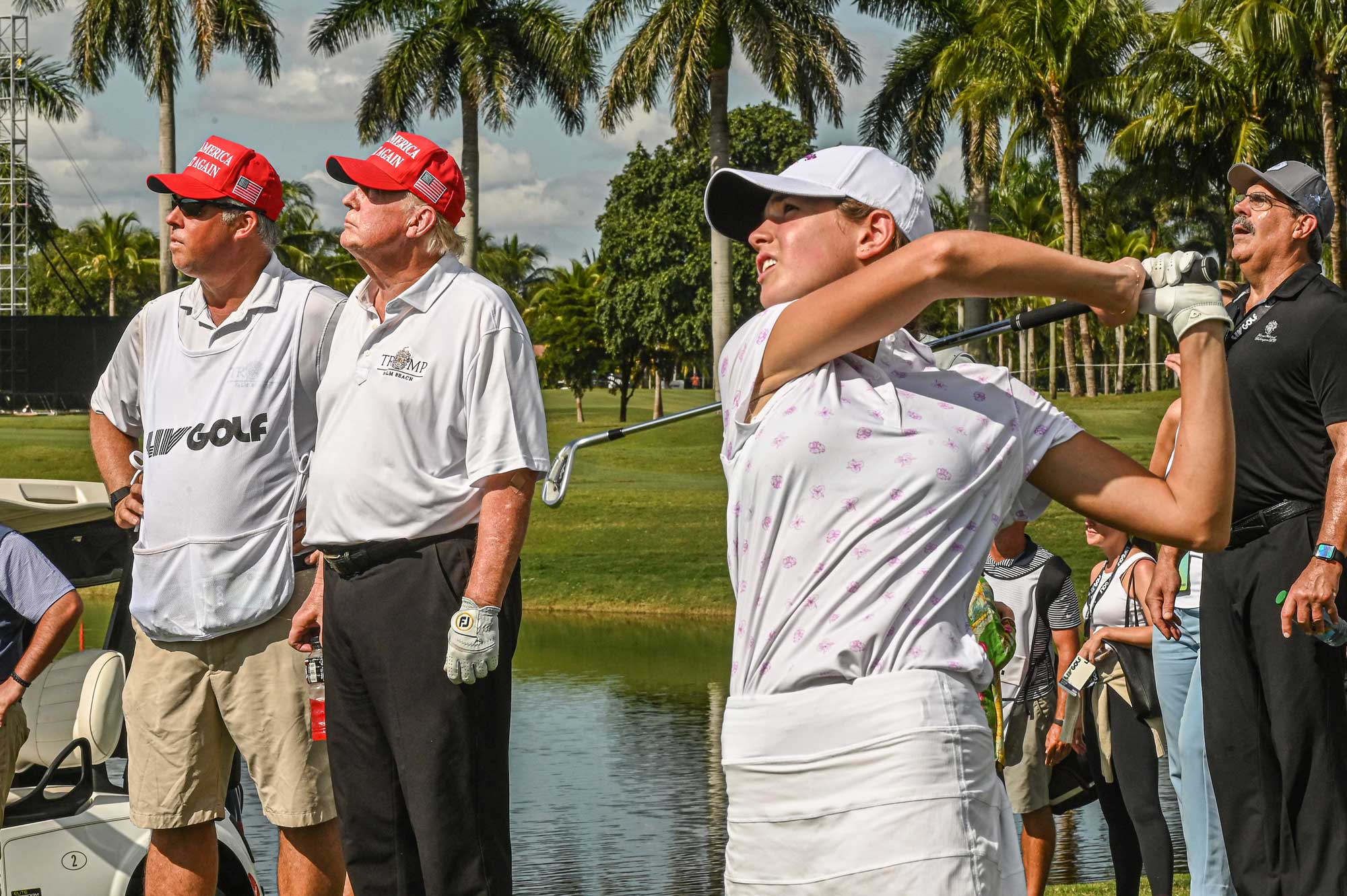
One thing that is certain about Trump’s visit to Aberdeenshire is that he will have a GREAT opening round. He is a more than decent golfer to judge by footage (though his declared handicap of 2.8 raises eyebrows), but he has never knowingly played badly, certainly not at a club he owns. Two weeks ago, he won the members’ championship at Bedminster yet again, while in 2023 he won a two-day competition at his West Palm Beach course, despite being 600 miles away on the first day. Trump explained that he’d had a brilliant practice round two days before and so submitted that as his Saturday scorecard in absentia, meaning the field began Sunday five strokes behind.
This performance, Trump declared, proved that he had the ‘strength and stamina’ to deserve a second term. He certainly has the sneakiness and chutzpah, though he falls a long way behind Kim Jong-il, the Eternal Scratch Champion of Pyong-yang, who famously once had five holes-in-one during a round that was 38 under par. Trump and Kim’s sporting prowess matches that of Vladimir Putin, who has scored eight goals in an ice hockey match three times, and Mao Zedong, who was said to have swum ten miles of the Yangtze in just over an hour.
It was ever thus with vain leaders, whose sporting boasts are rarely challenged. The Emperor Nero competed at the Olympics in the race for four-horse chariots, steering a vehicle pulled by ten horses. The excessive horsepower meant Nero crashed at the first corner, but he successfully persuaded the judges to award him the laurels since he should have won.
Trump’s latest visit to Bedminster put him within sight of Barack Obama in the list of golf-mad presidents. Obama played 306 rounds while in office, and Trump is now up to 304 after six months of his second term. During the 2016 election, Trump claimed he would be too busy to play golf as president. He then squeezed in 11 rounds in his first eight weeks. This term, he was back on the course on Day 6. And again on Day 7.
Trump is also not far behind Bill Clinton, the only president whose handicap went down in the White House – but he has some way to go to beat the top two. Dwight Eisenhower notched up 800 rounds in office, some quite iffy. Bob Hope quipped: ‘If Eisenhower slices the budget like he slices a golf ball, the nation has nothing to worry about.’
Way out in front is Woodrow Wilson, who played every other day during the first world war, including at the Versailles peace conference, but he remained mediocre. As a presidential duffer, he comes behind William Taft, who once recorded a 27 on one hole, including 17 to get out of a bunker, but believed that it was gentlemanly to be honest. ‘There is nothing which furnishes a greater test of character and self-restraint than golf,’ Taft said.
Trump takes a different view, which is why it is unsurprising that world leaders now see golf as a tool of diplomacy. Shinzo Abe, the deceased former prime minister of Japan, played five rounds with Trump and in 2016 gave him a $3,700 golden driver. Abe did so well out of this that Yoon Suk Yeol, the President of South Korea, took up the sport to help his own diplomatic game. Nigel Farage’s close friendship with Trump may in part be due to this shared interest – the Reform UK leader says he almost took up a US college golf scholarship – though Farage’s bad back doesn’t allow him to play any more.
When Cyril Ramaphosa visited the White House in May, the South African President took with him a pair of major-winning golfers, Ernie Els and Retief Goosen, in the hope that it would impress Trump. Alexander Stubb, the Finnish President and a former college golfer in South Carolina, negotiated the purchase by the US of some Finnish icebreakers after he played (and won) a tournament in Palm Beach with Trump as his partner in March.
That will be the challenge for Starmer when he pays homage. Unlike David Cameron, who rewarded Obama for his Brexit intervention in 2016 with a round at the Grove in Hertfordshire, Starmer can’t fake an interest in golf. He was the first prime minister to reject honorary membership of the Ellesborough golf club near Chequers. Perhaps he will bring a star golfer like Sir Nick Faldo with him to swing for Britain.
Starmer did have a professional golfer on his backbenches in Brian Leishman, MP for Alloa and Grangemouth, but the Socialist Campaign Group member, who recently lost the whip for rebelling, will surely not play ball. How about the Paymaster General? Nick Thomas-Symonds’s skill with a mashie niblick is unknown, but he was named Nicklaus by a golf-mad father. For diplomatic reasons, Starmer may want to allow Trump to say that his course was blessed by a British Nicklaus. Just don’t expect the President to concede any short putts.
How happy are private renters?
Coined terms
Liz Williams, a Reform UK council candidate in May’s local elections, began a High Court action trying to overturn the result after she lost on the toss of a coin, having tied with the Green candidate Hannah Robson. The toss of a coin has been used several times to decide local elections. Has chance favoured a particular party?
1987 Labour candidate Bob Blizzard defeated the Conservative May Reader in Pakefield Ward of Waveney District Council after the toss of a coin.
2000 Labour defeated the Conservatives on the toss of a coin in the Worksop North East ward of Bassetlaw District Council.
2007 The Tory Christopher Underwood-Frost defeated the Lib Dem candidate on toss of coin in West Lindsey, Lincolnshire.
2022 The Labour candidate won over the Conservative in Carmarthen’s Bigyn ward.
There is only one recorded instance of a tie in a general election – in Ashton-under-Lyne in 1886. On that occasion the returning officer used a casting vote to elect the Conservative candidate John Addison.
Bag news
Which retailers sold the most single-use plastic bags in 2023/24 (legislation compels them to charge at least 10p for each one)?
Ocado 190.4m
Morrisons 53.3m
Co-op 24.8m
Aldi 11.4m
Sainsbury’s 8.8m
Farmfoods 7.9m
Source: Defra
Flat rate
How happy are private renters?
80% say they are happy with their current accommodation (75% of social renters and 94% of owner occupiers say the same).
Private renters say they pay an average of 31% of their income on rent. They have been in their current accommodation for an average of nearly 4 years. 73% say they left their last rented home because they wanted to move; 10% because the fixed rental period ended; 6% because their landlord asked them to move. Of the latter, 61% said their landlord wanted to sell the property.
Source: English Housing Survey
The pension gap
What percentage of their earnings are employees putting into their pensions?
Males, public sector: 7.1% employee contribution and 20% employer.
Females, public sector: 6.8% and 17.9%.
Males, private sector: 4.3% and 4.5%.
Females, private sector: 4.1% and 4%.
Across both sectors men between ages of 55 and 59 have average accumulated pension wealth of £156,000 and women £81,000.
Source: DWP
Freestyle Grand Slam
Levon Aronian took the $200,000 first prize at the latest leg of the Freestyle Chess Grand Slam, held in Las Vegas earlier this month. The fifth event of the tour’s debut year, scheduled for Delhi in September, has been cancelled due to a lack of sponsors, but Carlsen tops the leaderboard ahead of the final, which remains scheduled for December in Cape Town. The game below was played in the semi-final, and had as a start position: Ra1, Nb1, Kc1, Nd1, Be1, Qf1, Rg1, Bh1. Black’s setup mirrors that: Ra8, Nb8, etc.
Arjun Erigaisi-Levon Aronian
Freestyle Chess Grand Slam, Las Vegas, July 2025
1 a4 d5 2 g4 c6 3 f4 g6 4 e4 dxe4 5 Bxe4 Bd7 6 Ne3 Ne6 7 c3 Na6 8 f5 gxf5 9 gxf5 Rxg1 10 Qxg1 Nec7 11 Bg3 Ne8 12 d4 Nf6 13 Nd2 O-O-O 14 Bd3 Nc7 15 a5 Qh6 16 Bxc7 Kxc7 17 Qg3+ Kc8 18 Ndc4
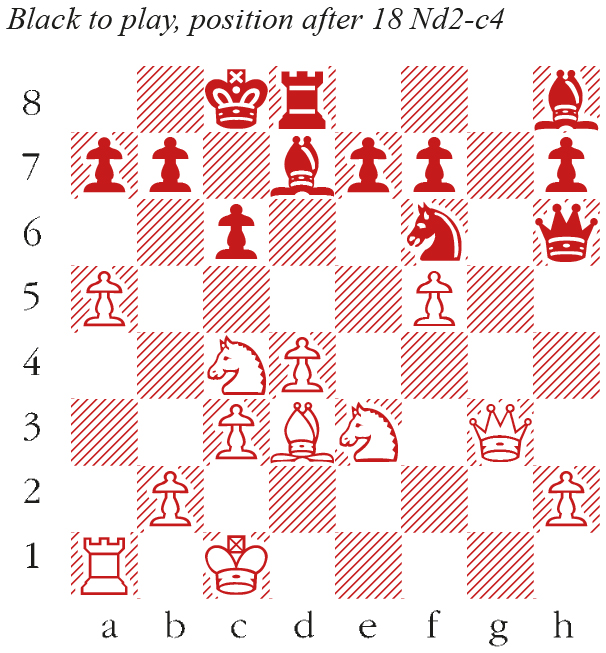
Erigaisi has handled the opening strongly, and now 18…Rg8 is refuted by 19 Nb6+ axb6 20 axb6, with dual threats of Ra8# and Qc7#. Aronian finds the only defence. Nd5 19 Kb1 Qg7 Another timely defensive measure. This time the tactical idea 20 Nxd5 cxd5 21 Nb6+ fails in view of axb6 22 axb6 Qxg3 23 Ra8+ Qb8. 20 Qf3 Qg1+ 21 Ka2 Qxh2 22 Nxd5 cxd5 23 Qxd5 Qc7 24 Qxf7 Bc6 Suddenly Bc6-d5 is a counter-threat. Now 25 Qe6+ Kb8 26 Qe2 maintains an edge, but Erigaisi errs. 25 Ne3 Bxd4 Sharply played. 26 cxd4 Qxa5+ 27 Kb1 Qe1+ picks up the knight. 26 Qe6+ Bd7 27 Qe4 Bc6 28 Qe6+ Bd7 29 Qe4 Bf6 Sensing the game’s momentum in his favour, Aronian declines the repetition. 30 Nd5 Qxa5+ 31 Kb1 Qc5 32 b4 Qf2 33 Ra2 Qg1+ 34 Kc2 Bc6 35 Qe6+ 35 Nxe7+ Bxe7 36 Qxe7 was still good enough for a draw, as 36…Qg2+ 37 Kb1 Qh1+ 38 Kc2 Qd5 (as in the game) is met by 39 Qe6+. This doesn’t work in the game because Aronian’s king is already on b8. Kb8 36 Nxf6 exf6 37 Qxf6 Qg2+ 38 Kb1 38 Kb3 Qd5+ 39 Bc4 Qd1+ 40 Ka3 Qa4+ 41 Kb2 Rd2+ and mate next move. Qh1+ 39 Kc2 Qd5 White resigns
Aronian had a narrow escape in the first game of the final against Hans Niemann (see below). He decided the match and the tournament with a win in the return game.
Hans Niemann-Levon Aronian
Freestyle Chess Grand Slam, Las Vegas
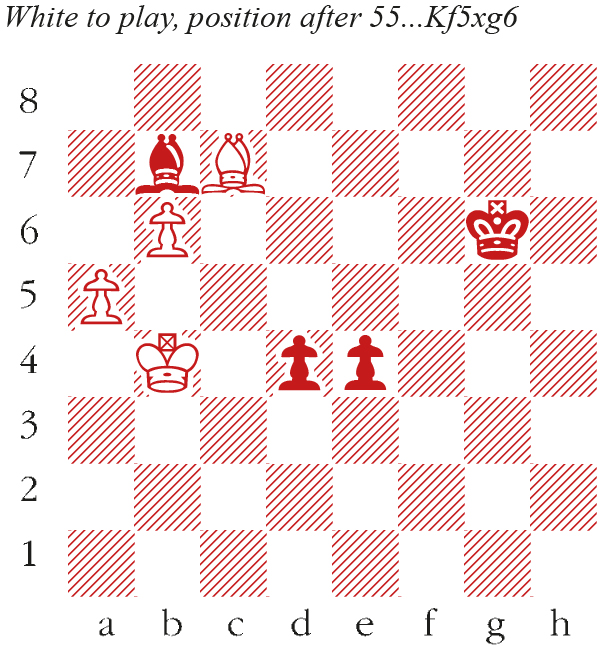
56 Be5 Losing a crucial tempo. Instead, 56 Kb5! wins, with the subtle idea 56…e3 57 Bf4! (preparing Bf4-d2 if the e-pawn advances). Then 57…Kf5 58 a6 Bxa6+ 59 Kxa6 Kxf4 60 b7 e2 61 b8=Q+ (crucially, this is check) and with a bit of precision the queen will win against the pawns. d3 57 Bf4 Ba6 58 Kc5 Kf5 59 Bh6 Kg4 60 Kc6 Kf3 61 b7 Bxb7+ 62 Kxb7 e3 63 Bxe3 Draw agreed
No. 860
Black to play. So-Keymer, Freestyle Chess Grand Slam, Las Vegas 2025. Keymer’s next move forced So to resign. What did he play? Email answers to chess@spectator.co.uk by Monday 28 July. There is a prize of £20 for the first correct answer out of a hat. Please include a postal address and allow six weeks for prize delivery.

Last week’s solution 1 Bf1! trapped the queen. Firouzja tried 1…Rb5 but 2 Qxb5 Qxe3+ 3 Rxe3 axb5 4 Bxb5 was easily winning for Gukesh.
Last week’s winner Ray Fisher, Shepley, W. Yorks
Spectator Competition: Family matters
For Competition 3409 you were invited to submit parental advice courtesy of famous writers. Kurt Vonnegut’s father’s advice to his son gave me the idea for this challenge: ‘Never take liquor into the bedroom. Don’t stick anything in your ears. Be anything but an architect.’
Your entries were witty and imaginative and there were many more potential winners than we have space for. Congratulations all round, and a special mention to George Simmers’s Georges Perec, Joe Houlihan’s Truman Capote, David Silverman’s Shakespeare and Max Ross’s Wordsworth. The following take the £25 John Lewis vouchers.
We assume today that an adult’s duty is to keep children entertained. This assumption can only lead to disappointment in adulthood and a disinclination to grow up at all. Children need to experience the banality of real life; the way potatoes, if allowed to boil dry, blacken and become bitter; the not-quite-matching of amateur wallpapering; the taste of a penny, licked on a long, boring Sunday afternoon. Bracing northern weather. Streets of houses whose only individuality is in their front doors.
As for books, the terse precision of The Very Hungry Caterpillar shames me. Deprecate the florid whimsy of The Wind in the Willows, but cherish its hay-scented nostalgia. Do not expose your children to Milne or Barrie. Forbid Dahl, so that they can read him illicitly.
Ensure that their clothing is a little dowdy and they will learn to secure approval through merit. Above all, be comically glum.
Frank Upton/Alan Bennett
I was never a child, chum. (Pause) But I can handle them. It’s largely a matter of the equitable distribution of mint humbugs. (Pause) The sparing. Equitable. Distribution. They’ll require repeated instruction. The youth of today possess little knowledge about the correct operation of a dumb waiter, the location of Sidcup or how to fashion an anecdote that goes very precisely nowhere. They’ll take none of it in, hence the necessity and futility of repetition. Culture is wasted on them. They prefer pantomime to the tragedies of John Webster. (Pause) Oh yes they do. Sport is the thing to break them in. If they can play impassively a properly umpired game of cricket your work is done. Start on the small and work up, that’s my motto. Should you fail, they’ll become merely childish. Succeed and, in due time, you’ll be eye to eye with something truly catastrophic: yourself.
Adrian Fry/Harold Pinter
Too much guff gets talked about fatherhood, most of it by childless sociologists. All a chap needs to make a decent fist of fathering is a wife who wants kids about three times as much as he does, a booklined study off-limits to the rest of the brood (decent single malt in top right-hand bureau drawer) and a repertoire of amusing faces – Monocled Headmaster Suffering Aneurism, Savonarola in Soho– to buck things up during meals you can’t spend out at the Garrick. Children are drawn to the parent they see least, a win-win. You can go drinking with pals most days and still expect to pop up in as many memoirs or romans à clef as you have offspring. Your brood want bedtime stories? Dick Francis is bloody good and will simultaneously grip you and set them snoring like piglets before the end of the first furlong.
Russell Clifton/Kingsley Amis
A word of good advice while I still can –
If you have based your life on solid virtue
And been the best of Ideal English Man;
If sticks and stones and words have never hurt you
You may by now be just one half a man.
Though ‘If’ has long inspired your moral core
And helped defeat the blandishments of sin
I’ll say now, as I meant to warn before,
You might have had some problems fitting in
With friends who think you’re now a priggish bore.
So try to loosen up a bit, my son.
Of all the Deadly Sins there must be one
Which, tried discreetly just for one-off fun,
Might win you street-cred as a proper man –
And, what is more, an English man, my son.
Martin Parker/Rudyard Kipling
Along the muddy lanes of Hampstead Heath,
Safe in a world of trams and buttered toast,
The children, dry in hoods and sturdy boots,
Return for tea – and tales of playground spats.
Then give them Scott’s Emulsion, rusks and malt,
And fortify with scones and Ovaltine.
Preparing them for School ma’am’s iron rule,
Ask, ‘Now, how many pennies in a pound?’
Then bath-time with the goddess Soap in hand,
And off to Dreamland, tucked in eiderdown.
But if young John should dare to disobey
Be hard of heart – it’s character they need.
‘All right, bend over.’ Three resounding thwacks
From Father’s gym-shoe bring a gulp. Then pause –
A pat upon the head, a thoughtful smile:
‘I liked the way you took that beating, John.’
Ralph Goldswain/John Betjeman
I have assembled you here, in this venerable library on this stormy night, to offer counsel.
Your lives have run hitherto on well-worn rails – the cashiered major, the faded adventuress, the Bohemian aspiring artist, still aspiring, the bankrupt man of business – and your assorted branch lines now run through the wilderness. You have ignored my advice and let the priceless alignment of motive, method and opportunity evade you. Or so I thought – for I now recognise the early symptoms of arsenic poisoning. Was it the Turkish Delight? The brace of woodcock? The Circassian liqueur or the amusingly edible Romany cigarette holder? I have ignored my second rule and my scornful Hubris is now followed by Nemesis.
I offer two bequests: My large fortune to my murderer, whichever one of you that might be. And secondly, the recommendation that you think very hard indeed before applying for probate.
Nick Syrett/Agatha Christie
No. 3412: Hard lines
You are invited to submit a poem about the struggle of writing a poem (16 lines maximum).Please email entries to competition@spectator.co.uk by midday on 6 August.
2713: Outdressed
Clockwise round the grid from the square between 6 and 7 runs a quotation which could have referred to the three unclued lights, and its source (7,2,3,3,5,3,3,7,4,3,2,5,5).
Across
9 Top part is the place to go in ships (5)
10 Wild party girl cycling (4)
11 Ex-president twice cut back tropical plants (5)
12 Unbounded profusion bewildered lunatic (7)
13 Article on devilish debonair Michael Gove? (10)
15 Microstate near heart of Burundi hoards gold (5)
18 He might steal object inside present (8)
19 But for squaddies we may serve mocktails (6)
21 Rebecca’s boy, second in hunt after sea snakes (4)
24 Primrose played this role in Twelfth Night (5)
25 Monarch astride a wild ass (5)
26 Sea duck finally fears what cats often do (4)
28 Trainee aboard three-master (6)
29 Tramline altered Liverpool Street perhaps (8)
34 Arboreal beast – it’s one of the deadly ones (5)
36 Mignonne quality? It’s Dianne’s when dancing (10)
37 Goddess turned male punches wandering boffin (7)
38 Old fools, they could be upside-down (5)
39 English actor and Irish poet leaving hotel (4)
40 Brother and father crossing drowned valley (5)
Down
1 One of a duo warming up cold listeners? (7)
2 Famous novelist has had coats of granular leather (10)
3 Spiteful poet hides bill of exchange (6)
4 Broadway star ejects male wastrel (5)
5 Praiseworthy Bella disturbed about proscribed group (8)
6 Rascal headed own goal? (5)
7 Roman poet’s nothing like Humpty-Dumpty (5)
8 Seabird kebab’s sound (4)
14 Aged tree encroaches on another tree (5)
20 Trained assassin somewhat often in jail (5)
22 Capital godly sort meets Venetian villain (8)
23 White wine roused no rector (4)
27 Corner in first half of untroubled game (7)
30 Old German unclothed in country (6)
32 Be stingy towards tax in Troon (5)
33 Fruit and veg Romeo ingested (5)
34 Cross old actor (4)
Download a printable version here.
A first prize of £30 and two runners-up prizes of £20 for the first correct solutions opened on 11 August. Please scan or photograph entries and email them (including the crossword number in the subject field) to crosswords@spectator.co.uk, or post to: Crossword 2713, The Spectator, 22 Old Queen Street, London SW1H 9HP. Please allow six weeks for prize delivery.
2710: The clash – solution
The four anagrams were 1A TROUNCES (defined by 7 BEATS), 12 COUNTERS (27 PARRIES), 21 CONSTRUE (10 INTERPRET) and 25 RECOUNTS (13 RELATES)
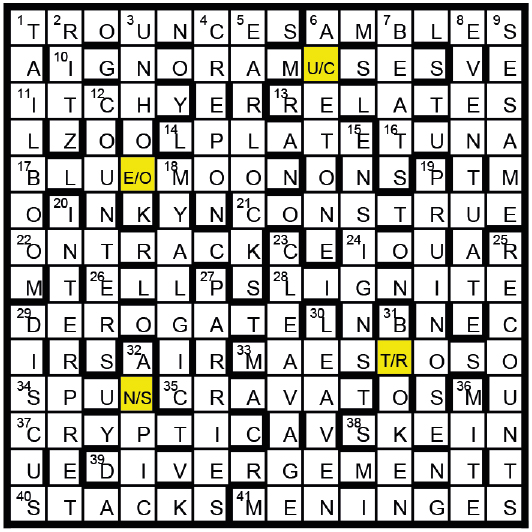
First prize Lisa Bramley, Shaldon, Devon
Runners-up Nick Huntley, Darlington; Lewis Osborne, Newton Mearns, Glasgow
Mothers’ union: The Benefactors, by Wendy Erskine, reviewed
This blistering debut novel from the acclaimed short-story writer Wendy Erskine circles around a case of sexual assault, expanding into a polyphonic story that is at once an evocative fictional oral history of contemporary Belfast, a powerful depiction of trauma and a provocative exploration of social power dynamics.
Erskine teases out narrative strands through a handful of characters’ viewpoints and intersperses these with vignettes written in a first-person verbatim style from a wider cast. She has carefully selected her main parts. Alongside Misty, the assaulted teenager, the focus is on the three women whose 18-year-old sons were the perpetrators. There is Frankie, who has left a childhood in care, thanks to the appeal of her laboriously maintained appearance to her tech-millionaire husband; Miriam, who suffers a complicated grief that involves stroking mannequins; and Bronagh, who relishes the glamour of her role as CEO of a children’s charity, while spoiling her only child.
Misty’s own mother is largely absent. Raised with her half-sister by her cab-driver stepfather, Misty hopes for a career in stage and special effects make-up, but is topping up her wages from a hotel restaurant with an account on Benefactors (also known as Bennyz), an OnlyFans-style website where people pay her for content. Erskine dexterously explores her characters’ flaws and conflicts, while creating comedy through dialogue, as in this typical takedown of Bronagh as she describes Misty’s Bennyz profile:
‘It’s quite ridiculous, but she calls herself Elizabeth Barrett Browning. Obviously trying to make herself sound like some Knightsbridge-dwelling It Girl.’
‘She was a 19th-century poet,’ Miriam says. ‘Married to Robert Browning.’
‘Oh. Well, you learn something new every day.’
When Erskine first introduces us to the Benefactors website, it’s via Misty, emphasising the painful clash of childhood with this adult world. For near-naked poses, ‘she made sure that she moved her old cuddly toy off the bed, the one with the zip where she can put her pyjamas. Because, sad to say, that would attract the wrong crowd.’ Misty goes on Bennyz after the sexual assault, where one of her regulars, Mike from Wyoming, says she should tell her mother, or the police. ‘She’d never heard again from Mike, after that night. She thought he might have hung around to see how it had gone with the police. But he didn’t.’
Erskine shows that even the least demanding clients can scarcely be considered ‘benefactors’ in the literal sense of ‘doing good’. The website is a metonym for Erskine’s exploration of societal inequality, as she considers how much goodness is attached to giving money; who benefits from supposed acts of beneficence; and, crucially, whether it’s possible for Misty to tilt the balance of power in her favour, against the three rich boys who assaulted her.
The Benefactors is vital reading, both for its lively energy and its political weight.
Bristling with meaning: the language of hair in 19th-century America
In Whiskerology, Sarah Gold McBride combs through a bristling, tangled mess of data, facts and theories about gender, race, national identity and their relationship to – yep, you guessed – hair. Do not buy this book if you are looking for a fun read about vintage updos, goatees and ponytails; Ye Olde Horrible Haircuts it is not. It’s a book about hair as a kind of cultural text; readable, manipulable, highly permable and ideologically curled. One does not, it turns out, simply go and get a haircut: one enters a vast semiotic salon, more Saussure than Sassoon, where you’re lucky to get out without a scalping.
McBride is a 21st-century American scholar writing about 19th-century American hair, but the manner is classic mid-20th-century French plait. Roland Barthes – remember him? – famously explained how everyday objects are invested with ideological meanings that serve to naturalise particular social orders: detergents symbolise the miraculous power of science to purify stuff; wrestling is a form of moral spectacle. And Michel Foucault – remember him? – traced how bodies become enmeshed in networks of knowledge and power, used to define, discipline and diagnose. Hair, in McBride’s telling, functions in exactly this mysterious, chic French way. A beard is not just a beard but a sign, depending on the beard-wearer, of the ruggedness of the frontier, say, or the honesty of the republic; or is a mark of untrustworthiness and racial otherness. Long, flowing locks may connote moral purity, but also erotic excess. Ideology flows hither and thither through the follicles.
McBride organises the book around four areas in which hair, according to her, was a ‘site of debate’ in 19th-century America – long hair, facial hair, the scientific study of hair and hair’s role in disguise and deception. Each of these strands, she argues, is knotted with the kinks and tensions of an emerging nation convulsed by civil war, industrialisation and new theories of the body, where hair was not only manipulated by its wearers but was also enlisted by the state and by science to stabilise or undermine identity.
Her argument is both utterly straightforward and distinctly weird and wonderful, in that slightly perverse academic fashion which combines statements of the obvious – ‘for all its malleability, hair is not entirely of the wearer’s choosing, unlike clothing, hats, jewellery and other accessories’ – with strange and fascinating examples that support her thesis. Basically, to cut a long story very short, or down to Number 1 all over, the 19th century saw the body increasingly subjected to empirical scrutiny through physiognomy, phrenology and, later, racial anthropology. And just as the shape of a skull or the angle of a jaw was believed to disclose character, so too might a beard, a lock of curls or a suspiciously cropped coif. In a brave new world where citizens were learning how to read one another, people grasped on to hair as a signifier and guide to ‘authentic meaning’.
Long flowing locks may connote moral purity, but also erotic excess
Facial hair provides one of McBride’s most convincing case studies. The ‘whiskerology’ of her title is no mere whimsical coinage, but a serious account of how beards became a locus for negotiating masculinity, morality and political ideology. In early 19th-century discourse, the clean-shaven face represented Enlightenment rationality and moral clarity. By mid-century, however, beards had come to symbolise a more robust, muscular masculinity, tied and tethered to frontier mythologies and patriotic virtue. Yet this meaning was hardly stable. McBride shows how African-American men’s facial hair was subjected to racialised readings, portrayed as either effeminising or dangerously animalistic. Even bearded women, exhibited in freak shows or circulated in medical literature, unsettled gender norms while also reaffirming them through spectacular exception.
Similarly, the chapter on the scientific analysis of hair draws some interesting links between the nascent fields of trichology and forensic anthropology and the broader project of making the American body legible. In an era when everything from temperament to criminal guilt was thought to reside in bodily signs, hair offered a tempting form of evidence. It was classified, measured and often preserved as relic, sample and proof. As for hair fraud, the story of Loreta Janeta Velazquez disguising herself with a wig and false moustache in order to be able to serve in the Confederate army is just one of McBride’s entertaining examples.
There is, apparently – but of course! – a whole ‘emergent field of hair studies’, which is where McBride situates her own work and which draws upon ‘anthropological, historical and black feminist hair scholarship’ to provide ‘useful models for thinking about hair culturally, historically and materially’. Whatever the new models of thinking about hair – and let’s hope for all our sakes it’s not another return to the fringe or mullet – the breadth of McBride’s sources is admirable, ranging from medical treatises and beauty manuals to court records and visual ephemera.
In a country undergoing seismic shifts – economic, political and demographic – hair, it turns out, is a site of both reassurance and anxiety. Hair-studies scholars of the future, examining the evidence of the early 21st century, will doubtless have all sorts of interesting things to say about Donald Trump’s long golden locks, Javier Gerardo Milei’s moptop and Keir Starmer’s overuse of gel. Hair may not tell the truth but it surely remains an indicator of character. For the record, if you can’t tell, I’m bald, while McBride has lovely pre-Raphaelite curls.
Tedious, lazy and pretentious – Irvine Welsh’s Men in Love is a disgrace
There are 32 years between the publication of Irvine Welsh’s Trainspotting and his Men in Love – a gap roughly equivalent to that between Sgt. Pepper and ‘Windowlicker’ by Aphex Twin. Perhaps three cultural generations. It is disturbing, therefore, to find Welsh still pumping out further sequels to his spectacular literary debut. But whereas that had verbal fireworks, razor-sharp dialogue, superb character ventriloquism and a fearless examination of Scottish moral rot, Men in Love is – let’s be frank – tedious, lazy, pretentious and simply bad writing.
Under the influence of American Psycho, Welsh has had characters narrating their fleeting perceptions since Filth (1998), in the hope that accumulation will create meaning. But where Bret Easton Ellis is satirising the vicious lizard-brain petulance of the 1 per cent, Welsh now simply takes you with the narrator on increasingly pointless journeys. The result is entire chapters that feel redundant and anti-plots that seem to build to something before ending in irritating anti-climaxes. (The Renton-Begbie confrontation in 2002’s Porno was so bad that I wondered whether a refusal to climax was a meta joke.)
Trainspotting vibrated with malevolent vernacular energy, but the prequels and sequels have seen Welsh lose his ventriloquial gift. This was already apparent in Porno, where Nikki’s speech at the end was pure authorial intervention as she tells us What It All Meant. From Skagboys (2012) onwards, Renton, Sick Boy, Spud and even Begbie have been articulating their thoughts in increasingly florid sentences, as if Welsh were trying to impress us with his new-found vocabulary.
But it doesn’t impress. Of course, part of the pleasure of reading Welsh was how he combined the demotic and the cerebral. But the writing in Men in Love can be as clumsy and self-regarding as undergraduate poetry. For instance, Spud thinks that ‘she should pure huv the vocabulary tae express hersel withoot recourse tae foul language’. Without recourse, aye?
The once-fearsome Begbie, meanwhile:
Now he was outside and it was Saturday, drifting into late afternoon, a time Begbie found replete with opportunities for violence. Potential adversaries were out, some since Friday after work. Many of those boys acquiring the delicious bold-but-sloppy combination that would service his chaotic outpourings.
He found them replete, did he? He had chaotic outpourings, did he? And the sex writing – ‘in languid, ethereal movements she groans in soft tones’, for example – is excruciating.

Another key weakness of Men in Love is how many earlier beats it replays. Sick Boy is involved with porn films and pimping; women magically fall under his spell; and he outplays a privileged male competitor (this time his father-in-law, a Home Office civil servant). Renton gets into nightclubs and DJ-ing. Spud is a romantic loser. Begbie is still psychotically aggressive. All of which we’ve seen in Porno, The Blade Artist and Dead Men’s Trousers. The record is stuck.
The heartbreaking thing is there’s a good novel to be written about the punk/smack generation of the early 1980s encountering the ecstasy love-buzz period as the decade progressed. But Welsh has signally failed to tackle any of that. He could have taken them to Ibiza, the Hacienda or Spike Island, or considered the achievements and failures of the Love Generation Mk II. But no. It’s another lazy retread.
The impression one gets from Men in Love is that of Fat Elvis, sweating and unknowingly self-parodic in Las Vegas. Welsh desperately needs an editor with the guts to tell him this schtick isn’t working any more. To quote Melody Maker on David Bowie: ‘Sit down, man, you’re a fucking disgrace.’
Pity the censor: Moderation, by Elaine Castillo, reviewed
After her America is Not the Heart was published in 2018, Elaine Castillo was named by the Financial Times one of ‘the planet’s 30 most exciting young people’, alongside Billie Eilish and Alexandria Ocasio-Cortez. That debut novel told the story of three generations of women torn between the Philippines and the United States.
In Moderation, thirtysomething Filipina-American Girlie Delmundo (not her real name) works as a content moderator, removing the most hideous material to be found on the internet. The author doesn’t pull her punches. In an early scene, Girlie has to moderate a video of child sexual abuse as part of her final assessment to get the job. (Another candidate passes his assessment, even though he throws up during it because, crucially, he doesn’t pause the video.) She is asked to explain how she knows it is a young girl in the footage and not a consenting adult. The details are hard to stomach.
Castillo has said that her two main characters (one of whom is Girlie) don’t realise they are in a ‘Jane Austen-style Regency romance’. In fairness, I’m not sure I clocked this either, at least in the first half, when a love story is barely mentioned and the pages are so muddy it is genuinely hard to persevere. In the second half, however, when Girlie starts to fall for an English co-worker, a sort of fluency develops.
Good at her job, Girlie is offered a large pay raise by her company to moderate virtual reality theme parks. The frequency of rape in these environments becomes horribly numbing, at least for the reader. We are led to understand that Girlie has long been desensitised. The reasons for this are hinted at when we learn that she ‘had known since she was seven what it looked like when she turned a man on’.
Castillo has important things to say about the internet, trauma and true connection, but it’s a shame that this novel wasn’t polished to make it clearer or more enjoyable to read.
With glee to the silvery sea
Was it more profitable for an early-20th-century seaside railway poster to promise the undeliverable or to be slightly less enticing but at least tell the truth? In his charming and unashamedly train-spotterish book about how the British travelled to the seaside in the great days of rail, Andrew Martin quotes slogans from posters. The Great North of Scotland Railway described the Moray Firth as ‘the Scottish Riviera’. The Furness Railway named Grange-over-Sands ‘the Naples of the North!’ (The exclamation mark injected a smidgeon of doubt, Martin feels).
More realistic companies toned down their boasts. The LNER decided it should go no further than claim it took passengers to ‘The Drier Side of Britain’. A North Eastern Railway poster proclaimed: ‘Scarborough Braces You Up. The Air Does It.’ ‘Come to Southport for Mild Winters,’ begged the Lancashire and Yorkshire Railway. A poster launching a new line to the Kentish resort of Allhallows-on-Sea, 12 miles from Gravesend, came up with the rather weak boast that the place was ‘Facing Southend’.
Any British pursuit once popular enough had to have a boardgame to go with it. Race to the Ocean Coast, created by Chad Valley Co. for the GWR in the late 1920s, was a game for all the family. Hazards included ‘communication cord pulled’ and ‘line under construction’. It didn’t sell very well and was discontinued in 1932. But the craze for taking trains to the seaside carried on growing, as it had been steadily since the mid-1870s. A bench a quarter of a mile long was installed on the new ‘excursion platform’ at Scarborough station in 1883 to absorb the vast home-going crowds after their day out. To cater for northerners travelling south, there was a regular sleeper service from Glasgow to Brighton.
That Scarborough bench still exists, unlike so much else mentioned in this book, discontinued or demolished and turned into a car park in the aftermath of the brutal and short-sighted Beeching report of 1963, which recommended the closure of 2,363 stations. Every few pages in this book there is mention of 1964 or 1965. Those years were as deadly for British railway stations as 1538 and 1539 were for English monasteries.
On the subject of Scarborough, Martin adds that Edwardian crowds were so huge that the excursion platform wasn’t sufficient and a whole new ‘excursion station’ had to be built, called Scarborough Londesborough Road. Alert to class distinctions, he notes that the Londesborough Road station was very much the ‘tradesman’s entrance’: ‘The premier Scarborough train, the ex-King’s Cross Scarborough Flyer, wouldn’t have been seen dead at Londesborough Road.’
This is a very different book from Madeleine Bunting’s The Seaside: An English Love Affair (2023), which was a work of gritty social journalism. She forced us to face the truth about the sometimes dismal and impoverished back streets of these places.
Martin sticks more cheerfully to the trains, the stations, the arrivals and the departures, in the past and present. To spread joy about what’s left, he travels on lines to the coast that remain open, evoking his journeys in infectiously enthusiastic detail – ‘sand blowing on to Platform 4 at Cleethorpes’. ‘The most interesting sights on the Atlantic Coast Line,’ he writes, ‘include the St Blazey freight yard just beyond Par.’ I must go and have a look. He salutes the Victorian visionaries who got local coastal railway lines going, such as Sir Peter Hesketh-Fleetwood, who in the 1840s developed Fleetwood, Lancashire as a port and resort.
To enhance my enjoyment, I kept referring to Google Maps and the National Rail app to see what Martin meant about, for example, how long it would now take to go by train from Pwllheli to Llandudno (just 50 miles). It would be a six-hour, 40-stop trip, requiring a change at Shrewsbury. His description of his journey from Euston to Pwllhelli, complete with the diesel smell and growl of the Transport for Wales Sprinter, almost made me want to have a go – except that, in the ‘quiet carriage’, a passenger started a phone conversation with: ‘Hi, gang, can you hear me?’
There are some lovely glimpses of the early-20th-century public’s appetite for the seaside – those wonderfully disinhibiting places where, as Martin writes, ‘clocks were floral, golf “crazy”, castles were made of sand and piers offered a walk to nowhere’. In order to avoid cramming too much into their heavy suitcases in the days before wheelie ones, passengers arrived sweltering in layers of overcoats. So great was the demand for the sea that in 1908 the Great Eastern Railway brought barrels of seawater to Liverpool Street. Londoners could order it to be delivered to their doors at 6d for three gallons.
Martin’s wistful, overarching story is that ‘the cars killed the trains, the planes killed the seaside, and Dr Beeching assisted the car cause with unjustified enthusiasm’. But wherever Martin goes, local railway societies seem to be doing all they can to resurrect the closed-down lines. This book makes you long for Dr Beeching’s evil work to be undone.