Place

A terrible tale of a French village

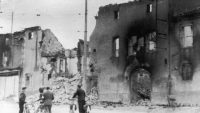
The new prime minister of France, Gabriel Attal, has promised to “take care” of Oradour-sur-Glane. The village, in west-central France, was the scene on June 10, 1944, of an infamous Nazi massacre of 643 men, women and children, shot or locked in the local church and burned alive. Only six villagers escaped to tell the tale; the last of them died in 2023. For years Oradour-sur-Glane has been a site where schoolchildren were taken to learn about what France endured during World War Two. Recently the abandoned village has become overgrown with vegetation, but with the eightieth anniversary this summer, the descendants of the victims are making sure they are not forgotten.

Oradour
Galápagos

The Galápagos evolution even Darwin didn’t foresee

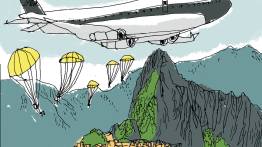
Lonesome George, a Pinta Island giant tortoise, spent the latter half of his hundred years munching on cacti and roaming around the Charles Darwin Research Station on the Galápagos island of Santa Cruz. He borrowed his name from the 1950s American comedian and actor George Gobel and one of the three B-52 Stratofortresses that completed the first non-stop jet circumnavigation of the world in 1957. But the name was ultimately more fitting for the tortoise who was the last of a million-year-old species. In 1959, fishermen introduced three goats to Lonesome George’s home of Pinta Island, one of the smallest islands of the Galápagos archipelago. Just ten years later, they had multiplied to around 40,000.

Staten

Dispatch from an unloved borough

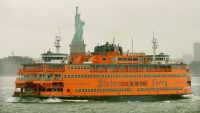
Once a year, Nick, a surgeon who lives on the Upper West Side of Manhattan, visits Staten Island. Almost as soon as he arrives, he literally runs back to where he just came from. Nick is a marathon runner — he’s done New York seven times — and like millions of similarly masochistic athletes and wannabes, he’s lined up at the mouth of the Verrazzano Bridge, the eastern edge of New York City’s least exalted borough, with the sole aim of getting back to more familiar territory as briskly as his legs can carry him. “Of course I don’t have anything against Staten Island,” he explains. “There’s just not that much of a reason to go there.” Many others, it turns out, feel the same. I moved to Manhattan just over four years ago.

Bringing back rhinos in Pakistan

The drive from Islamabad to Multan takes about eight hours. We passed through fields of citrus fruit and farmers tending weed-burning fires. Boys carried giant bunches of twigs over their heads or zipped by on old Honda 70s, balancing water tubs. All had early-Beatles haircuts and wore the shalwar kameez, the Punjabi suit of lightweight trousers and a tunic. Multanis, distinguished by their good looks and their own musical dialect, are called meethi churiyans by other Punjabis, meaning “sweet knives.” They are charming and generous, serving up piles of warm chapati and mutton chops, before stinging you with a hefty bill.

rhinos

Montréal serves up a surprising array of off-season delights

There’s cold, then there’s winter-in-Canada cold. The kind where I’m jamming hand-warmers into my ski gloves — yet still somehow my fingers go numb — and snowflakes keep their intricate patterns as they scatter over my clothes (back home in comparatively balmy England, they’d melt instantly). But what did I expect? I’d made it my New Year’s resolution to travel off-season. Think Rajasthan in the summer monsoon, Sicily’s midwinter citrus harvest, Portugal’s Atlantic Coast when the record-breaking waves roll in come November. I’m not the only one with this idea.

Montréal
goose

My first family goose hunt

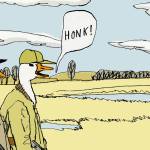
It's a slow Sunday in Paducah, Kentucky, the day before our snow goose hunt. Morning Mass down the road, where the priest quizzingly asked where we were from. Brunch with my husband’s family at a cozy café. Chocolate cake with that crackly boiled icing and fresh coffee in the late afternoon at his aunt and uncle’s house. It isn’t until close to dinnertime that we pack up our bags and hit the road for the bootheel of Missouri, where we will hope to catch a few hours of sleep at our hotel before we meet our local hunting guide. About halfway through our drive, the phone rings with bad news. Our guide, Scooter, spent the day scouting and could find no signs of geese at his usual spots.

hogs

How serious is the feral pig problem?

Let’s play a guessing game: I’m a dangerous force threatening Americans’ health, safety and way of life. We largely rely on government agencies to monitor and manage me. What to do about me is still a matter of debate, as is the severity of the menace I actually create. The media is likely sensationalizing the threat. A new study suggests I’m “not as bad as originally thought,” that reports of the devastation I’m causing were “premature,” and that if you’re outside a specific subset of people I disproportionately affect, you wouldn’t know I exist. Still, there are interactive maps to track my movement, and I’m reported to be related to a new, “hard-to-eradicate, super” strain invading from a foreign country. What am I? Yep, you guessed it.

Megève’s enduring magic

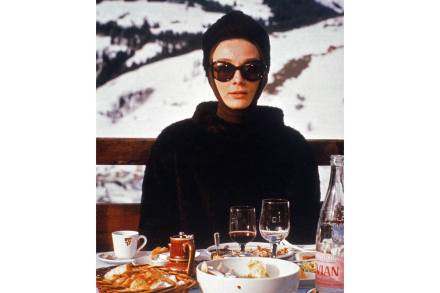
Kitted out in black Givenchy, huge sunglasses blocking out the snow glare, Audrey Hepburn is lunching al fresco in the French Alps when a meet-cute with Cary Grant ensues. It’s the opening scene of Charade, filmed just over sixty years ago in Megève — the chichi winter resort for both Hollywood royalty and true bluebloods during the 1960s. Back then, Brigitte Bardot, Yves Montand and Jean Cocteau were often seen swooping down its pistes. Imagine a snow-dusted Saint-Tropez and you’re on the right track. This medieval market town was hardly destined to become a darling of the beau monde. Megève was something of a backwater (the name even translates to “village in the middle of the waters”) until 1920, when Baroness Noémie de Rothschild spotted its potential.

Megève
plogging

Plogging: Europe’s bizarre eco-friendly fitness craze

The first finisher crossed the line sweaty, tired and almost black with dirt, his white Decathlon shirt turned gray and his standard-issue blue gloves transformed into a deep midnight. He dragged behind him a refrigerator-sized plywood box, piled high with swollen rubbish bags and secured with a hooked rubber bungee cable — where he grabbed that, nobody knew. Yet José Luis Sañudo Lamela’s smile was wide, and he laughed heartily when onlookers and fans expressed amazement at his feat. But despite Lamela’s assuredness that he would take home top billing in the annual World Plogging Championships, one man outdid him — if not in diversity of goods, in pure heft.

Finland

Mökki life and Moomin minutiae in Finland

Moomins are synonymous with Finnish life, like saunas, porridge and mökki (summer cottages) culture. The large-snouted white fairytale creatures feature in the Moomin books, which are published in nearly sixty languages. Moomin World, a theme park 100 miles from Helsinki, crawls with tourists come summer — some feat, in a country with roughly twenty-one inhabitants per square kilometer. Moomin merch is ubiquitous too; fans are cult-like in their collection of rare mugs and first editions. Every day, Tove Jansson’s iconography is inked into skin. And it’d got under mine, in a way. In my twenties, a boyfriend’s collection of paraphernalia from a Finnish former partner quelled any curiosity about Jansson’s imaginary oafs (and Finland).

The vagabond spirit of Mirleft, Morocco’s surf nook

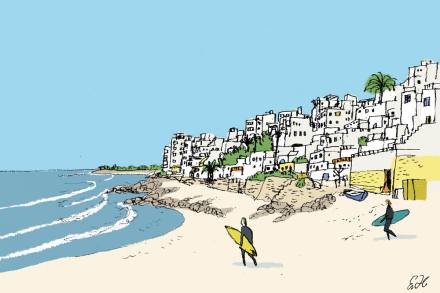
At first, the sleepy little town of Mirleft looks like all the others on the 600-mile trek through the sands of the Sahara: half-gravel, half-concrete sidewalks, faded paint, brightly painted schools and the minaret of a new mosque jutting up toward the sky. But a mile past Mirleft’s dusty high street lie cliffs of California proportions — with swells to match. The cliffs arch down at a near forty-five-degree angle and into meaty waves rolling toward a point break. It’s here that a group of ten French and German surfers have joined up with Issam Surf School, heading down to Plage Sauvage, the beach below, in a 4x4.

mirleft
sharks

Swimming with sharks is nothing to be scared of

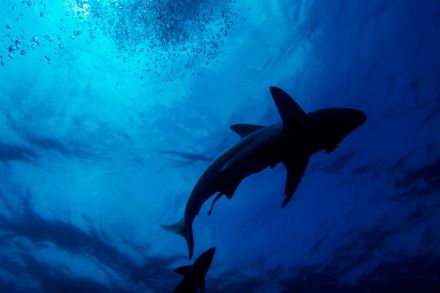
The small South African coastal town of Umkomaas hosts many scuba diving operations and resorts; its local reef system, the Aliwal Shoal, is one of the top fifty dive sites in the world. It contains the usual attractions like schools of tropical fish, turtles, rays and a few shipwrecks. The real attraction though — the reason people come from all over the world to this sleepy town — is to dive with sharks. Without a cage. For up to sixty minutes at a time. The Blue Ocean Dive Resort, where I stayed for a week, specializes in these dives, employing several experts to maximize the shark sightings. During my time there, I must have seen over fifty different sharks, including oceanic blacktips, bull sharks and tiger sharks.

The wellness retreat reborn

Rebecca Illing’s résumé doesn’t read like your typical hotelier’s: circus school graduate, free diver, marine conservation advocate and certified death doula. So when the thirty-seven-year-old Londoner inherited a rundown guest house in Portugal’s northerly Minho region, the property was destined to be reimagined as something more than a straightforward B&B. Illing had spent childhood summers at Paço da Glória, roaming its cork oak woodlands and swimming in the nearby Lima River. But the circumstances of her return in 2020 were less idyllic. Europe was entering lockdown, and she was grieving the sudden death of her brother.

retreat

Kihnu, Estonia’s imaginary isle of women

Who could resist the opportunity to visit a women’s island? Four years ago, I read an article in the New York Times travel section about an Estonian island called Kihnu, which the Times dubbed an “Isle of Women.” Its subhead asked “What would life be like without men?” and I wanted to find out, making a mental note to visit this peculiar island — “run by women” — someday, and my opportunity came last summer as part of a trip with my wife, Jen, and our teenage sons to Finland and the Baltic countries. But Kihnu, we discovered, isn’t a women’s island, or anything close to it. Before our trip, I reread the Times piece plus similar ones before combing YouTube for Kihnu videos.

kihnu

Exploring the forgotten towns of Green Bay

In Pilley’s Island, Canada, a tiny fishing town of barely 290 people along the northeast Newfoundland Great Whale Tour route, there’s a memorial to the area’s dead. It sits on a hillside, with a view of the rocky and wooded bay on the left, and a direct line of sight to the historic church on the right. These aren’t any generic old dead people honored at the memorial, though. Nor is it a memorial for local war casualties (that’s up a small trail nearby) or to fallen firefighters (that’s in the next town over). No — this is a memorial to the people who have died in other terrible ways. The top of the memorial says only “TRAGIC DEATHS,” with small plaques naming each person with possibly a date and a single letter in parentheses to denote the manner of death.

Green Bay
rolf's

Deck the halls at Rolf’s

It’s a common lament each year — starting around October, people love to complain that the Christmas season continues to creep further and further into the fall. But for some, that creep is a welcome one. If that’s you, I know a place. At 3rd Avenue and 22nd Street in Manhattan, you can get your Christmas fill for around six months of the year — at least if you wander into the narrow German restaurant on the corner. You might almost miss it if you walk by during daylight hours. At night, it’s hard to miss. In this rather unsexy portion of Manhattan, Rolf’s has been a New York institution since 1968.

Visiting with bears on the Russian border

Bear viewing in Finland can be a cloak-and-dagger affair. We were told to meet our guide, Pekka Veteläinen, at 5:45 on a Monday afternoon — not at a landmark, but at a set of GPS coordinates deep in the woods, fifty minutes outside a town called Kuusamo, just one kilometer short of the Russian border on logging road number 8691. Here are some of the instructions we received. Wear dark clothing. Take ready-made food with you. Bring cash because credit cards don’t work in this wilderness. We had an early dinner at a “wild food” certified restaurant in the Karelian town of Kuusamo — it’s Finland’s seventy-fifth biggest town, a distinction that means the place still has more reindeer than people.

bear
Gilpin

Tuning in and dropping out at Gilpin Hotel

It is 7:30 a.m. and already seventy degrees in Bowness-on-Windermere. A rare, early summer heatwave. My friend Ebele and I lower ourselves into a sunken outdoor hot tub in groggy disbelief. We appear to have woken up in Utopia. Llamas and alpacas frolic yards away as we sip coffees in silence. A butterfly lands on the decking. There’s no noise but for the bubbles, until a perfect breeze ruffles the fronds of the tree that’s dappling the sunlight. The grass could not be greener, skies cerulean. This is the definition of “bucolic,” I think. William Blake’s England, plus massage jets. His pastoral poems that plagued me in university start to make more sense (plenty of lambs here, too; the local “Herdies”).

A month in the Baltics

On Joe Biden’s first day in Lithuania, he skipped the opening dinner of world leaders at the NATO summit and made a beeline from the airport to his suite at the opulent Kempinski Hotel for a plate of spaghetti bolognese and some quality sack time. My introduction to the country a couple of weeks later involved no fanfare, but was far more memorable. I woke up in the 700-year-old Jaunpils Castle, in a fantastic, out-of-the-way place, lost to my teenage son in an archery competition there and then drove south on winding country roads to northern Lithuania’s Hill of Crosses, a place that better symbolizes the victory of faith over communism than any other. The Baltic countries — Lithuania, Latvia and Estonia — are often lumped together.

Lithuania
catfish

A beginner’s guide to noodling

In Oklahoma, noodle is both a food and a sport. For generations, Okies have been jamming their hands in crevices, trying to find the gaping maws of unsuspecting catfish to rip out of their hideaways. And for more than twenty years, they’ve competed at the Okie Noodling tournament held under an hour away from the country bars of Oklahoma City. Before covering the tournament, I had to noodle myself, to see what all the fuss is about. In Shawnee, I met up with the award-winning noodler Nate Williams, who runs Adrenaline Rush Noodling.