Food and Drink

The chowder crowd

Cape Cod winters are brutal: they are long, freezing cold and windy. Cape Codders don’t know what spring is. The Pilgrims, having first touched terra firma in Chatham after months at sea, headed across Massachusetts Bay for Plymouth to more shelter. Days jump from those when Cape Codders think that Old Man Winter has played a nasty trick on them once again, to days of suddenly delicious warm sun which breaks through feathery skies, filled with what my father Bob called ‘unused air’. One of my dearest memories of spending a winter living in Chatham’s Old Village is of my father, Bob, in mid-May, appearing in his 10-foot skiff putt-putting out of the Mill Pond past our house, wearing his salt-laden floppy hat, heading for Stage Harbor to do some clamming.

clam chowder

A tale of two tapas

In 146 BC, Scipio Aemilianus laid siege to and destroyed the city of Carthage, thus bringing the third Punic War to an end. Scipio made a gift of what remained of the Carthaginian library to the kings of Numidia, Rome’s old ally against Carthage. At the direction of the Senate, however, he held back one book, the agricultural treatise of Mago, which he sent back to Rome. It was duly translated into Latin, but all that remains are fragments, which is too bad, for Mago apparently had a lot to say about many exigent matters, including the cultivation of grapes and making of wine. It appears that it was the Phoenician precursors of the Carthaginians who, around 1500 bc, first planted grapes in the Iberian peninsula.

Tapas bar

Can I be vegetarian and conservative?

My jar of vegan flaczki has been eyeing me for the last four months. It sits in my fridge, large, round and imposing, filled with a lumpy gray mixture. Flaczki is tripe soup, a traditional Polish concoction of broth, herbs, spices, vegetables and guts. Poles adore the stuff. It is warming and hearty. An unimpressed friend once described it as ‘elastic-band stew’. My vegan flaczki contains mushrooms instead of tripe. I bought it for a lark. My Polish friends thought it funny that a modern, progressive twist was being put on a firmly traditional dish. I am a vegetarian, but every time I think about eating my vegan flaczki, I think again. Traditional Polish food is warm, rich and meaty. Roulada, for example, is a meat roll stuffed with, among other things, more meat.

vegetarian

The need to knead

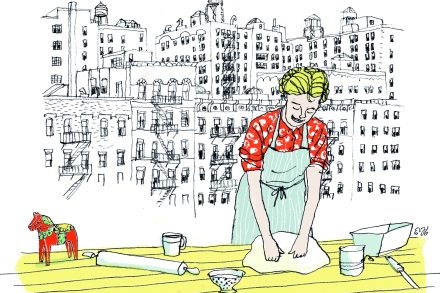
I don’t remember my grandmother, Anna Olson Nelson (Nelsie to her grandchildren), ever measuring out anything for her divine Swedish bread. The recipes must have been kept under the thick, blonde braid that she piled expertly on top of her head. What I do recall, as if it were yesterday, is helping Nelsie bake fläta and limpa every other Sunday in her small kitchen. The heavenly smells of cardamom and fennel wafted throughout her apartment while she tried to improve my Swedish. My mother, Mimi, often spoke Swedish to me and my sister, Chris, when we were babies and my father was with the Office of War Information as a correspondent in China, Burma and India during World War Two. Nelsie was our ‘Swedish nanny’.

bread

Dinner with Judy

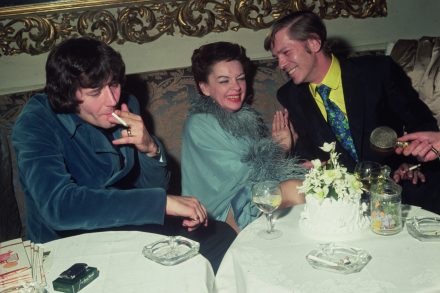
How better to lift a torch against late-winter gloom than by conjuring an evening from a time when our country was still a confident going concern, when its culture and ideas bestrode the free world? What with our plague-driven mania for virtual living, it’s hard to get anyone to come to dinner these days. And since she died in 1969, our virtual guest of honor won’t be coming either. But from an era full of entertainment giants, we pick one, the star of stars: Miss Judy Garland. If only in our minds, we invite Judy to cocktails and dinner and then, just maybe if we get lucky, to linger late into the evening around the piano and sing a few of the old songs. This is not a formal affair, just two couples on a Friday evening after work.

judy

Georgians on my mind

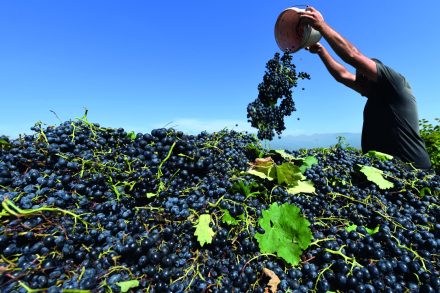
Long before Achilles chased Hector around Troy and Homer wrote about the οἶνοψ πόντος, the ‘wine-dark sea’, people living in what is today the republic of Georgia were making wine. Archaeologists have found evidence of wine making there dating from 8000 BC: an impressive statement to the inventiveness to which necessity gives birth. Stretching from the Black Sea to the Caucasus Mountains, Georgia is home to a wide variety of climates, types of soil and geographical physiognomies. Today it is home to some 500 varietals, few of which are familiar to westerners (even though many if not most western grapes probably have precursors in Georgia and the Black Sea ‘cradle of wine’).

georgian wine

Hopping through Holy Week

What will Easter 2021 be like? Nothing like 2020, if I have my way. This year, I dream, Easter will be preceded by a Holy Week as solemn as if COVID had never been. Purple-veiled statues will stand solemnly about the church overlooking the Holy Thursday foot washing, a jug of water the only cleansing agent in sight, while a large choir sings the Ubi caritas. The Mass will be jammed with people, as it is every normal year, lovely, unknown people who spontaneously show up, unregistered and untraceable, squeezing in wherever there’s space. Afterwards an altar boy swinging a golden censer will lead the procession through volutes of blue smoke to an altar of repose, swathed in white silk.

rabbits holy week

Why Grüner is my go-to

The first person ever to tell me something true about wine was my first real boss, a generous and wise woman who toted me along to the Frankfurt Book Fair with her for several years in my early twenties. At the time I drank mostly sweet red blends that came in denominations of ‘box’ or ‘jug’. When she sensed (or perhaps shared) my fear of humiliating us both when I was asked for my wine order at a long, formal luncheon in a rather famous hotel, she leaned across the many forks of her place setting and whispered to me, ‘Get the Grüner.’ She elaborated that the American white wines I’d had were probably sweet or buttery, but German whites, like dry Rieslings and Grüner Veltliner, were mineral and fresh and lovely. They paired well with all foods.

grüner

The diversity dinner

Growing up in a mixed American household of Indian, Italian and Puerto Rican descent, I never questioned the varying menu each night for dinner. Until I was a teenager, I hadn’t realized my family’s weekly meals were different from those of my friends — until they began begging me to eat at my house on weekends after I told them what was being cooked. For me, dietary normalcy meant chicken curry on Mondays, arroz con habichuelas on Wednesdays and lasagna on Fridays. My Puerto Rican and Italian American mother Loretta had married my father Roop, an Indian immigrant, in 1981. I always admired my mother for her fearlessness in crossing cultural lines during an era when interracial marriage was less common than it is today.

family diversity dinner
paris

The Judgment of Paris

What’s the most famous story about wine in the last 50 years? My candidate is the so-called ‘Judgment of Paris’ of May 1976. It was actually two judgments, one of American and French Chardonnays (the subject of the movie Bottle Shock), the other, more consequential, of American and French Cabernets (well, French Bordeaux, which are predominantly Cabernet). The competition was organized by Steven Spurrier, now one of the world’s most renowned wine connoisseurs, then a 35-year-old British bundle of energy who in 1970 had moved from London to Paris and acquired a small wine shop off the Rue Royale.

Sap happy

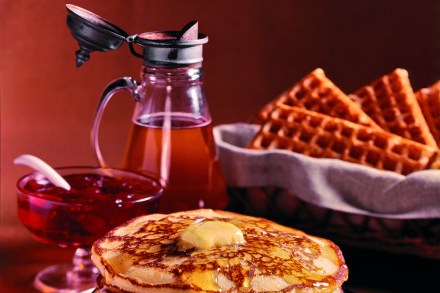
The decline and fall of the New York Times, like that of the Roman Empire, did not happen overnight. Believe it or not, by 1970 the rot had already set in at the Times and rank error was being peddled as fact to a trusting public. I have proof. In August of that year, the paper ran a review of a Canadian theatrical production just arrived in New York called ‘Love and Maple Syrup’ (a reference to a Gordon Lightfoot song). The show was panned — so far, so par for the course — but the review ended on a shockingly error-riddled and un-factchecked note: ‘Love, incidentally, is great, but have you actually tasted maple syrup? Ugh! Only a nation with built-in insecurities and a dire need for blood sugar could have chosen it as its national drink.

syrup pancakes

Fresh food, fresher air

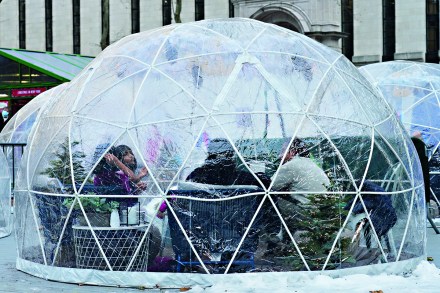
One takes the chance, in writing about al fresco dining during winter, of getting pigeonholed as that guy who always goes on about how cold it is in Chicago. But if I’m to write about food and drink at this time of year, there’s no attractive alternative, unless you want to hear about my puttering in the kitchen making spaghetti, and how exciting is that? With indoor restaurant dining forbidden due to the pandemic, the remaining choice is the outdoors — the ideal setting, in this challenging time, for the intrepid individual to demonstrate boldness without being a complete idiot about it, always a fine line. The question is, how?

outdoor dining
chartreuse

Holy spirit: how the monks make Chartreuse

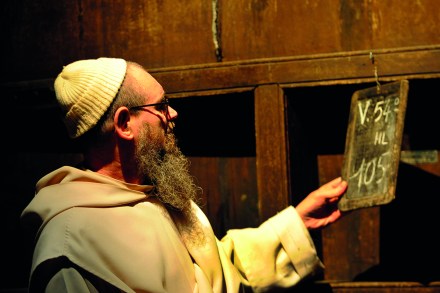
Trivia time. Put down the magazine, look away from the page and name as many green liqueurs as you can. Well? Did you get crème de menthe? Award yourself a point. Absinthe? Sorry, no point; absinthe contains no sugar, and is therefore a flavored liquor, not a liqueur. Note the difference in spelling: liquor can serve as a base to which sweeteners and flavors are added to form liqueur, but technically the one is not the other, and the other is not the one. What about Chartreuse? If you guessed it, well done: the Queen of Liqueurs claims the distinction of being the only naturally green-colored liqueur in existence.

Noble Rotters

Frank Zappa said writing about music is as absurd as ‘dancing about architecture’. Dan Keeling and Mark Andrew ask if you could say the same about wine. Our authors make light of their own or any attempts to quantify an ever-evolving liquid essence into words, points or subjective flavor interpretations whilst providing a helpful ‘Lexicon of Usefulness’ to assist the reader’s endeavors.

noble rot

The screw-top letters

Some people think that appreciating wine is all about the taste of the beverage. Others, more cynical, think that, at bottom, it is about the efficient ingestion of that complex hydrocarbon that the body converts into sugar, and merriment, as it passes through the system. The name of that compound is ethanol, a type of alcohol produced by the fermentation of certain fruits. If you look up ‘alcohol’ in a sociologically or anthropologically disposed reference work, you’ll find owlish observations to the effect that ‘alcohol plays an important social role in many cultures’. This is a nod to fact that wine is a both a goad to conviviality and a glue binding up the multifarious wounds to our amour propre that are the natural result of the conduct of daily life.

screw

Raclette sports

Raclette is the ultimate comfort food. From the French word racler, to scrape, this simple, hearty dish is all Swiss. There isn’t a village in Switzerland, in the Alps, the Jura or the Engadine, where you can’t have raclette. There are even restaurants, called carnotzets, just for raclette, although they usually serve fondue, as well. Many Swiss homes have their own raclette-designated space, often in the basement, sometimes doubling as bomb shelter, featuring fireplace and wooden table, with cozy banquettes. It’s where the Swiss go when they want to soak up carbs for comfort. In the film Heidi, you’ll watch the orphan’s uncle serving her raclette in the rustic chalet during a cold winter’s eve.

raclette

Dutch treat

Moving back from New York City to Central Pennsylvania has been like the Five Stages of Grief, if only the last stage were eating hot soup with a hard-boiled egg in it on a 90 ̊F day in August, which is what I’ve been doing. In other words, I’m becoming a native again. Moving back to a place as particular as my hometown of York, Pennsylvania appealed after rootless years in a coastal city. From our rich colonial history to our high concentration of snack manufacturers and the pack of wild turkeys that patrols the bike path along the old railroad, York may not be an elite metropolis, but it’s no anonymous suburban wasteland, either. We owe some of that specificity to the Pennsylvania Dutch.

dutch

Hors sense

It’s hard to keep up with the French. First they invent a perfectly good culinary term, hors d’oeuvre, which as everyone knows refers to the bite-sized appetizers served at cocktail hour. We Anglos, in keeping with our ancestral custom, duly pirate the word and put it to work in kitchens on three continents. But barely have we wrestled the silent h into submission and gotten the vowels in oeuvre sorted out (is that ue or eu?), when the French — who had permitted their attention to wander for a brief space — deign to take note of our efforts, lifting a single languid eyebrow: ‘What? Hors d’oeuvres? Oh, you mean amuse-bouches?’ Stop the presses, everyone; cancel the cookbooks; send the menus back to the printshop. It’s an amuse bouche now...

hors d'oeuvre

Alpha seltzer: why do Trump bros love White Claw?

Enrique Tarrio, chairman of the Proud Boys, stood for a photo at a recent political rally in Portland, Oregon, arms outstretched in a V, flashing the ‘OK’ sign with both hands, peacocking in a manner reminiscent of Richard Nixon’s victory pose. With a depleted cigarette dangling from his lips, Tarrio wore the fraternity’s black-and-gold Fred Perry polo shirt, a baseball cap reading ‘The War Boys’ and dark sunglasses — part Gen. McArthur, part steampunk hipster. The most curious part of Tarrio’s togs was stuffed in the front pocket of his tactical vest, where the grenade should be: a can of the light, refreshing, low-calorie beverage White Claw.

proud boys white claw

Nietzsche and Wagner

Before he was a celebrated travel writer, Patrick Leigh Fermor (who died in 2011 at 96) was a celebrated special operations soldier. In February 1944 he commanded a raid to kidnap General Heinrich Kreipe, the newly installed German commander of Crete, and take him to Egypt. Leigh Fermor, his fellow officer William Stanley Moss and three members of the Cretan resistance commandeered the general in his car and made a daring trek across the island pursued by the German occupiers. They spent one chilly night on the slopes of Mount Ida.

wagner