Food and Drink

Travels with Herodotus

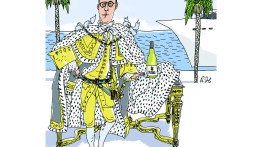
I am part of an informal reading group with a few friends and colleagues. At the moment, we are reading Herodotus’s Histories (or “Inquiries,” as he might have said had he been writing in English). It’s lots of fun, in part because it is also an excuse to conduct a little wine appreciation class, but also because that old denizen of Halicarnassus — Herodotus lived from around 484 to 425 bc — was possessed of such high-octane and companionable curiosity about the world: what happened when and to whom and with what result. He wanted to know; moreover, he wanted you to know. Herodotus is most famously a major source of our knowledge of the Persian Wars and such signal moments as the Battle of Marathon (490 bc), Thermopylae (480) and Salamis (also 480).

Herodotus

Making a raclette

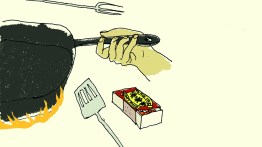
Cheese, potatoes, sausage and bacon for dinner? Let’s just throw in bread and heavy cream for the sake of it. Sounds like a recipe for a heart attack or stroke? Why do the Swiss and French then double up — or even triple up — on these carbs and calories when cold weather comes? The answer is easy and old; the combos are delicious, divine and de rigueur, filling the body’s need for cozy food and energy to shovel snow and ski. The French and Swiss still argue about which country invented raclette.

cheese raclette

The finest festive fizz

A dinner party without good conversation is like flat Champagne: pretty pointless. It’s like that not-so-funny joke about the inscription on an atheist’s tombstone: “All dressed up and nowhere to go.” Of course at a miserable dinner party you and your glad-rags have reached a destination of sorts, but (as for the late atheists) it’s not the one you were expecting. How to avoid such an infernal disappointment? Jean-Paul Sartre famously felt that hell was other people; all I can say is, that’s no attitude to bring to the table.

champagne

What’s good from the goose

One of the more curious habits of the British is their tendency to publish opinion polls in national newspapers about their own food habits. Which way round, for example, are you meant to dress your scone? Is it clotted cream first, then jam — or jam first and cream second? Well, the Queen does it jam first, so that must be the way. Or that other national debate, tea and then milk, or the opposite? When I first arrived in the UK thirteen years ago, I was amused to see how worked up the British get about such questions. Try asking them sometime and see what happens. A new poll reveals that 58 percent of the British public admit to preferring roast potatoes over turkey. “How could you?” we’re supposed to gasp. “Everyone knows Christmas dinner is about the turkey!

goose

I ate Audrey Hepburn’s kidneys

It was late November when Diana called, telling me her butcher would soon kill the “fatted calf.” Sharing a butchered calf once a year with a Swiss friend meant you both had a freezer-full of veal at half price. Being asked to share a calf was also a sign of a deep friendship — akin to using tu instead of vous and locking arms in a toast over shot glasses of white wine. Both could take ten years, which was about as long as I’d known Diana. I had long since gotten over what butchers did. I liked meat — most meat. But I didn’t want to see lots of blood. Growing up, I always asked my father for the outside slice of a roast or his charcoal-grilled steak. Now, I drew the line with rabbit. Rabbit is not normally on an American menu.

kidneys

Silky, sumptuous wines for Christmas dinner

I have had occasion to mention George Saintsbury’s classic, if quirky, Notes on a Wine-Cellar (1920) in this column before. Back then, it was to sample and swish about the mouth Saintsbury’s fondness — which I took to be a broader public fondness — for fortified wines like port, sherry, and Madeira. I suspect that most of my readers, except when listening to Flanders and Swann, rarely give Madeira a second thought. And although afternoons were made for sherry, they were made for other things too. As for vintage port, we are wheeling into the season — Thanksgiving through New Year’s — when it comes into its own and gladdens the hearts of many. I am certainly counting on it to gladden the hearts of the serious thinkers chez Kimball at Thanksgiving and Christmas this year.

chambertin

Drinking with James Bond

James Bond’s most impressive talent is not his prowess as a spy or his skills of seduction. It’s his ability to always get exactly what he wants at the bar. In the 1954 novel Live and Let Die he orders a round of Old Fashioneds while on a train to meet Felix Leiter, his CIA opposite number. Not only does the buffet car make them for Bond, they even have his preferred brand of bourbon, Old Grand-Dad. You try pulling that sort of thing on the Acela from Penn Station to DC. ‘Sorry Solitaire, they wouldn’t do us a cocktail, but I’ve got a cup of Lipton’s and a bag of pretzels.’ We’d all like to drink like Bond but, lacking his miraculous powers, we need to be in the right sort of bar to do it.

bond

In defense of the English original sandwich

Hannah Moore’s June Spectator piece on sandwiches made me hungry. Then it made me think. Ms Moore makes a sound distinction between modern Britain’s plastic-boxed, triangular ‘sandwich’ and the custom-made, piled-high, endlessly imitated, seldom-matched product of a good New York or Chicago delicatessen. Why, one wonders, do the Brits put up with it? Landing in countless foreign ports over the years, for business or pleasure, I’ve always wondered, pretty much before wondering about anything else, ‘What’s the food like?’ Almost always, I’ve liked what it was like. In the age of real borders and undiluted ethnicities, food was a powerful expression of locality.

sandwiches

Mums the word

In early October I bought three chrysanthemum plants to brighten my front doorstep during the gloomy days here in Montecito, California. The outdoor plant stand at Trader Joe’s, overflowing with a panoply of colored mums, reminded me how I love seeing French flair flourish when decorating with these seasonal blossoms. How, for a decade, I’ve been sharing and creating recipes with my daughter, a wine executive, with chrysanthemum flowers from her local organic épicerie and leaves discovered in a Burgundian marché. In Burgundy, as in the rest of France, mums are displayed for Toussaint (All Saints’ Day) on November 1, and for Armistice Day, to mark the end of World War One.

chrysanthemum

Two modest but delightful wines

According to Tennyson, ‘in the spring, a young man’s fancy lightly turns to thoughts of love’. Be that as it trochee, in the autumn a man of any legal age abandons rosé and moves on to Cabernet. If he is broadminded, he also makes a spot in his heart for Chablis, which I’ll come to in a moment. First, some anthropological, or perhaps I mean ethological, news. A friend recently passed along a slender but improving book called Wine: the Source of Civilization. Written by John J. Mahoney, a ‘certified wine educator’, it is full of edifying revelations. Right at the beginning, we have this bulletin: ‘Man did not settle from nomadic travels to build cities and civilization, and then develop wine.

wines

Condiments and conservatives

Years ago, an entrepreneurial friend had the idea of marketing ketchup with a catch, a jaunty political declaration. I say ‘many years ago’, and to give you a sense of just how ancient this ancient history is, contemplate that the ketchup was called ‘W’ and the ‘W’ stood for the personage that the followers of William Jefferson Clinton mean to disparage when they removed that letter from the computer keyboards in White House and other government offices just before the W in question — George W. Bush — took office.

people
burrata

Burrata inamorata

Wise men say only fools rush in. But in this particular instance, I really couldn’t help falling in love on the spot. Like a zillion others, the story starts on a night out. When my party, dripping with rain, arrived at the restaurant, our table wasn’t ready, and they ushered us to wait at the bar The bar was a happening kind of place. Instead of looking up at shelves of bottles and bartenders mixing drinks, it looked down onto the kitchen area, which was built around a giant wood fire over which five or six cooks labored frenetically. The flames blazed openly, fed from the picturesque log stack that lined the back wall of the dining area.

Bread is the staff of life

I cannot claim the gift of prophecy, but early in 2020 — before lockdown panic-buying and the warnings of a dire wheat harvest causing bread-price rises — I became a bread-maker. I dug around on the internet for a good recipe for sourdough, and found one padded out with the usual bloggery and waffle. Absent the philosophy and the pious musings, it gives a clear, sensible route to bread self-sufficiency. Sourdough doesn’t need bought-in yeast, only a ‘starter’ of flour and water. This is often called a ‘mother’, and attracts wild yeasts as it develops; after five days in the jar it is a gently bubbling ferment of living yeasts, and you keep it going by adding flour and water to it day by day.

bread
French

In search of lost French restaurants

Readers of a certain vintage will recall when any listing of fancy restaurants in a big city had a heavy French accent. Look at the ‘Let’s Eat Out’ section at the back of an old issue of Gourmet magazine from the 1970s for the evidence, at least for New York but, if memory serves, it was true for London as well. (The Italians probably ran second, then the Chinese, then a big falloff to other countries but still mostly European ones.) The way it worked at Gourmet — you got a listing if you bought an ad — only understated things. Lots of good places never advertised at all or simply did not aspire to the tony status that association with the likes of Gourmet conferred. Names like Le Chamberlin, La Caravelle, Le Chantilly, Mon Paris, announced their sole culinary allegiance.

Thoughts on dearly departed vintages

Some people, out at a nice restaurant, are shy about sending a bottle of wine back when there is something wrong with it. They shouldn’t be. Wine, as the vintners like to tell you when everything is going as it should, is a living thing. Like all living things, it is subject to a variety of unfortunate vicissitudes. We’ve probably all encountered ‘corked’ wine at one point or another — that taint caused by a smidgen of 2,4,6-trichloroanisole (TCA) or 2,4,6-tribromoanisole (TBA), which can be transferred from or through a cork. But wine is susceptible to other liabilities as well. One is the same liability that, sooner or later, affects us all: age.

wines

The American dream has no time for offal

You can get goat in parts of New England. Consumers of Portuguese origin create a market unparalleled elsewhere in the US. In Boston, as I recall, Savenor’s used to sell camel and kangaroo. Few meats are too un-American for New York City. Ottomanelli, purveyors to whatever is left of the Four Hundred, still has venison of the quality they sold to the Upper East Side in the Gilded Age. Los Paisanos in Brooklyn stocks alligator, turtle and caribou. But the great days of the 1950s, when a club in New York served porcupine, caribou, muskrat and armadillo, are fled. With the closing of the American mind has come the narrowing of American appetites. Americans’ self-image is of enterprise, pioneering, innovation, adventure and the call of the wild.

offal

Coffee with Coleen

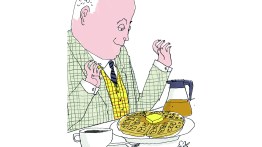
I’ve eaten a lot of breakfasts in my time — hell, it must be approaching 20,000 by now — and few if any have equaled those consumed at Coleen’s Kitchen on Main Street in the lived-in Erie Canal village of Brockport, New York. It takes a few minutes before you sense that there’s something not quite wrong about Coleen’s. Upon entering the restaurant you pour your own coffee at the beverage station. Maître d’ Coleen directs you to your seat. She hands you the extensive four-page menu, which warns that ‘you will be charged 59 cents if you ask what kind of bread I have’. Read it well and don’t waste Coleen’s time, you lazy bum! Waitress Coleen takes your order.

coleen

A taste of heresy

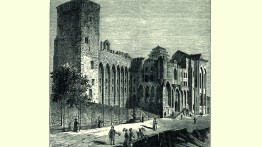
The weight of history — a seemingly infinite vista of incident — hangs heavy in the Languedoc in the South of France. The region (also called Occitania) is the place where people said ‘oc’ rather than ‘oui’ for ‘yes’ — langue d’oc instead of langue d’oïl. Gauls, Romans, Visigoths, Franks, Moors, Cathars: one by one they came, they pillaged or prayed, slaughtered or were slaughtered. A plaque in the Carcassonne cathedral reminds us that only yesterday St Dominic (1170-1221) preached there during Lent. A lot of nasty things have happened in Languedoc over the centuries. Perhaps that is one reason the people are so cheerful now. The area is also the biggest wine-producing region in France, which also contributes to the quota of cheerfulness.

languedoc
lobsters

Lessons from a lobsterman

Willard Nickerson was about as Cape Cod as you could get. Chatham locals even gave him the nickname ‘The Codfather’. Willard was a 12th-generation member of the Nickerson family, his ancestors having arrived on the Mayflower. He was also a Chatham lobsterman/fisherman and on July 4, 1976, Willard led the annual parade down Chatham’s Main Street in my father’s 1952 Woody car. My father was rightly proud to chauffeur one of the town’s most revered residents. Willard was not just a local treasure because of his profession, he also played the trombone during Chatham’s summer band concerts. If you happened to be a year-round resident, Willard would come and find leaks in your roof during a blustery nor’easter.

The culinary wisdom of charity cookbooks

Joy’s Toasted Parmesan Canapés: mix four tablespoons grated Parmesan cheese with half a cup of grated Swiss (or any other mild cheese that will melt), add mayonnaise enough to make a spread, season with salt and oregano or basil, spread on bite-sized rounds or squares of thin-sliced white bread, top with a slice of green olive (optional), broil until bubbly, serve immediately. Caveat, sophisticates: the ‘Parmesan’ likely as not was that pale yellow powder dispensed from the green Kraft cylinder, the Swiss was from Wisconsin, the mayonnaise was aka Miracle Whip Salad Dressing, the spices dried ones from the McCormick jar and the bread courtesy of Pepperidge Farm (if you were lucky). Not a whiff of anything cordon bleu or ‘artisanal’ here, the latter a term not yet dreamt-up c.

cookbooks