Features

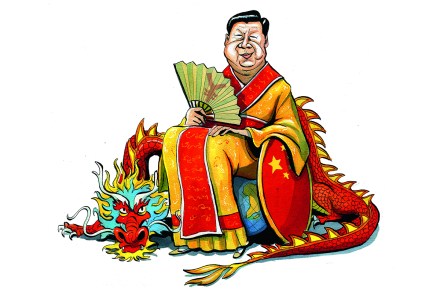
We need a Pompeo Plan to tame the dragon

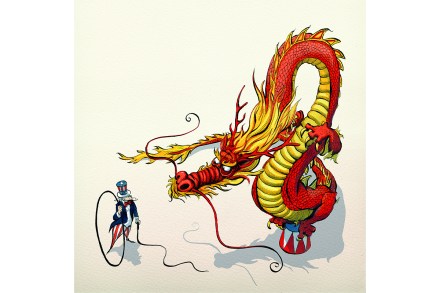
It is traditional that the serious statesperson should respond to a crisis such as COVID-19 by calling for a ‘new Marshall Plan’. The New York Democrat Chuck Schumer wants one for the domestic economy. The Texas Democrat Julián Castro wants one in Central America. A chorus of European leaders, some of them democratically elected, wants one for the European Union. It is only a matter of time before the Trump administration wants one too, but on its own terms, in order to counter the threat of China. Call it Marshall’s Law. Between 1948 and 1951, the Marshall Plan or European Recovery Program (ERP) transferred $12 billion (c. $130 billion in today’s money) to western Europe, most of it to Britain, France and Germany.
marshall plan

Putin needs Xi more than China needs Russia

On May 9, Vladimir Putin had been due to review a parade of troops and military hardware on Red Square alongside Xi Jinping and Emmanuel Macron. Russia’s coronavirus lockdown forced Putin to cancel the elaborate celebrations of the 75th anniversary of the end of World War Two in Europe — as well as to postpone a national referendum that would have extended his personal rule until 2036. But though Putin and Xi have been deprived of the opportunity to make a show of solidarity amid the sea of Soviet flags that bedecks Moscow annually for Victory Day, the coronavirus crisis promises to throw Russia and China closer together than they have ever been. China needs friends; Russia needs money.

putin xi

Xi’s useful idiots against free speech

On December 30, Ai Fen, director of the emergency department at Wuhan Central Hospital, got the lab results back about one of her patients who had a flulike illness. The words she read on the report made her blood run cold: ‘Sars coronavirus’. She circled the word ‘Sars’, took a photo and emailed it to a doctor at a neighboring hospital. Within hours, the photo had been sent to dozens of people in the Wuhan medical community. One of them sent a series of messages to a private group on WeChat, advising his colleagues to take precautions, and someone took screenshots of those messages and shared them more widely.

useful idiots

Rebuilding #MeToo

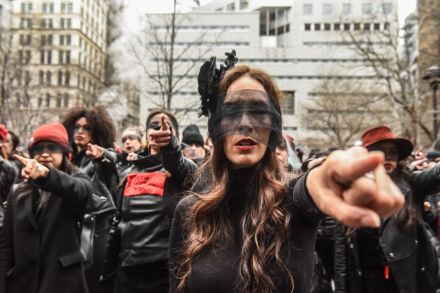
When Tarana Burke started the original Me Too movement in 2006, it was about the victims. It was about power in numbers and emboldening survivors of sexual assault to come out of the shadows. When the allegations about Harvey Weinstein broke in 2017 and #MeToo really started gaining traction, I was happy to see the purging of predators across all industries and political parties. #MeToo was a bipartisan movement that was long overdue. After a few questionable high-profile accusations, such as the hit piece against the comedian Aziz Ansari on the now-defunct website babe.net, lots of voices started to ask if #MeToo had gone too far.

metoo
globalization

A new balance

It is already commonplace to say that coronavirus has brought the age of globalization to a shuddering halt. How silly it suddenly seems for production to be held up at a factory in Ohio for want of a 50-cent part normally imported from China. Months after the first COVID-19 deaths in America, we are still waiting for urgently needed Chinese medical supplies. Americans are going without pork or beef, but Chinese-owned US meat processing plants are exporting carcasses to China. Something seems to have gone wrong with almost everything. The global supply chain has us in domestic and strategic knots. As a result, the idea of national self-sufficiency, which had already been growing since the financial crisis of 2008, is suddenly in high fashion.

When money dies

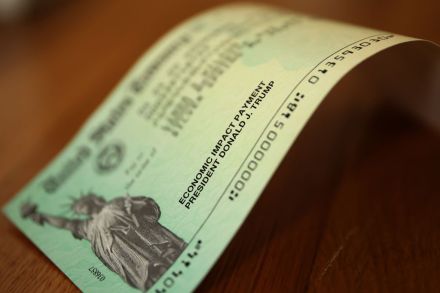
‘Money for Nothing’ is more than just the name of a Dire Straits hit from 35 years ago. Today it’s the guiding principle of an increasingly wide spectrum of American political thought. Andrew Yang built his campaign for the 2020 Democratic presidential nomination on a call for a universal basic income — a $1,000 monthly payout from the federal government to every adult in the country. When Congress in March fumbled for something grand to do in response to the coronavirus crisis, a consensus quickly settled on sending out $1,200 checks to most Americans. But free money isn’t just an emergency measure or a faddish idea from the left.

money stimulus

Him too: is Alec Klein a predator — or a victim?

Alec Klein has spent a lot of time on the telephone to people in jail. As a reporter, Klein investigated wrongful convictions and excessive sentences. He freed many unfairly incarcerated people. Then the tables turned. Today, Klein is a social and professional pariah. For more than two years, he has been effectively confined to his home after being accused of sexual harassment while working as the director of the Medill Justice Project at Northwestern University. Is he yet another victim of injustice? Klein took over the Medill Justice Project in 2011 after its founder, David Protess, was accused of fabricating evidence and manipulating a man into falsely confessing to a murder he didn’t commit.

alec klein

There are lies, damned lies and epidemiological models

I think it was Sir Charles Dilke who warned against ‘lies, damned lies, and statistics’. I live in a small, fairly isolated neighborhood of about 100 houses on the Connecticut side of Long Island Sound. Most of my neighbors seem to be trying out for the part of Prince Prospero in The Masque of the Red Death. Our neighborhood association issues frequent, increasingly shrill bulletins. Most appeal to the authority of the CDC, warning us and our children to stay at home, wear a mask and, should we dare to venture out, to keep at least six feet apart from one another. We are forbidden from congregating in public spaces. We are discouraged from socializing with friends inside.

overreaction lockdown ccp virus

What if a virus were ever used as a WMD?

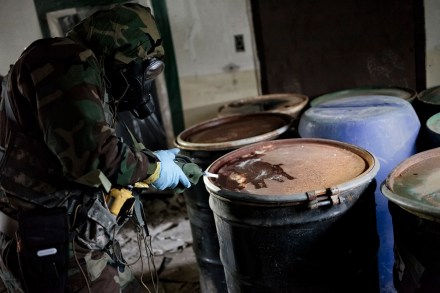
Faced with the coronavirus pandemic, Donald Trump declares ‘I’m a wartime president’, echoing George W. Bush after 9/11. For both men, the jaw-jutting self-flattery was absurd as both had been draft dodgers during the Vietnam war. W. used the family name and connections to secure a place in the Texas Air National Guard, Trump getting a draft deferment because of bad feet (a condition that was never so debilitating as to slow down his golf game). 9/11 did produce two real wars, in Afghanistan and Iraq, so W. had some claim to the title. But should we really be talking about a war against a virus? It’s a strange kind of war that drafts you to stay at home playing Xbox and watching the shopping channel from your couch.

wmd virus

After the lockdown, the breakdown

We are told that ‘we’re in this together’ by people who can afford to wait out the epidemic in the way the aristocrats of old retreated to their estates when the plague arrived in the city. It is more accurate to say that we are, as this edition’s cover puts it, ‘together, alone’. The coronavirus has revealed that people today can live in ‘connected solitude’, as Sam Leith describes. It has never been easier to retreat from society if you have the money. But it has never been more vital to sustain real-world connections. We may feel atomized but the truth is we can no more insulate ourselves entirely from other people than we can from the economic effects of an unprecedented shutdown.

breakdown lockdown

Who will win the corona wars?

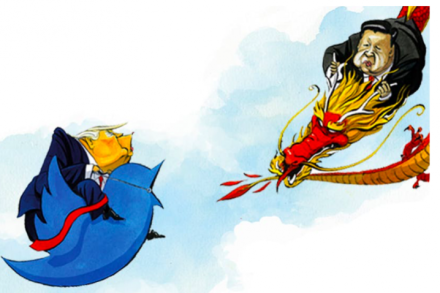
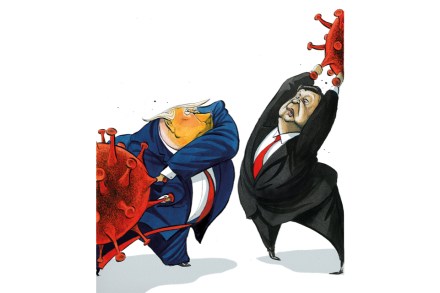
The COVID-19 pandemic came along just as Cold War Two was getting under way between the United States and the People’s Republic of China — the superpowers of our time — with the European Union and a good many other US allies quietly hoping to be non-aligned. Far from propelling Beijing and Washington towards détente in the face of a common enemy, the new plague has only intensified the Cold War. For the first time, China’s campaign of disinformation has been on a Russian level, with wild anti-American conspiracy theories being disseminated by senior Foreign Ministry officials.

corona wars

Sovereignty rules

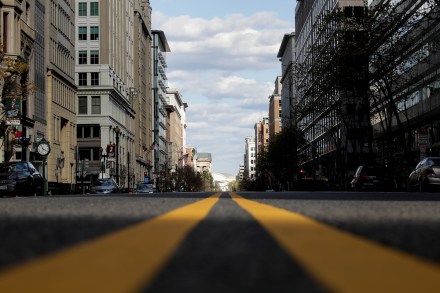
Washington, DC At the end of March, about two weeks into the coronavirus emergency, I looked out my window onto the street below and saw something that made me uneasy about the future of the country. There was a commotion down there. Two white teenagers were standing in the street with their hands up. A man — who looked and sounded like an East African immigrant — had stopped his car in the middle of the road and sprung out. I squinted to see what it was he was holding in front of him that made the kids look so alarmed. It was a pizza. The kids had ordered it. The car was marked with a Domino’s insignia. ‘Whoa, whoa, man!’ said one of the kids. ‘Take it easy!’ He was grotesquely corpulent.

sovereignty

Giving up Twitter for Lent went well

It’s Lent and the good Catholic schoolgirl in me loves this season of fasting and rending the heart and not my garments and all that jazz, so I dug deep and asked myself the hard question: what would be the most challenging thing in my life to give up? Since I’ve already given up heroin, cocaine, alcohol, weed, cigarettes and toxic men, two primary substance addictions remain: coffee and Twitter. If I’m honest with myself, Twitter is the most hardcore addiction I have and it’s also the one that robs me of the most productivity. So. Into the media desert I go...I rip the Band-Aid off around 5 p.m. PST on Tuesday, logging out from my account and removing the app from my phone. Goodbye, my love. Day 1: Holy Moly. I have a problem. 6 a.m. PST: Ash Wednesday.

fatwa twitter

Right on: Boris Johnson’s Britain and the new political reality

Political realignments occur when large groups of voters desert one party for one or more other parties, shattering old coalitions and forming new ones. In America and northern Europe, working-class voters — mostly, but not exclusively, native and white — have been leaving established left-of-center parties. On their way out, they have met college-educated metropolitan professionals and managers migrating the other way. Center-left parties have exchanged the industrial workers who were once their core constituency for a new upscale clientele. The emerging center-left is supported by the college-credentialed middle classes, native minorities and immigrant diasporas.

boris johnson right neoliberalism
foreign policy

Foreign policy is in a straitjacket

Before the world went into quarantine, I had the chance to take part in a small way in some interesting discussions about the present and future of US foreign policy. Some of these involved Trump administration officials and think-tank honchos; others brought together US and European diplomats and scholars. Chatham House rules were in effect, but identifying who said what is less important than giving a sense of how hard it is for conversations on these topics to break out of old habits of thought and ideological preconceptions. The academics and policy minds of America’s most respectable think tanks, for example, still assume that the most morally edifying solution to a world problem is also the most practically effective one.

Constrained by freedom: what do post-liberals want?

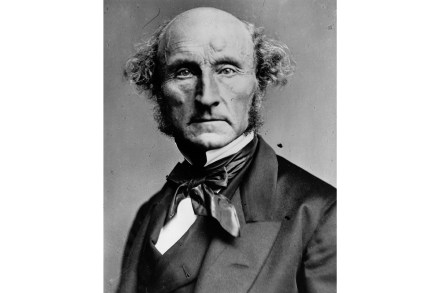
Any attempt to expound post-liberalism must begin by taking a view of what liberalism is. And liberalism can be viewed as a philosophy that enshrines freedom as its foundational principle. Freedom from what, though? That is a moving target. The pioneers of liberalism, whether they be John Locke or the Founding Fathers, wanted to be free from the tyranny of the minority, that is, from power exercised arbitrarily by a political sovereign. Two hundred years later, following J.S. Mill’s disdain for the craven conformism of late-Victorian social mores, liberals realized they wanted to be free from an empowered majority. That is, even if a majority want democratically to decide gambling should be made illegal, for liberals the practice should remain legal as long as one gambler remains.

post-liberals

After liberalism

We’re entering the post-liberal moment. From Trump to Brexit, Ireland to Brazil, we’ve seen a number of revolts at the ballot box that point to a mass vote of no-confidence in the economic and cultural status quo — in other words, in 21st-century liberalism. The liberals aren’t taking it lying down. They’re doing their best to define post-liberalism in language they are most comfortable with, calling it ‘fascist’ or ‘communist’ — and sometimes the criticism is spot-on. But other times it is wholly inaccurate. One of the glaring paradoxes of the post-liberal moment is that many of the people involved in it want to rescue liberalism from itself.

liberalism post-liberal

America is socialist, dummy

It’s widely agreed that Bernie Sanders fell short in the Democratic primary because he described himself as a socialist. As a movement, socialism has never had mass appeal in America. Even at its strongest, in 1912, it garnered fewer than one million votes for presidential candidate Eugene Debs, who was trounced by Woodrow Wilson. More often, Americans have used the word ‘socialism’ as a synonym for communism, to signify everything America doesn’t stand for. Pundits put Sanders’s failure down to his attempts to give the word a positive spin. On the other hand, a dispassionate glance at American history shows that Uncle Sam has already gone a long way down the road of democratic socialism.

socialist

The weak response to coronavirus is a symptom of the decay of the liberal state

If COVID-19 spreads in the United States as it has spread elsewhere, then quite soon the virus will be established within the general population. The federal response will have changed from containing isolated ‘hot spots’ to managing a national epidemic. ‘Social distancing’ and self-quarantining will be endemic, hospitals will be overloaded and the economy will have continued to contract. This could test not just the American people — their social bonds, their sense of collective fate — but also America’s government and institutions. That testing will be far more demanding than the ‘stress tests’ faced by the banks after the financial crisis of 2007-08. America’s resolve will be challenged again. This should not be a time for petty politicking.

coronavirus state liberalism

Impeachment: the verdict of history

This article is in The Spectator’s March 2020 US edition. Subscribe here.Spring term, 2170. Professor Hankins assigns an English translation from the 22nd century’s most authoritative historical survey, The Beijing Universal History. This week’s course reading is from Volume VIII: The Far Western Hemisphere — North Central American Province. Chapter 33 The Era of Impeachment, 2020-52 At this time the North Central American province was still independent and under the system of governance known as ‘liberal democracy’, described in Chapter 29.

impeachment