Features

The afterlife of Christopher Hitchens

In 2011, a terminally ill Christopher Hitchens faced death with droll stoicism: “To the dumb question ‘Why me?’ the cosmos barely bothers to return the reply: ‘Why not?’” he wrote. As his health declined and the end drew nearer, the skeptical Hitchens stuck to his atheist guns, clear-eyed in his confidence that death was final. Hitchens died in 2011, but his work and reputation live on. No paradox there, of course, but just how large Hitchens looms twelve years after his death would surely have surprised even this immodest author. It’s certainly a surprise to me, a reformed Hitchens fanboy. The face of twenty-first-century atheism is having quite the afterlife.

Hitchens
influencer

Has the influencer bubble burst?

If you ask anybody under twenty about their life plan, social media will likely play some part in the answer. A friend’s nine-year-old son has just launched his own YouTube channel. My prepubescent cousins are telling their parents that TikTok is “the key to financial freedom.” When I was their age, my entrepreneurial skills went as far as selling single cigarettes to my classmates for loose change. The appeal of the influencer life isn’t hard to understand. Over the last decade, it’s been touted as the sexy, well-paid, democratic career of the future. A 2019 Morning Consult survey found that one in ten young people consider themselves “influencers.” But now these micro-celebrities are trading in their tripods and ring-lights for real jobs.

Make tech great again

Mark Zuckerberg has dubbed 2023 Meta’s “year of efficiency.” The slogan is a corporate euphemism for layoffs, of course — and not an especially subtle one. Zuckerberg’s company has parted ways with tens of thousands of employees this year. Other tech firms are following suit. Crunchbase estimates that US tech firms fired more than 118,000 employees in the first quarter of 2023. These are lean times in Silicon Valley — and, as Joel Kotkin explains in this month’s cover story, there is more to this tale than Big Tech belt-tightening after a pandemic-era hiring spree. The Valley, Kotkin explains, is in trouble. A place that America, and the world, once looked to for an ambitious and optimistic vision of the future, has grown sclerotic.

tech

I was injured covering Ukraine — but I’ll work my way back

A little over a year ago, I was gravely injured in a missile blast while covering the Ukraine-Russia war for Fox News. The severity of my injuries has made recovery a very long and arduous process. Every day I have a number of things I have to do. So in the morning, I’ve got about an hour and a half or so of facing all the problems that have popped up overnight. I do a lot of exercises, a lot of stretches. I do a lot of balance work. Everything from using rubber bands to try and get my thumb to move a little bit more to taking care of my burns because if I don’t, they break open and bleed a lot. I do that every single day. The list is honestly endless, and the beginning of every day is tough. I tell myself that the worst part of the day is finished in the morning, which is great.

recovery

Charles III is fighting for the monarchy’s life

On September 10, 1946, British foreign secretary Ernest Bevin remarked, “kings are pretty cheap these days.” His comment was directed at the displaced monarchs who floated, dispossessed, around Europe, but it might also have been a dig at the ailing king George VI, who had found his métier in wartime but struggled to regain it afterwards. Less than six years after Bevin’s comment, the king died and Elizabeth II assumed the throne, leading to an unprecedented period of monarchical duration, stability and popularity. Yet after her own death last September, at the age of ninety-six, and the subsequent accession of her son, Bevin’s statement has assumed new and unlooked-for relevance.

Charles

A lament for the Los Angeles we lost — and why I’m off

Like so many wannabe actors before me, I came to this gritty city with big dreams of “making it” in Tinseltown. I thought I wanted to be an actress until I got here and realized that driving around begging casting directors for approval wasn’t for me. Nonetheless, I stayed in Los Angeles — and over the last sixteen years, this big, messy, giant suburban sprawl has become a part of me. My husband and I have agonized over the decision of whether to stay or go. Making a cost-benefit analysis — like whether to stay near family in perfect weather or go where we can provide a better quality of life for our daughter in a place with unbearable heat — has felt like trying to solve an impossible math equation.

Los Angeles

Why Ron DeSantis should wait for 2028

Maybe Niccolò Machiavelli was not the first political consultant, but he remains one of the best. Ron DeSantis might solicit his advice before deciding whether a 2024 campaign for the White House is wise. DeSantis could start with the penultimate chapter of The Prince, “What Fortune can do in human affairs, and how it can be resisted,” which is famous for its imagery. Machiavelli first likens fortune to a raging river, whose flood cannot be met head on but whose fury can be dissipated by dams and dykes built in advance. Later he says Fortune is a woman who yields to a young man who comes on strong, even roughly. The lesson for a forty-four-year-old DeSantis is obvious: seize the moment. She’s yours for the taking — if you’re bold.

metaverse

Good riddance to the metaverse

So pack it all in then. Away with the wisecracking butterfly that sits on your shoulder during work meetings. Out with the Gamorrean Guards who play Texas Hold’em with you around a floating table. The metaverse, Mark Zuckerberg’s fever dream of a virtual-reality infused world, is dead. That’s assuming it was ever alive and kicking in the first place. To assess just how “real” the metaverse ever was, we need to go back to its inception in the fall of 2021. That was when Zuckerberg released a video of himself in suspiciously Steve Jobs-esque garb — black shirt and pants, sneakers — tooling around what he called a “home space” that brimmed with holographic bric-a-brac.

wawa

Inside Pennsylvania’s gas station wars

Travelers road-tripping across Pennsylvania this summer, take heed: a war is brewing in the center of the state. Buildings have been flattened. Families have been torn apart. The threat of an emerging third power regularly captures headlines and fuels the local rumor mills. I am referring to the competition among three gas stations-cum-convenience megastores — Sheetz, Rutter’s and Wawa. It is said to be the “most heated food rivalry in the country.” Food? A lot of what these places pass off as “food” is up there with the cosmic chicken sponge found at airports. Nonetheless, the rivalry is real. It’s palpable. It’s all-American. And as for the rural places benefiting from this capitalism, as the kids like to say, we’re here for it.

Neumann

Inside the unlikely return of WeWork’s Adam Neumann

Imagine for a moment you are Adam Neumann, the slick, smooth-talking Israeli-born entrepreneur who took the world by storm thirteen years ago with WeWork, his ultimately failed effort to rethink the way we office. After your start up took a tumble and your IPO failed, you nonetheless walk away with roughly $600 million in cash, plus another $400 million loan, and a new lease on life. You head underground, lick your wounds and claim to be trying to learn from what went wrong, including the relentless overhyping, the mismanagement and the enormous losses that your investors suffered. When you re-emerge, you decide to start again and persuade one of Silicon Valley’s most respected investors to back you. Whoa.

america

Is it too late to save America?

Regular readers may recall how fond I am of a mot from the British diplomat, author and art collector Edgar Vincent, the first (and, as it happened, the last) Viscount d’Abernon: “An Englishman’s mind works best when it is almost too late.” When I first encountered Lord D’Abernon’s saying, I was impressed by its slightly disabused cheerfulness. “Whew,” I thought. “As usual, some impending disaster was neatly avoided at the last moment by the wit and pluck of the doughty Brits.” The drama of the near-escape added to the sweetness of relief. Surely we Yankees — most of whom, until recently, were basically displaced Brits — could also be counted on to display the requisite derring-do at the critical moment. Could we though? “Almost too late.

woke

Why ‘woke’ doesn’t have the moral high ground

The much-overused word “woke” — basically meaning to be at all moments of the day and night conscious of racial and sexual discrimination — has been remarkably resistant to criticism, reason and even ridicule. Ever since the initial exposure and denunciation of Harvey Weinstein in 2017 — a long-drawn-out prosecution and sentencing only recently concluded — the “wokes” have paraded their righteousness in every corner of society with very little pushback. Occasionally, a super baddie such as Bill Cosby gets released from prison on constitutional grounds, but super-wokes in the United States never let such minor reversals slow them down, since the public momentum and the arguments are overwhelmingly in their favor.

The New Right is going nowhere — and knows it

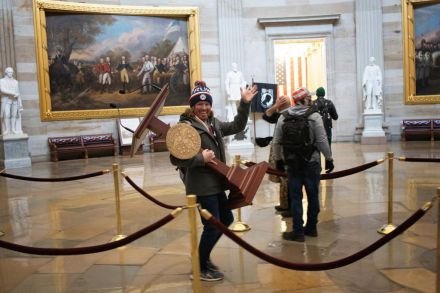
It is an irony of history that the bronze Statue of Freedom which stands tall atop the US Capitol dome was commissioned by the man who would seek to break the nation apart a few years later. Jefferson Davis, secretary of war when the statue was ordered, clashed with Yankee sculptor Thomas Crawford over his original design, which included a liberty cap, the symbol of an emancipated slave, above the statue’s crown. The statue is adorned with a sword, a shield and a wreath of victory. It’s symbolic in other ways as well: struck hundreds of times by lightning, it conducts and dissipates that violent energy into the earth. Freedom makes an excellent lightning rod. Today, critiques of the statue and what it represents arise from different sources.

university college

Will US colleges’ brand power survive falling standards?

Nike. Supreme. Ralph Lauren. Abercrombie and Fitch. Harvard and Yale. On the streets of Budapest, style-conscious teenagers have collapsed the distinction between the Ivy League and streetwear. Maybe Americans still balk at wearing the logo of schools they didn’t get into, but the market for collegiate apparel in Eastern Europe is not limited to alumni, students and ambitious high-schoolers. Even kids with no interest in (or chance of) going to Harvard are drawn by the power of its name. Meanwhile, American higher education is being convulsed by a social-justice revolution that upends the basis of these schools’ claims to exclusivity.

A woman for all seasons

One of the things I love most about living in Pennsylvania is experiencing all four seasons. They are pronounced, and regardless of how long you’ve lived there, the changes in weather are always remarkable. People comment on the weather constantly, as if the four things it might be doing outside — being warm, cold, wet or dry — are novel any old day. Whether these remarks are upbeat or grumbly seems to depend on one’s age and if snow is more likely to result in a day off school or a bout of rheumatism. For me, though, a change in the seasons — any season — is a sentimental event. It’s as if nature is poignantly reminding me that time is passing. A late February warm spell this year inspired me to do some spring cleaning.

seasons

A history lesson for Joe Biden

Some moderately clever people, reflecting on the confusing morass of current events, knowingly quote George Santayana’s most famous observation: that those who cannot remember the past are condemned to repeat it. Since the past is largely an almanac of unfortunate (not to say horrific) events, the idea that we are “condemned to repeat it” concentrates the mind in approximately the way Dr. Johnson said the prospect of hanging in a fortnight tends to do. But of course the past never really repeats itself. When it comes to history, Heraclitus rules: you cannot step into the same river twice, mon brave. Moreover, as that sage of Ionia said, “the true nature of things loves to conceal itself.

Vladimir Putin

Did Ernest Hemingway have CTE?

It was July 2, 1961. Ernest Hemingway was three weeks shy of his sixty-second birthday. He had been living comfortably in a cabin in Ketchum, Idaho, with his fourth wife, Mary. He liked it there. He liked the hunting and fishing and the clean air. Still he had a plan. That morning he padded to the basement in his pajamas and bathrobe. He unlocked the gun closet. He selected a favorite shotgun, a double-barreled twelve-gauge. He put a shell in each barrel. He put the muzzle of the gun in his mouth. Why pull the trigger now, after so many years of defying death? Eight months earlier he had checked into the Mayo Clinic as “George Saviers,” the name of his elderly doctor in Ketchum.

hemingway
taleb

Nassim Nicholas Taleb, the anti-confidence man

Dealing with the writer, statistician, Twitter warrior and self-described flâneur Nassim Nicholas Taleb is no simple matter. First there was the initial approach, months ago. I ventured to email him and ask for an interview despite his long-held and often-expressed low opinion of journalists. (Heuristic: those who make the biggest deal out of disliking the media care about it the most.) To my surprise, Taleb agreed to it almost immediately even though he “doesn’t do interviews.” Some logistical back and forth ensued. Then a twist: he would only agree to be interviewed if he wasn’t photographed. Why? Because in photos he is “made to look sickly and weak.