And Finally

‘Life, Liberty and the pursuit of Happiness’ is genius marketing

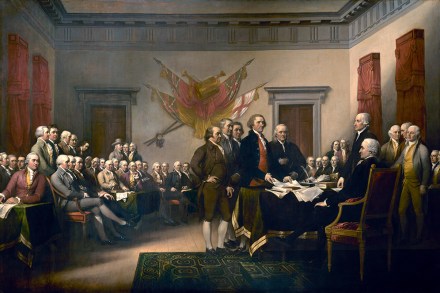
I recently delivered a speech to mark the 250th anniversary of Adam Smith’s second-best book: An Inquiry into the Nature and Causes of the Wealth of Nations. The year 1776 was a momentous one for many reasons. It saw the installation of James Watt’s first steam engine, the recognition of Captain Cook by the Royal Society for his work in preventing scurvy and his departure on his final and ultimately fatal voyage. It witnessed the publication of Edward Gibbon’s The Decline and Fall of the Roman Empire and Common Sense by Thomas Paine.
Why my mustache had to go

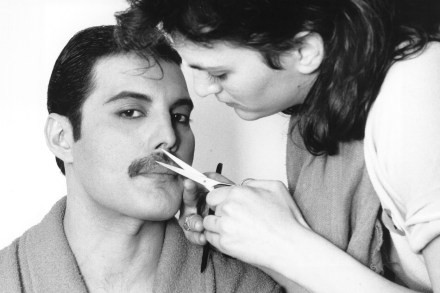
I loved my mustache. Unfortunately, my fondness for it seemed inversely proportionate to its popularity among my peers. After much unsolicited feedback from friends ("You look like a young Peter Mandelson") and online strangers ("You look like a 1970s porn star"), I put a poll on my Instagram asking my followers whether or not I should scrap it. Four-fifths said I should. After a brief consideration of my options (ignore the results? Rerun the vote? My mustache was making me think like a Latin American dictator), I reluctantly shaved. God how I miss it. There is something intoxicating about a mustache – a small hedgerow on his top lip can convince even the dowdiest man that he looks like a Battle of Britain pilot.

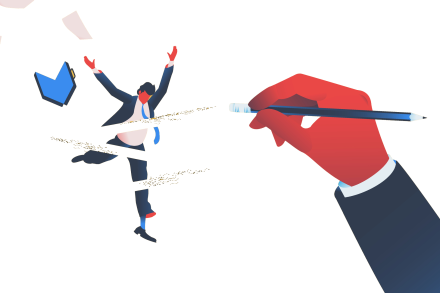
Dear Mary: how can I stop people pitying me for being made redundant?

Q. I have just got off a nine-hour overnight flight from Miami to Heathrow. I was in premium economy in the middle of the plane, an Airbus A330, sitting in the left aisle seat of a middle row of three. Beside me was another man and on his right, also in an aisle seat, was his wife. He made several trips to the loo during the night, and each time he chose to climb over and wake me up rather than disturbing his wife and using the other aisle. I just didn’t have the nerve to start something up with him about it, but now I wish I had. How could I have dealt with it? – R.H., London SW3 A. You might have switched to woke mode and told a member of the crew that this fellow passenger had rubbed against you inappropriately and you feel violated.

people

Does The Spectator hate the Welsh?

This St. David’s Day weekend, I devote this column to a celebration of the world’s most under-appreciated ethnic group. Under-appreciated, certainly, in the pages of The Spectator, whose editorial policy suffers from a Pictish delusion that its readers are eager to hear of the appointment of a new procurator fiscal in Ayrshire, or political divides on Pitlochry council, while having zero interest in the finer country to the west. Sometimes mere exposure to Wales may be enough to inspire greatness, as in the work of Alfred Russel Wallace or Led Zeppelin Now in celebrating Wales, we need some ground rules. Since the Welsh are much more agreeable than other Celtic tribes, they are widely content to have sex with people from other cultures and ethnicities.

welsh

‘Both things can be true’: The creep of an annoying cliché

‘It’s lunchtime and it’s raining. Both things can be true at the same time,’ said my husband, putting on the face that makes him look like John Betjeman on a windy day. The use of this gnomic formula has grown so popular that not many minutes go by without encountering it. Danny Fortson, in the Sunday Times, wrote: ‘If the question is “is AI ‘real’ or a bubble?”, the answer is “yes”. Both can be true.’ A leading article in the Times observed that ‘violent crime has dropped to historic lows, yet a rise in antisocial behavior has made many Londoners feel less safe. Both phenomena can be true at the same time.

wood yoga

Why I’m a proud Zionist

The bomb shelter reserved for ‘volunteers’ at Kibbutz Dafna near the town of Kiryat Shmona in northern Israel was definitely substandard. It was damp and smelly, more like a lavatory than a fortified bunker, and not considered fit for the kibbutzniks: a pampered species compared to us. But when the Soviet-built ordnance started raining down on us, it did its job. We emerged, unharmed, the following morning, blinking into the dawn light. The terrorists had not succeeded in hitting the kibbutz with a single Katyusha rocket. No, I’m not embedded with the Israel Defense Forces on the Lebanese border, although the area surrounding Kiryat Shmona was under fire from Hezbollah earlier this week. This was in 1981 and I was just 17.

Me, myself and the i

Misuse of myself "should be a capital offence," suggests Oliver Duff, the editor of the i Paper. "As reflexive pronouns, myself and yourself require a prior subject (I, you)," he says. I applaud the prospect of a general massacre of abusers of the English language, but by Mr. Duff’s criterion, Shakespeare and Richardson, Ruskin and the great lexicographer Samuel Johnson himself should have been slaughtered. Historically, myself began not as a reflexive pronoun but as an emphatic, and as an emphatic it is often still used. Other constructions allow it too. In a letter in 1782, Johnson wrote that "both Williams, and Desmoulins and myself are very sickly." There it is used as part of a compound subject.

myself

The horror of the male wig

Horrible injuries are commonplace in boxing but none, surely, has been quite so devastating as that sustained by the heavyweight Jarrell Miller. In the moment it took for an uppercut to land, the Brooklyn boxer’s life changed forever. Miller went from professional athlete to, well, "the man who got his wig punched off." I have rewatched Miller’s hairpiece getting punched off countless times, my hand clamped to my mouth. Why didn’t his team throw in the towel? Why didn’t the referee just stop the fight? Why didn’t Miller, his wig flipped up at 90 degrees like a kitchen trashcan lid, simply step out of the ring, exit the arena and start a new life several thousand miles away under an adopted identity?

wig

Do only bitches bitch?

‘How many letters?’ asked my husband, as though it were a crossword we were doing together. ‘Five,’ I replied. ‘Begins in b, ends in h.’ The clue, according to the Daily Telegraph, was that the head of Norfolk county council had told opponents not to ‘b---h and moan’. ‘Belch?’ asked my husband optimistically, adding at intervals, in exactly the same hopeful tone: ‘Blush? Birch? Bunch? Bleach?’ ‘Too many letters,’ I replied to the last suggestion. Obviously the intended word was bitch. But I wondered why it had to be blanked out. Is bitch taboo in every sense? Would it be blanked out in the Crufts sense of a female dog? The doublet ‘bitch and moan’ is quite common.

What Freud would say about Andrew Mountbatten-Windsor’s teddy bears

It is widely known that when a Duke of York is down, he is down, and the recent hit-piece in Heat – "'Pathetic' Andrew’s tantrums over prized teddy bears" – found a new way of kicking Andrew Mountbatten-Windsor. Its royal source said that "being forced to move [out of Royal Lodge] has sent him into a full-on meltdown because he keeps telling people the bears won’t cope with the change… as he says, it’s their home too." When it was reported last month that Andrew’s teddy bear collection was being sent to a south London storage facility, I was on the verge of feeling sorry for him; until I realized I was actually feeling sorry for the bears. There are no wonderful games to play in a lock-up. Of course I anthropomorphize teddy bears: that is what they are for.

‘Invalid’ has become invalid

“They should ask me. I’m a complete cripple,” said my husband, heaving himself from his chair with great determination to reach the whisky. Britain’s Department for Transport is asking disabled people whether the term invalid carriage in legislation should be changed and what term they might prefer was used instead. “Language has moved on and changed,” the UK government says, since 1970, when the legislation was first drafted. One problem is having to keep changing terminology. No one, even my husband, should be called a cripple. No one should be called handicapped. Now it has been decreed that no one should be called disabled, but rather a person with a disability. These changes are paralleled in the languages across Europe.

invalid

The politics of long hair

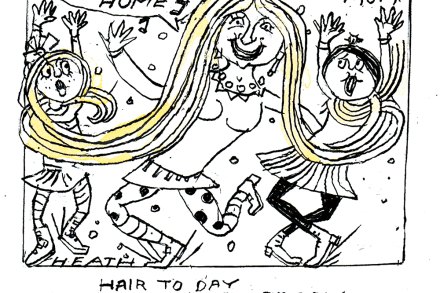
What is the literal cut-off point for women having very long hair (and by “long” I mean where it almost goes into the toilet bowl)? Thirty? Forty? Fifty? Try 65 – the age I turned this year. If this strikes you as grossly inappropriate, in theory I’m with you. The unspoken rule is that the older you get, the shorter your hair should be. Nobody within ten or even 20 years of me has hair as long as mine. What can I say? As with wearing inappropriately colored nail polish, it is just another small act of defiance women d’un certain age can employ to remind this cruel world that we do actually still exist. My hair has been this length for so long it has become a part of my identity: how I see myself in the universe. I am my hair and thus find it hard to imagine life without it.

If you’re ‘reaching out’, you sound deranged

“Why doesn’t anyone ever do what you ask them to?” inquired my husband, who is something of an expert on the question, I should have thought. He was referring specifically to a plea I made three years ago to people I’ve never met to stop sending emails that begin: “I am reaching out to you.” But it has grown worse. Using the expression makes it sound as though the emailer is deranged. Reach out has for more than a century meant “to offer sympathy, support or assistance” to people. Correlatively it can mean to seek those things. British Prime Minister Keir Starmer has acquired the habit of issuing a Christmas message. For 2025 he said: “At this time of the year, which celebrates love and abundance, loss or hardship can feel even more acute. Reach out.

invalid

Make mine a Moka pot

It’s strange the things that can trigger amity or affection. At the beginning of the capsule/pod coffee-maker craze, when George Clooney, with his come-to-bed eyes, was seducing the world with Nespresso machines, I bonded with my eldest daughter’s Italian boyfriend over the Bialetti Moka pot. Notwithstanding the expense and waste of the capsule coffee makers, I need at least three pods to get the lights on in my head in the morning. I’ve never had a good coffee from any of them. Contrast that with the cute, economical, environmentally friendly little Moka, the smallest of which – one cup – costs about $30 and, depending on the quality and freshness of the coffee used, makes a better cup than any café or restaurant.

What makes money ‘short?’

I heard on the wireless a reference to the growing number of small political parties getting funds from short money. I’m afraid I let it slide past me as one of the many things about money that I don’t understand. Short is an extremely productive element in English vocabulary. Short-haul journeys preceded by decades the invention of airplanes. The unlikely sounding shorthorn carrots have been with us since the 1830s. The Americans favor short hundredweights, which are only 100lb instead of the Imperial 112lb; worse, the standard ton is consequently a short ton of 2,000lb, a long way off the metric tonne, to which British tons approximate.

Scotland offers myths, legends and bespoke textile designs

As part of the planning for a retreat I’m organizing in May, I recently visited Scotland. I spent time near Edinburgh to learn more about the work of designer and weaver Araminta Campbell, whose approach reflects the connection between nature and clothing. Her atelier, set within a fairytale castle outside the city, is renowned for its team of skilled artisan handweavers who create bespoke textile designs. It is a place I have long admired, a magical world of tartan and tweed. As a model, you become attuned to the clothes you wear – how they shape your image and how others perceive you. But it took time for me to realize that the clothes themselves also shape the world. Eleven years ago, I became interested in the environment.

Down with exclamation points!

Punctuation is a gendered thing. I’ve been trying to stop myself overusing exclamation points and it’s been difficult. Exclamation points are girly because they’re a way of taking the sting out of what you say; they make any pronouncement seem more tentative, less serious. They’re the equivalent of a disarming smile, a marker that says: “No offense!” You add them to the end of a sentence to prevent anyone thinking you’re being bossy or critical. They’re an economical form of non-confrontation. Women use them far more than men. Almost 20 years ago, a study in the Journal of Computer-Mediated Communication found that women used nearly three-quarters of the exclamation marks in electronic messages, but it identified the tic as “markers of friendly interaction.

Punctuation

What’s so fresh about ‘fresh hell?’

“What fresh hell can this be?” Dorothy Parker would ask if the doorbell rang. Now fresh hell has been freshly added to the Oxford English Dictionary. But was Parker the onlie begetter of the phrase? The hunt has been on to find earlier examples. The OED quotes a ghostly story within The Pickwick Papers (1837) for a parallel: “He started on the entrance of the stranger, and rose feebly to his feet. ‘What now, what now?’ said the old man – “What fresh misery is this? What do you want here?’” I’ve been doing what counts, for me, as research. In The Pickwick Papers, Charles Dickens uses fresh twice as frequently as he does in Great Expectations 24 years later.

content potash survivor fresh hell

What’s so fresh about ‘fresh hell?’

“What fresh hell can this be?” Dorothy Parker would ask if the doorbell rang. Now fresh hell has been freshly added to the Oxford English Dictionary. But was Parker the onlie begetter of the phrase? The hunt has been on to find earlier examples. The OED quotes a ghostly story within The Pickwick Papers (1837) for a parallel: “He started on the entrance of the stranger, and rose feebly to his feet. ‘What now, what now?’ said the old man – “What fresh misery is this? What do you want here?’” I’ve been doing what counts, for me, as research. In The Pickwick Papers, Charles Dickens uses fresh twice as frequently as he does in Great Expectations 24 years later.

Cheers to corkscrews!

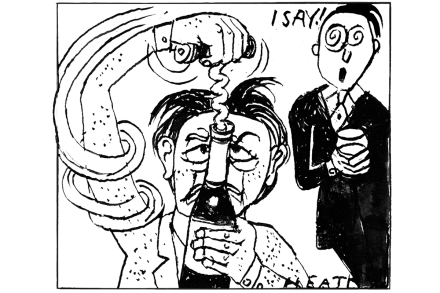
For the first 50 years of the corked bottle, there was no easy way to get into it. The combination of cork and a strong glass bottle came together around 1630, but the first mention of a device to open the bloody thing wasn’t until 1681. Cavalier get-togethers must have resembled the teenage parties I attended, with everyone desperately trying to open bottles using keys, pens, knives etc. Or using that technique where you bang the bottle against a wall with the heel of a shoe. Halcyon days. More likely the Cavaliers would have just taken the top off cleanly with a swift blow from a saber. Early devices for extracting corks were called “bottle screws.” According to wine writer Hugh Johnson, the word “corkscrew” was first used in 1720.

corkscrews