Theatre

Sado-erotic review

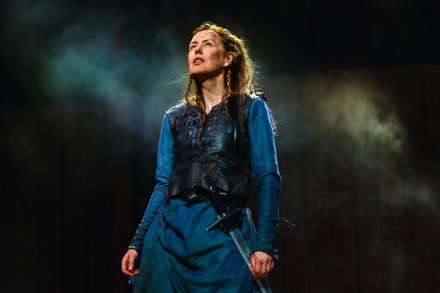
The Olivier describes Salomé by Yaël Farber as a ‘new’ play. Not quite. It premièred in Washington a couple of years ago. And I bet Farber was thrilled at the chance to direct this revival at the National’s biggest and best equipped stage. She approaches the Olivier’s effects department like a pyromaniac in a firework factory. She wants everything to go off at once. And it does. Goatherds yodel. Bells bong. Flutes warble. Birds parp. A revolving conveyor belt twirls spare actors around the stage in dizzy circles. Chord surges swell and fade on the soundtrack. Kneeling shepherdesses sift mounds of soap powder into mahogany salad bowls.

Killing time | 18 May 2017

Jez Butterworth’s new play The Ferryman is set in Armagh in 1981. Quinn, a former terrorist, has swapped the armed struggle for a farming career and now lives with his sick wife, their countless kids, his sister-in-law and her only son. But the IRA, who murdered his brother as punishment for his disloyalty, are due to pay a visit with unknown intentions. More violence, perhaps? Protection money? Or both. Well, neither, it turns out. They merely want Quinn to refrain from blaming his brother’s death on them. Rather a low price to ask. And yet Quinn is willing to defy them even though he knows they repay disobedience with murder, and he now has a dozen vulnerable dependents to protect. These plot elements don’t quite stack up.

Sins of the flesh | 11 May 2017

Obsession at the Barbican has a complicated provenance. The experimental Belgian director Ivo van Hove adapted the show from a Visconti film based on the novel The Postman Always Rings Twice. This version originated in Amsterdam and was rendered into English by a London playwright. The story mixes surrealism with torrid carnality. Sexy Hannah is married to nasty Joseph, who runs a failing hotel. Hunky Gino (Jude Law) seduces Hannah. Let’s elope, he suggests. No, says Hannah. Gino hangs around the hotel mending a truck engine parked by Joseph in the foyer. Gino gets the engine working and it soars upwards and hovers 30 feet in the air. But even with a miraculous levitating engine to attract the punters, the hotel remains empty.

Masonic bodge

Left-wing groupie Paul Mason has written a costume drama about the suppression of the Paris commune in 1871. We meet Louise Michel and her all-female gang of arsonists as they’re carted off to jail for setting fire to the Tuileries. After a harsh stint in the cells, they’re shipped out to the French colony of New Caledonia, in the eastern Pacific, where they live in an open prison. Things aren’t too bad. They mingle with the natives, enjoy the local hooch, and sing comradely songs about ‘spilling the blood impure’. Escape is on the agenda. A committee of anarchists is said to be making swift progress across the ocean in a rescue ship.

Pleasing pedantry

Christopher Hampton’s 1968 play The Philanthropist examines the romantic travails of Philip, a cerebral university philologist, forced to choose between his unexciting fiancée and a predatory seductress. The play’s opening scene contains one of the most brilliant comic shocks in all drama. And the paradoxes and flashes of Hamptonian wit are an everlasting treat. ‘I’m a man of no convictions,’ says Philip. ‘At least I think I am.’ The production, brilliantly directed by Simon Callow, is exquisite to look at. Libby Watson creates a stark white sitting room, with great pools of crimson carpet, enlivened by colourful rows of books that are harmonised carefully, but not obtrusively, with the overall palette.

Boozy bard

Even the Bard’s staunchest fans admit that ‘Shakespeare comedy’ may be an oxymoron. That’s the assumption of the touring company Shit-Faced Shakespeare, which produces the plays as adventures in boozy slapstick. The audience is encouraged to swig along too. I saw their hooch-assisted Much Ado. The colourful costumes looked a bit am-dram, perhaps deliberately, and the stage was decorated with cheap flapping drapes on which gargoyles, arches and other medieval devices had been painted. Enter a larky compère in puffy breeches carrying a horn. ‘PARP PARP’. He announced that a member of the cast had just consumed two beers and half a litre of gin in the dressing room. Which is quite a lot.

Law in action

It’s like Raging Bull. The great Scorsese movie asks if a professional boxer can exclude violence from his family life. Nina Raine’s new play Consent puts the same question to criminal barristers. We meet four lawyers engaged in cases of varying unpleasantness who like to share a drink after a long day in court. They gossip about the more horrific behaviour of their clients with frivolous and mocking detachment. But when their personal relationships start to falter under the strains of infidelity, they’re unable to relinquish their professional expertise, and their homes become legalistic battlefields. This sounds like a small discovery but Raine turns it into a grand canvas.

Kill the DJ

Don Juan in Soho rehashes an old Spanish yarn about a sexual glutton ruined by his appetite. Setting the story in modern London puts a strain on today’s play-goer, who tends to regard excessive promiscuity as a disease rather than a glamorous adventure. And the central character, a vulgar aristocrat named DJ who grades everyone on a scale of ‘fuckability’, contravenes the sentimental egalitarianism of our current sexual code. Writer Patrick Marber offers us a version of London where the social structure of the Regency still endures. Educated Englishmen are the only fully evolved human beings. Beneath them swarms an amusing underclass of thick, greedy motormouths from whom the Englishman must recruit his prostitutes and servants.

LA story

BREAKING NEWS: ‘Enjoyable play found at Royal Court.’ Generally, the Court likes to send its customers home feeling depressed, guilty, frightened or suicidal. And, generally, it succeeds. The Kid Stays in the Picture is based on the memoirs of Hollywood super-mogul Robert Evans. Director Simon McBurney uses artful lighting and complex staging effects to disguise the fact that this is just a glorified book-reading of the kind broadcast by Radio 4 every day of the week. The performers are concealed by deep shadows or behind screens and this threatens to break a basic rule of live theatre: an actor who can’t be seen can’t be heard. But the performers are audible enough and one of them, Danny Huston, has a wonderfully gnarled and leathery voice.

Royal prerogative

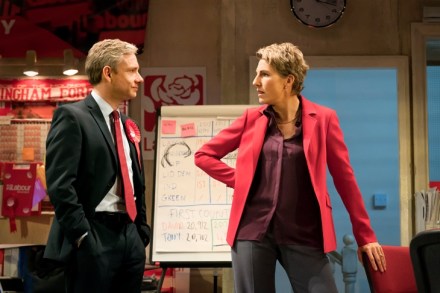
No one should complain that My Country; a work in progress is a grim night out. It’s rare for a good play to be written by royal command. The co-authors are the Queen’s personal minstrel, Carol Ann Duffy, and the director of her Royal National Theatre, Rufus Norris. These inspiring artistes have sent their vassals beyond the security of London to annotate ‘the words of people across the UK’ in the hope of understanding a humanitarian disaster: Brexit. The show makes its prejudices clear by dedicating the script to a Remain voter, Jo Cox, who was murdered by a Leave supporter. And it promotes the view, common among Remainers, that Brexit is a crisis caused by thick proles.

Ersatz erudition

Harry Potter, who uses the stage name Daniel Radcliffe, is a producer’s delight. By now it’s becoming clear that the four-eyed wizard lacks distinction as an actor. He’s not a comedian, certainly not a leading man or a heart-throb, and he hasn’t the ugliness or eccentricity to be a villain. But this Polyfilla quality means he can be dropped into anything without harming the fabric. His presence in Rosencrantz and Guildenstern Are Dead — a difficult and at times flimsy exhibition of varsity wit — is an insurance policy that will guarantee brisk business at the box office.

Changing of the Bard

Hamlet was probably written sometime between 1599 and 1602. The Almeida’s new version opens with a couple of security guards watching surveillance footage taken in a corridor. Well, of course it does. Nothing says ‘late medieval Denmark’ like closed-circuit television. Hamlet (Andrew Scott) appears. His black shirt and matching trousers suggest a snooker pro at the Crucible or a steward on a Virgin train. Scott is known as a ‘character actor’ (code for ‘baddie’) rather than a leading man.

All that jazz | 2 March 2017

It’s every impresario’s dream. Buy a little off-West End venue to try out stuff for fun. Andrew Lloyd Webber has snaffled up the St James Theatre (rebranded The Other Palace), which he intends to run as a warm-up track for new musicals. First off the blocks The Wild Party, a New York import set in the 1920s. We meet a couple of vaudeville veterans, Queenie and Burrs, whose romance has hit the rocks. To rekindle the flame they invite everyone they know around for a party. Hang on. A party? Booze, drugs, flirtation, seduction: the recipe for destroying a romance, not salvaging it. But never mind. The guests have started to arrive, direct from the Scott and Zelda Tribute Society. Everyone is talented, sophisticated and glamorously tragic.

Let’s talk about sex | 23 February 2017

What does it take to become a prostitute? Youth, beauty, courage, sexual allure, a love of money, a need for hard drugs, an addiction to risk? None of these, according to this fascinating show written and performed by London sex workers. What prostitutes need is the right mindset: humane, adaptable, tolerant, altruistic. Sex work is one of the caring professions. And it attracts operatives of any age, creed or physical configuration. An elegant 67-year-old rent boy explains, with touching humour, that his clients tend to be married men who just happen to be interested in fellatio. ‘Will you put your penis inside my body?’ a shy punter once asked him. ‘Yes, that’s more or less what I do.’ He works in the afternoons. In the mornings he has a cleaning job.

Stuffed but dissatisfied

Sandi Toksvig’s new play opens in a Gravesend care home where five grannies and a temporary nurse are threatened by rising floodwaters. In Act One the ladies prepare for a rescue party that fails to materialise. In Act Two they build a life raft out of plastic bottles. There’s a bizarre sequence involving a silly young burglar who gets beaten up and flung through a window by a woman of 71. The ending is more of a petering out than a conclusion. All the characters feel interchangeable apart from the nurse, who claims to come from Cheltenham. Her name, Hope Daly, prompts one of the old dears to quip. ‘My life in a nutshell.’ Later Hope admits, ‘I’m from Croydon, OK? I don’t tell people because I don’t need the pity.

Timeless and dated

Tennessee Williams’s breakthrough play is a portrait of his dysfunctional family. A young writer, Tom (Williams’s real name), lives with his effusively domineering mother and his painfully coy sister, Laura. Mother, once a famous beauty, gets Tom to find an eligible chap for Laura. Tough call. Beautiful Laura has a deformed ankle and she’s just flunked out of secretarial college after suffering the embarrassment of vomiting over her type-writer. She now pines away at home forming sterile friendships with a colony of animal statuettes lodged in a glass case. This set-up has the delicious simplicity of a comedy sketch. The conflict between the unstoppable mother and the self-effacing daughter promises fun galore.

Playing dead

It could be the nuttiest idea ever. The protagonist of this American musical is Death, who secretly reprieves a beautiful Italian princess, Grazia, and spends the weekend at her father’s palace where a house party is in full swing. The dad knows the gatecrasher’s identity. But Death introduces himself to the others as a suave Russian duke. All the womenfolk promptly fall in love with him, including Grazia, who sets out to bag the mysterious foreigner. Where can this strange plot go next? Nowhere. Once Grazia learns that Death has come to terminate her existence the story will end. So the script is padded out with additional entanglements between a sprawling crew of sub-personalities.

Amphibious assault

David Spicer’s farce Raising Martha opens with a skeleton being disinterred on a frog farm by animal-rights activists. They hope to force the frog farmer, an ageing dope fiend, to set his amphibious livestock free. Got all that? It’s complicated. And there’s more. The skeleton turns out to be the long-dead mother of the farmer, who alerts his shifty brother and calls in the cops as well. A loquacious twerp, Inspector Clout, arrives to investigate and the tangled narrative starts to unfold. This is an uneven play but the good bits are excellent. Stephen Boxer is amusingly deranged as the hallucinating frog man. The animal-rights activists are wittily portrayed as misanthropic nuisances.

Remembrance of things past

The Kite Runner, a novel by Khaled Hosseini, has sold more than 30 million copies worldwide. Now it arrives on the West End stage, a doggedly efficient piece that somehow lacks true dazzle. The narrative style involves thick wodges of plot being delivered at the audience like news bulletins on the half-hour. The emotional range is limited and the characters never challenge our expectations. The setting is Kabul in the 1970s. We meet nice Amir, a personable everyman, whose family have foreseen the rise of theocratic despotism and are plotting to escape. We hope they do. We’re attracted to Amir’s garrulous, whisky-drinking dad. ‘All crime is a form of theft,’ he philosophises. We find the psychotic street bully Assef utterly appalling.

Drama queen

God, what a dusty old chatterbox Schiller is. Like Bernard Shaw, he can’t put a character on stage without churning out endless screeds of cerebral rhetoric. But unlike Shaw, he has no sense of humour, nor any instinct for the quirks and grace notes that create a personality. Mary Stuart is a psychological drama with a single issue. How soon, and with what political consequences, can Elizabeth execute her treacherous cousin Mary? Schiller’s characters sound and feel identical: super-brainy, highly confident know-alls who treat each problem like a gang of Chancery briefs discussing a particularly knotty insolvency case. Director Robert Icke’s regimented production imposes high-street fashions on England in the 1560s.