Theatre

Seeing stars

The Best Man by Gore Vidal is set during a fictional American election in 1960. Two gifted candidates seek their party’s nomination. Secretary Russell is a chilly but experienced political hack whose marriage is a sham. Senator Cantwell, a more attractive character, is an impulsive charmer married to a blonde bombshell who adores him. The show feels dated but the acting, the costumes and the set designs capture the period nicely. The plot is perhaps short of pace and density. Each character has an embarrassing secret to hide. Secretary Russell suffered a mental breakdown a few years ago. Senator Cantwell enjoyed a bisexual fling in the army. The action turns on their ability to keep these details hush-hush.

Save the children

Fanny & Alexander opens like a Chekhov comedy and turns into an Ibsen tragedy. Ingmar Bergman’s movie script, adapted by Stephen Beresford, has been directed for the stage by Max Webster. The children, Fanny and Alexander, belong to the famous Ekdahl acting dynasty who live in Bohemian chaos. Their home is full of jokes and pranks and sophisticated merriment, and the family business is overseen by their grandmother (Penelope Wilton), who runs their theatrical affairs with a benignly imperious eye. Then disaster strikes. The kids’ father dies of a brain haemorrhage while rehearsing the Ghost in Hamlet. Their mother, Emilie, is comforted by the sinister Bishop Edvard who marries her and moves the children into his chilly episcopal palace.

Killer instinct

Frozen starts with a shrink having a panic attack. She hyperventilates into her hand-bag and then gets drunk on an aeroplane where she yells out, ‘We’re all going to die.’ She’s a bit loopy, clearly, which is how lazy playwrights make psychologists interesting. The shrink’s task is to examine Ralph, a serial murderer of children, and to deliver a lecture on the cause of his malignity. We hear bits from the lecture, bits of confession from Ralph, and weepy bits from the mother of one of Ralph’s victims. The subject is punishingly gruesome but its dramatic power is non-existent because the writer Bryony Lavery hasn’t learned how to stimulate the viewer’s imagination.

House rules | 22 February 2018

The Donmar’s new show, The York Realist, dates from 2001. The programme notes tell us that the playwright, Peter Gill, ‘is one of the most important and influential writers and directors of the past 30 years’. Who wrote that? Not Peter Gill, I hope. The play, directed by Robert Hastie, follows a gay affair between a strapping Yorkshire cowherd and a sensitive London artiste. They meet while rehearsing an am-dram production of a mystery play set in a ruined abbey. Gay men will enjoy this charmingly acted production but it’s apt to bore the general audience because the characters are trite, the gay theme feels antiquated and the storyline is as light as a Post-It note. It doesn’t help that Peter Gill writes like a newcomer at a creative writing weekend.

Torture in the stalls

It’s considered the great masterpiece of 20th-century American drama. Oh, come off it. Long Day’s Journey into Night is a waffle-festival that descends into a torture session. Who would choose to spend time with the Tyrone family? Dad is a skinflint millionaire. Mum is a wittering smack addict. They’ve produced two layabout sons. One is a dipsomaniac with a moustache; the other has TB and a cough. These doomed narcissists chase each other around the family mansion in a spiral of vicious, self-regarding gossip. It’s like being trapped in a broken cable-car with four prattling drunks who hate each other. And I’m not convinced they drink that much. A bottle and a half of whisky, or a little over, is consumed in the course of a day.

Changing the bard

Nicholas Hytner’s new show is a modern-dress Julius Caesar, heavily cut and played in the round. It runs for two hours, no interval. The action opens with the audience grouped around a central stage where a ramshackle rock gig descends into a riot. The play unfolds like an illegal rave at a warehouse. It’s bold, in its way, and some of it works. A couple of the Roman senators are played by actresses and the text has been bodged to suit the cult of gender neutrality. ‘Romans’ is substituted for ‘men’ in Mark Antony’s famous line, ‘so are they all, all honourable men’. This small change is curiously painful to hear. It turns the ominous finality of Shakespeare’s original into a tuneless clatter.

Drivel time

The NT’s new production, John, is by a youngish American playwright, Annie Baker. We Brits tend to assume that ‘john’ is American for ‘toilet’ so perhaps lavatorial treats are in store. The setting is a provincial hotel run by a blithering old dear whose only guests are two grumbling yuppies with marriage problems. The plot of a play usually starts within ten minutes but not here: nothing happens. That’s the point. Instead of a story there’s a minor predicament and this, oddly enough, suits the show’s personalities. The yuppies, Elias and Jenny, are just about memorable enough to be human beings but they haven’t the substance or grit for dramatic characters. Their personalities lack density or appetite.

The Pinter conundrum

The Birthday Party is among Pinter’s earliest and strangest works. It deconstructs the conventions of a repertory thriller but doesn’t bother to reassemble them. The setting is a derelict seaside town on the south coast. Petey, a thick deckchair attendant, runs a guest-house with his ageing wife, Meg. She’s a zero-IQ cook whose signature dish is a slice of white toast charred in fat. They have one resident, Stanley, a former pianist whom Meg cossets and mothers like a substitute son. Enter two London thugs, Goldberg and McCann, who invite Stanley to a party as a pretext to punish him for unknown misdemeanours. The whisky-soaked celebrations involve a game of blind man’s bluff during which Stanley’s glasses are smashed, rendering him sightless.

The price of success

A pattern emerges. A hot American playwright, dripping with prestigious awards, is honoured in London with a transfer of their best-known work. And it turns out to be all right. Not bad. Nothing special. The latest wunderkind to wow London is Amy Herzog (five plays performed, six awards received), whose marital bust-up drama Belleville is set in a glamorously derelict corner of Paris. Abby and Zack, both 28, are newlywed Americans trying to shore up the wreckage of their European gap year. Abby wanted to learn French but has stopped attending classes. Instead, she’s studying yoga although the lessons are regularly cancelled. And her acting career seems to have stalled.

Lost in space | 11 January 2018

The Twilight Zone, an American TV show from the early 1960s, reinvented the ghost story for the age of space exploration. Director Richard Jones has collaborated with Anne Washburn to turn several TV episodes into a single play. Eight episodes in all. Way too many. The structure is designed to bamboozle us from the start. Some of the storylines have been broken up and are placed episodically throughout the piece, while others are preserved as units and delivered whole. Even the most keen-eyed viewer gets flummoxed by this mystery.

Faking history

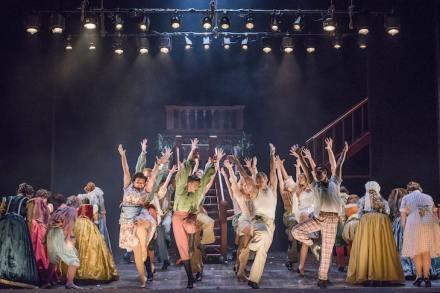
It’s all about the rhythm. Hamilton is a musical that tells the story of America’s foundation through the medium of rap. It sounds crazy but it works because the show’s arsenal of effects is simply overwhelming. The lyrics drive the narrative, the rap gives energy to the lyrics, and the dancers double the effect by adding a visual complement to the pulsing soundscape. Dramatic lighting, synchronised with the music, provides a final sensory flourish. It’s like being softly slapped across the face with a beautiful velvet glove. The set is a luxuriantly solid affair, like a five-star hotel inspired by Wild West themes. Two wooden staircases soar up towards a raised gallery draped with thick lassos.

Burning questions

A new play at the Bush with a catchy political title. Parliament Square introduces us to Kat, a young Scots mum, who abandons her baby girl and her devoted husband and commutes to London to kill herself. She doesn’t want to die but shrill voices in her head are urging her to turn her body into a human fireball on College Green, opposite parliament. Her political cause is unclear. Her personal hopes are plainly set out: death and posthumous fame. Everything is ready. Kat douses herself in unleaded petrol (it’s not a carbon-neutral protest), and as the flames engulf her flesh she emits a blood-curdler from her solar plexus. ‘The worst scream we’ve ever heard,’ says the stage direction, an aim that the production achieves with more success than one might wish.

Festive feast

Maximum Victoriana at the Old Vic for Matthew Warchus’s A Christmas Carol. Even before we reach our seats we’re accosted by bonneted wenches handing out mince pies. Merchants in top hats roam the aisles proffering satsumas, which they call, with accurate Victorian incorrectness, ‘oranges’. The guts of the theatre have been ripped out for this show. A slender catwalk stretches 40 yards from the rear of the stage to the farthest wall of the auditorium, with the seats gathered around this runway in odd little clumps. The narrow performing area leaves no room for scenery, so Dickens’s London is suggested by dozens of oblong lanterns dangling overhead, like mini-Tardises, all glowing amber, as if recently nuked. Then a soapy blizzard starts.

Dancing queen

Everybody’s Talking About Jamie opened at the Sheffield Crucible in February for a standard three-week run. The show is based on a BBC documentary, Jamie: Drag Queen at 16, about a working-class lad who attended his school prom in a scarlet frock. Director Jonathan Butterell saw the potential to create a replica Billy Elliot and he brought in two co-writers to turn the material into a comic musical. Word of mouth was excellent and the show received immediate offers for a West End transfer. The action starts in a Sheffield comp where a class of 16-year-olds are being given career advice by a computer. Blond misfit Jamie is encouraged to train as a forklift-truck driver. But he has other ideas. With his mum’s help he sets off in search of his inner self as a gender-fluid diva.

Net effect | 23 November 2017

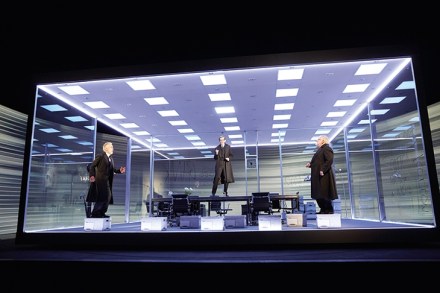
The inexplicable popularity of Ivo Van Hove continues. The director’s latest visit to the fairies involves an updated version of Network, a creaky and over-rated news satire from 1976. Van Hove appears to be unconstrained by thrift or self-discipline and he fills the Lyttelton stage with expensive clobber. It’s like a hangar full of half-tested prototypes. Centre, a TV studio featuring three cameras and an anchor man’s desk the size of a lifeboat. Behind it, a controller’s gallery with lots of TV monitors shielded by wobbly glass. Stage-rear, a vast flat-screen telly that relays the action as it happens but with an irritating quarter-second delay.

Faking it | 16 November 2017

David Mamet’s plays are tough to pull off because his dialogue lacks the predictable shapeliness of traditional dramatic speech. He prefers the sort of meandering, oblique, backtracking and self-deluding conversation you might overhear in a hotel dining-room. Glengarry Glen Ross opens in a restaurant, where a handful of realtors are discussing the perils and joys of their craft. The scene culminates in one of the landmarks of American drama. Top salesman Ricky approaches a potential customer in disguise and delivers a sales pitch that sounds like a poetic meditation on destiny and existence. It’s impossible to say what darkness this little masterpiece emerged from but Christian Slater (Ricky) captures all of it, abruptly and shockingly, with laser-like precision.

Country music | 9 November 2017

Americans may be able to draw on only 250 years of history, but they’re not shy of making a song and dance of it. In early December, Hamilton, Lin-Manuel Miranda’s $1 billion-grossing, hip-hop and show-tune extravaganza about one of the country’s founding fathers will finally open to sold-out crowds in London. It joins the Menier Chocolate Factory’s sold-out revival of Sondheim’s Assassins, the Tony Award-winning musical about the cranks and misfits who have, to paraphrase its opening number, exercised their right to follow their dreams by attempting to assassinate US presidents from Roosevelt to Reagan (but not, yet, Trump).

To hell and back

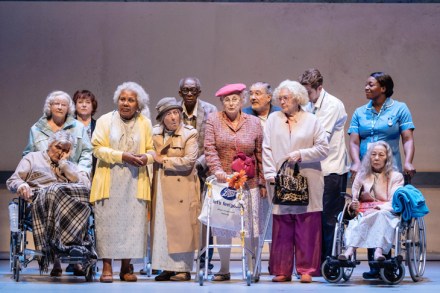
The Exorcist opened in 1973 accompanied by much hoo-ha in the press. Scenes of panic, nausea and fainting were recorded at every performance. Movie-goers showed up to witness mass hysteria rather than to enjoy a scary movie. This revival, produced by Bill Kenwright, targets the early 1970s demographic. At press night, the stalls were thronged with pensioners eager to relive a lurid evening from their adolescence. As one who dislikes shocks of any kind, I sat through this ordeal with my eyes bent towards the floor and my fingers wedged so firmly in my ears that their tips turned crimson. The show opened with a CRUMP loud enough to shake the theatre to its foundations. Everybody screamed. Then they all giggled. This pattern of shrieking followed by feathery tittering continued throughout.

Not with a bang but with a whimper

Bang! A brand new theatre has opened on the South Bank managed by the two Nicks, Hytner and Starr, who ran the National for more than a decade. Located near a river crossing, their venture bears the unexciting name ‘Bridge’. If these two adopted a child, they’d call it ‘Orphanage’. Visitors approach along the Thames embankment and arrive at a soaring cliff of glass whose revolving doors usher them into a large anonymous foyer. It feels like a student union bar or a bit of an airport. Dangling from the ceiling are dozens of light bulbs, their radiance muted with tea-stained shades that cast an absolving glow over facelifts, hairpieces and liver spots.

Family planning

Beginning starts at the end. A Crouch End party has just finished and the sitting room is a waste tip of punctured beer cans, tortured napkins and crushed nibbles. Wine bottles lie scattered across the carpet like fallen ninepins. Hostess Laura invites her last guest, Danny, for a final glass of Chardonnay. Twitchy conversation ensues. Then she tells him point-blank that she’s fallen in love with him, even though they’ve only just met. He rejects her weird come-ons (‘Kiss me, you lemon’) with evasive hyperactivity. He dashes about the room filling a bin-liner with defunct wine bottles and pulverised cheesy Wotsits. She forces him to sit next to her on the sofa, where he squirms and flips like a beached haddock. What’s wrong with him?