Theatre

Hedda Garbler

Hedda Gabler is one of the most influential plays ever written. It not merely illuminated an injustice, the enslavement of women within marriage, it fomented the revolutionary achievements of feminism. It deserves to be done as Ibsen intended. This updated version from Ivo van Hove locates Hedda in one of those posh urban dream homes that resemble an art gallery. Stage left, buckets filled with flowers. Centre, an abandoned plinky-plonk piano. At the rear, a lamp the size of a traffic bollard. Scruffy off-white masterpieces deck the walls. Everything looks chic and scaled-up. Tesman is a penniless American academic married to tetchy Hedda who pads about barefoot, in her nightie, grousing. Effortful gestures abound.

Deplorable entertainment

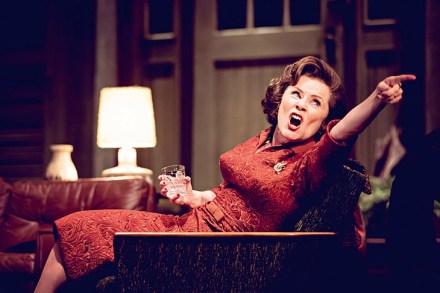
Buried Child is a typical Sam Shepard play. The main character, Dodge, is a brain-damaged alcoholic cripple stuck in a Midwest shack with a half-witted xenophobic wife shrieking at him from the coal cellar. The wife makes an early speech about her son who ‘married a Catholic whore’ and got stabbed to death by her on his honeymoon. This sets the tone for the play. Every character is a shrill, chippy barbarian and every speech is an exercise in tragicomic one-upmanship. The audience for Shepard’s work consists of social voyeurs who want to gawp at the underclass from a safe distance. The play purports to be a mystery but the family secret is revealed in the title. Even so, Shepard proceeds as if there were a puzzle to solve. He keeps offering us ‘clues’.

Angst and cant

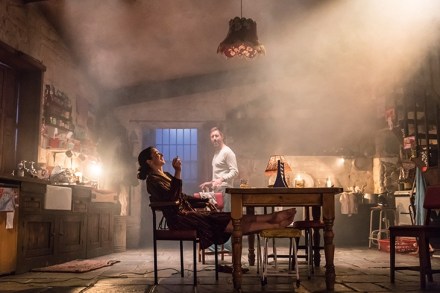
What if? is the engine of every great story. What if the toys came to life when their owner left the room? What if the prince’s uncle killed the king, seduced the queen, and stole the crown? Lucy Kirkwood asks: what if an elderly atomic physicist volunteered to take charge of the team decommissioning a stricken nuclear power plant in order to spare the lives of younger workers? Quite a complicated set-up. The play takes an hour to reach its starting point. First it feels like an oldies love triangle with a post-apocalyptic twist. We’re in a farmhouse near the site of a nuclear disaster. Rose, a wrinkly beauty, arrives unexpectedly and is greeted by fun-loving Hazel. Both are retired physicists who worked at the plant but haven’t met for 38 years.

Of ice and men

An ice floe. Two anglers. Months to kill. That’s the premise of Nice Fish by Mark Rylance and Louis Jenkins. The off-beat script is full of bleak and quirky insights. Rylance, who stars as the bungling Ron, admits that sometimes he gets so bored he bangs nails through frozen bananas. His pal compares dogs with wolves by observing that wolves are pessimists, jaws low to the ground, like homeless scavengers, whereas dogs are chin-up go-getters, natural corporate players, keen to win promotion in a worldwide enterprise called ‘Man’s Best Friend’. There’s a piece of obsessively nerdy rhetoric about 36-hour fishing permits which sounds like Peter Cook at his best. These treats appear early on.

Precious metal

Who could resist School of Rock? For me it was a chance to see a heavy-metal musical written by the best-known headbanger in the House of Lords, Julian Fellowes. The movie features Jack Black as a failed rock guitarist who bluffs his way into a private school and turns a class of robotic snoots into a prize-winning band. It’s one of the most joyous stories ever filmed. This version, faithfully scripted by his lordship, rises to the same level and delivers a night of sheer rapture. The thing is like a drug. Every performance sends skyrockets of happiness zinging up and down your spine. David Flynn has an echo of Jack Black about him but he brings added stores of charm and humour to Dewey. Preeya Kalidas is wonderfully nasty as Ned’s hideous girlfriend, Patty.

Space oddity

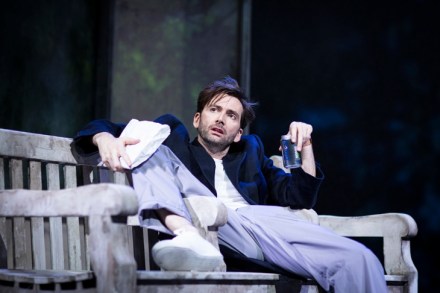
One of David Bowie’s last works, Lazarus, is a musical based on Walter Tevis’s novel The Man Who Fell to Earth. Enda Walsh has written the script. The lead character, Newton, is a derelict celebrity addicted to gin who occupies a big brown apartment full of bickering attendants. It’s unclear who or what Newton is. Human or alien? Something in between? His ontological status is a further puzzle. He may be alive, dead, half-dead, non-dead, half-undead or semi-not-quite-half-unalive. This is a problem, dramatically. A character who exists outside the mortal realm can’t make choices or perform actions that affect himself and others. He’s not a personality, therefore, just a puzzle wearing some clothes. Beige clothes in this case.

Angry bird

Dynastic affairs and international relations were once a seamless continuum. Royal weddings accompanied peace treaties. An heirless realm was vulnerable to invasion. Botched successions led to war. This is the political context of King Lear but Deborah Warner sets the play in modern times, which muddles everything. Britain in the Dark Ages is represented by a scout hut or a therapy suite. Plain walls, bleached flooring, a semi-circle of blue plastic chairs. Enter the king’s court led by a crownless Glenda Jackson (Lear), sporting a black ensemble topped by a chic scarlet cardigan. Is this a brutal tyrant on the brink of a psychotic meltdown? Nope. It looks like Granny wearing ‘something special’ for her 80th at the care home.

Just kidding

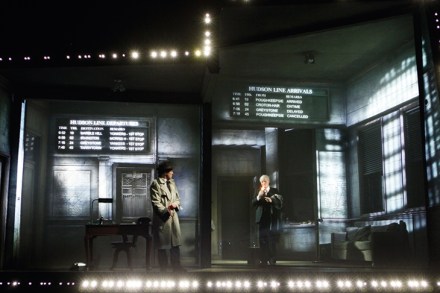
Amadeus by Peter Shaffer is haunted by its own antecedents. Viewers are apt to feel that a new production lacks the beauties they’ve seen, or believe they’ve seen, in previous versions. Director Michael Longhurst opens with a fusion of time zones. The courtiers are attired in silk curtains like proper 18th-century toffs, while the musicians on stage wear the baggy subfusc of a contemporary orchestra. Electronic cries of ‘Salieri, Salieri’ are broadcast through a Tannoy as if the tardy Kapellmeister were being chivvied from his dressing-room by an irate stage hand. Early on we get the famous ‘voice of an obscene child’ speech, which is perhaps the most sublime piece of English prose ever written on the subject of music.

Sweet and sour | 27 October 2016

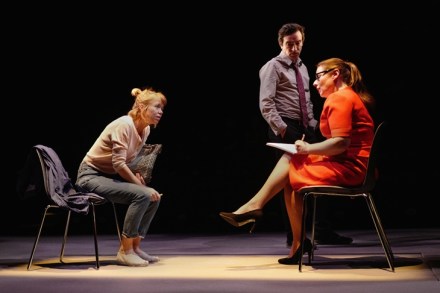
Great subject, terminal illness. Popular dramas like Love Story, Terms of Endearment and My Night With Reg handle the issue with tact and artistry by presenting us with a single victim and a narrative focus that reveals as much about the survivors as about the patient. Crucially, the disease is omitted from the title for fear of discouraging the punters from mentioning the work in conversation. A Pacifist’s Guide to the War on Cancer violates all these strictures. Half a dozen characters seated in a hospital ward shout at us about their failing health. These disjointed gobbets of testimony are interspersed with repetitive zombie dances and noisy songs with lyrics like ‘fuck cancer’. Snatches of insulting dialogue reinforce the mood of chippy sourness.

Ziggurat of bilge

Ella Hickson’s new play analyses our relationship with oil using the sketch format. First, there’s a candlelit soap opera set in Cornwall, in 1889, with a lot of ooh-arr bumpkins firing witless insults at each other. Next, a bizarre Persian scene, set in 1908, where a Scottish footman (who uses the celebrated Edwardian colloquialism ‘OK’) rescues a ditzy waitress from a sex-maniac serving in the British army. Then we move to Hampstead, in 1970, where a female oil magnate is visited by a Libyan diplomat seeking to nationalise her wells by waving documents at her, in her kitchen, while teenage kids pop in and out performing oral sex on each other. (This is one of the most disorganised pieces of stage writing I’ve ever witnessed.

Box of tricks

Travesties is a multi-layered confection of art, song, literature and pastiche. Tiny snippets of it are true. In Zurich, in 1917, James Joyce directed a production of The Importance of Being Earnest featuring a British diplomat, Henry Carr, in the role of Algy. Joyce and Carr fell out over the costume budget and became embroiled in a brief legal wrangle. That’s the starting-point for Tom Stoppard’s dazzling intellectual pantomime which features cameos from Lenin and Tristan Tzara, both residents of Zurich at the time. Tzara was an experimental vandal whose penchant for slicing sonnets into pieces was taken up by copycats and flowered, or degenerated, into the Dada movement.

Top of the Pops with silk tights

Here are three roles all actors love to play. The drunk (no need to learn your lines), the dementia victim (ditto) and the aristocratic roister-doisterer humping his way through the brothels of restoration London. Nothing quite beats the 17th century. Great costumes, stylish language, shoes that add three inches to your height, and a parallel universe of moral licentiousness where every cleavage is there be ogled and every passing bottom pinched. It’s Top of the Pops with silk tights. Into this land of platitudes walks Dominic Cooper, a super-smooth baddie, who has very little warmth or humour about him, and not a trace of vulnerability.

Hilarious, puzzling, boring

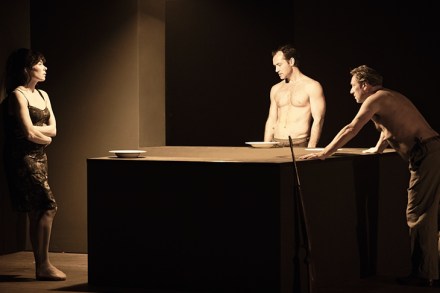
No Man’s Land isn’t quite as great as its classic status suggests. At first sight the script is a bit of a head-scrambler because Pinter’s characters are obscure to the point of incoherence. A demented alcoholic, Hirst, is cared for in his Hampstead mansion by two mysterious thugs, or servants, who may be emeritus rent boys and who are, or perhaps were, romantically linked to one another. Into this mysterious triptych comes Spooner, a simple and fascinating creation, a washed-up Oxford poet of high intelligence and low achievement who lives by cadging favours from kindly Hampstead folk. He wheedles his way into Hirst’s affections in the hope of gaining employment as a secretary, companion, literary consultant, cleaner, house-pianist, or anything.

In a league of her own

The Emperor seems like a worthy lesson in Ethiopian history. Haile Selassie’s final days are recounted by a retinue of devoted flunkies. He had valets, chauffeurs, zoo-keepers and door-openers to perform every conceivable chore. Each morning a butler proffered a silver dish loaded with meat from which the emperor fed his exotic pets. A clock-watcher, ‘the Cuckoo’, performed a coded bow during meetings to inform His Majesty that new suppliants awaited him. A royal bursar helped him hand envelopes of cash to petitioners who discovered, always too late, that the donation was barely a fraction of the sum expected. A cushion-handler ensured that his titchy legs were never seen to dangle in mid-air when he took his seat on one of his many thrones.

Sense of humour failure

Coleridge deemed the narrative structure of The Alchemist perfect. But, I wonder. A landowner quits plague-ridden London and his cunning servants pose as learned sages in order to defraud affluent locals. Ben Jonson’s plotting is certainly adroit. The action takes place in a single location within the span of an afternoon, and this concentration of forces may have appealed to Coleridge’s idea of classical purity. What Jonson’s narrative doesn’t explain is why so many dim-witted toffs are kicking around in a city abandoned by all but its poorest inhabitants. His characters’ names crassly signal their roles: Surly, Dapper, Lovewit, Sir Epicure Mammon.

Brackish as old Brylcream

Kenneth Branagh’s obsession with Larry Olivier’s career is becoming such a bizarre act of theatrical necromancy that it deserves to be turned into a drama. Sir Ken and Lord Olivier could be played by the same actor. The Entertainer, written for Larry in 1956 by John Osborne, presents us with a washed-up music-hall star, Archie Rice, who is supposed to symbolise Britain’s post-colonial decline. This version, directed by Rob Ashford, opens with a tap-dancing routine so ponderously executed that it leaves one wondering if Branagh is a lousy hoofer trying too hard, or a master of the art impersonating a lesser practitioner. This difficulty permeates the piece. By making the central character a useless comic, Osborne has sabotaged the play as an act of entertainment.

First aid

In the 1980s, supermarkets stocked a fruit juice named ‘Um Bongo’ with the strapline ‘They drink it in the Congo!’. This is the starting point for Adam Brace’s examination of Britain’s relationship with the Congolese (whose word ‘mbongo’ means money). A group of do-gooding Londoners host a festival to celebrate the Congo’s culture and history but they rapidly become mired in controversies about age-old injustices and white-to-black ratios on steering committees. The Congolese party includes a few rogue terrorists whose death threats the British publicists find rather glamorous and titillating. The characters rarely reach beyond the obvious. The Londoners are bloodless yuppie go-getters.

Doctor Death

‘European premiere of classic American musical’ is a phrase that deeply alarms the experienced playgoer. As I tootled along to Southwark Playhouse I asked myself why this Rodgers and Hammerstein masterpiece had taken so long to plough its way across the ocean. In 1947 the Broadway prodigies decided to follow up their first two hits, Oklahoma! and Carousel, with a brand new storyline drawn entirely from their imaginations. The plan was to extoll the life of the ordinary Midwest Joe and they created a figure (Joe Jr, after his dad), living in a backwater in the early years of the 20th century. The script doggedly stalks Joe Jr through every phase of his morally exemplary and supremely tedious existence.

Words of wisdom

Dominic Frisby is an actor best known for voicing the booking.com adverts (‘Booking dot com, booking dot yeah’). Voiceover specialists can earn large fees for a morning’s work and they have endless time in which to ponder where their money ends up. Frisby is irked by the UK tax regime, whose code-book is four times longer than Chilcot. He argues persuasively that our sprawling system should be replaced with a land value tax. Set at the right level this would ensure the abolition of all other duties, and those of us who don’t own property would pay no council tax, no income tax, no VAT, and no duty on fuel, alcohol or inheritance. Ever again. An attractive scheme laid out in a funny, absorbing show full of historical insights.

Losing the plot | 4 August 2016

Consider it commercially. So powerful is the pull of the Potter franchise that the characters could simply re-enact the plot of ‘Incy-Wincy Spider’ and the fans would swoon with joy. The stage show has been written by a two-man committee, Jack Thorne and John Tiffany, with the help of billionaire equality campaigner J.K. Rowling. Harry is now 37 and working as a Whitehall clodhopper at the Ministry of Magic. He’s troubled by his stompy bed-wetter of a son, Albus, whose tantrums cause the middle-aged miracle-worker to suffer agonies of weepy self-doubt. Together they visit Hogwarts and the multifarious plotlines start to punch each other in the face.