Portrait of the week

Portrait of the week | 24 August 2017

Home Big Ben ceased sounding for a planned period of four years, thanks to a decision by the Speaker and two Commons committees. The silence was attributed to the need to protect the hearing of workmen restoring the Elizabeth Tower, though experts on the bell and on previous restorations saw no reason for it. A game of hunt-the-issue was begun when Sarah Champion, the Labour MP for Rotherham, was obliged to resign as shadow minister for women and equalities after writing a piece for the Sun that began: ‘Britain has a problem with British Pakistani men raping and exploiting white girls.

Portrait of the week | 17 August 2017

Home Regulated rail fares will rise by 3.6 per cent in January, bringing the price of annual tickets from Oxford, Colchester or Hastings to more than £5,000. The rise depended on the annual rate of inflation in July as measured by the Retail Prices Index, which had risen to 3.6 per cent; as measured by the Consumer Prices Index it remained unchanged at 2.6 per cent. A passenger train was derailed near Waterloo station but none of the 23 on board was injured. A train from Royston hit the buffers at King’s Cross. Richard Gordon, the author of Doctor in the House, died aged 95. The landlord of the Mallard in Scunthorpe became the third person at the pub to win £1 million in the National Lottery.

Portrait of the week | 10 August 2017

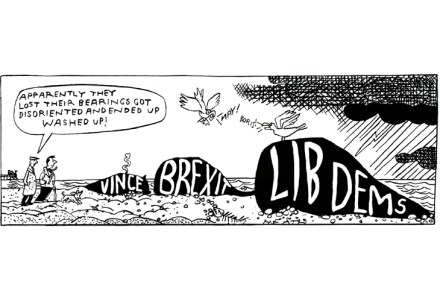
Home British negotiators are prepared to pay up to £36 billion to the EU to settle the so-called divorce bill for Brexit, according to the Sunday Telegraph. By voting for Brexit, ‘the old have comprehensively shafted the young’, the leader of the Liberal Democrats, Sir Vince Cable, aged 74, wrote in the Mail on Sunday, ‘imposing a world view coloured by nostalgia for an imperial past on a younger generation much more comfortable with modern Europe.’ Lord Neuberger, who will retire as president of the Supreme Court next month, said that the government should ‘express clearly what the judges should do about decisions of the European Court of Justice after Brexit.

Portrait of the week | 3 August 2017

Home Philip Hammond, the Chancellor of the Exchequer, appeared to wrest control of plans for Brexit from cabinet rivals, while Theresa May, the Prime Minister, was in Italy and Boris Johnson, the Foreign Secretary, was in Australia. Mr Hammond foresaw a ‘transitional deal’ ending by June 2022, when the next general election is due. He said it would be ‘some time before we are able to introduce full migration controls between the UK and the European Union’. Liam Fox, the International Trade Secretary, insisted that the cabinet had not agreed to a three-year transition. Mr Johnson said he was unaware that Amber Rudd, the Home Secretary, had announced a year-long inquiry about the costs and benefits of EU migration.

Portrait of the week | 27 July 2017

Home Theresa May, the Prime Minister, invited the media to take a photograph of her beginning a holiday with her husband Philip at Lake Garda before pressing on to Switzerland for some walking. David Davis, the Brexit Secretary, resisted demands by Guy Verhofstadt, the European Parliament Brexit negotiator, that the European Court of Justice should retain jurisdiction over EU migrants in Britain. BMW said a fully electric Mini is to be built at Cowley in Oxford, with motors made in Germany and shipped over for assembly. The government announced plans to ban new diesel and petrol cars and vans from 2040. The number of people over 90 with a driving licence reached 100,000.

Portrait of the week | 20 July 2017

Home Theresa May, the Prime Minister, told MPs before the summer recess: ‘No backbiting, no carping. The choice is me or Jeremy Corbyn. Nobody wants that.’ Her remarks followed a spate of leaks and negative briefings from cabinet ministers. It was said that Philip Hammond, the Chancellor of the Exchequer, had called public-sector workers ‘overpaid’. He responded by warning cabinet colleagues against leaking, but maintained a 10 per cent pay disparity was a ‘simple fact’.

Portrait of the week | 13 July 2017

Home In her first big speech since the general election, Theresa May, the Prime Minister, said: ‘I say to the other parties in the House of Commons… come forward with your own views and ideas.’ She was responding to a government-commissioned review of modern working practices by Matthew Taylor, the chief executive of the Royal Society of Arts, and a former adviser to Tony Blair. The report was hostile to payment in cash and suggested that immigrant visas might insist on non-cash payment for work. Unemployment fell by 64,000 to 1.49 million. A leading article in the Evening Standard, edited by one of Mrs May’s enemies, George Osborne, commented on the position of David Davis: ‘For the first time in his political career he is trying to be loyal.

Portrait of the week | 6 July 2017

Home Philip Hammond, the Chancellor of the Exchequer, urged colleagues to make the case for ‘sound money’; he said, ‘We must hold our nerve,’ as he came under pressure to end the public-sector pay cap of a 1 per cent rise a year. Boris Johnson, the Foreign Secretary, thought that pay rises could be awarded in ‘a responsible way’; Michael Gove, the Environment Secretary, did not think that taxes would need to increase to accommodate pay rises. Firemen boasted of a 2 per cent pay rise. The government won the vote on the Queen’s Speech by 323 to 309 after heading off an amendment by the Labour MP Stella Creasy, by suddenly announcing that women in Northern Ireland (where abortion is illegal) would be able to have free abortions on the NHS in England.

Portrait of the week | 29 June 2017

Home In preparation for the vote on the Queen’s Speech, the Government, after weeks of negotiations, bought the support of the Democratic Unionist Party in the House of Commons by promising to spend a billion or two pounds in Northern Ireland on broadband and other good things. In reply to expostulations from the Opposition, Nigel Dodds, the parliamentary leader of the DUP, told the Commons: ‘We might publish all the correspondence and conversations we had in 2010 with Labour front-benchers, and in 2015 with Labour front-benchers, and indeed also the Scottish National party, because some of the faux outrage we have heard is hypocrisy.

Portrait of the week | 22 June 2017

Home The burnt-out skeleton of Grenfell Tower, the 24-storey block of 127 flats at Latimer Road, west London, became a focus of recrimination. Initially, kind-hearted community action provided food and clothing for survivors, but organisation by the authorities was not apparent. After five days the police estimate for those dead or missing presumed dead was put at 79. Jeremy Corbyn, the Labour leader, said that properties in Kensington should be ‘requisitioned if necessary’ to house the survivors. Supporters of Mr Corbyn denounced Theresa May, the Prime Minister, for talking only to emergency services when she visited the scene. Her advisers sent her back to a church, from which she was driven in a car with cries of ‘coward!’ from the crowd.

Portrait of the week | 15 June 2017

Home Theresa May, the Prime Minister, spent the week confronting the consequences of the general election that she had called to bring ‘stability and certainty for the future’. It had instead surprisingly left the Conservatives with no overall majority. They won 318 seats (a loss of 13) and Labour 262 (a gain of 30). The Scottish National Party won 35 (a loss of 21), with the Conservatives gaining 12 extra seats in Scotland, even capturing Stirling. Labour won an extra five seats in Scotland. Angus Robertson, the SNP leader at Westminster, lost his seat, as did Alex Salmond. Nick Clegg, the former Lib-Dem leader, lost his seat, but Sir Vince Cable won back Twickenham.

Portrait of the week | 8 June 2017

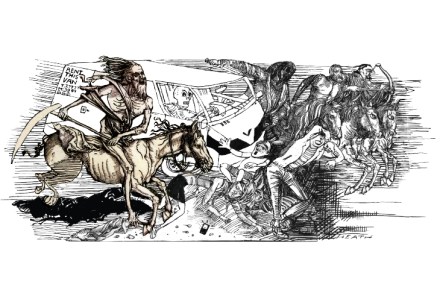
Home Eight people were killed and 48 taken to hospital when three men, in a hire van travelling south shortly after 10 p.m. on Saturday, ran into pedestrians on London Bridge, then jumped out with knives and attacked people in pubs and restaurants around Borough Market. A policeman tackled one of the knifemen with a truncheon and was wounded. At 10.16 p.m., police firing 46 shots killed the men, who were wearing fake explosive vests with visible canisters. A bystander was wounded in the head by a police bullet. Police led people to safety and cleared a wide area. The Islamic State said it was behind the attack.

Portrait of the week | 1 June 2017

Home The Conservatives grew restive when polls, for what they were worth, indicated a closing gap between their support and Labour’s. In a generally uneventful 90 minutes of television, in which Theresa May, the leader of the Conservative party, and Jeremy Corbyn, the leader of the Labour party, were questioned, Jeremy Paxman said to Mrs May: ‘If I was sitting in Brussels and I was looking at you as the person I had to negotiate with, I’d think, she’s a blowhard who collapses at the first sign of gunfire.’ Mr Corbyn said in an earlier interview with Andrew Neil: ‘I never met the IRA,’ leaving viewers wondering in what sense this could be true.

Portrait of the week | 25 May 2017

Home  Twenty-two people were killed and 59 wounded by a man who blew himself up, with a bomb containing metal fragments, in the foyer of Manchester Arena as crowds were leaving a concert by the American singer Ariana Grande, aged 23, who has a strong following among young girls. Of the wounded, 12 were children. Police named the suspected murderer as Salman Ramadan Abedi, aged 22, a Mancunian whose family come from Libya, which he had recently visited. Isis said it was behind the attack. A 23-year-old man was arrested the next day. The official threat level was raised to ‘critical’, meaning that an attack was expected imminently. Soldiers were deployed in the streets to support armed police.

Portrait of the Week – 18 May 2017

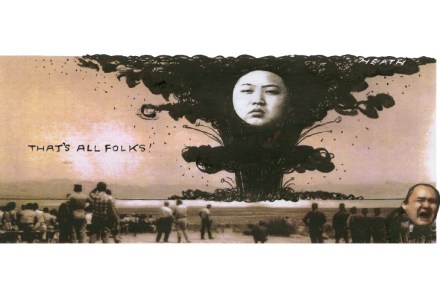
Home The National Health Service was one of the first big victims of a vermiform global ransomware computer infection going by names such as WannaCrypt and WannaCry, which locked computer systems. Hackers demanded $230 a time in Bitcoin to unlock them. Thousands of NHS devices were affected and outpatient appointments had to be cancelled. The Nissan plant at Sunderland was also hit. A 22-year-old from Devon, Marcus Hutchins, who runs the Malware Tech blog from his bedroom, found an effective kill switch that slowed the infection’s spread. Organisations abroad affected included Renault and Telefónica. Baddies had apparently unleashed the worm from software once in the keeping of America’s National Security Agency. Some people blamed North Korea.

Portrait of the week | 11 May 2017

Home After spectacular local election results, Theresa May, the Prime Minister, said: ‘I’m taking nothing for granted over the next five weeks. I need support from across the United Kingdom to strengthen my hand, and only a vote for me and my team will ensure that Britain has the strong and stable leadership we need.’ The Conservatives increased their number of council seats by 563. Labour lost 382 and Ukip lost all 145 it held, but gained a single one, Padiham and Burnley West, Lancashire, from Labour. In Scotland, the Conservatives became the second party to the Scottish National Party and gained seven seats in Glasgow (where Labour lost control of the city) and Paisley’s Ferguslie Park, Scotland’s poorest community.

Portrait of the week | 4 May 2017

Home Jean-Claude Juncker, the president of the European Commission, told Theresa May after dinner with her on 26 April, ‘I’m leaving Downing Street ten times more sceptical than I was before,’ according to an account in Frankfurter Allgemeine Sonntagszeitung. At the dinner, also attended by Michel Barnier, the EU’s chief negotiator, and David Davis, the Brexit Secretary, Mrs May was said to have declared that Britain was not legally obliged to pay the EU ‘a penny’; Mr Juncker said ‘the EU is not a golf club’ with a subscription that could be cancelled at any time. ‘Let us make Brexit a success,’ May is said to have remarked, to which Mr Juncker replied: ‘Brexit cannot be a success.

Portrait of the week | 27 April 2017

Home Jeremy Corbyn, the Labour leader, cheered the United Kingdom by promising four new bank holidays for the whole country when he becomes prime minister, for the patronal days of St David, St Patrick, St George and St Andrew. Asked about the replacement for the Trident nuclear deterrent, he said: ‘I’ve made clear any use of nuclear weapons would be a disaster for the whole world.’ Three hours later, the Labour party put out a statement saying: ‘The decision to renew Trident has been taken and Labour supports that.’ The Communist Party decided not to field candidates against Labour.

Portrait of the week | 20 April 2017

Home Theresa May, the Prime Minister, having repeatedly said that there would be no election until 2020, surprised the nation by suddenly standing at a lectern in Downing Street, while the wind ruffled her hair, and saying that she sought a general election on 8 June. ‘Britain is leaving the EU and there can be no turning back,’ she said. ‘The country is coming together but Westminster is not.’ She said later that she had taken the decision after a walking holiday in Wales, and had spoken to the Queen on Easter Monday.

Portrait of the Week – 12 April 2017

Home Boris Johnson, the Foreign Secretary, having cancelled a trip to Moscow over the Syrian poison gas incident, consulted other foreign ministers at the G7 summit at Lucca in Italy about how to get President Vladimir Putin of Russia to abandon his support for President Bashar al-Assad of Syria. The Scottish Medicines Consortium accepted for routine use by NHS Scotland a drug called Prep which, at a cost of more than £400 a month, can protect people at risk of contracting the HIV virus through unprotected sexual activity. In England, 57 general practitioners’ surgeries closed in 2016, Pulse magazine found, with another 34 shutting because of mergers, forcing 265,000 patients to move.