Letters

Letters: the problem with emojis

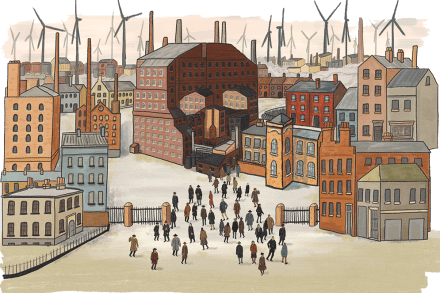
Industrial waste Sir: I endorse your concerns about the closure of Grangemouth and Port Talbot and the statement that ‘if high-quality jobs are to return to the North and the Midlands then re-industrialisation is presumably the answer’ (‘Time for a change’, 12 October). However, your leading article fails to observe that Ed Miliband has already committed £22 billion to the re-industrialisation of Liverpool and Teesside in the form of Carbon Capture, Usage and Storage (CCUS) projects. One might wonder where Miliband acquired the daft notion that it is a good idea to spend £22 billion on a technology that has only been proven to work in a coal-fired power station (a sort we don’t have any more).

Letters: AI isn’t the only threat to middle-class jobs

Poetic licence Sir: As a Welshman well-used to the prejudice and insults to which our ancient language and its speakers are often subjected, I read Lloyd Evans’s article (‘Language barrier’, 5 October) with some trepidation. Mercifully, my fears were allayed by a generally even-handed summary of some of the thorny issues that inspire debate in much of north-west Wales. I confess that I have never understood why so many Englishmen seem to treat as a personal insult the existence of a language of such noble and ancient pedigree on the shores of the British Isles, or why its continued usage in everyday life should inspire such consternation.

Letters: Are there still any reasons to be cheerful?

Doctor’s note Sir: Your leading article ‘Labour vs labour’ (21 September) follows a recent theme that I have noticed in The Spectator, in which the government is criticised for allowing public pay rises without implementing changes to working practices to increase productivity. I cannot comment on other sectors but I work in the NHS, working closely with junior doctors as colleagues and am involved in training them. Your article appears to imply that if they worked harder or differently, productivity would improve.

Letters: The case for assisted dying

Craic down Sir: If Ireland had been investing in infrastructure as Ross Clark writes (‘Bog down’, 21 September), Dublin would have a metro, Galway a ring road, and primary school parents wouldn’t be forced to pay for basic necessities. And when the only local hotel cancels wedding and birthday parties because government has block-booked it for migrants and refugees, no wonder people beyond the Dublin bubble are mutinous. Rural areas often lack broadband or even piped water (just ask Melissa Kite) and where the blue pipe does reach, ‘boil water’ orders are common. Corporation tax is 27 per cent of government revenue (per head of population, more than four times that in France or Germany) and 90 per cent of it is paid by foreign multinationals.

Letters: The mass appeal of cathedrals

Mass appeal Sir: The upcoming ‘rave’ at Peterborough Cathedral follows the trajectory of using this sacred space as a mere entertainment venue (‘Raving mad’, 14 September). Previous secular attempts to commercialise include ‘experiences’ of the moon, dinosaurs, the deep sea and light shows. I assume the rave organisers did not witness the cathedral in June when a Saturday evening vigil mass was celebrated by the Catholic Bishop of East Anglia for local Catholics. When used for its original and sacred purpose, Peterborough Cathedral was filled with Catholics participating in the divine liturgy. Many were standing for want of seats, like some of our churches on Sundays.

Letters: A cautionary lesson for England’s schools

Lessons to learn Sir: Your leading article ‘Requires improvement’ (7 September) rightly raised concerns that a curriculum review in England might reverse the excellent progress in schools following the Gove reforms. Fortunately, there are two very good examples of what happens when you replace rigour and the acquisition of knowledge with left-wing dogma and woolly thinking. The introduction of the Curriculum for Excellence in Scotland has led to a dramatic fall in standards in Scottish education and a resultant collapse in its Pisa [Programme for International Student Assessment] ranking. Last year Wales recorded its lowest-ever Pisa ranking.

Letters: Lucy Letby and the statistics myth

Pensioners at risk Sir: Douglas Murray wonders what would have happened if a Conservative chancellor had announced the removal of the winter fuel payment (‘Labour’s age of miracles’, 31 August) and speculates about the reaction. No such speculation is needed: the Conservative manifesto of 2017 stated that it would means test this benefit, as Labour is now doing. The Labour party’s reaction was to publish research stating that up to 4,000 pensioners’ lives would be at risk and add that ‘pensioners in our country will struggle to heat their homes’ (the then shadow chancellor John McDonnell, as widely quoted in the press). No journalist has yet put this to the government. Does the government agree with its party’s research then, and if not, how is it different now?

Letters: The dark side of chess players

Spinning a line Sir: Roger Alton is too enthusiastic about the Hundred tournament (Sport, 24 August) – I can’t recall another sport that has so successfully alienated its entire support base. Before the season ends, I encourage Roger to watch his local cricket team and ask for their thoughts about the Hundred. He will find that most are terribly unhappy. While it has attracted a few big names in the men’s, we have no Indian powerhouses and few Australian heavyweights; other franchises round the world are, simply put, outcompeting us. Overseas investment will inevitably increase the number of teams and widen the window of play into most of July, similar to the length of the Indian Premier League.

Letters: we have let down white, working-class boys

The lost boys Sir: The only statement in your powerful leading article (‘Boy trouble’, 17 August) which can be challenged is that ‘the plight of poor white boys is a new burning injustice’. It is certainly not ‘new’. Even 40 years ago when the Inner London Education Authority (ILEA) produced policies designed to counter inequality affecting girls, it was obvious that the problem was no less serious for white working-class boys. But the subject was highjacked by those obsessing about girls, with the results described in your article 40 years later. During the hijacking (for which he was not responsible), ILEA’s former leader Sir Ashley Bramall said to me: ‘Perhaps we should also be worried about the boys.

Letters: Britain doesn’t have a ‘two-tier’ policing problem

Less is more Sir: While I wholeheartedly agree with Toby Young’s observation that ‘more censorship would make things worse, not better’ (No sacred cows, 10 August), I’m confused by his remedy – ‘more and better speech’. First, how does one decide what better even means, without it becoming a form of censorship? Second, and perhaps more worryingly, it feels like something Stalin might appreciate. ‘Quantity has a quality of its own,’ he once said. In their different ways, both incessant social media and weekly magazines rather disprove that.

Letters: you can have a ‘good’ divorce

Splitting the difference Sir: Hannah Moore’s article ‘Split personalities’ (27 July) is brutal. ‘There’s no such thing as a kind divorce,’ she writes. Ms Moore cites Amicable, the company I co-founded after my own long, painful divorce, as promoting the impossible idea of a ‘successful divorce’. Unless you have been divorced, it is hard to understand the pain and soul-searching that ending a marriage entails. Emotionally, psychologically and financially, it tears you apart. Divorce can reduce unhappiness and remove unbearable pressure from families. In broken relationships, the only thing worse than breaking up can be staying together, especially for the children. Do you really want to role-model ‘put up or shut up’ to your kids?

Letters: Why marriage matters

Pretender to the crown Sir: Kate Andrews combines detail and analysis with a sprinkling of satire to devastating effect in her article on Kamala Harris (‘Trump’s new rival’, 27 July). The news anchor she describes in the first sentence (‘I’m struck just in your presence’) is more partisan than journalist, and would give Ofcom good reason to clutch its pearls if they popped up on GB News. Here is someone who identifies as, but isn’t actually, a news anchor. Rather like Harris, who identifies as a politician but hasn’t gone to the trouble of securing any actual votes. Perhaps this is why the Democrats have the overwhelming support of Hollywood, whose whole business is, after all, pretence.

Letters: You can grow to hate Wagner

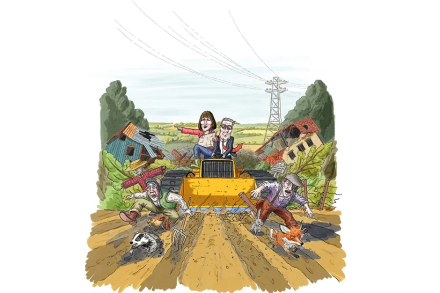
Disappearing England Sir: Rod Liddle’s reference to Labour’s intention to build 1.5 million new houses (‘The great bee-smuggling scandal’, 13 July), even though there is not a shortage, leads one to worry where they will be located. The green belt was introduced for London in 1938 and the Town and Country Planning Act of 1947 extended powers with local authorities for self-designation. In 1937, John Betjeman wrote for one of his BBC talks: ‘England is disappearing and there is growing up, where the trees used to be and where the hills commanded blue vistas, another world that does not seem to be anything to do with England at all. This new world lives in ill-shaped brick horrors, for which it has had to pay through the nose.

Peter Hitchens: I invented the ‘left-wing face’

Sitting ducks Sir: James Heale is right to highlight the important question about Rishi Sunak’s replacement (‘Who will lead the Tories?, 13 July). A weak leader will be a sitting duck for Nigel Farage to target, resulting in a worsening split on the right and an open goal for Labour to exploit at the next general election. They need a bold, principled and pragmatic leader who is prepared for fierce resistance by Reform UK. All the proposed candidates are great at preaching to their own respective choirs, but are any of them prepared to bravely fight for their beliefs like a Margaret Thatcher? They need to reinvent themselves, akin to in 1975, when Thatcher took the necessary steps to change the Conservative party, providing an alternative to the normalised managed decline.

Letters: what Biden and Ronaldo have in common

True conservatism Sir: Douglas Murray claims that the Conservative party ‘will need to have some people who are actually right-wing’ (‘The Tories only have themselves to blame’, 6 July). Why? Its name isn’t ‘the right-wing party’. It has no foundational obligation to be right-wing for the sake of it. Rather its mission is to be conservative, and the people who now identify as ‘right-wing’ seem to have no interest in conserving anything, whether it’s our countryside, rivers, values, place on the international stage, parliamentary system, cultural institutions, national life expectancy, economic stability – or anything other than their own positions and status, which many have lost regardless.

Letters: why I’m voting Reform

Back to 1976? Sir: Your leading article perfectly reflects the public’s attitude to the manifestos of the major parties (‘Challenging democracy’, 29 June). No one has a plan that can remotely be seen as likely to work. Each party promises goodies they have no idea how to pay for; the only question is who will bankrupt us first. As ever, it is easy to distribute largesse, but no one has a clue how to remove it. We are heading towards a rerun of 1976 when the Labour government had to go cap in hand to the IMF. Those old enough can remember inflation of 25 per cent and a Bank base rate of 17 per cent. If you think rates now are excessive, just wait.

Letters: the courts are not trying to subvert parliament

Judge not Sir: The claim by Ross Clark (‘Keir’s law’, 22 June) that the left can achieve what it wants by relying, in part, on ‘judicial activism’ is uninformed and misleading. I can assure Mr Clark and those who might share his sentiments that the courts are, in general, at pains to respect the separation of powers and the will of parliament. A cursory consideration of recent decisions from the Supreme Court would have revealed this.

Letters: the Tories’ fatal flaw

Major error Sir: Even as a former Tory voter, I acknowledge that the predicted scale of the Conservative electoral defeat would be a national tragedy. Starmer’s government needs to be kept in check by a robust opposition. There are many explanations for the Tory decline, but George Osborne’s Diary (15 June) gives some clues: his celebration of a ‘Middle England’ country fête having a tombola for Gaza rather than a worthy local cause, for instance. More tellingly, Osborne also celebrates John Major’s advice that the Conservatives ‘will never win while we remain in thrall to the hard right of our party’. The practical interpretation of this involves moving the Tories to the left, while leaving voters to choose Labour’s ‘real thing’.

Letters: could Nigel Farage ever be a statesman?

Debunking the debanking Sir: Toby Young is wrong to say the Conservatives have ‘failed us on debanking’ (No sacred cows, 8 June). On the contrary, this was a situation where immediately following his incident being brought to my attention, swift and decisive action was taken. The Free Speech Union was indeed ‘patient zero’ of the ‘debanking’ epidemiology and such was my concern about its chilling impact on freedom of expression that I invited Toby and Miriam Cates MP to meet me in my Treasury offices.

Letters: the problem with Ozempic

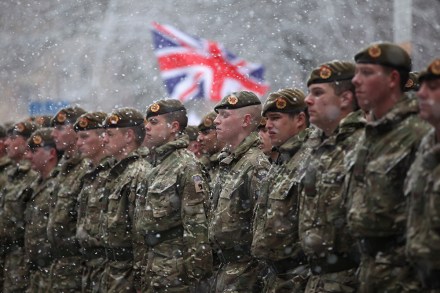
At your service Sir: National service is a contentious issue with many people including the Armed Forces themselves (‘Identity crisis’, 1 June). National community service might be a far better option whereby everyone reaching the age of 18 would spend a year working in a care home, hospital, day nursery, park, graffiti cleaning, litter clearance and so on – all areas in which help is badly needed. We have a generation of young people badly affected by Covid isolation and screen addiction and this might help them feel more integrated into society.