Barometer

Barometer | 19 January 2017

Starting cold Why is US Presidential Inauguration Day always on 20 January? — The date was moved from 4 March in the 20th amendment to the US constitution, passed on 23 January 1933, but it is hard to find any significance to the date. The change was made in an attempt to reduce the lame-duck period of an outgoing president, though it did increase the risk of a repeat of what happened in 1841 when William Henry Harrison was sworn in. Choosing not to wear a coat, hat or gloves, he made the longest inaugural speech of any president, at two hours. Three weeks later he was reported to be suffering from a cold, which developed into pneumonia and then pleurisy, leading to his death on 4 April — although some doubt the connection with inauguration day.
Barometer | 12 January 2017

Black background A Morris dancing troupe with blacked-up faces had to abandon its performance in a Birmingham shopping centre after being heckled and accused of racism. — There are several explanations for the tradition of Border Morris groups blackening their faces, but it was certainly established by 1509, when a Shrovetide banquet for ambassadors featured torch-bearers with blackened faces. — Some believe it to have derived from Spain and Portugal, where dancers blacked up as Moors. Others believe that it derives from the practice of poachers blackening up to conceal themselves in darkness. — Blacking up is punished more mildly now than in the 18th century: a 1723 anti-poaching law made it a capital offence to be caught in a forest with a blackened face.

Barometer | 5 January 2017

Village people The government announced plans for 14 ‘garden villages’. The concept of a garden city or village is attributed to Ebenezer Howard, who founded the Garden City Association in 1899 and Letchworth Garden City in 1903. But he was inspired by his time in Chicago, which had already been nicknamed ‘Garden City’. — The term ‘garden village’, however, was coined by Alexander Turney Stewart, a Northern Irish Protestant who emigrated to the US with a suitcase full of linen and went on to found the world’s biggest department store, on Broadway, New York. — In 1869, looking for new ventures, he purchased 10,000 acres of Long Island.

Barometer | 29 December 2016

Supremely exciting The nation awaits with bated breath the decision of the Supreme Court on whether the government can exercise Article 50 of the Lisbon Treaty without parliamentary approval. This is more exciting than the first day of the US Supreme Court in 1791, when six judges sat around all day waiting for a case. It was not until the following year that they finally got down to action: — A farmer, William West, had held a lottery to try to pay off his mortgage. The winner, David Leonard Barnes, was paid in bank notes but demanded gold or silver. The case was decided on a procedural issue, not exactly boosting the court’s reputation, and West lost his farm. Leader of the packs A number of wolves were reported to be living near Paris.

Barometer | 1 December 2016

Autumn Budgets Philip Hammond announced that in future the Budget will be held in autumn rather than spring. This is not as revolutionary as some have made out. — In his 1992 Budget Norman Lamont announced that there would be two budgets in 1993, one in spring and one in autumn, and that from then on the date would switch to autumn for good. — The Budget was delivered every November from then until 1996. In 1997, Gordon Brown held his first Budget in July, before reverting to a spring date. — Denis Healey also delivered a November Budget in 1974, soon after the second general election of that year. Tickets please The Department for Transport says it will force train companies to make passengers aware if there is a cheaper ticket available for their journeys.

Barometer | 24 November 2016

Bucks for Bucks Buckingham Palace is to be renovated at a cost of £369m, funded through an increase in the sovereign grant. How much have home improvements to the palace cost over the years? — The original house was built by the Duke of Buckingham in 1706 for £7,000. — In 1761, George III spent £21,000 to buy it, and £73,000 on remodelling it. — In 1826, George IV hired John Nash to remodel the building for £450,000. He was fired in 1828, having spent £496,169. — In 1845, Queen Victoria complained it wasn’t big enough for her growing family and added the east wing, using £53,000 raised by selling Brighton Pavilion.

Barometer | 17 November 2016

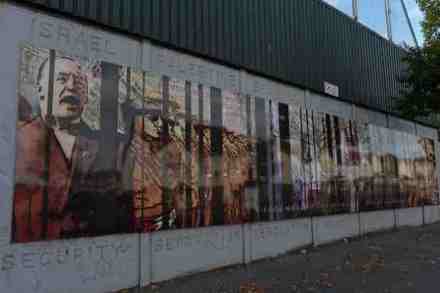
Long divisions Donald Trump reaffirmed his plan for a border wall between the US and Mexico, but said parts might end up as a fence. Who has the longest, highest barriers? India-Bangladesh India is still building a 2,545-mile three-metre-high barrier of barbed wire and concrete. Morocco-Western Sahara Separated by a 1,700-mile sand berm, typically two metres high, reinforced with land mines. US-Mexico 580 miles of fence already exist along the 1,950-mile border. Israel-Palestinian territories 440-mile barrier: part concrete wall, part barbed wire. Hungary-Serbia To thwart migration there is a 110-mile, four-metre-high fence. Catholic and Protestant Belfast 25-mile long ‘peace lines’ up to 8.5 metres high still separate some communities.

Barometer | 3 November 2016

Strike force Nissan is to expand its plant in Sunderland, building two new models there. The Japanese company is praised for not losing a day to strikes in three decades in the city. But labour relations weren’t always so good. — In 1953, when part of Nissan’s business was assembling Austin cars in Japan under licence, the company suffered a bitter 100-day strike. Occupying US forces became involved, helping the Japanese government to arrest union leaders. — As a result of the strike, a new, less militant union was formed, with a Harvard-educated leader. The union accepted job losses but became involved in discussions over new technology. Global race And where did the UK fit in among the world’s largest car producers in the second quarter of 2016?

Barometer | 27 October 2016

Folio society A new collection of Shakespeare’s work credits Christopher Marlowe as co-author of the three Henry VI plays. Some other candidates claimed to have written Shakespeare plays: FRANCIS BACON (1561-1626). His poems are said to share a similar structure. But lacks motive to use Shakespeare as a pen name. WILLIAM STANLEY, 6th EARL OF DERBY (1561-1642): A Jesuit spy claimed he was secretly writing plays. EDWARD DE WERE, 17th EARL OF OXFORD (1550-1604): Theatre patron said to have used pen name because an aristocrat could not take credit for public plays. Dead for the last 12 years of Shakespeare’s life. ROGER MANNERS 5th EARL OF RUTLAND.

Barometer | 20 October 2016

Ape escapes A gorilla got out of its enclosure at London Zoo and entered a keepers’ area, prompting an evacuation of visitors. Other gorillas who tried to emulate King Kong: — Casey, a 400 lb male, scaled a 15-foot wall and a four-foot fence at Como Zoo in Minnesota in 1994 and spent an hour at large before being coaxed back. — Little Joe, a 300 lb male, got out of Franklin Park Zoo, Boston, in 2003 and roamed free before being shot with a tranquiliser dart. Two people were injured. — Jabari, a 300 lb Western Lowland Gorilla, scaled 16 ft walls to escape at Dallas Zoo in 2004. He injured four people, including a boy of three, before being shot dead. A 19-year-old female gorilla escaped briefly at the same zoo in 2010.

Barometer | 13 October 2016

Fears of a clown Professional clowns complained that the current craze for scaring people by dressing in clown outfits was damaging their trade. But why do some people find clowns frightening? — The effect was analysed in 1970 by Japanese professor Masahiro Mori as he researched robot faces. He found that the more lifelike faces induced increasing feelings of empathy until a critical point, at which point people began to find them scary. Then, as the face was made still more lifelike, empathy quickly returned. He called the effect the ‘uncanny valley’, after its shape on a graph. — Clown faces occupy a gap between primate and human, so the fear may originate from ancient aversion to breeding with near-human relatives.

Barometer | 6 October 2016

Tenement Scots John Cleese referred to the editor of this magazine as a ‘tenement Scot’. Do more Scots live in tenements? — The term tenement became associated in Scotland with 14-storey blocks built in Edinburgh in the 18th and 19th centuries. One collapsed in 1861, killing 35 residents and leading to an Improvement Act which largely did away with the old blocks. — Today, 38% of homes in Scotland are flats or maisonettes, markedly higher than the 21% in England and Wales. But only 14,900 (0.6%) are ‘buildings in multiple occupancy’, with shared facilities like the original tenements. More than a landslide Hungarians voted by 98% to 2% to reject the EU’s plan to resettle a share of refugees in the country.

Barometer | 29 September 2016

Lynch lore John McDonnell refused to apologise for a 2014 interview in which he called for former employment minister Esther McVey to be ‘lynched’. — Several Lynches have been credited for giving the term to the language. One was Charles Lynch (1736-96), a farmer, community leader and, remarkably, a Quaker from Lynchburg, Virginia (a town named after his brother John). Suspects were supposed to be sent 200 miles to Williamsburg for trial, but during the war of independence the journey became very difficult. Instead, Lynch and his neighbours dispensed justice themselves — although they did try to do it according to the law.

Barometer | 22 September 2016

Underbooked David Cameron is said to be struggling to get a good price for his memoirs, with talk of a £5 million advance shrinking to just £1.5 million. How does that compare with the advances for previous political memoirs? Greenland’s former prime minister said he had no regrets about the country’s vote to leave the EU in 1982, though it took three years to negotiate an exit. What happened to the economy before the vote, during negotiations and after departure from the EU in 1985? Tony Blair, A Journey (2010) £4.6m Lady Thatcher, the Downing Street Years (1993) £3.

Barometer | 15 September 2016

French intelligence Some interesting facts about the French foreign minister, Jean-Marc Ayrault, for the benefit of shadow foreign secretary Emily Thornberry. Ayrault was elected mayor of Saint-Herblain, a suburb of Nantes, in 1977 aged just 27. He went on to become mayor of the entire city. In 2012 he was appointed prime minister by incoming president François Hollande. His appointment caused a crisis in Arabic newsrooms because when pronounced properly his name sounds like Lebanese slang for penis. Ayrault resigned as prime minister in 2014 after disappointing local election results for the Socialists, but made a comeback as foreign minister in February. No visa necessary The EU threatened to force British travellers to other EU countries to apply for visas.

Barometer | 8 September 2016

In it together Caroline Lucas and Jonathan Bartley were elected co-leaders of the Green party. Has a political party had co-leaders before? — The Green party of Aotearoa, New Zealand, founded in 1990 from an earlier Values Party, has been co-led since 1995, when Jeanette Fitzsimons and Rod Donald were elected. The party, which gained 6.9% of the vote in the 1990 general election, is currently the third largest political party in New Zealand with 14 seats and 10.7% of the vote in the 2014 general election. — Inspired by its example, New Zealand’s Alliance Party also adopted co-leaders in 2004, but failed to arrest its decline. It was de-registered as a political party last year. New, improved Vaz How much could Keith Vaz earn selling commercial washing machines?

Barometer | 1 September 2016

Behind the cover-up Some facts about Burkinis: — The Burkini was invented by Ahedi Zanetti, a Lebanese-born Australian businesswoman, in 2004 after watching her niece trying to play netball in a hijab. — Muslim lifeguards started wearing them on Sydney beaches in 2007. — According to Zanetti, 40% of her customers are non-Muslim. — Two years ago, several swimming pools in Morocco were reported to have banned them for hygiene reasons. Drowning by numbers Five men drowned at Camber Sands in Sussex after being trapped playing football on a sandbank. Where did the 311 people who drowned in Britain last year die?

Barometer | 25 August 2016

Golden years How many Olympic events would Team GB have to win before we could earn back the gold reserves sold by Gordon Brown? — Olympic gold medals are in fact gold-plated silver and contain only 6g of gold. Between 1999 and 2002 Gordon Brown sold off 395 tons of gold — enough to mint 64.7m medals. Assuming the number of golds on offer at the summer Olympics remains 812, as at Rio, that would mean winning every event at 79,679 Olympiads, taking us to the games of ad 320736. — It would be a different story if, as last happened in 1912, the medals were solid gold. With 500g of gold in each medal, we could achieve the feat by ad 5848.

Barometer | 18 August 2016

Four-letter surveys A judge at Chelmsford Crown Court who was sworn at by a man she was sentencing to jail swore back at him from the bench. How common is swearing? — A study in 1980 by Timothy Jay of the Massachusetts College of Liberal Arts analysed 11,609 words of everyday conversation and found 70 taboo words — a rate of 0.7%. — A similar study in Britain in 2006 suggested that between 0.3% and 0.5% of words we utter are swearing, and a 2007 US study suggested a rate of between 0.5% and 0.7%. According to the latter, Americans utter between 15,000 and 16,000 words a day, 80–90 of them taboo.