Books & Arts

Books and Arts

This month in culture: October 2024

Joker: Folie à Deux In theaters October 4 Set in the aftermath of the first Joker film, Folie à Deux returns to Joaquin Phoenix’s Arthur Fleck in the Arkham State Hospital as he faces trial for five murders. While under treatment, he meets and falls in love with fellow patient Harleen “Lee” Quinzel, a woman obsessed with his Joker alter ego. The sequel is a smudgy Seventies crime noir deviation from the canonical material of DC Comics characters Joker and Harley Quinn; this Joker does not become the Clown Prince of Crime. With no Batman in sight, Joaquin Phoenix engages in a chaotic pas de deux with Lady Gaga as he stops taking his medication and descends into an MGM dreamscape of musical fantasia.

Culture
Böcklin

Böcklin brings out the dead

In the fall, a middle-aged man’s fancy turns to thoughts of death. As shadows lengthen, decay takes root in the raised beds, and the “spooky season” recalls the shortening of our days. It also provides an opportunity to reflect on how one artist embraced this time of year. Much of the life of the Basel-born Symbolist Arnold Böcklin (1827-1901) was haunted by the specter of death. His first fiancée died before they could marry; he himself nearly died of typhus. Of his fourteen children, five died in childhood; three others predeceased him. His daughter Maria was buried in the English Cemetery in Florence, where Böcklin spent much of his life. Scholars believe that the cemetery partly inspired Böcklin’s most famous work, 1880’s eerie “The Isle of the Dead.

Bud Powell should be a household name

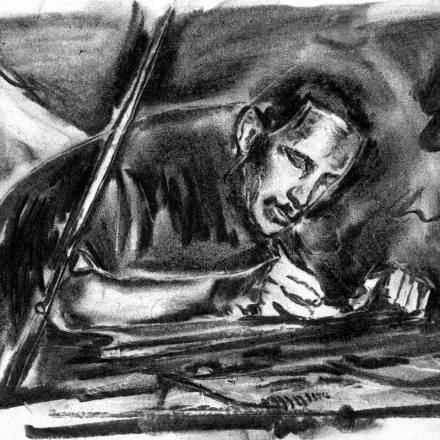
Late one January night in 1945, a young black man stumbled drunkenly toward Broad Street Station in Philadelphia. He was exhausted after playing a long set in a grotty club half a mile away. The naturally nervous musician often used alcohol to settle his unbearable over-excitements and debilitating despairs. On this occasion he had one too many. His awkward gait caught the attention of two policemen. They went to shoo him away, but instead of escorting him peacefully along, something about the twenty-year-old vexed the pair and they began to bash him about the head repeatedly with their truncheons. When the seriousness of his injuries became apparent, after he’d been slung into a frozen cell, he was taken to a hospital to recuperate.

Powell
von trier

The world needs more Lars von Triers

In 2009, cinema audiences were faced with a choice between two talking-fox pictures. The first, most obviously user-friendly option was Wes Anderson’s Roald Dahl adaptation Fantastic Mr. Fox, with the eponymous reynard voiced by none other than George Clooney. If your tastes verged on the darker and more perverse, the Danish director Lars von Trier had a treat in store for you with his controversy-laden psychodrama Antichrist. In one key moment, the male protagonist played by Willem Dafoe is approached by a mangy-looking fox — voiced, uncredited, by Dafoe himself — that declares, in maniacal bass tones, “Chaos reigns!” You wouldn’t get that with George Clooney.

Caligula’s second wind

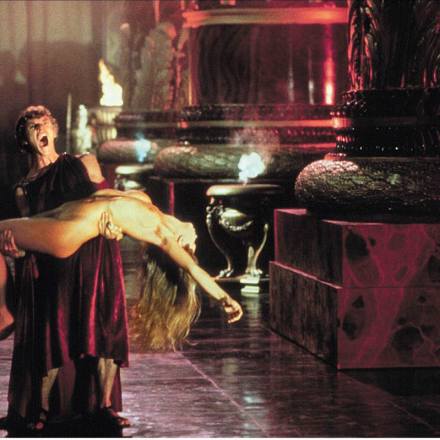
Imagine, if you will, that you are a patron of what used to be euphemistically called “blue movies” at the beginning of 1980, during the so-called “Golden Age of Porn.” The previous few years have seen pornography enter the mainstream in the form of such hugely popular pictures as Deep Throat and Debbie Does Dallas, which saw such stars as Linda Lovelace and Marilyn Chambers briefly achieve nearly the fame (or notoriety) of their Hollywood peers, as their films came close to becoming, if not respectable, at least part of the cinematic fabric of the day. Then you hear tell of something truly remarkable: a big-budget Roman epic with an A-list cast, scripted by Gore Vidal and combining intricately recreated scenes of classical debauchery with envelope-pushing sexual content.

Caligula
Greenwich

Back to the birth of the Greenwich Village music scene

In 1961, the folk guitarist Barry Kornfeld moved back to Manhattan after spending a year in Boston. The Greenwich Village folk musicians he called friends, who before his trip to Boston had been enduring a hand-to-mouth existence, were now making a living playing their music in clubs along MacDougal Street — not necessarily “a good living,” Kornfeld noted, but certainly enough to get by. Kornfeld spotted another difference, too. Audiences at clubs weren’t merely clapping; they were snapping their fingers in appreciation, which felt like the hippest thing ever. Rolling Stone writer David Browne’s latest book, chronicling the history of Greenwich Village music, pivots around 1961.

Will Self’s impressive paean to his mother’s frustrating life in the US

Will Self’s recent, exceptional fictional trilogy, comprising Umbrella, Shark and Phone, displays a deep preoccupation with the ways that time, memory, family, psychosis and history interact. The novels are complex, multigenerational narratives, composed in a late modernist style as engaging as it is experimental. Formal playfulness, with the prose switching between its characters’ consciousnesses, sometimes even midsentence, is married to solidly satisfying plots. Having already excavated his own life in a memoir, Will, Self has now turned to his mother in a novel, Elaine. Self has written about Elaine Rosenbloom before (in the short story “North London Book of the Dead”); she also appears as the narrator, Lily Bloom, in How the Dead Live.

Self
Blood Test

Charles Baxter’s Blood Test is a necessary novel

The books that most vividly and expansively illustrate the human experience are not the ones that grapple with life’s most romantic or fantastical tribulations. Charles Baxter’s latest work is splendid proof of this abiding literary fact. Baxter, a Minnesotan who is author of a multitude of novels and short story collections, returns with Blood Test, a book that delves into some quotidian yet disconcerting aspects of modern American life. He is well-known for 2000’s The Feast of Love, which garnered a National Book Award nomination, and 2020’s The Sun Collective, among others; his new offering continues his tradition of blending the mundane with the extraordinary.

Michael Richards’s memoir is heavier on introspection than laughs

An unusual disclaimer greets the reader on the title page of this memoir of an actor chiefly known for starring as the lovable goofball Cosmo Kramer on the hit TV sitcom Seinfeld. “Neither the US Army nor any other component of the Department of Defense has approved, endorsed, or authorized this book,” it notes. But in the event the Pentagon probably needn’t have worried. Drafted into the army in 1970, the actor in question, Michael Richards, seems to have avoided any Sergeant Bilko-like shenanigans and instead separated from the service with a heightened appreciation for the punctuality, discipline and meticulous preparation that characterized his later career.

Richards