Politics

Read about the latest political news, views and analysis

Watch: Jacinda Ardern’s final cringeworthy speech as PM

It's a bad time for soporific narcissists in office. Just weeks after the self-indulgent grandstanding of Nicola Sturgeon's farewell press conference, Jacinda Ardern has today followed suit. The New Zealand premier treated her long-suffering public to one last display of egotistical over-excitement. Swathed, bizarrely, in a traditional Maori cloak and fighting back tears, the world leader whose pronouns are me/me/me gave her final speech as Prime Minister in parliament. She told legislators in Wellington's House of Representatives that: I do hope that I’ve demonstrated something else entirely. That you can be anxious, sensitive, kind, and wear your heart on your sleeve. You can be a mother or not. You can be an ex-Mormon or not. You can be a nerd, a crier, a hugger.
Nicola Sturgeon’s husband arrested in SNP finance investigation

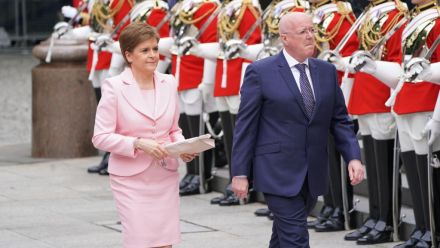
Peter Murrell, the former chief executive of the SNP and the husband of Scotland’s former first minister Nicola Sturgeon, was arrested at 7.45am this morning in connection with an investigation into the SNP’s finances. Murrell was later released from police custody at 6.57pm without charge, pending further investigation. Police raided the SNP’s head office this morning. They cordoned off an area outside Sturgeon and Murrell’s home before Murrell was taken into police custody for questioning by detectives. Searches of the property are understood to be taking place as part of an investigation into a ‘missing’ £600,000. The police search is understood to have expanded outdoors, and detectives have been seen in the garden.

Kemi Badenoch is right to review the definition of sex

Kemi Badenoch is considering a change to the Equality Act 2010 that would restore the meaning of sex to what everybody once understood. I am a science teacher, so I know this. There are two sexes: male and female. Females produces large gametes called eggs while males produce small motile gametes called sperm. Science doesn’t care whether it happens in frogs, monkeys or people – sexual reproduction is a robust process that has been around for millions of years. Maybe – even as recently as 2010 – this was so obvious that it did not need to be stated when legislation was drafted. The Equality Act defines the protected characteristic of sex, quite simply as, ‘a reference to a person who has a particular protected characteristic is a reference to a man or to a woman’.

My unexpected lunch with Nigel Lawson – and Prince Philip

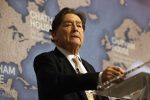
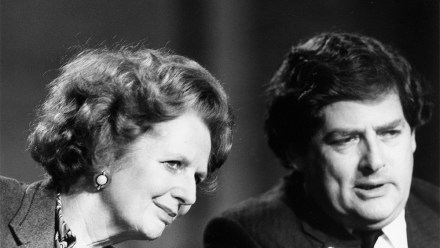
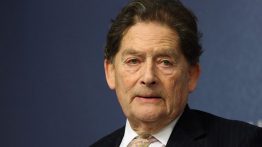
When I joined the House of Lords in 2013 I soon realised that, despite its poor reputation, the place contained plenty of wise, quick-witted and courageous minds. None more so than Nigel Lawson who died this week. An intellectual titan who had once almost become a philosophy professor, he was not content to rest on his considerable laurels as a politician and seemed unafraid to challenge any conventional wisdom to check if it deserved that status. But it was a lunch in 2017 with Lord Lawson and two ninety-somethings who are also now dead that remains probably the most sparkling memory of my nine years as a member of the Lords. It came about thus.

Trump’s indictment is a tempest over bookkeeping

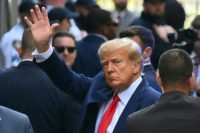
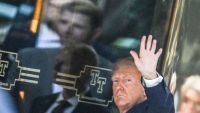
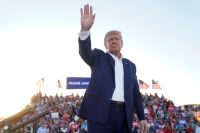
The American rule of law, which seems so precious to holier-than-thou Democrats these days, depends above all on one thing: a belief among the majority that while no one is above the law, it will be applied fairly to those it does affect. Whether you loathe Trump or love him, you know this: what is happening in Manhattan right now is unfair and inconsistent with a nation that once prided itself on believing in the rule of law. Who amongst Americans is still a believer today? The previously sealed indictment shows that Donald Trump was charged with 34 felony counts for falsification of business records. This crime is normally prosecuted in New York as a misdemeanour.

The insanity of the anti-Trump ‘resistance’ led America to this point

They have come from far and wide today to see the elephant in New York City. The #Resistance that promised so much from its dawning days, which turned the fever dreams of millions of Donald Trump-hating Americans into a cash machine for books, non-profits and cable news, has come to its apex. They’re actually doing it! They’re indicting the Orange Man. And the people are coming to town to see it. The #Resistance has come a long way since Chuck Schumer told Rachel Maddow that then-President-elect Trump was ‘being really dumb’ to attack the intelligence community which has ‘six ways from Sunday at getting back at you.’ It has meandered through a series of heroes who fell short time and again.

Scotland’s cancer crisis has been laid bare

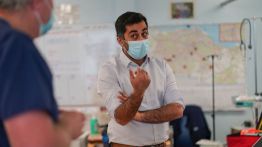
Scotland’s cancer wait times have hit the worst levels on record, as shown by a Public Health Scotland report that was released today. Under 72 per cent of eligible patients received their first cancer treatment within 62 days of being urgently referred in the quarter ending 31 December 2022, while the target is 95 per cent. This revelation comes less than a week after new health secretary Michael Matheson was appointed to Humza Yousaf’s cabinet, and will make for uncomfortable viewing. Of 4,262 eligible patients who were referred urgently for cancer treatment, over 1,200 were left waiting for more than 62 days after they had been referred before they received their first dose.

Has Kate Forbes begun her comeback?

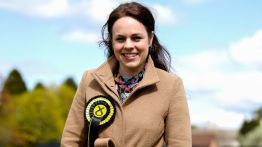
Kate Forbes may have lost the battle but will she win the war? Forbes narrowly missed out in the SNP leadership race last month but she has handled her defeat much more gracefully than Humza Yousaf has greeted victory. While the Farce Minister has purged anyone of any talent from his cabinet, Forbes has done the sensible thing: left office without a public fuss while her allies brief the press on her behalf. Following reports that a 15-strong SNP caucus is being set up to keep the Forbes flame alive, the lady herself is flexing her Highland muscles. She has today been announced as the new weekly columnist for the National, the Paisley Pravda which self-identifies as a newspaper.  So why not the Herald or Scotsman?

What I learned from Nigel Lawson

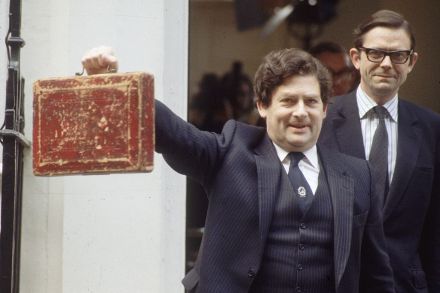
The memory of Nigel Lawson will always be a blessing. He was the embodiment of serious radicalism, a politician who changed Britain for the better – and for good. When I became chancellor, I hung a picture of Nigel behind my desk in No. 11. It was a large photograph of him holding up his red Budget box. It was an image which summed up the intellectual confidence that he brought to the job. But it was also a reminder of the sheer amount of preparation, hard work and attention to detail that he had put in to get the party and the government into a position where it could do those radical things.

It’s springtime for Rishi

Two years ago when the Tories won the Hartlepool by-election at the local elections, the political mood was summed up by a 30ft inflatable blow-up of the then prime minister Boris Johnson looming over the town. He was photographed in front of it as part of his victory lap. The message was clear: under his leadership, the Tories were insurmountable and no seat was safe for Labour in what used to be the party’s heartlands. There are no plans for similar photo ops for the local elections next month. In fact, according to one No. 10 staffer, photographers are actively being avoided. No national media were invited to the Tories’ campaign launch. The elections are viewed in Downing Street as an exercise in damage limitation.

Get ready for the Passion of The Donald

It won’t have escaped Donald Trump’s notice that his arrest has come during Holy Week, when our Lord and Saviour was sentenced by a cruel mob and crucified only to rise again. Trump — aka ‘the Tangerine Jesus’ — has long understood the religious power of politics in America. That’s why ‘I am your retribution’ is his campaign pitch in 2024. It’s why, recovering from Covid in the run up to the 2020 election, he described his recovery as ‘a blessing from God’ and behaved a bit like Lazarus brought back from the dead. It’s why he accuses the Democrats of stealing ‘our sacred elections.

Rishi revels in his ‘Stop the Boats’ message

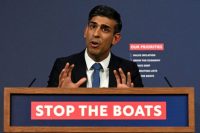
Four weeks ago Rishi Sunak proudly unveiled the branding for his campaign to deter migrant Channel crossings. Standing at a lectern, the Prime Minister unveiled his new, stark slogan: ‘Stop the Boats’ – a message emblazoned on his backdrop and podium. And, in keeping with the Prime Minister’s other ‘five prioritises’ of reducing debt, Mr S has discovered that the fiscally-conscious Sunak is keeping the spirit of Cop26 alive in No. 10 by recycling his older lecterns, rather than buying a new one. According to a Freedom of Information request response from Downing Street, the expenditure on the snazzy new set up was a mere £1,575 - the cost of the backdrop to illustrate Sunak’s much-trumpeted ‘five pledges’.

Why Democrats want Trump

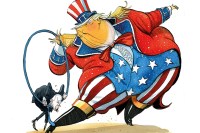
Manhattan district attorney Alvin Bragg’s indictment of an even more prominent fat man seems a big win for Donald Trump, regardless of how the case is decided. If convicted, Trump is a martyr, managing to portray himself once more as a persecuted Washington outsider, a status that’s quite a feat for a politician to retain after setting up shop in the White House for four years. If found not guilty, Trump is exonerated, a contrived case likely to rely on tentative legal reasoning exposed as an overtly partisan manhunt. After all, in a Quinnipiac poll last week, a plurality of Americans (42 per cent) considered the charges in New York either ‘not too serious’ (16 per cent) or ‘not serious at all’ (26 per cent).

What’s going on with Carol Vorderman?

It seems that Labour have a secret weapon in their local election campaign. For months now, Carol Vorderman has been on a one-woman war against the Tories, taking to Twitter to decry the incumbent government. The former Countdown star is a devotee of the all caps tweet, railing against her onetime friend turned bête noire Michelle Mone with such understated gems as 'the greed of the rich knows no limit ALWAYS remember that'. Her online crusade has also been conducted in the TV studios, including an earnest speech about Rishi Sunak's financial investments on ITV's This Morning, to the bemusement of fellow guests Alison Hammond and Dermot O'Leary. Her latest campaign though is a positively Herculean feat of investigative journalism.

Nigel Lawson’s legacy is one of British transformation

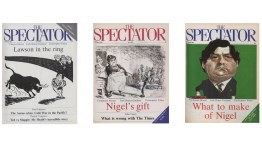
The path from the editor’s chair at The Spectator to 11 Downing Street was not untrodden when Mrs Thatcher asked Nigel Lawson to replace Geoffrey Howe as Chancellor of the Exchequer after the 1983 general election. Iain Macleod had made the same journey in 1970. But whereas Macleod died 13 days into the job, Lawson went on to become Britain’s most significant post-war chancellor, and the architect of high Thatcherism. You have to be at least 50 now to remember the stupor in which the British economy lay when Lawson took office. The statist economy of the 1970s, with its wretched labour disputes and under-performing nationalised industries had still not been fully dismantled.

France’s Boomers have a lot to answer for

Paris has banned e-scooters after the people were asked to vote in a referendum. Not many of the capital’s 1.38 million registered citizens bothered to cast their ballot on Sunday, but of the 103,000 who did 90 per cent voted against.   The Mayor of Paris, Anne Hidalgo hailed the referendum as a red letter day for ‘participative democracy' over ‘democracy of public opinion and polls’. The city’s three e-scooter operators – Dott, Lime and Tier – quickly cried foul, citing what they described as ‘very restrictive voting methods’; only 21 voting stations were open, and there was no internet voting.

Nigel Lawson: 1932-2023

Nigel Lawson has died at the age of 91. He was the editor of The Spectator from 1966 to 1970 and then a Conservative politician who served as Chancellor of the Exchequer from 1983 until 1989. Below is an article written by Lawson in 1967 on the need for 'An Alternative Economic Policy', written some 16 years before he entered No. 11 under Margaret Thatcher and was able to realise that vision. So far as the short term is concerned, it is generally agreed, right across the political board, that the state should intervene at any rate to maintain full employment, to prevent undue inflation and generally to iron out so far as is possible the fluctuations in the trade cycle. Nor is there a fundamental difference between Conservatives and Socialists about how this ought to be done.