Music and Opera

Our curation of music and opera reviews

Was Elgar really a snob?

There’s not much point pretending to be an expert on Elgar (or so The Bluffer’s Guide to Music assures us) because everyone already thinks they are. And there’s definitely no point getting hung up on the historical accuracy (or otherwise) of Alan Bennett and Nicholas Hytner’s new film The Choral. It’s set in a West Riding mill town during World War One and the plot pivots around the local choral society’s performance of The Dream of Gerontius. This being Bennett, of course, there’s rather more to it than that, but in any case – spoiler alert, and there’ll be more – Sir Edward himself makes a cameo appearance: Simon Russell
In defence of Katie Mitchell

Janacek’s The Makropulos Case is a weird and very wonderful opera, but its basic plot isn’t hard to follow. Still, it seems to send directors into a tailspin. One recent production (since revised) had a cast member break character and pull out a flipchart to recap the story so far. Katie Mitchell’s new staging for the Royal Opera takes the more familiar route of updating the action to the present, and it’s always fascinating to see what opera directors think we’ll find relatable. Luxury hotels, recreational heroin use, Tinder hookups with locally sourced hotties: no, me neither. How the other half live, eh? In short, it’s a bit like Mitchell’s

Mrs Göring is far too sympathetic: Nuremberg reviewed

Nuremberg is one of those films that falls short on everything it wants to be and everything it could be. It’s a historical drama, set just before the trials, where an American psychiatrist (Rami Malek) is charged with assessing whether Hermann Göring (Russell Crowe), Hitler’s second in command, is fit to stand trial and to ascertain what his defence might be. This should be electric and terrifying and take us inside the Nazi mind. In other words, I had expected a tense two-hander. But it’s serviceable rather than inspired, plodding rather than tense, its running time (two and a half hours) trying. (Keep a Red Bull to hand.) It also

The rise of psychedelia

On YouTube – and I urge you to look it up – there is a magnificent piece of footage from German TV, in which big band leader James Last leads his orchestra into a medley of hard rock hits, opening with Hawkwind’s deathless space-rock drone ‘Silver Machine’. And damn it if they don’t nail it. The members of the band with electric instruments play it just as Hawkwind did: the whooshing synth, the thudding bass, the fuzzing guitar. But instead of Lemmy growling out the topline melody, there is a huge rush of brass from the band, the brightness cutting unexpectedly through the murk. It is, unironically, brilliant. I have

This Othello is almost flawless

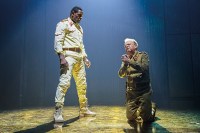
Othello directed by Tom Morris opens with a stately display of scarlet costumes and gilded doorways arranged against a backdrop of black nothingness. This is Venice at night with no hint of sea or sunshine. Crimson-robed senators gather to discuss Othello’s alleged abduction of Brabantio’s daughter. And here he comes, David Harewood as the Moor, wearing a gauche two-tone suit like a tasteless guest at a wedding. The scene is stiff, arid and over-ornate but the show opens up when the location shifts to Cyprus. Warmth and light fill the stage and the costumes improve. Othello and his men wear creamy white battle fatigues that look stylishly and subtly masculine.

Del Toro's Frankenstein offers nothing new

Guillermo del Toro’s Frankenstein stars Oscar Isaac (Baron Victor Frankenstein) and Jacob Elordi (‘the creature’) and retells the basics of Mary Shelley’s story – man creates monster, man rejects monster, monster goes off on one – with high-camp sumptuousness. Del Toro’s spin is to include a redemptive arc, plus he throws in some invented characters. ‘The creature’, meanwhile, is portrayed with great sympathy, as a soulful, mistreated innocent. In other words, there’s no Boris Karloff lumbering around in that blazer a size too small with a bolt through the neck. It opens with a Danish expedition-ship stuck in the Arctic ice and the crew rescuing an injured Victor. They are

Violin concertos from two Broadway legends

Grade: B+ The 20th century, eh? What a lark that was. Vladimir Dukelsky studied in Kiev under Glière and looked set to be one of the smarter Russian composers of his generation. He even wrote a ballet for Diaghilev. Then communism happened and Dukelsky ended up in the USA where to the bemusement of his friend Prokofiev he reinvented himself as Vernon Duke, Broadway songsmith. ‘Autumn in New York’ and ‘Taking a Chance on Love’ are both by Duke; classic Americana by way of Tsarist Ukraine.  Duke’s Violin Concerto (1943) is recorded here alongside the 1941 concerto by Robert Russell Bennett – better known as the king of Broadway orchestrators;

What a joy La Fille mal gardée is

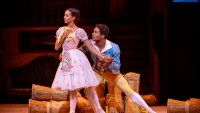
The winter nights may be drawing in and everyone is down with stinking colds as the civilised world inexorably disintegrates, but in La Fille mal gardée, it’s sunlit springtime and young love is busting out all over. Frederick Ashton’s bucolic masterpiece, revived by the Royal Ballet, manages to be both child-like in its innocence and wickedly sophisticated in what it demands of the dancers – it looks so artless, so easy, and it just isn’t. Of Ashton’s supreme genius in the devising of it all there can be no doubt, but John Lanchbery and Osbert Lancaster deserve credit too – Lanchbery’s pasticcio score is a chocolate box filled with toe-tapping

Film and TV are run by satanists

I once came up with a brilliant idea for a children’s Sunday-evening TV series. It would follow the adventures of young Jesus in Britain, circa AD 16, and his rich, tin-trading great uncle Joseph of Arimathea. There’d be dragons and giants and lots demonic figures, all trying to kill the boy Messiah before He achieved his true purpose. And young Jesus would continually be constrained from using any of His real powers because it was all a secret and His time had not yet come. If you’re clever, you can probably guess the title. But it’s never going to get made because a) I haven’t written it and b) the

A cracking little 1967 opera that we ought to see more often

Ravel’s L’heure espagnole is set in a clockmaker’s shop and the first thing you hear is ticking and chiming. It’s not just a sound effect; with Ravel, it never is. He was an inventor’s son, half-Swiss, half-Basque, and timepieces, toys and Dresden figurines were in his soul. For Ravel, they seem to have possessed souls in their own right. ‘Does it not occur to people that one may be artificial by nature?’ he remarked, and few artists have shown such tenderness towards these small, lovingly made things that strive so tirelessly, and so hopelessly, to be alive. So that was something to think about, as Alexandra Cravero conducted the opening

Dimes Square on screen

I can’t watch films anymore without looking at my phone. If I watch a film on my laptop, I’ll be scrolling throughout – reading Wikipedia, checking group chats, looking up filming locations on IMDb. To properly watch a film, I have to take myself to the cinema. Luckily, and perhaps as a direct result of our scrolling habits, London’s indie cinema scene is having an ascendent moment. I recently ventured down to Peckham for two screenings at the Ivy House, a pub with a cinema room where films play on a stained pull-down projection screen. Both screenings were organised by Deeper Into Movies, which puts on arthouse films at cinemas

Let's face it, Sleeping Beauty is a bit of a bore

Let’s face it, The Sleeping Beauty runs the high risk of being a bit of a bore. A wonderfully inventive score by Tchaikovsky fires it up of course, but precious little drama emerges after nasty Carabosse gatecrashes the royal christening, and there’s too much imperial parading and courtly kowtowing throughout. Connoisseurs may relish what survives of Petipa’s choreography as a lexicon of academic classicism, but it has to be magnificently danced if it is to be animated. And it almost never is. English National Ballet has revived Kenneth MacMillan’s production, originally staged by American Ballet Theater in 1987. On the first night of the current run, the lighting was prosaic

No band should play Ally Pally

The last time Gillian Welch and David Rawlings played in London it was a different world: the world of David Cameron and Barack Obama and a Manchester United at the top of the Premier League. Welch and Rawlings have changed, too: Welch is silver rather than red, and Rawlings as grizzled as a bear. Welch was in brown floor-length dress and Rawlings in suede jacket and cowboy hat. With a rather younger upright-bass-player, Paul Kowert, the trio looked like farmers trying to save their land from The Man in some Taylor Sheridan TV series. And then they started singing. Welch and Rawlings have released records under their own names and

Perfection: Hampstead Theatre's The Assembled Parties reviewed

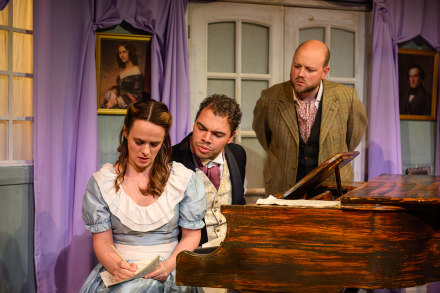
The Assembled Parties, by Richard Greenberg, is a rich, warm family comedy that received three Tony nominations in 2013 following its New York première. Hampstead has taken a slight risk with this revival. The cryptic title doesn’t suggest an easygoing drama full of excellent jokes. The Yiddish slang may be unfamiliar to English ears, and the social pedigree of the family needs explanation. These are wealthy New York Jews living in a 14-room apartment which they rent but don’t own, so their fortune is insecurely anchored. And the action starts in 1980 and fast-forwards to 2000 so it feels like a period piece aimed at the over-sixties. Those drawbacks aside,

Why was the 19th century so full of bigots and weirdos? 

Da Vinci’s Laundry is based on an art world rumour. In 2017, Leonardo’s ‘Salvator Mundi’ sold at Christie’s for $450 million but some experts claimed that the attribution was inaccurate. Could the world’s costliest artwork be a fake? Writer, Keelan Kember, considers the provenance of a fictional Leonardo owned by a thuggish oligarch, Boris, who claims to have bought the masterpiece at a flea market. He invites two posh British experts, Christopher and Milly, to authenticate the painting and when Christopher questions its origins he earns Boris’s instant displeasure. Boris threatens to toss Christopher from the roof of his luxury mansion. Enter a brash American, named Tony, who wants to

A Magic Flute that will make you weep

English Touring Opera has begun its autumn season and the miracle isn’t so much that they’re touring at all these days, but that they do it so well. Two generations back, this was the natural condition of opera in the UK: not Netrebko at Covent Garden, but agile, medium-scale companies playing at the Wolverhampton Grand or the Sheffield Lyceum alongside the panto and the 1950s equivalent of Friends: The Musical and An Evening with Sandi Toksvig. Don’t believe it? It’s all in Alexandra Wilson’s new book Someone Else’s Music, which is out now, and which all British opera buffs should read because it’ll make their jaws drop. Case in point:

The new Springsteen biopic is cringe

Springsteen: Deliver Me from Nowhere is a biopic of ‘the boss’ starring Jeremy Allen White. It is not cradle to grave and do not expect the usual crowd-pleasing beats. There isn’t a single montage. Instead, it focuses on 1981, the making of his sixth album, Nebraska, and his mental troubles at that time. This will doubtless satisfy the completists. But non-completists – I could have named only two of his songs, tops – may wonder if it’s that interesting. Also, as White’s performance isn’t a million miles from tortured chef Carmy in Disney+’s The Bear I kept expecting him to put down his guitar and go tweeze micro-herbs on some