Culture

The good, the bad and the ugly in books, exhibitions, cinema, TV, dance, music, podcasts and theater.

Our long national slapmare continues

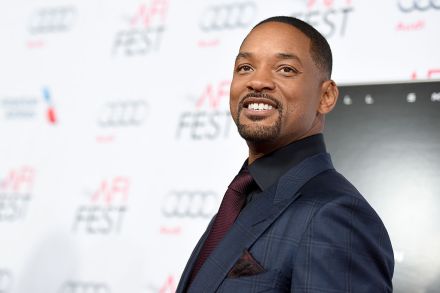
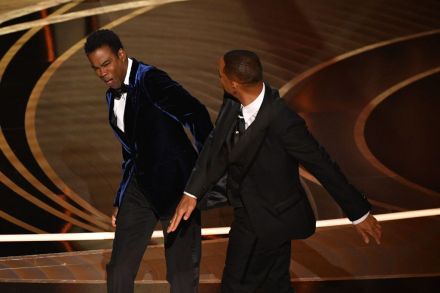
Jesus is going to come back and we're going to ask him about The Slap aren't we. He'll be standing there, resplendent in his all his glory, preparing to feed the poor and clothe the naked, when some jamoke on an iPhone will walk up and say, "Did you see this GIF edit where it's totally Timothée Chalamet instead of Chris Rock?" Yes, our long national slapmare has now entered its third week and it shows no sign of breaking. Viral phenomena usually subside pretty quickly but Will Smith's front-hand to Chris Rock at the Oscars has proven to have legs. To show how deep the mania runs, last week I saw an electoral map breaking down which states support Smith versus Rock based on Twitter data.
will smith

Finding the religious right in remote Wisconsin

The New York Times has re-discovered the religious right. In a front-page story, we learn the awful truth that there is a "right-wing political movement powered by divine purpose, whose adherents find spiritual sustenance in political action." They sing hymns; they pray; they burn candles. They import “their worship of God, with all its intensity, emotion and ambitions, to their political life.” Quite a few support Trump and also protest “against Covid restrictions,” among other unspeakable acts. Once, long ago, I ventured into this dark territory, not armored by the shield of New York Times-style contempt for the deplorables, but like Marlowe heading up river into the Heart of Darkness. It was a hard-won lesson.

Just whistle while you woke

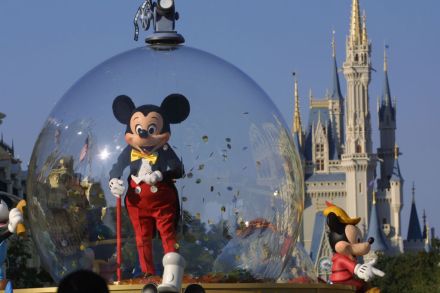
It’s the dream of every little girl: Prince Charming rides in on a white horse and asks her to come with him. They gallop off to his castle where he takes her hand, gets down on one knee, and says... “BIPOCs and other marginalized groups face cultural genocide thanks to a patriarchy that encourages heteronormativity and ableism.” To which she sings, “When you microaggress upon a starrrrrrr...” Yes, from out of the “too tone deaf to function” file this week comes the Disney corporation, that peddler of fairytale escapism, which has now gone full woke. Its new business model appears to be as follows: Disney hikes its ticket and merchandise costs, making its theme parks increasingly unaffordable to poor and middle-class families.

New York City’s desperate attempt to lure Floridians

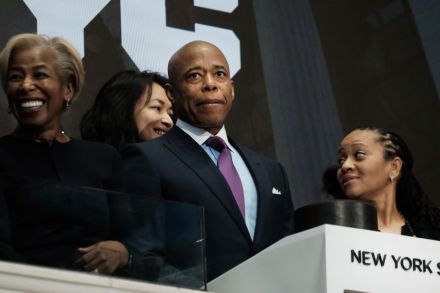
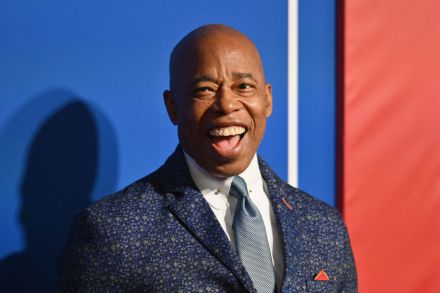
In his latest desperate attempt to prove that New York is “back,” the city’s hapless mayor Eric Adams has taken a hysterical potshot at Florida — a much happier jurisdiction to where many of his constituents have had the good sense to move. Adams announced that private funds made available to his cash-strapped city would be used to place billboard and digital ads in five booming Florida markets: Jacksonville, Orlando, Tampa, West Palm Beach and Fort Lauderdale. These ads invite Floridians to “come to a city where you can say and be whoever you want.” The jibe is directed at Florida’s recently approved Parental Rights in Education bill, which prohibits instruction in sexuality and gender identity for children from kindergarten through third grade.

How ‘questioning authority’ gave us wokeness

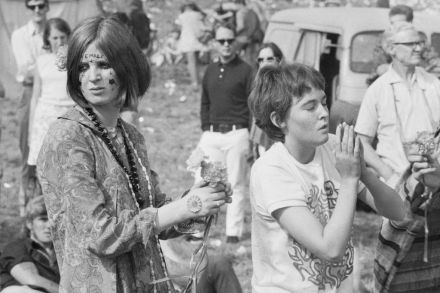
When I was in high school in the late 1960s, a bumper sticker, “Question Authority,” became a common sight, as did a button saying the same thing, usually worn on a tie-dye T-shirt or denim jacket. I was among those contrary teenagers who wanted to know, “On whose authority am I commanded to question authority?” The answer wasn’t hard to find. The man who most visibly pushed the slogan was former Harvard clinical psychologist and ardent LSD proponent Timothy Leary. He was known for his counsel “Drop out, turn on, tune in,” which was adopted by his League of Spiritual Discovery, which turned LSD into a sacrament. Whether Dr. Leary originated “Question Authority” or just promoted it is unclear, but that seems apposite.

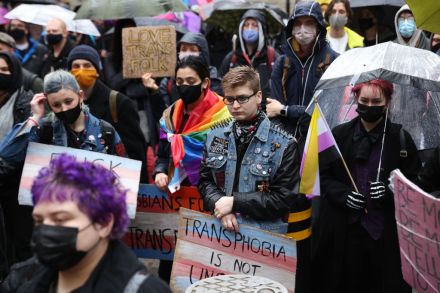
There’s nothing ‘pro-trans’ about deleting women

I can pinpoint the moment I knew I wouldn’t be able to remain, as I had thought of myself until that time, “pro-trans.” I had grown up in 1990s New York City and had known many gender-bending people. Very few called themselves “trans,” but androgyny was in. Drag queens ran the club scene. “Girls who want boys/Who like boys to be girls/Who do boys like they're girls/Who do girls like they're boys,” the 1994 Blur song went. What was the big deal about being a girl who wanted to look like a boy or a boy who wanted to present as a girl? No one was hurting anyone. You like red lipstick, that boy likes wearing a dress. Who cared? I certainly didn’t. It was the early 2000s, the heyday of the blogosphere, and the comment sections were lit.

Will Smith: the last gentleman

Cardinal Newman said that “it is almost a definition of a gentleman to say that he is one who never inflicts pain.” The key word there is almost, because some things are worth more than gentleness. Honor, for one. For those who somehow missed it, at the Academy Awards on Sunday, host Chris Rock made a crack about Jada Pinkett Smith’s shaved head (Mrs. Smith has alopecia). Her husband Will Smith then climbed onstage and slapped Mr. Rock. America was horrified. Yet Mr. Smith was just obeying the first rule of chivalry: if you insult a guy’s wife, get ready to throw hands. To be fair, Mr. Smith probably should have struck Mr. Rock with a glove or something. Cold-cocking him wasn’t very dashing. And the language he used afterwards was a little crude.

We are all still prisoners of the Sixties

In her 1970 essay “On the Morning After the Sixties,” author Joan Didion recalled a Berkeley autumn weekend seventeen years earlier when she was reading Lionel Trilling in a fraternity house instead of going to the football game, a collegiate occasion fixed in the memory of an earlier era, “so exotic as to be almost czarist.” It suggested “the extent to which the narrative on which many of us grew up no longer applies,” Didion observed in her crisp, distinctive tone. Before the Sixties, youthful elites were close enough to their patrimony to respect its intellect, energy, values and travail. Liberal guilt, such as it was, rarely went further left than Rockefeller Republican.

The trans debate shows we’re all supremacists

Why did Lia Thomas bother changing his name? According to the gender-studies mavens, it wasn’t strictly necessary. A trans woman doesn’t need a vaginoplasty or breast implants. He doesn’t even need to wear dresses. He doesn’t have to date men, or watch Downton Abbey or merge into traffic without checking his blind spots. Those are all socially constructed ideas of femininity. Trans women don’t have to conform to these sexist, patriarchal norms. Womanhood is a state of mind. The question, of course, is: what kind of state? The LGBT lobby refuses to answer that question. The official line is that anyone who identifies as a woman is a woman. If Hugh Jackman came out today and said, “Oi, mate, I’m a sheila,” a sheila he’d be. Fair dinkum.

Hollywood, fist-fights and getting canceled

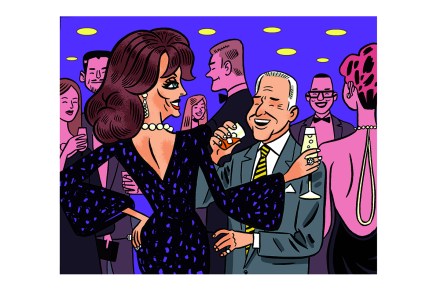
Introductions Scene: a drawing room in London. When the recording starts, Taki is already mid-anecdote... Taki: I was sent out to Monte Carlo to speak to Roger Moore. The Spectator offered to pay all my expenses. I said thank you, I’ll pay my own. I went and had a terrific drunken dinner with Roger who really spilled the beans, cos we were buddies. I came back. The tape was empty because I’d never turned the recorder on. Joan: I’d known Roger since I was fifteen, because my father was a big agent in London and I came back from school — oh, fourteen actually, because I left school at fifteen — and there’s the most gorgeous man I’ve ever seen standing there. He came over and said, “How do you do? You must be Joan, my name is Roger Moore.

Joan Collins
Mamet

Why David Mamet went right

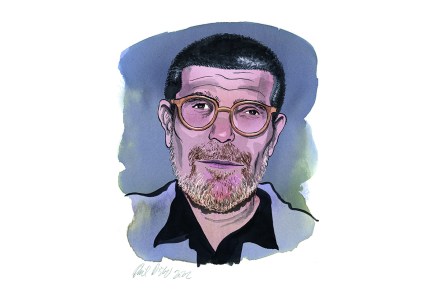
How did David Mamet spend the pandemic? The answer, as anyone familiar with the prolific, brilliant playwright and screenwriter would probably have guessed, is that he wrote. “I’ve been writing a lot of essays lately,” Mamet, seventy-four, says when we meet at his Santa Monica home on a cool January evening. “Because, you know, I don’t want to go and sit on a park bench. I’m a writer.” A collection of essays written during the tumultuous plague years is published this month by Broadside, an imprint of HarperCollins. Recessional: The Death of Free Speech and the Cost of a Free Lunch is combative, challenging, witty, and, as the title suggests, its prevailing mood is as dark as the “terrible” period in which it was written.

Twitter suspends the Babylon Bee for telling the truth

Admiral Rachel Levine, who currently serves as assistant secretary for health in the Biden administration, is not a woman. This is simply a statement of fact. Rachel Levine is also not a powerless, marginalized individual. Yet Twitter as a company seems to believe that pointing out both of these truths is worth suspending accounts over. The conservative satire website Babylon Bee recently found their account locked over a tweet they recently sent naming Rachel Levine their “Man of the Year.” The joke was in response to USA Today naming Levine its Woman of the Year despite Levine not being a woman. By writing this piece and tweeting it out, I and perhaps the Spectator could also find their Twitter accounts suspended.

When victimhood is a game, everyone loses

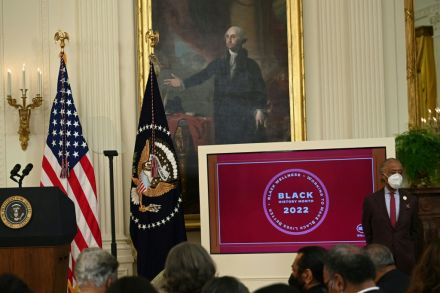
Black History Month is now over, and we’ve moved on to Women’s History Month. In April, we’ll get the best of both worlds, with Black Women’s History Month. May will be Jewish-American Heritage Month, and then in June the nation will enjoy a blowout celebration of LGBT Pride Month, if the normalization (and commercialization) of the cause in recent years is any indication. The point of all of this is to serve as an annual national re-ratification of diversity, inclusivity and equity as America’s preeminent causes (and doctrines, as Spectator World editor Matt Purple has so perceptively assessed).

Pop culture is making millennials miserable

When I went to the mall last week, I noticed all the women in their late teens and early twenties were wearing the same thing: long-sleeved tees with little prints, high-waisted jeans and canvas sneakers. It was a little surreal, because that’s how the girls in my preschool used to dress. Apparently, college students have collectively decided to dress like toddlers from the late Nineties. According to pop-culture experts, many of my fellow millennials are feeling a little disoriented, too. We’re undergoing what they call a “vibe shift.” And sadly most of us aren’t going to make it. As Allison P.

self millennials

#Wanderlusting

I’m twenty-seven weeks pregnant, which is technically the last week of my second trimester, and shit is getting real. Apparently, this is also the “longingly and obsessively scroll through Instagram travel pages” phase of pregnancy, so of course Facebook took it upon itself to remind me that nine years ago today I was in Sri Lanka. The algorithm is tormenting me. I’m wanderlusting. Wondering if I’ll ever travel again. Reminiscing about the good ol’ days. As I scroll through my photo albums on Facebook, I am reminded of how often people would comment, “You’re so free!” The people who said this to me over the years had “real” jobs and mortgages and pets and kids.

traveling

Fifty years of Fear and Loathing

God bless Hunter S. Thompson’s editors. Imagine paying someone a handsome amount of money to cover an off-road race and getting thousands of words of rambling prose that have a great deal more to do with drugs than with cars. It was a good time to be a writer, I suppose. The manuscript that became Fear and Loathing in Las Vegas appeared in two installments in Rolling Stone in November 1971. (Sports Illustrated passed.) Somehow, this rabid work of “gonzo journalism” spawned a book, a film, a graphic novel and a host of imitators, catapulting Thompson to the higher realms of fame. He never recovered from his own success. Fear and Loathing is easily summarized. Raoul Duke (Thompson) and his friend Dr.

thompson

Hunting deer in the DC suburbs

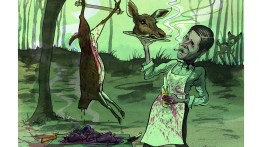
I was driving along in my 2018 Honda minivan when I received a call from a member of the National Symphony Orchestra who has been on leave since March 2020: “Just bagged a doe. If you’re up for it, I’m going to gut this thing.” I regretted taking the call through the van’s speakerphone. A text message followed; thankfully the image did not project onto the dash display. I spent the rest of the drive to school explaining to my four daughters how Daddy had to dissect Bambi for work. My father took me hunting once in high school. He shook me awake at six in the morning, loaded me into the family car, a 1998 Chevy minivan, then drove it straight into a deer. I can still picture the white-spotted fawn’s body cascading across the asphalt. “Thank God it was just a baby.

deer

What’s in a name?

I used to have a cantankerous old relative who hewed to generalizations drawn from long experience. One of them concerned people named “Adam.” On a Sunday morning twenty years ago, as we sat around reading the papers, I mentioned Adam Sandler — or maybe it was Adam West or Adam Vinatieri. “All Adams are assholes,” he grumbled. “You ever notice that?” I tried to respond with some piety about how these people were not to blame for being called Adam. But I had a nagging sense that that was not how the Wheel of Onomastic Destiny spun. I had spent much of my adult life looking for heroic qualities in people bearing my own middle name, which is Scott. Even before I was fully emerged from childhood, Scott had acquired a bad name.

name

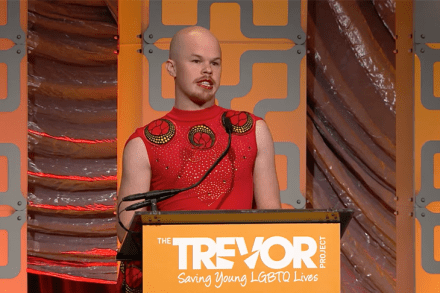
Sam Brinton and the dorkification of kink

Remember when gay people were cool? Libertines and romantics, reviled, spat-upon, defiant and irreverent? Gay life could be sexy and thrilling, tragic and shameful. If the homosexual offered nothing else, he carried an arsenal of bawdy tales that left any housewife glued and dithering at a cocktail party. Judge his life as you may, but never call it ordinary. The mystique is gone. That dusky boundary between the dark and dirty and the workaday has evaporated. Assimilation has meant the faces of gay are either vapid, Instagram-famous semen receptacles, complete goobers or repulsive shrills. And they’ve dragged the rest of us, by association, into their orbit of cringe. The Forces of Biden particularly love the latter two.

sam brinton

Eric Adams and the new Democratic censors

Eric Adams had no idea what drill rap was until just last week when his son introduced him to it. Now he’s convinced it’s the reason for rising rates of lethal firearm crimes in New York City. As crime spirals to new highs in urban areas nationwide, Democratic mayors, who have controlled these cities for decades, are looking for any excuse that doesn’t implicate their policies or those of their predecessors. That’s why Mayor Adams has turned his attention to the presence of an aggressive form of hip-hop on YouTube. Adams threatened to pull social media companies into the principal’s office and “sit down with them and state that, ‘you have a civic and corporate responsibility.

eric adams censors