Books

A time for Ice and Fire

No one likes to watch television with me, because I am that sick pedant who delights in pointing out anomalies and plot-line errors, never more so than when the show in question is connected in some way to a cherished book. That’s when my pedantry enters an almost superhuman phase, as I educate the room about literally every single deviation from the original literary source. HBO’s Game of Thrones series was an absolute gold mine in this respect, because it came out just after I’d finished devouring the books in George R.R. Martin’s epic series. If you haven’t read those books, you should do so now — as you may never again have this much spare time on your hands.

a song of ice and fire

Going both ways

Probably most of the world is bilingual, or more than bilingual. It is common in many countries to speak a national language alongside an international lingua franca such as Arabic, Spanish or English. On top of that, there may be a mother tongue that is not the same as a national language. A Nigerian, for instance, may be at once one of the million speakers of Berom, one of the 64 million speakers of Hausa and one of the 1.13 billion speakers of English. The same pattern is repeated across the globe.

bilingual brain

Dave Rubin’s ode to the so-called ‘independent thinker‘

Dave Rubin loves to talk about ideas. In his new book, Don't Burn This Book, he tells the reader:‘I want you to walk into a bar and order yourselves a full-bodied opinion. I want you to get absolutely wasted on facts until 3:00 a.m., and then, when you’re just about ready to pass out, I want you to get another large glass of reality and chug it.’It's telling that Rubin suggests that we order the opinion before the facts. Would it not make more sense to suggest, say, blending a cocktail of facts into an opinion? Rubin’s advice seems backwards to me.But it would be wrong to take this suggestion seriously. Don't Burn This Book is not a serious work. It is, in fact, extremely lazy, bearing all the hallmarks of a project that was knocked together over a few wet weekends.

dave rubin

Why men don’t read books anymore

When John F. Kennedy was dating Jacqueline Bouvier, he gave her two books. One was Pilgrim’s Way (1940) a memoir by the British spy and author John Buchan. The other was The Young Melbourne (1939) by Lord David Cecil, which describes the raffish exploits and political intrigues of a Whig aristocrat, and later prime minister, in the early 19th century. Quite what Jackie thought of this is unrecorded. Later President Kennedy told Life magazine what his favorite books were. Both of the titles above were in this proto-listicle, along with works about Byron, John C. Calhoun, Talleyrand and Gibbon’s The Decline and Fall of The Roman Empire.

read books

Dedicated to literature

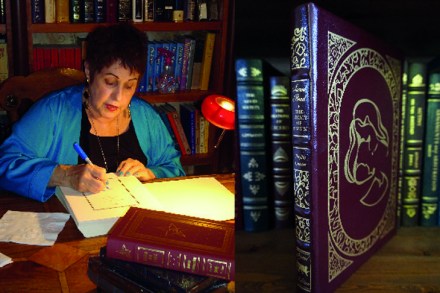
The convention is that if you happen to meet authors and have just bought or acquired a book of theirs, you ask them to sign it. Particularly stuffy authors might refuse, but in most cases they feel flattered and duly inscribe your name and theirs on the title page or the flyleaf of the book in question. If the mood is right, they may add ‘with best wishes’ or something of the sort. At a superficial level, of course, such signatures are only the equivalent of an autograph album. There’s more to it than that, however. Added value perhaps, but association certainly. The human race lives by the stories we tell ourselves about our identity and our purposes, and that signature helps to make the author’s story part of the reader’s story.

signatures david pryce-jones

The wisdom of Salman

‘Things that would have seemed utterly improbable now happen on a daily basis,’ Sir Salman Rushdie tells me. ‘The implausible has now become everyday.’ Isn’t this a problem for a writer whose books derive from the fantastical traditions of magic realism and science fiction, where crazy stuff happening is what sets them apart? ‘It is.’ The active threat to Rushdie’s life from radical Islam is two decades behind him. His novels have a way of dealing in sour, sometimes apocalyptic ironies. His latest, the Booker-shortlisted Quichotte, is set in what it describes as ‘the Age of Anything-Can-Happen’.

salman rushdie

It’s different for girls

‘Buy pink baby clothes,’ Kim Jiyoung, the protagonist of this best-selling South Korean novel is told at the obstetrician’s office. Jiyoung’s mother responds: ‘It’s OK, the next one will be a boy.’ There are numerous births in this book. Births of girls are met with disappointment. The births of sons are celebrated. When Jiyoung is born in 1982, ‘abortion for medical problems had been legal for 10 years...aborting females was common practice as if “daughter” was a medical problem’. Her younger sister is ‘erased’.

jiyoung
warhol

Magus of mass production

‘If you want to know all about Andy Warhol,’ the artist said in the East Village Other in 1966, ‘just look at the surface: of my paintings and films and me, and there I am. There’s nothing behind it.’ This quotation re-appeared in 2002 on the US Post Office’s commemorative Warhol stamp. It’s fabulously fitting for a stamp that reproduced a self-portrait, but when scholars recently compared the audiotapes of the interview with the printed version, the passage wasn’t on the tapes. Warhol sometimes invented interviews from whole cloth. He answered questions with a gnomic ‘yes’ or ‘no’ or, refusing to speak at all, allowed proxies like his ‘superstar’ Edie Sedgwick to answer for him.

Cosmopolis

Every history of London, and there have been many, has looked at the importance of migration to the city. Failing to mention that would be as inconceivable as not mentioning the River Thames. Both, after all — one literally, the other metaphorically — flow directly through the city’s heart. In this new and scholarly study, the difference is that London’s history of migration — its patchwork of settlement, its Irish ‘rookery’, its ‘colored quarter’, Huguenot silk-weavers, Jewish street-sellers, German bakers, Italian waiters, Chinatown, Banglatown — is put center-stage. The movement of all these people to London, the city’s extraordinary national, then continental, then international pull, is the story.

migrant

The lockdown list: books to read during quarantine

Now we’ve got time on our freshly cleaned hands, The Spectator’s literary luminaries are lubricating the wheels on time’s wingèd chariot and seizing the chance to boost their morale and brain function, reflect on the meaning of life and catch up on a good book or six. Each day, the Lockdown List carries our bibliophilic recommendations. Day 74: Indian summerRoss Clark The success of Black Lives Matter has deflected attention from a group which has no less a cause for grievance over its treatment throughout US history: native Americans. Indeed, to this day Native Americans, thousand for thousand, have an even greater chance of being killed by police officers as do African Americans.

custer

Apocalypse soon

An age demands a name when it’s an age of upheaval. The name should describe the ills of society and even suggest their cure. Ross Douthat’s The Decadent Society aims to do exactly that — and succeeds in ways that he might not have intended. Douthat rejects the common view of decadence as Caligula-inspired orgies or Marquis de Sade-style perversion, or even excessive consumption of chocolate cake by women. For him, decadence is ‘neither empty of any judgment nor excessively deterministic’. He finds this sweet spot in the work of Jacques Barzun, who defined decadent times by their ‘deep concerns’ and ‘peculiarly restless’ mood.

decadence douthat
metternich

Prince of Europe’s long peace

This is a giant Teutonic forest of a book, to be progressed through with determination as if by seasoned infantry; it is as far as biography can get from a Viennese waltz. But it has its rewards. It is an extensive and wellresearched chronicle of Klemens von Metternich’s monumental career — 39 years as foreign minister of the Austrian Empire, the last 27 of them also as state chancellor, and an extensive diplomatic career prior to all that. Wolfram Siemann presents and argues for a new and rather liberal interpretation of ‘the Metternich system’ instead of the normal view of Metternich’s influence as rigid and reactionary.

Around the world in 49 days

This article is in The Spectator’s March 2020 US edition. Subscribe here. No one remembers Wendell Willkie. If you don’t believe me, mention him as a man worth looking up at your next cocktail hour. Then watch as even well-informed acquaintances wonder when, exactly, you started taking an interest in adult-entertainment performers or bothered to locate the inspiration for Arrested Development’s hit ‘Mr Wendal’. Even the learned (and let’s throw in friends who subscribe to the New Yorker to even things out), will struggle to recall that Willkie was not only referred to as ‘Private Citizen Number One’ by FDR.

wendell willkie

Charlie Kirk’s about-turn

'Sometimes the most vicious opposition to me,' writes Charlie Kirk in his new book The MAGA Doctrine, 'has come from the right, not the left.' Kirk thinks this is because 'older, established “conservative” publications' think his 'Turning Point' organization is 'a nuisance, an upstart'. Another explanation is that he is a hack. To be fair, The MAGA Doctrine contains some cheering passages. Kirk is right, in his introduction, that Trump has shattered the complacent Republican paradigm of Wall Street and foreign wars. He is right to bash the reckless adventurism of neoconservatives (he rightly details American military and financial losses, though he does not spare a mention for dead Afghans and Iraqis).

charlie kirk

Uniform beats

This article is in The Spectator’s March 2020 US edition. Subscribe here. Right from the beginning, everything about Kraftwerk was odd. They had no frontman, they seemed to play no instruments and their strange, electronic music owed nothing to blues, soul or any of the other forms of music that underpinned 20th-century pop. Instead, a Kraftwerk gig consisted of four gauche-looking fellows from Düsseldorf standing in a row, each poking at a synthesizer while strange, apparently unconnected images appeared on screens behind them. A Kraftwerk album could be just as confounding. The cover of 1977’s TransEurope Express featured the band in suits and ties, looking more like the partners at an accounting firm than a pioneering electronica band.

kraftwerk

Finding the Lost Girls

This article is in The Spectator’s February 2020 US edition. Subscribe here. Encapsulations of a particular art-world demographic nearly always fall wide of the mark. Just as there were plenty of people on hand in the 1950s to protest that the Angry Young Men were neither especially angry nor exclusively male, so countless chroniclers of interwar social life complained that the Bright Young People were neither bright nor young. But the critic Peter Quennell’s phrase ‘Lost Girls’ to describe the gang of female twenty-somethings who worked on the magazines and populated the parties of Blitz-era literary London carries an unmistakable tang of conviction.

lost girls

The prophetic Raymond Chandler

This article is in The Spectator’s February 2020 US edition. Subscribe here.Laramie, Wyoming In an age of extreme individualism complicated by racial sensitivity and class resentment, ancestry is an uncomfortable subject. But it remains a fact that a man’s ancestors are never irrelevant to who and what he is, though of course they determine neither. Raymond Chandler (1888–1959) said that he was conceived here in Laramie, before being delivered in Chicago following the usual interval of nine months. His American father deserted the family and his Anglo-Irish mother took her son to England, to be educated at Dulwich College.

raymond chandler

Birth of a nation

This article is in The Spectator’s March 2020 US edition. Subscribe here. The 20th century was a crowded century. Event piled upon world-historical event to produce a mass of history so heavy with the prospect of annihilation and so alive with the possibilities of individual emancipation that one of humanity’s most extraordinary accomplishments, the constitution of a liberal democratic republic on the Indian subcontinent, went largely unnoticed in the West. The significance of India’s birth was, however, not lost on a colonial world clamoring for freedom, or African Americans striving to unlock the full promise of America. India’s founding on August 15, 1947, W.E.B. DuBois rhapsodized, would be ‘remembered as the greatest historical date of the 19th and 20th centuries’.

india

The way we read now

For almost 300 years, the novel was a major art form, perhaps the major art form, of the modern world — the device by which we tried to explain ourselves to ourselves. Something new came into art during the transition out of the Middle Ages, through the Renaissance and the Reformation, and into the modern age. We might call it the turn to the interior — an increasing agreement that domestic life and drama are real, not merely minor activities necessary to keep body and soul together while we play out our real lives on the world’s stage. Think how rare domestic drama was before the novel.

novel bottum

‘Literary Blackface’ is woke as hell

In order to cash in on celebrate Black History Month, Penguin Random House and Barnes & Noble planned a collaboration to achieve an amazing feat of wokeness. They were set to perform what I like to term as ‘positive blackface’ on a number of literary classics in order to show their support of diversity. Very much in the spirit of Justin Trudeau, they redesigned the covers of classic novels such as The Secret Garden and The Wonderful Wizard of Oz so that the main characters are more representative of ethnic minorities. Now, the more cynically-minded among those less in tune with what people of color want might see this promotion as a horrendously clumsy and lazy attempt at earning virtue points. Well, to that I say a resounding, ‘NO!’.

literary blackface