Books

A colonial adventure in Mohawk Valley

You should never camp in a ravine. Look for higher ground, and a windbreak — a fallen tree is fine, but rocks are the best. Gather balsam wood for bedding, and use your tomahawk to cut firewood from a dead tree. Make two fires. Set the bigger one against the rocks for warmth, and spread the ashes of the smaller one over the ground you wish to sleep on — they will stop it being so cold and damp. Catch fish from the river, but keep an eye out for Indians moving silently through the forest on moccasined feet. This much I have learnt from Ronald Welch’s Mohawk Valley. I just wish I had read it as a boy, for it would have furnished my bivouacking trips in the woods with a far greater level of detail.

Donald Trump and the art of the lawsuit

When Donald Trump proffered advice to then-UK prime minister Theresa May in her Brexit negotiations, he told her to sue the EU. It might have seemed a laughable throwaway line; but suing is second nature to Trump. More than that, it’s a whole way of life. Just to what extent the litigation is the man is comprehensively detailed in Plaintiff in Chief: a Portrait of Donald Trump in 3,500 Lawsuits. James D. Zirin, respected lawyer, legal commentator and broadcaster as well as a  litigator himself in federal and US courts, delivers a fascinating insight into Trump’s legal history — exposing his motives and methods, psychology and morals.

lawsuit

Rand Paul offers a thorough take down of today’s left

When Sen. Rand Paul described Venezuelan leader Nicolás Maduro as a 'socialist' during an appearance on ABC’s The View Friday, co-host Ana Navarro refused to believe it. 'Maduro is not a socialist,' Navarro insisted. 'He’s a corrupt, murderous thug who is starving his people.' She made these two statements as if they were mutually exclusive. When Paul tried to explain why Maduro was indeed a socialist and why that was bad, Navarro wouldn’t hear it. She told him to stop 'mansplaining' to her. Yes, the exchange was as dumb as it sounds: A man was invited on a television show to explain something, and then told him to stop explaining because he is a man.This is today’s left.

rand paul

The Nobel Committee honors an apologist for genocide

Peter Handke’s Nobel win is the latest in a series of unfortunate incidents surrounding the Nobel prize in literature, from the weird decision to give it to Bob Dylan in 2016 to last year’s sexual assault scandal. When Handke called for the prize to be abolished in 2014 he said it was a 'false canonization' of literature. The fact that he has now won it proves he was right. This is what Sweden is today – if the Nobel committee had any courage they would give the peace prize to Julian Assange (one of the true heroes of our time), yet instead they would rather honor an apologist for genocide.

peter handke nobel
harold bloom

Harold Bloom, the Falstaff of lit crit

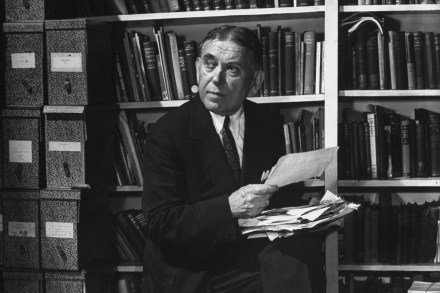
In a time when literature is held to be futile, it is cheering that some literary values persist. One of those values, confirmed by T.S. Eliot in ‘The Function of Criticism’ (1923), is that writing a book is almost invariably less futile than writing a book about books. Criticism, Eliot wrote, could not be ‘autotelic’, expressing only itself, because criticism was about other things, like ‘the elucidation of works of art and the correction of taste’. The critic, then, performs a kind of clean-up operation after the party.Harold Bloom, who died yesterday at 89, was a rare exception to that rule. For Bloom, criticism was the vehicle of spiritual autobiography.

Race to the finish

This article is in The Spectator’s October 2019 US edition. Subscribe here. ‘I have observed,’ Joseph Addison wrote in 1711 in the first article in the first issue of the first version of The Spectator, ‘that a Reader seldom peruses a Book with Pleasure, ’till he knows whether the Writer of it be a black or a fair Man, of a mild or cholerick Disposition, Married or a Batchelor, with other Particulars of the like nature, that conduce very much to the right understanding of an Author.’ Thomas Chatterton Williams has earned a reputation as a tough, thoughtful and genuinely interesting commentator on race.

chatterton

Blondie ambition

This article is in The Spectator’s inaugural US edition. Subscribe here to get yours. Once upon a time in the Seventies, rock ’n’ roll was a man’s game. Then Blondie happened –– or ‘Blondie’ herself, Debbie Harry, platinum bombshell and queen of punk. Actually, before Blondie there was the Runaways, an exploitation act from which the singer, Joan Jett, ran away. There was Patti Smith, who moved to New York City, fell in love with Robert Mapplethorpe and wrote poetry. There was Chrissie Hynde, who moved to London, passed through the rehearsals that generated the Sex Pistols and the Clash, and then, after Blondie had charted in Britain, formed the Pretenders.

debbie harry blondie

The passion of Bari Weiss

A couple of years ago, I took a shuttle train at London’s Heathrow airport, heading to the medium- and long-haul gates. I was standing at the end of the carriage, and as the ends of the carriages were mostly made of smoked glass, I could see into the carriage behind. A group of Orthodox Jewish men stood on the other side of the glass in full sectarian fig — beards and sidelocks, long coats and vaguely Habsburg Homburgs, the Bronze Age waistcoat of the tallit katan and its knotted fringes. Through the glass, I could see the other passengers staring with curiosity; fair enough, given that almost everyone else in the carriage seemed to be wearing Lycra and sweat-wicking leisurewear.

bari weiss anti-semitism

Novel advice for incoming STEM freshmen

When college and university students arrive on campus this month, they will choose their courses with an eye on future summer internship and postgraduate career opportunities. Enrollment in the humanities is in free-fall, while the rapid growth of American technology companies suggests that STEM is the only path to a prosperous career. But as the novelist Sigrid Undset writes, 'there is nothing in the experience of man which shows that the raw material of human nature has ever changed.' My advice to students interested in a career in investing or technology: read more novels. Business school courses offer practical case studies to learn from others’ strategy success in key functions and industries.

novel books

The Spectator USA guide to book curation

Books Do Furnish a Room was the title of one volume in Anthony Powell's sequence of novels A Dance to the Music of Time. How true that is. When you enter a room, where do your eyes turn? To the wallpaper? The ceiling? The furniture? No, the books! What do you have in common with the person you are visiting? What can you talk about? What can you slip into your pockets while they are out of the room? 'Books do furnish a room' is the thesis Thatcher Wine has built his career around (yes, that is his name, not the special vintage of some kind of hideous Young Tory club.) Wine is Gwyneth Paltrow's 'book curator', as an interview in Town & Country Magazine describes. 'After everyone tired of reading on their Kindles,' the interview begins (everyone, everyone): '...

gwyneth paltrow

Demining at the foot of Mount Sinjar

Sinjar, Iraq, December 2015. Major Adel Sleman poured more sweet tea into a small glass. It was cold outside the half-built shed we were sitting in, and we inched closer to the jet-black stove. Kurdish men stood next to small mattresses they had arranged on top of cinder blocks around the stove. Each man seemed to have a different style of camouflage. The pot-bellied major with his loose-fitting fatigues looked dressed ready to blend into a jungle. His colleague Major Hussein Yusuf wore forest green. Even though it was cold, the two men didn’t put on coats.  ‘I’ve spent 19 years working in demining,’ said Sleman. Born in 1963 in northern Iraq’s Kurdish region, he had been a Peshmerga, or Kurdish soldier, since the 1990s.

iraq demining

Kevin D. Williamson has a people problem

'Democracy,' wrote H.L. Mencken, 'is the art and science of running the circus from the monkey cage.' Kevin D. Williamson is a man cut very much from Mencken's cloth. He has the same caustic humor. He has the same contempt for the mob. He has the same respect for the transcendent individual. In his new book The Smallest Minority, Williamson is at his most Menckenesque. This is not to say that Williamson is a mere imitator of the sage of Baltimore. For one thing, it is hard to imagine Mencken opening a book by advising the reader that 'you can’t fuck with a monkey in Delhi.' Sound advice. Williamson is not just offering a tip to tourists, though, but comparing India's shit-flinging monkeys to the denizens of social media.

kevin d williamson

When Tom met Groucho

The man of distinction who longs to be acclaimed for something else is a recurring and quite endearing figure. A few years ago, I wrote a small book about the fraught relationship of Arthur Conan Doyle and Harry Houdini. The escapologist was driven by shame about his lack of formal education. He had dropped out of school at the age of 12 to support himself as a shoeshine boy before embarking on a career as an acrobat and magician. For Conan Doyle, the attainment of influence and wealth as the author of the Sherlock Holmes stories apparently never dispelled the vulnerability that dwelled inside the alcoholic’s son from a slum household in Edinburgh.

groucho marx

The uneasy legacy of Christopher Hitchens

Winston Churchill looked forward to an expansive lunch. He was in his late seventies, prime minister for a second time, and this cabinet meeting was dragging on. It was nearly one o’clock and they were down to the eleventh item on the agenda, a memorandum on town planning. Wearily, Churchill said: ‘Ah yes, I know town planning, densities, broad vistas, open spaces...give me the romance of the 18th-century alley with its dark corners, where footpads lurk.’ It is possible to have this exact feeling watching cable news today. Somehow, you’re watching CNN or MSNBC, and some bloviating no-mark like Don Lemon or Chris Hayes or Ezra Klein is grimacing through air time.

christopher hitchens

An American in Darwin’s family

In the spring of 1883 my mother, Maud Du Puy, came from America to spend the summer in Cambridge with her aunt, Mrs Jebb. She was nearly 22, and had never been abroad before; pretty, affectionate, self-willed, and sociable; but not at all a flirt. Indeed her sisters considered her rather stiff with young men. She was very fresh and innocent, something of a Puritan, and with her strong character, was clearly destined for matriarchy.The Jebbs, my great-uncle Dick, and my great-aunt Cara, lived at Springfield, at the southern end of the Backs, and their house looked across Queens’ Green to the elms behind Queens’ College.

raverat darwin

A gas-lit world

For me, a home without Period Piece is like a house without a cat — lacking an essential cheering and comfortable element. I have loved Gwen Raverat’s memoir of growing up in Cambridge in the 1890s ever since I first read it 20 years ago when recuperating from a bad bout of ’flu, at that blissful moment when you are feeling better but not quite strong enough to get up and do anything. I can still recall the delicious feeling of reading and dozing, dozing and reading, snug in the gas-lit world of Victorian Cambridge, until the January afternoon outside the bedroom window gradually turned purple and faded into dark.

period piece

Nineteen Eighty-Four is not a guidebook for the present day

Is there a literary cliché more dull than saying of some old yellowing book that it is 'as relevant today as it was when it was written'? This month marks the 70th anniversary of George Orwell’s Nineteen Eighty-Four. Journalists on both sides of the Atlantic – to whom Orwell is a holy patron saint – have clacked out lengthy tributes (and entire whole books) to St Orwell’s most famous work. What, they ask, does Nineteen Eighty-Four mean today? Well my answer, for whatever that’s worth, is: nothing. Nineteen Eighty-Four has nothing new to say to us and we have almost nothing new to say about Nineteen Eighty-Four. Realistically, we have very little left to say about George Orwell too.

nineteen eighty-four

Plato, Socrates and Glaucon’s Fate

The astronomer Nicolaus Copernicus studied Plato’s writings in the original Greek, and found in him a kindred spirit. In his main work, On the Revolutions of the Heavenly Spheres, Copernicus draws on what the philologist František Novotný describes as Plato’s ‘metaphysical heliocentric argument from the Republic’ — his characterization of the sun as the god and ruler of the visible sphere and image of the Good, the unifying source and highest principle of reality.

plato glaucon

A chance encounter with a butterfly-catching Nazi

In the winter of 1943, Eric Newby, captured in 1942 on a commando raid on Sicily, escaped from an Italian prisoner of war camp. Love and War in the Apennines, his memoir of life on the run among the peasant farmers of the Apennine Mountains, is that rarest of combinations, a military classic and a love story. Patrick French’s tribute to Newby’s memoir can be read here. In this excerpt, Newby describes an unlikely encounter in a mountain pasture. As I climbed, the trees began to thin out and at last I came to a place where there was nothing but juniper growing.

butterfly naxi apennines

Love and War in the Apennines

An escaped British prisoner-of-war is sleeping in a grassy hollow by the edge of a cliff. He wakes to find a German soldier standing over him, wearing summer battledress, a pistol at his hip. Realizing he has been caught, he says his name and adds, ‘I’m a lieutenant in the infantry, or rather I was until I was put in the bag.’In the bag – captured. It is one of the many phrases of the time that add to the resonance of Love and War in the Apennines (1971), a vivid memoir of Eric Newby’s capture, escape and recapture in Italy’s mountainous terrain during the later years of World War Two. The man standing over him will not, though, take him away.

apennines