Arts Reviews

The good, bad and ugly in arts and exhbitions

Paddington review: put your mind at rest – no one gets marmalade up the bum

‘Please look after this bear,’ reads the famous label hanging round Paddington’s neck, and this film does that, admirably, handsomely, endearingly, lovingly and not at all sexily. Such a furore, when the film was awarded a PG instead of a U certificate for ‘sexual references’ — oh no! What have they done to the bear? — but it was just the BBFC being somewhat over-enthusiastic, as it would later admit, when it downgraded it to ‘innuendo’. Still, I wanted to put your mind at rest, wanted you to know the bear is safe and this isn’t Paddington: the Sex Pest or anything, even though that’s a film I’d probably quite


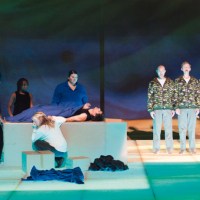
ENO’s Gospel According to the Other Mary: great music weighed down by a worthy staging

Terrorism; East-West diplomacy; nuclear war: John Adams’s operas have poured music into the faultlines of 21st-century global politics, and the tremors have been significant. Simply staging The Death of Klinghoffer recently was enough to see the Met picketed on charges of anti-Semitism. While The Gospel According to the Other Mary isn’t going to start any riots, Adams’s latest work marks a turning point, both in the composer’s music and his social mission. No longer content to comment and observe, Adams turns his gaze to the story of the Passion — reclaiming and rewriting the originary narrative of the Christian West. Yes, Gospel is a companion-piece to Adams’s 2000 opera-oratorio El

Don’t sneer at I’m a Celebrity. The show is teaching us to become model citizens

One of the great benefits of having teenage children is that they force you out of your fuddy-duddy comfort zone. There was no way, for example, that the Fawn and I were ever going voluntarily to watch I’m a Celebrity… Get Me Out of Here! because we’re snobby old farts who only like history documentaries and University Challenge. But Girl decreed otherwise. That’s why, unlike many of you, but like most of the nation, I am now able to comment knowledgably on how well Michael Buerk is doing, who Tinchy Stryder is, why it was a sensible idea to choose world superbike champion Carl Fogarty to undertake the first bushtucker

Was this Christian pioneer of radio evangelism a fraud?

She was the sequinned star of the airwaves back in the 1920s, the first preacher to realise the potential of the wireless, long before Billy Graham and co. But who now has heard of Aimee Semple McPherson, the radio evangelist? Born in 1890 and raised on a farm in Canada, she was converted as a teenager by a Pentecostal preacher whom she married and joined on his missionary travels. When he died she took up preaching herself, moving to Hollywood and becoming enormously popular as a great healer of the sick and saviour of souls, dressed up for the part in a long white figure-hugging gown adorned with a huge

Language

And when I landed in America, aged ten, I knew the language was the same. And yet At once the alien words confronted me Like tests I must perform before I passed: Gotten and cootie and the way they said ’erb, and the different gas, and turning on The faucet. That first Christmas, presents wrapped In something called excelsior, just bits Of wood-shavings.       I learned fast, but still baulked Later at sniggerings over those secret words Too bad to be explained: jamrag — a pad Of cotton-wool I saw, stained, on the road; And, inexplicably worse, the taunt Thrown at a boy just down the way from

First Day of Spring in Bath

Quick-flowing creamy light and all cohering: Faux fanes in gardens, Nash and Wesley’s shades, Gold, gaily weighty houses, rocketing sky, And open hillside turning as I turn, All witnessed through ancestral engineering, Small canny bones and inward fine parades We had no part in, choiceless ear and eye Meting out pleasure I could never earn.

Apollo Awards 2014: Digital Innovation of the Year

This article first appeared in Apollo magazine Apollo’s new Digital Innovation of the Year award commends organisations harnessing digital technology to advance access to, or knowledge of art. The winner will be chosen from the shortlist below and announced in the December issue of Apollo. Find out more about the Apollo Awards. After Dark Tate Britain, London For five nights in August, four robots equipped with cameras roamed the galleries of Tate Britain and live-streamed their journeys to a microsite. A few of the robots’ online observers were also allowed to log in and manoeuvre them by remote control. The project was conceived by London-based design studio The Workers, winners of the first IK Prize (Tate’s

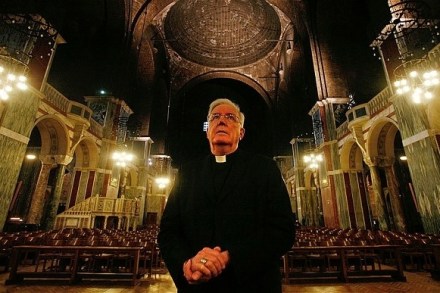
What is the truth about Cardinal Murphy-O’Connor and ‘Team Bergoglio’?

A couple of days ago John Bingham, the excellent religious affairs editor of the Telegraph, broke a story that is only now filtering out. I hope he’ll forgive me if I wonder whether he realised just what a big story it was. Bingham wrote: Cardinal Cormac Murphy-O’Connor, the former leader of the Roman Catholic Church in England and Wales, helped to orchestrate a behind-the-scenes lobbying campaign which led to the election of Pope Francis, a new biography claims … [The book] to be published next month, discloses that there had been a discreet, but highly organised, campaign by a small group of European cardinals in support of Cardinal Bergoglio. The Great Reformer, by

David Hockney interview: ‘The avant-garde have lost their authority’

‘I just stay here and do my thing,’ David Hockney told me soon after I arrived at his house and studio in Los Angeles this August. ‘I’m not that interested in what happens outside. I live the same way as I have for years. I’m just a worker.’ Hockney has been labouring prodigiously for more than 60 years now, since he entered Bradford School of Art at the age of 16. ‘There is something inside David,’ his assistant Jean-Pierre Gonçalves de Lima noted, ‘that drives him to make pictures.’ In the summer of 2013, after a series of disasters — including a minor stroke and the terrible death of a

Are the British too polite to be any good at surrealism?

The Paris World’s Fair of 1937 was more than a testing ground for artistic innovation; it was a battleground for political ideologies. The Imperial eagle spread its wings over the German Pavilion; the Soviet hammer swung above the Russian Pavilion; and the Spanish Pavilion unveiled Picasso’s shocking monument to the civilian dead of the bombed city of Guernica, raising the clenched fist of the Spanish Republic in the capital of non-interventionist France. Not everyone was convinced by ‘Guernica’ as art. Anthony Blunt in The Spectator commended Picasso’s political gesture but dismissed the painting as ‘the expression of a private brainstorm’. Piqued on the artist’s behalf, the British surrealist Roland Penrose,

The story of the first painting to sell for over a million pounds

Nothing could have prepared the art world for the astounding moment in 1970 when, at a Christie’s sale on 27 November, the world auction record for a painting smashed through the million-pound barrier for the very first time. It was Velázquez’s portrait of his assistant Juan de Pareja, and in the week leading up to its sale the international press became excited about the possibility that it would beat the previous record of £821,482, paid in 1961. I had recently become the art critic of the Evening Standard, and its enlightened editor, Charles Wintour, asked me to write a special article about this Velázquez portrait. Propped up on a chair

No one in the Bible has been as elaborately misrepresented as Mary Magdalene

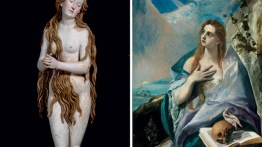
How would the real Mary Magdalene have reacted to her posthumous reputation? Not very kindly, one suspects. Our only historical source, the New Testament, does not even hint that she was a prostitute, and she’s unlikely to have been placated by Christians telling her: ‘It’s OK, we think you were a reformed whore.’ No one in the Bible has been so elaborately misrepresented. In addition to not being an ex-prostitute, Mary of Magdala was not Mary of Bethany, the sister of Martha and Lazarus, who anoints the feet of Jesus with ‘about a pint of pure nard, an expensive perfume’ and then wipes it up with her hair. Nor was

The Imagined Day

The imagined day includes sunshine and shopping And people saying Yes and being on my side. There’ll also be traffic and occasional drizzle So I know I haven’t died.

Why radio is a surprisingly good medium for talking about art

You might think it a fool’s errand to attempt programmes about art on the wireless. How can you talk about pictures or sculptures or any other visual form without being able to see them? But features on artists and their work can have a surprising resonance on radio precisely because without any images the programme-makers and their listeners are forced to work harder, and to look beyond the canvas to the back story, the purpose of a self-portrait, a seascape, a domestic interior. You could say that’s why the great film Mr Turner lacks a certain meaning. The visuals are stunning but the dialogue disappoints. At the same time radio

Just because The Homesman has a few women in it doesn’t make it a ‘feminist western’

The Homesman, which stars Hilary Swank and Tommy Lee Jones and is set in the Nebraska territory in the 1850s, is being sold as ‘a feminist Western’, which is a bit rich. This is not a bad film. It’s modestly entertaining, in its way. And it does portray the harshness of life for the early women settlers. But feminist? When, at around the midway mark, it goes all John Wayne on us? ‘Oh please, don’t go all John Wayne on us,’ I begged the film. ‘Please be more interesting than that.’ But it was determined. And I suppose the clue was in the title all along. This is not, ultimately,

Norman Mailer’s wife comes out of the shadows

‘It’s not as bad as I thought it would be,’ said Norman Mailer to his wife, Norris Church, after reading the first chapters of a novel she wrote in the 1970s. It took her decades to recover from this accolade and the book remained unpublished until 2000. Here’s a two-handed drama she drafted in the 1980s. The setting is a New York strip joint. A social anthropologist finds a girl in a booth and hires her to describe her daily life. He feeds her banknotes through a slot, like a zoo-keeper giving peanuts to a caged marmoset, and she prattles away at him earning a dollar every 60 seconds. She

Jaw-dropping confessions of a very un-PC Plod

There can’t have been many people who watched Confessions of a Copper (Channel 4, Wednesday) with a growing sense of pride. Among those who did, though, will presumably have been the creators of Life on Mars and Ashes to Ashes — because, in its frequently hair-raising way, the programme confirmed how well they did their research into old-school policing. Of the seven ex-officers interviewed, the most old-school of the lot was probably Ken German (sample quote: ‘We all have a view on political correctness: it’s bollocks’), who began by explaining in full the admission procedure that he’d gone through to join the force — he was told to bend over

Why are students of curation being taught to ignore the public and be suspicious of enterprise?

The world exists and then it disappears, piece by piece, the gaps widening until one age is replaced by another, leaving only fragments of the past. With luck, these pass through the hands of curious collectors dedicated to bridging the gaps formed by the desecrations of time, before reaching a terminus point in a museum as votive offerings on the altar of culture. And that’s where it so often goes wrong. Charged with the care and conservation of these precious fragments, curators can all too easily become anxious hoarders of knowledge instead of agile communicators serving a synaptic function between object and audience. Curating as an art of defence —