Arts Reviews

The good, bad and ugly in arts and exhbitions

A sack of bilge: End, at the Dorfman Theatre, reviewed

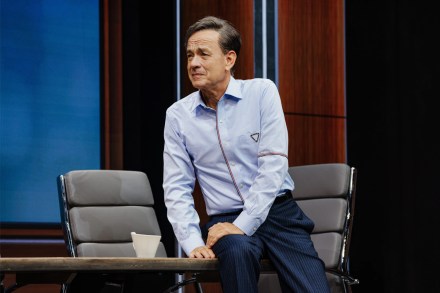
End is the title chosen by David Eldridge for his new relationship drama. Clive Owen and Saskia Reeves star as Alfie and Julie, a pair of wildly successful creative types who live in a mansion near Highgate. Both are 59. Alfie is a retired DJ who made a fortune touring the world at the height of the ecstasy craze and Julie earns a living from crime fiction. But she’s bored with detective stories and wants to publish her memoirs and to write a state-of-the-nation novel set during the 2012 Olympics. Despite their amazing careers, both characters are moaning dimwits who swear constantly and have nothing of value to say about

Gothic lives matter: BBC2's Civilisations reviewed

Anybody growing weary of the debate surrounding the BBC’s unexamined assumptions and biases about modern politics might have expected to find some relief in a scholarly documentary about the sack of Rome in AD 410. Sad to say, though, the first episode of Civilisations: Rise and Fall offered very little of it. Of course, it’s not unusual for history programmes to want to prove that the people in the past were Just Like Us. But in this case the parallels drawn/rather desperately imposed were a particularly uncanny fit with those same pesky assumptions and biases. It transpired, for example, that Ancient Rome ‘was a two-tier society that favoured the rich

An adorable Taiwanese debut: Left-Handed Girl reviewed

Left-Handed Girl is a Taiwanese drama about a single mother who moves back to Taipei with her two daughters to run a noodle stand in the night market. It’s one of those films where the stakes don’t appear that high – will the mother make the rent this month?; will the littlest daughter settle at her new school?; what’s grandma’s game? – yet we become so attached to this family and their survival it will all matter a great deal. It also features an adorable pet meerkat, GooGoo, and I doubt you’ll see a better film starring an adorable pet meerkat called GooGoo this year. I’d bet my life on

Indian classical music's rebellion against modernity

When Gurdain Ryatt, Ojas Adhiya, Milind Kulkarni and Murad Ali Khan take to the stage at Milton Court this Sunday they will be united by a common language: the tradition of Hindustani Indian classical music, rooted in the north of India. Ryatt and Adhiya’s job will be to keep beats circulating on their pitched, drum-like tablas, while Kulkarni’s harmonium will sustain drones, apparently towards infinity. Khan plays the sarangi, a string instrument famed for its uncanny invocation of the wavering of the human voice. Shankar’s tireless advocacy spawned a crossover culture that he felt too often sullied the very music he loved British audiences have a head start when it

London's stupidest gallery

Everyone loves a private view, and I am no exception. I don’t know how many hours I must have spent trudging around central London’s art galleries in search of warm white wine – my social life doesn’t extend much beyond the confines of that circuit to be honest. Lately, however, I’ve been to some dreadful things; shows that seem to exist purely in order to enable their ritzy opening galas. I suppose I have only myself to blame for turning up to an evening at London’s stupidest gallery last week, but it was truly horrible: a party thrown for a scenester artist who turned DJ for the night, spinning butchered

The orchestra that makes pros go weak at the knees

Stravinsky’s The Firebird begins in darkness, and it might be the softest, deepest darkness in all music. Basses and cellos rock slowly, pianissimo, in their lowest register; using mutes to give the sound that added touch of velvet. Far beneath them rumbles the bass drum: a halo of blackness, perceptible only at the very edge of the senses. In Liverpool Philharmonic Hall, with Sir Simon Rattle conducting the Bavarian Radio Symphony Orchestra, you felt your hairs tingle before you discerned a note. Seconds later, the very air within the hall seemed to be quivering with sensuous, engulfing bass warmth. You can be sure that Rattle anticipated that sensation; planned for

The Thing With Feathers is a disastrous adaptation of a wonderful book

The Thing With Feathers is an adaptation of Max Porter’s acclaimed novella about a widower who is left to raise his two sons after his beloved wife’s sudden death and whose grief is embodied in the form of a monstrous, giant black crow. It stars Benedict Cumberbatch, who gives his absolute all, but while the film deploys psychological horror tropes it’s too mired in a pit of despond to be anything other than a misery fest. Also, while the crow works as metaphor in the book (it’s a rather wonderful book, as it happens), on film it’s a disaster. Unless, that is, you too see grief as a big talking

The tedium of softboi rap

A male British rapper who is unafraid to show tenderness and vulnerability is not a particularly new phenomenon: Dave, Stormzy, Headie One and Kano have all walked this path in recent times. None, however, has made emotional fragility his USP to quite the same extent as Loyle Carner, who writes about his children, his masculine role models, mental health, race and inherited trauma in an unthreatening sing-song style which has made him both a pop star and a bit of a poster boy for Feeling Things. His tour is named after his fourth and most recent album, hopefully!. To his credit, he has put his money where his rhymes are.

The best thing Cathy Marston has ever done

The Royal Ballet has scheduled what – on paper at least – looks like one of the most dismally dull and cautious seasons I can recall. The company is hobbled by a £21.7 million government loan (that had tided the place over during Covid), which the Royal Opera House is being forced to ‘service’. One bright spot of interest comes with the commissioning of a new work from Cathy Marston and an import from New York City Ballet’s Justin Peck, slotted into a triple bill alongside Balanchine’s nocturne, Serenade. There’s not much to say about Peck’s Everywhere We Go. Big, bold, bright and much too long, it is devoid of

The babyishness of Hunger Games on Stage

The Hunger Games is based on a 2008 novel  about a despotic regime where brainwashed citizens are entertained with televised duels between teenagers. Not a bad idea. We go behind the scenes and watch Katniss (Mia Carragher) being selected to fight Peeta (Euan Garrett) who secretly adores her. As soon as the plot starts, it seizes up. Instead of a gripping tragedy about two lovers forced to kill each other on TV, we’re given a masterclass in the show’s elaborate format. The duellists take part in interviews, coaching sessions, target practice, public parades and a popularity contest which permits them to attract ‘sponsors’ whose role is opaque. At the same

The cult of Powell & Pressburger's I Know Where I'm Going! 

I know where I’m going. I’m on the sleeper train chugging out of Euston and heading to Fort William. A wedding dress hangs on the wall in its transparent cover. I know from my printed itinerary that upon arrival at Fort William, there will be a car, then a ferry from Oban, and finally a gin and Dubonnet waiting for me at the Western Isles Hotel in Tobermory. But no one is getting married. Something much stranger than that is happening: an event that lies somewhere between a fandom convention and a secular pilgrimage. I’m on my way to the Outer Hebrides to celebrate the 80th anniversary of Michael Powell

'Ballet is antiquated, and it works': Royal Ballet principal Matthew Ball interviewed

The history of the male ballet dancer is a chequered one. In the early 19th century, he was the star of the show, albeit more as an acrobat and tumbler than fairy-tale prince. The vogue for sylph-like damsels floating in white tulle put paid to that, reducing him to the auxiliary role of porter and attendant. Then came the comet of Nijinsky, introducing a note of mysterious Slavic androgyny that left the male dancer suspiciously homosexual and prone to the ‘pink tights’ cliché. Nureyev and Baryshnikov cemented the exotic Russian connection, until the late 1990s when the allure of the musical Billy Elliot and Matthew Bourne’s version of Swan Lake

Was Elgar really a snob?

There’s not much point pretending to be an expert on Elgar (or so The Bluffer’s Guide to Music assures us) because everyone already thinks they are. And there’s definitely no point getting hung up on the historical accuracy (or otherwise) of Alan Bennett and Nicholas Hytner’s new film The Choral. It’s set in a West Riding mill town during World War One and the plot pivots around the local choral society’s performance of The Dream of Gerontius. This being Bennett, of course, there’s rather more to it than that, but in any case – spoiler alert, and there’ll be more – Sir Edward himself makes a cameo appearance: Simon Russell

There's a lot to like in Rosalia's new album

Grade: A Welcome to the Andalusian cadence, the minor fall and the major lift, the descent from Am through G and F to E. Welcome also to Rosalia Vila Tobella, who is not Andalusian, but Catalan, but uses that cadence an awful lot, much as Status Quo prefer to stick to C, F, G. She has been much praised for the depth and ambition of her compositions – and commercially much rewarded when those compositions, sometimes appended to fairly straightforward EDM, get the kind of downloads you would more usually expect from Ariane Grande. Though I find a good few of the compositions comparatively slight, there is no doubting the

In defence of Katie Mitchell

Janacek’s The Makropulos Case is a weird and very wonderful opera, but its basic plot isn’t hard to follow. Still, it seems to send directors into a tailspin. One recent production (since revised) had a cast member break character and pull out a flipchart to recap the story so far. Katie Mitchell’s new staging for the Royal Opera takes the more familiar route of updating the action to the present, and it’s always fascinating to see what opera directors think we’ll find relatable. Luxury hotels, recreational heroin use, Tinder hookups with locally sourced hotties: no, me neither. How the other half live, eh? In short, it’s a bit like Mitchell’s

This exhibition made my companion gasp

Numerous research academics have contributed to this highly cogent show celebrating the craftspeople of Ancient Egypt. My pre-teen companion, though a big fan of Egypt, was still slightly hesitant about whether this would be the most interesting angle. It began with a 4,000-year-old stele, or tombstone, on loan from the Louvre, praising the sculptural and painterly skills of an artisan called Irtysen, about whom, of course, nothing more is known. The perennial problem. General information, however, came thick and fast. We learned that a cooperative of skilled workers was a hemut, and a singular skilled worker a hemu. We came face-to-face with a cubit (a measuring stick six palms in

Bleak but gripping: Channel 4's Trespasses reviewed

Yeats famously summarised Ireland in the four words, ‘Great hatred, little room’. But, as Louise Kennedy’s 2022 debut novel Trespasses showed, in 1970s Northern Ireland the hatred had grown even greater and the room even littler. Channel 4’s faithful adaptation began – as it would continue over its four parts this week – with the suffocating omnipresence of sectarianism. As 24-year-old Cushla (Lola Petticrew) drove through her small town, everything she saw screamed Catholicism or Protestantism: the graffiti, the flags, the ash on children’s foreheads at the start of Lent. By night, Cushla worked in a bar where the punters were either nervously or aggressively aware of each other’s religion.

Mrs Göring is far too sympathetic: Nuremberg reviewed

Nuremberg is one of those films that falls short on everything it wants to be and everything it could be. It’s a historical drama, set just before the trials, where an American psychiatrist (Rami Malek) is charged with assessing whether Hermann Göring (Russell Crowe), Hitler’s second in command, is fit to stand trial and to ascertain what his defence might be. This should be electric and terrifying and take us inside the Nazi mind. In other words, I had expected a tense two-hander. But it’s serviceable rather than inspired, plodding rather than tense, its running time (two and a half hours) trying. (Keep a Red Bull to hand.) It also