
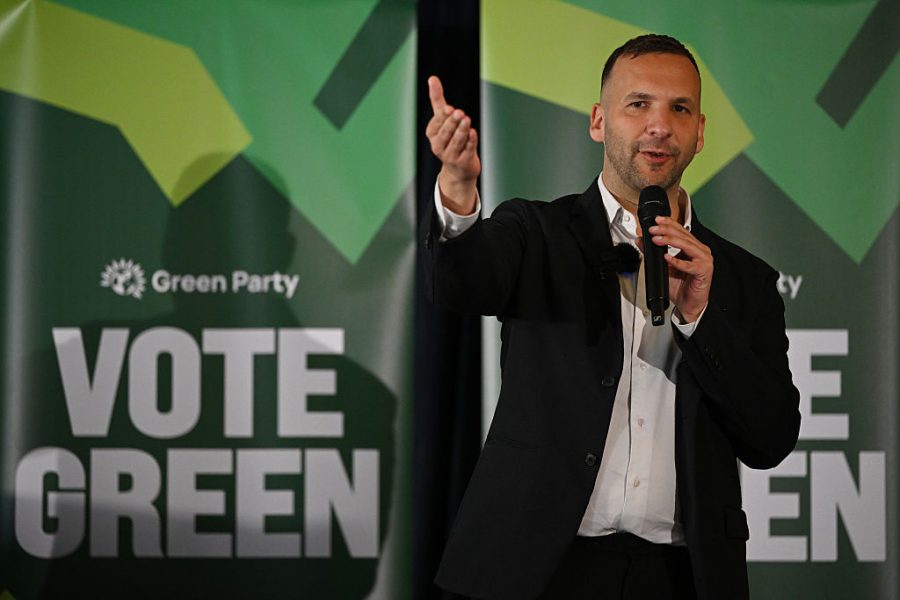
It was bound to happen sooner or later, but coming at the beginning of a local election campaign in which his party is expected to make a huge breakthrough, it is pretty much the worst time for Zack Polanski. The nice, middle-class Greens who joined the party because they care deeply about the climate, bunnies and hedgehogs are rebelling against Polanski’s efforts to turn it into a far-left party obsessed with trans issues and Palestine.
Last week, Michael de Whalley, a Green councillor on Kings Lynn and West Norfolk borough council, resigned his membership and now sits as an independent. All parties suffer defections of councillors on a regular basis, yet in this case de Whalley – who set up the local party in West Norfolk in 2009 after a career in the RAF – seems to be speaking for a very large number of the party’s oldest and most-established supporters. ‘I was always impressed that the Green party seemed to be informed by science and evidence,’ he said, explaining his resignation.
The Greens are built on an unlikely coalition of nature lovers, Islamists and unreformed trots
The party has now moved away from that to more dogma and ideology. There are a very significant number of older, deeper Greens who are looking on in horror, and I am one of them.
He cited in particular Polanski’s unrealistic fiscal policies, but it isn’t hard to connect comments about abandoning science and evidence to the Green party’s fundamentalist approach to trans issues. As for the Greens’ conversion to the Palestinian cause, it might work in Gorton and Denton, where the party last month won its first by-election victory, but it is unlikely to have much heft in West Norfolk, a land of bungalows and lavender bags – as well as being the new, unwanted home of Andrew Mountbatten-Windsor. Polanski, quite brazenly, has stopped talking about the environment and has ended up creating the far-left party which Jeremy Corbyn and Zarah Sultana tried – and failed miserably – to create.
Similar sentiments to de Whalley’s are reported to have been expressed by senior figures in recent days. Tacking to the left of Labour is a piece of opportunism which has brought rapid rewards, bringing the Greens equal with Labour on 16 per cent of the vote in one poll this week.
But as Polanski is rapidly discovering, it is a number built on an unlikely coalition of nature lovers, Islamists and unreformed trots. True, all parties are to some extent awkward coalitions – the Greens’ mirror image on the right, Reform UK, has also experienced some difficulty in binding together its golf club element with its Red Wall supporters – but the Greens do seem to be an especially disparate bunch at the moment. At least Reform UK supporters can pretty well all agree on one subject: Brexit. It is harder to see a defining issue which unites the Greens’ current crop of supporters in the same way.
The dissent among the deep Greens won’t necessarily stop the party making big advances in the local elections. The advantage of such elections is that you can spin entirely different narratives in different places, which is how the Liberal Democrats managed to advance in local politics over many decades. But it will be a lot harder when it comes to the next general election. If Polanski’s bubble has not already burst by then, it is unlikely to survive the scrutiny of policies which that will bring.


Comments