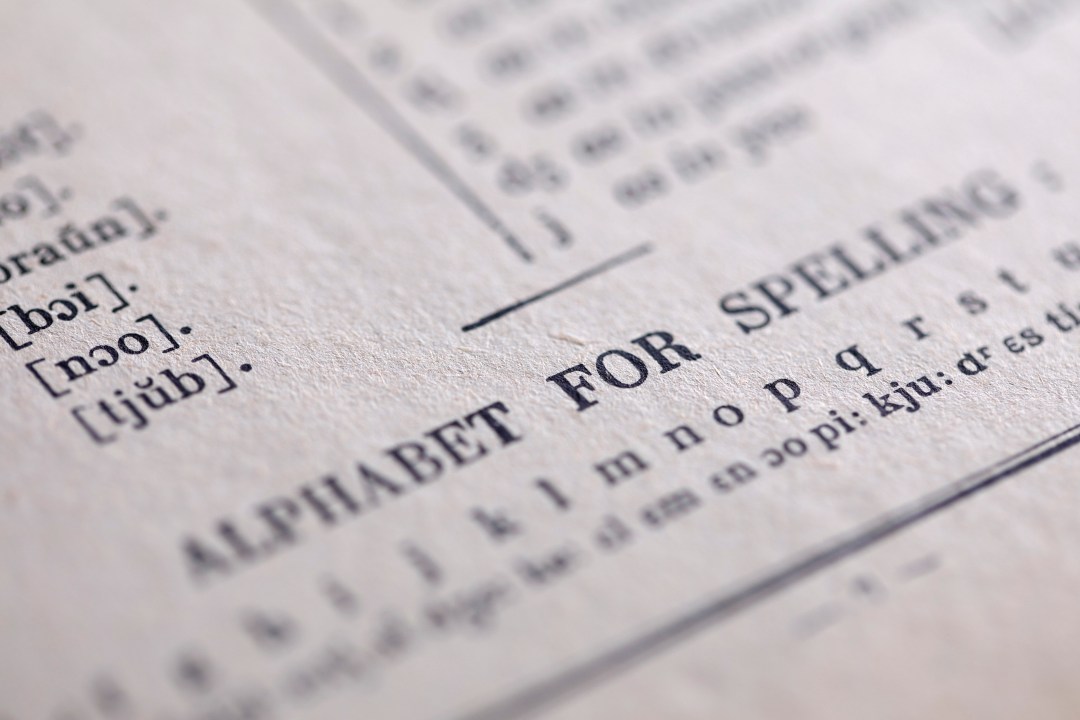
I don’t exercise much, except my self-control. To wit: ten times a week, I bite back the urge to grab someone by the lapels and holler my guiding life philosophy, and favourite line from Friends: ‘By the way: y-o-u-apostrophe-r-e means ‘you are’. Y-O-U-R means YOUR!’ Like most of my opinions, this one is trivial, curmudgeonly and no doubt doomed to failure. Top of my list of grumbles, penned in italics and painted scarlet red: people should be able to spell. Is that too much to ask?
I say, no. And the fact that we’ve reached such lows is baffling. Pundits like to decry the death of book reading, but in many ways, we’re the most literate society to ever exist. We spend about 60 days a year on our phones, gobbling up subtweets, Instagram captions and bitchy WhatsApps. Six years after the pandemic, millions of us still Wordle daily.
We read like crazy, yet spell like Manuel from Fawlty Towers. I’ve had texts from well-read contacts, talented chaps with squadrons of degrees, that sound like they’ve suffered some sort of crippling stroke. Grammar, logic, spelling — all thrown to the wind, and I’m left to decrypt an email that says ‘your going to need to atend the next confarance sorry, any absance will be noted I no its anoying.’
How are such travesties of thought possible, when spellcheck has infiltrated every corner of our software? Forget about the nanny state, what about the dangers of nanny technology, coddling our already indolent brains into mush? Such sloppiness, to me, is the equivalent of showing up to a wake in flip-flops and your fly half-down. I can’t be the only one who thinks such mental slouchery shows disrespect to the lingua franca, let alone whoever you’re messaging — the subtext being ‘I didn’t have time to put real thought into my message to you, but whatevs.’
My thesis is this. We live in a time when being judged by your accent or clothing is not acceptable, and hoorah to that. But sometimes, a modicum of snobbery is needed; a jolt of embarrassment swiftly delivered when someone tweets ‘my enemies are just gelous of me’. Think of it as an intellectual favour, to you and the mis-speller. If we don’t start correcting errors, they multiply insidiously, because what’s one more typo in a tidal wave of them? That’s how you end up with singer Jessie J posting ‘Yes my tattoo says “don’t loose who you are in the blur of the stars”. Yes they are MY lyrics from my song who you are. Yes that I wrote. Yes the tattoo artist didn’t mention it. Yes I was 18 … Yes It’s the reason I wear everything high waisted.’
Things will only get worse as AI does our mental lifting for us (and in 2014 half of Britons already had trouble spelling common words, thanks to autocorrect). But is there a solution? Apart from raising an army of pedants, my suggestion is this: Britain is one of the most panel show-addicted nations on earth. Verily, I say, let us use this addiction for good. Make the UK fall in love with grammatical matters. After all, the first spelling show in history (aptly named Spelling Bee) aired here in 1938. And according to YouGov, Countdown — with its beloved sea-blue word jumble wall — is still the 30th most popular current TV show.
So why not take things further with a spelling-only show with real stakes? Instead of a ceramic teapot, à la Countdown, winners get a million pounds (sponsorship TBC). Instead of a ‘bad luck’ commiseration from the host, losers get a non-fatal dose of electricity delivered to their nipples. Or, failing that, the chilling revelation that an audience of millions now judges them for being unable to spell, ironically, the word ‘ignorance’.
Before you dub me the grand Generalfeldmarschall of grammar Nazis, know that I know I’m a hypocrite. I have never, not once in 38 years, spelled the word ‘receive’ correctly the first time. ‘I’ before ‘e’, except after ‘c’ and all that, yes… But as Stephen Fry, the platonic ideal of erudition, notes, ‘tis a silly rule, ‘because there are more exceptions to the rule than the rule itself.’ There are 923 examples of words that don’t follow that dated maxim: Glacier. Being. Species. Weird. Caffeine.
There’s a wonderful moment in the film adaptation of My Fair Lady worth quoting at length here. As Professor Henry Higgins tells his weary student, deep into a lesson meant to transform her into an educated lass: ‘I know your head aches. I know you’re tired. I know your nerves are as raw as meat in a butcher’s window. But think what you’re trying to accomplish — just think what you’re dealing with. The majesty and grandeur of the English language; it’s the greatest possession we have. The noblest thoughts that ever flowed through the hearts of men are contained in its extraordinary, imaginative and musical mixtures of sounds.’
The point is, English is indeed hard. Mistakes will be made. But it’s a beautiful mistress of a language, and as such, deserves to be treated like a lady.



Comments