Americans who are concerned with heightened levels of political violence should understand that we are fortunate compared with Pakistan, whose most visible political family, the Bhuttos, have a history that makes even that of the Kennedys look tame. One survivor, journalist Fatima Bhutto, born in 1982, encapsulates the family tragedies.
Her grandfather, the charismatic prime minister Zulfiqar Ali Bhutto, was executed under trumped-up charges by the government serving the man who deposed him, army chief Zia-ul-Haq. Her uncle, Shahnawaz Bhutto, died in mysterious circumstances, possibly murdered, at the age of 26. Her father, Mir Murtaza Bhutto, was executed gangland-style outside his home in Karachi during his bid to take power from his sister, Benazir, in 1996; the 14-year-old Fatima was inside the house when the killing took place. It is possible that Benazir and/or her husband, Asif Ali Zardari, ordered the hit. Fatima, traumatized by the brutal murder of the father who had been the center of her life, certainly thought so. And then, of course, in 2007 Benazir herself was slain: on whose command, the world has never been quite sure.
Fatima Bhutto’s 2010 memoir, Songs of Blood and Sword, was biased and subjective, warped by her idealization of the father whose flaws and crimes were as obvious as his love for his daughter was profound. (Among other outrages, he and Shahnawaz started a gang-that-couldn’t-shoot-straight terrorist organization, al-Zulfiqar, in a reckless and self-dramatizing attempt to avenge their father’s murder.)
But over the past 15 years Bhutto has become a particularly sharp critic of contemporary politics, especially in South Asia, while pointedly dissociating herself from the party machinery of her native country. Her special concerns are women’s issues and human rights, and anything with her byline tends to be worth reading.

Now, with a slim memoir called The Hour of the Wolf, Bhutto gives a painful account of what she calls her “lost decade”: the nearly ten years in which she was in thrall to a coercive, cruel and manipulative partner, whom she calls simply “the man.” How could this happen to someone who prided herself on being a strong woman – one who defined herself as such? “Those things just didn’t happen to women like me,” she remembers thinking. But as she notes, some controlling men see strong women as a personal challenge and set out to break them. The Hour of the Wolf relates such an attempt.
The man’s behavior – his coldness, treachery and flirtation with violence – should immediately have had Bhutto heading for the hills. In retrospect, she can locate the reason for her otherwise inexplicable attachment to him in the trauma of her childhood. Her father divorced her mother, an Afghan woman named Fowzia, when Fatima was only three and at that point Fowzia exited her life forever; Murtaza and Fatima, exiled in Syria during Zia’s regime, were alone for several years until Murtaza married his next bride, Ghinwa.
The grisly killing of Murtaza left Fatima in Damascus under Ghinwa’s not always sympathetic control; her stepmother, she writes, could be “complicated and calculating… suffice it to say, I was well schooled by a narcissist long before I met the man.” And of course, the loss of her father, as she recognizes, made her terrified of abandonment – easy prey for a lover whose affection was always conditional. Following a classic pattern, in Bhutto’s effort to escape a controlling parent – in this case a stepparent – she threw herself into another coercive relationship.
Not everything was bad. Anxiety caused her to lose her voice over a period of nearly a year; the man persuaded her that she must forgive the many people who had caused her pain, and when she did so she found that her voice had returned for good. But at the same time the man isolated her from her personal world, insisting that they keep their relationship a secret from Bhutto’s friends and family. “My mood,” she remembers, “became quickly tethered to his.” And his was rarely sunny.
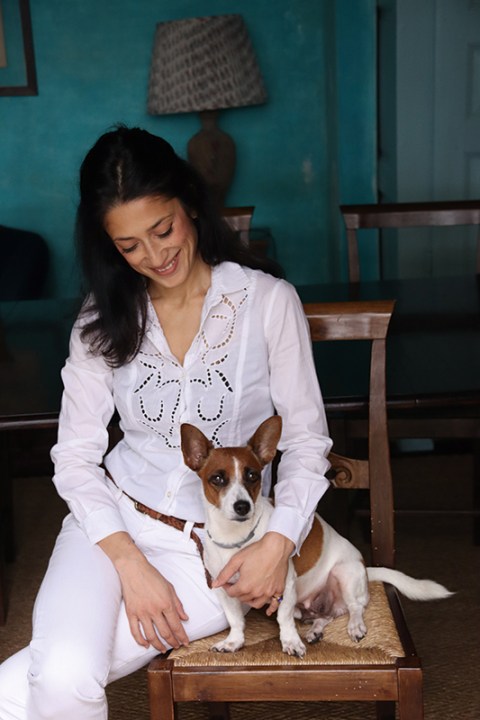
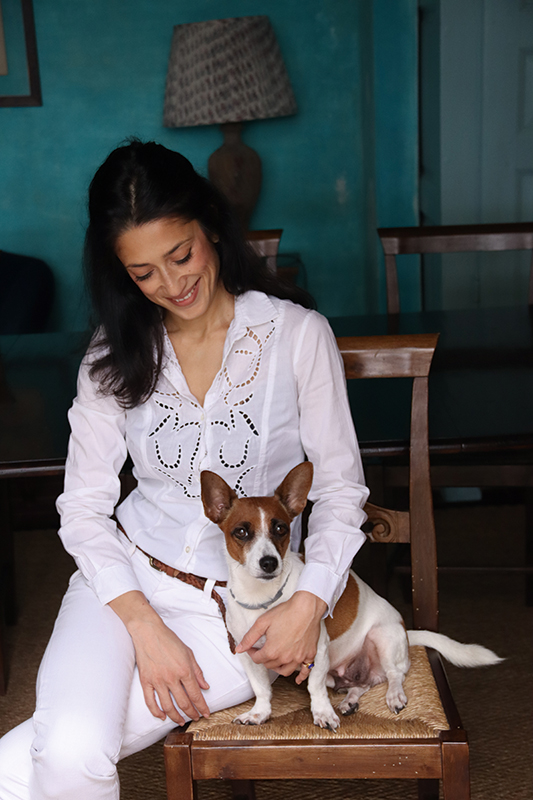
The being that eventually rescued her from this deadly spiral was not human but canine: a female Jack Russell named Coco. As the memoir progresses, it becomes less about a woman trapped in an abusive relationship and more about a relationship between a woman and a dog – and, more broadly, a meditation on the healing, almost sacred connective bonds that can form between humans and animals.
“Before my father’s murder I thought animals were animals and humans were humans and a gulf separated the enormity between our feelings and experiences,” Bhutto writes. But years later, when she was trapped in the man’s poisonous orbit and deeply confused about the very meaning of love and connection, Coco, simply through her presence, offered Bhutto hope. “There is something celestial about dogs – what they teach us about love and time and the smallness of our own beings and place in the world.”
One pivotal moment occurred when the man, without any noticeable provocation and offering no explanation, bit Bhutto sharply on the hand. Her first thought was, “My dog would never, ever bite me.” And then, later, there was the moment when the man hit Coco, another turning point. When Bhutto objected, he asserted, “She’s my dog too.” As she writes,
No. No she wasn’t. He never looked after her, never stayed with her at night, sleeping on the floor next to her because she was ill, never spent hours walking around the park to give her exercise, never paid a single vet’s bill… and had consistently refused to pick up her poo, which was – as an antimaterialist Buddhist – beneath him. He had never done anything except enjoy what dogs give so freely: her love.
A secular Muslim, Bhutto had absorbed many of the countless Islamic parables and legends about animals and humans, but it was not until her bond with Coco that she reflected on their meanings. Other traditions and thinkers informed her thoughts as well. Barry Lopez’s Of Wolves and Men helped develop her ideas about the interplay of the tame and the wild. Buddha reminded her that the idea of the self – “the shallow belief that we are special” – is an illusion. “How can we ever be forgiven the debt we owe the creatures of the wild?” she wonders. Torture, abuse, abandonment – it is important to remember “not just how much animals endure: but how noble they are in surrender, how much dignity they possess in the face of a ceaselessly violent world.”
Coco and her puppies, in the end, led Bhutto away from the man, a true destroyer, toward some kind of light. The simple act of care restored her to herself, and in the end she attained what she had longed for throughout her lost decade: a husband and child. Looking back, she tries to understand just what it is that humans think they want from animals. Perhaps it is only their beauty, for which our hunger seems insatiable. But perhaps it is also their dignity, or their affection. “With their love,” Bhutto reflects, “animals remind me that time is elastic and to live well is to remember only that we must live now and do so with purity, free of fear and alive with the possibility of wonder.” One can only concur.



Comments