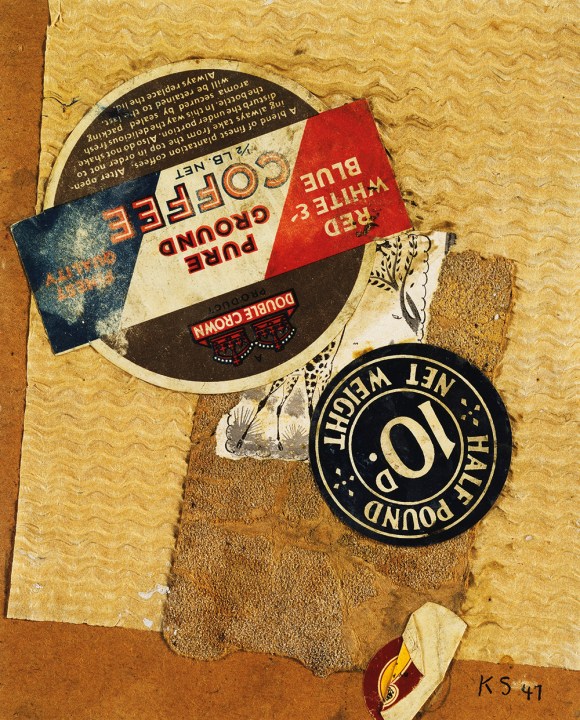
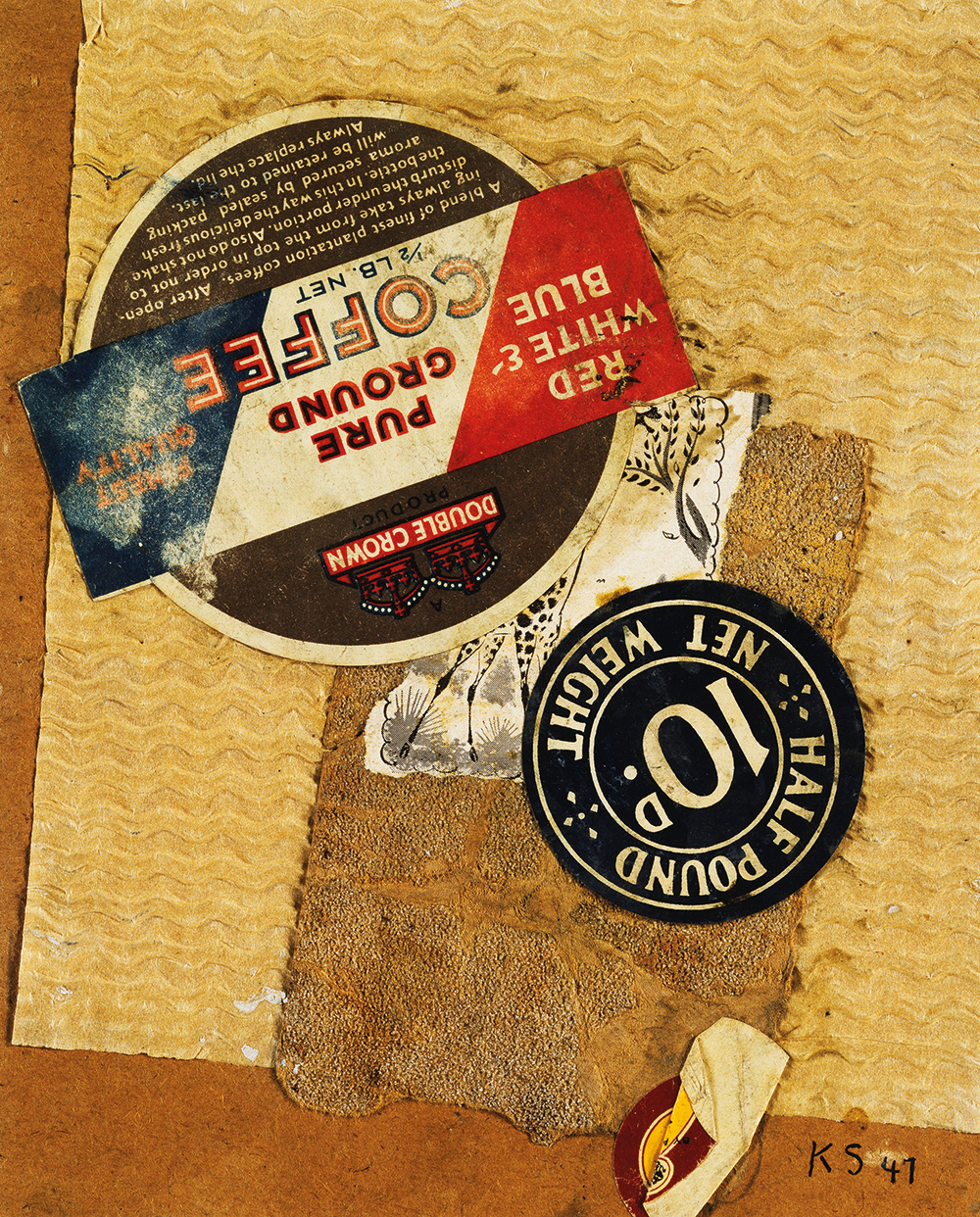
Aged ten, Jennifer Potter moved to Ambleside in the Lake District and was soon aware that one of the giants of modern art, Kurt Schwitters (1887-1948), had lived there some years earlier. He was a German artist associated with Dadaism, the anarchic movement that ushered in Surrealism, who developed his own brand of anti-rational art called ‘Merz’. He assembled urban detritus into two or three dimensions (collages and objects). His work was witty, lyrical and abstract, but also organic. He called art ‘structure’ or ‘creative evidence’, as natural as a plant or a crystal, but reliant, too, on the action of the artist’s imagination.
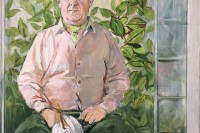
He was a large man, somewhat shambolic in appearance. His girlfriend called him ‘Jumbo’
Schwitters became a lifelong obsession for Potter, and this book, besides being an evocative love letter to Lakeland, is an account of their unusual relationship. She was drawn to the German by the intensity with which he lived and by his dedication to his work. Schwitters pursued his vision through painting, collage, sculpture and writing (he was a considerable poet), from single pictures and objects to complete environments, never deviating from the certainty that he had something worth communicating. For an epigraph to her book Potter takes Schwitters’s exhortation: ‘Make connections, if possible, between everything in the world.’
She questions why he is in her head, why he has ambushed her imagination; but the principal reason must be that they both surveyed the same landscape with wonder and appreciation, Potter as she grew up, Schwitters in his last precious years. Aghast at the rise of fascism, he left Germany for Norway in January 1937 and then again fled the Nazis to the UK. After arriving in Scotland in June 1940, he was interned in shameful conditions in Bury, Lancashire, before being transferred to the Isle of Man. He was released in November 1941 and spent the rest of the war in London, visited by his girlfriend Wantee, until he suffered a stroke in April 1944, at which point she moved in to look after him.
Wantee was Edith Thomas, a young English girl whom Schwitters had befriended. Her nickname came either from her regular question ‘Want tea?’ or from her affectionate chant of ‘One tea for you, one tea for me’. She called Schwitters ‘Jumbo’. He was a large man, somewhat shambolic in appearance, but with dignity as well as humour. Ever the professional, he tried to live by his work, but only sold the occasional collage and looked for other employment. The BBC didn’t want him, neither did Selfridges, where he applied to be a window-dresser (what a spectacle that would have been). He found English society difficult to penetrate: Ben Nicholson and Barbara Hepworth refused his friendship, and Kenneth Clark wouldn’t even see him. However, Herbert Read, the art historian and co-founder of the ICA, was supportive, writing enthusiastically about his art.
If London was not welcoming, Schwitters was also regarded with some suspicion in Cumbria, where he moved in 1945 after a holiday reconnoitering there three years earlier. The Lake District stood in for the Norway he loved, though he thought the English landscape more romantic. He was happy in the mountains. Schwitters is usually considered an urban artist, picking up the junk of a careless city civilisation and making of it something new. But his late work takes on a more rural identity, employing stone and wood as well as the more familiar bus tickets, photographs and other printed material.
It is often said that Schwitters painted his late landscapes and portraits simply to survive – that they were potboilers; but this is far from the truth. Painting from life was an important aspect of his work, essential to his passionate engagement with the world. It enabled him to discover the underlying rhythm of appearances, the movement in the design that held together lines and planes and light and dark, with his very distinctive colours. However abstract his art, he never wanted to separate it entirely from its sources in nature. Nature was a refreshment for his soul, just as it was a renewal of his art.
Potter counts 25 drawings and 39 paintings of the Lake District in Schwitters’s oeuvre. He always hoped to sell his more representational work, but sometimes he gave pictures away to friends or bartered them for meals in a café or a new set of false teeth. In this book, Schwitters’s story is interwoven with the author’s own, whose family history is presented beside the German’s in an effort to see things clearly and perhaps lay his ghost to rest. But in the course of writing, the two of them have grown closer and Potter now celebrates that. One of the enduring purposes of art is to make sense of life. This intriguing book does just that.



Comments