
Britain’s first grandmaster, the late Tony Miles, once said about a game he won: ‘I did absolutely f*** all and it proved to be enough!’ It was a long endgame squeeze, in which his opponent made a series of modest weakening moves which eventually cost him the game. Experienced players know that passive ‘waiting’ in the endgame takes reserves of patience which few possess. Indeed, I have even seen defending players sabotage their own position out of sheer boredom.
In the very late endgame placing the opponent in ‘zugzwang’ – a situation where all moves worsen their position – may be the only technique to win the game. Composers of problems (particularly mate in two problems) often play with the same idea. Regular solvers of the Spectator chess puzzle will have seen some examples (including last week’s puzzle no. 904).
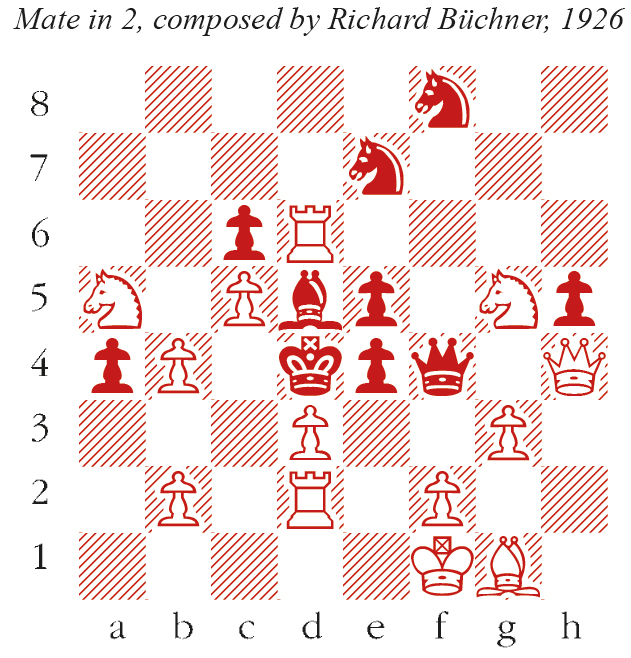
Above is an elaborate example, with the curious feature that Black is already in ‘zugzwang’. For example, moving the Ne7 allows Na5xc6 mate, or moving the Nf8 allows Ng5-e6 mate. Also, …Qxd2 allows Qxe4#, or …Qxh4 allows dxe4#, or …Qxf2+ allows Bxf2#. Most visually pleasing is that …e3 could be met by Nf3#, because then both the Bd5 and the Qf4 are pinned.
The tricky part is that almost all White moves fail to maintain this equipoise, allowing Black to stave off mate for at least one more move. For example, 1 Rd8 Nd7, or 1 gxf4 exf4 or 1 dxe4+ Qxd2 all fall short. Try a few more!
The correct key move comes as a shock: 1 Kg2!, because it allows Black to give check in five different ways. The beautiful point is that each of those checks can be parried with a move which simultaneously delivers mate, e.g. 1…e3+ 2 Nf3#, or 1…exd3 2 f3#, or 1…Qxf2 2 Bxf2# or 1…Qf3+ 2 Nxf3# or 1…Qxg3+ 2 fxg3#.
The position shown below is the starter problem for the Winton British Chess Solving Championship, an annual competition. White must force mate in two moves, against any defence. (White moves, then Black moves, then White delivers checkmate.)
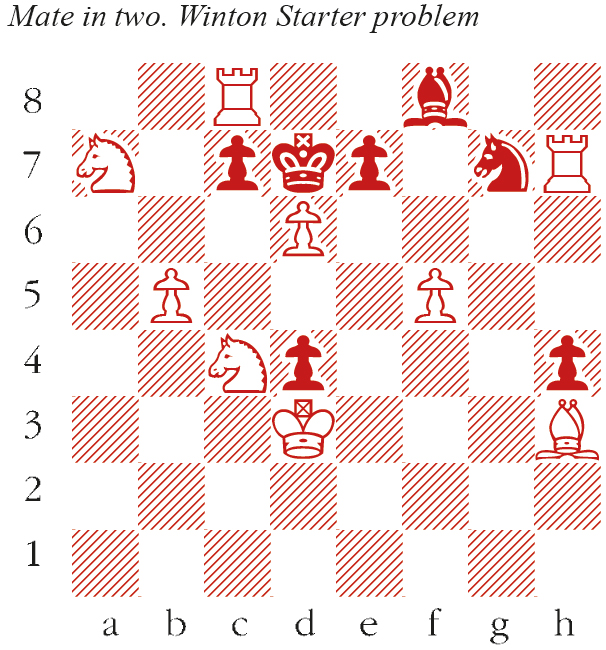
Entries by email to winton@theproblemist.org no later than 31 July. Only the first move is required. Successful entrants qualify for a postal round, so do include a name and address. Mark your entry ‘The Spectator’. Those who were under 18 on 31 August 2025 must give their date of birth. For more details, including how to enter by post, visit spectator.com/winton26. For more on the rich world of problem-solving, visit ‘theproblemist.org’. The website has an excellent section titled ‘For Beginners’, in which the ‘Two-Move Secrets’ section may provide inspiration.






Comments