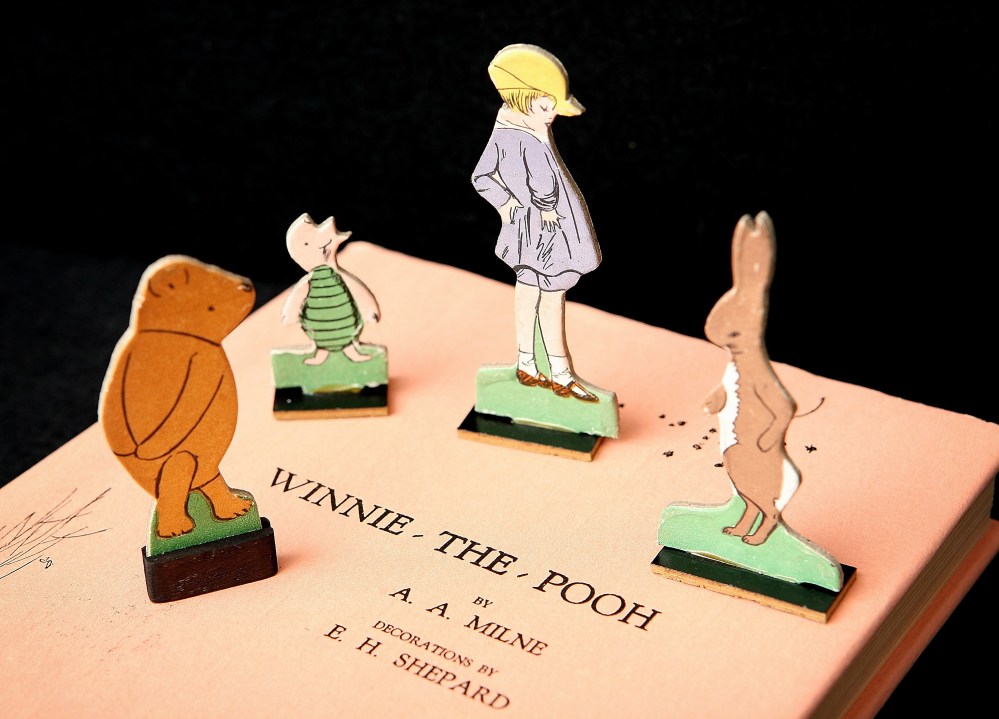
Today makes the centenary of the publication of A.A. Milne’s Winnie-the-Pooh, which brought the bear of little brain to the world’s attention. It was not, in truth, the ubiquitous ursine’s first appearance – that would be Milne’s nearly-as-beloved When We Were Very Young, which came into the nation’s bookshops in 1924 – but that featured a rather cloying poem called ‘Teddy Bear’, featuring ‘Mr Edward Bear’, who would, if he was born today, probably need to go on the Ozempic:
‘A bear, however hard he tries,
Grows tubby without exercise.
Our Teddy Bear is short and fat,
Which is not to be wondered at.’
Yet it would be Winnie-the-Pooh that would give the bear a greater dose of popularity as well as introducing his fellow residents of the Hundred Acre Wood. Gone is the rather twee poetry, and in its place are a delightful collection of stories that revolve around the (mis) adventures of Pooh and his friends, of whom the most entertaining, as far as contemporary readers are concerned, is the lugubriously pessimistic donkey Eeyore, who is only too ready to see the bad side of everything.
The human counterpart to the animals is Christopher Robin, named and inspired after Milne’s own son. While the real-life Christopher came to loathe the associations that his father had bestowed upon him as an inheritance, he is presented as a charming, remarkably non-irritating child, as ready to join in a wholesome adventure with the Hundred Acre Wood inhabitants as he had been to kneel by the side of his bed in his father’s notoriously awful 1923 poem ‘Vespers’ (‘Hush! Hush! Whisper who dares/Christopher Robin is saying his prayers’).
Christopher Milne would later say of that appearance ‘that has brought me toe-curling, fist-clenching, lip-biting embarrassment’, which is perfectly justifiable, but he was never reconciled with the reputation that his appearance in Winnie-the-Pooh brought him throughout his life, saying ‘It seemed to me, almost, that my father had got to where he was by climbing upon my infant shoulders, that he had filched from me my good name and had left me with nothing but the empty fame of being his son.’
Two relatively recent films, the good-natured Ewan McGregor fantasia Christopher Robin and the rather darker Domhnall Gleeson and Margot Robbie Goodbye Christopher Robin both explored the lingering after-effects of the Winnie-the-Pooh stories and the effects that it had on the boy. And anyone who possessed any compassion whatsoever could see that it would be a tricky, even unfortunate legacy to bear (no pun intended), but this should not obscure the charm and, ironically enough, humanity of Milne’s most famous creation, who might be presented as a roly-poly figure of fun but is also given a good deal of dignity and likeability.
Big Bear is watching you, and the results are not pretty
For the bear of either no brain or, at best, very little brain, mealtimes play as large a role in his existence as marmalade sandwiches do in that of his great rival for the title of Britain’s National Bear, Paddington. Michael Bond’s creation undoubtedly owes a significant debt to Milne’s Winnie-the-Pooh, but then all fictitious bears do. Yet something that has become increasingly depressing over the past few years is the way in which Paddington has gone from being a hugely enjoyable, rather bumbling but good-natured character to a small, furry representative of the nanny state, forever lecturing people on good citizenship and responsibility and Being Kind. Even for someone who believes Paddington 2 to be one of the finest films of the modern age, the endless post-Bond sanctimony can be A Bit Much, reaching its nadir with a huge, terrifying mural in Waterloo, telling us all that ‘Mrs Brown says that in London everyone is different, and that means anyone can fit in.’ Big Bear is watching you, and the results are not pretty.
Conversely, if there was a giant Winnie-the-Pooh looking down on us all, I cannot imagine that he would offer any more didactic edict to the nation than that we should all eat more honey and go woozle-hunting, which are, frankly, sentiments that we can embrace without any guilt or reluctance. There is something wonderfully peaceful and comforting about the prelapsarian world that Milne created in Hundred Acre Wood that makes it an endlessly appealing place to visit, with Pooh a jolly guide to it all. He is not an agent of chaos, like Paddington, or an arrogant blowhard, like Mr Toad, but a thoroughly likeable, sympathetic bear whose relative lack of ambition makes him even more timeless.
But what of the real-life Pooh? Well, to see him and his friends, you’d have to head over to the New York Public Library (NYPL), where they have resided ever since 1987. Given Christopher Milne’s ambivalence – at best – towards the characters, it is unsurprising that they have not been given a home in Britain but instead remain one of the crown jewels in the NYPL’s collection. There are occasional grumblings that they cannot be seen in Britain, even as a loan, but this is to miss the point. The corporeal form of Winnie-the-Pooh, a stuffed bear, might be found across the Atlantic, but the cheerfully indomitable spirit of this good-hearted bumbler lives on forever. Here’s to his next century, and beyond.



Comments