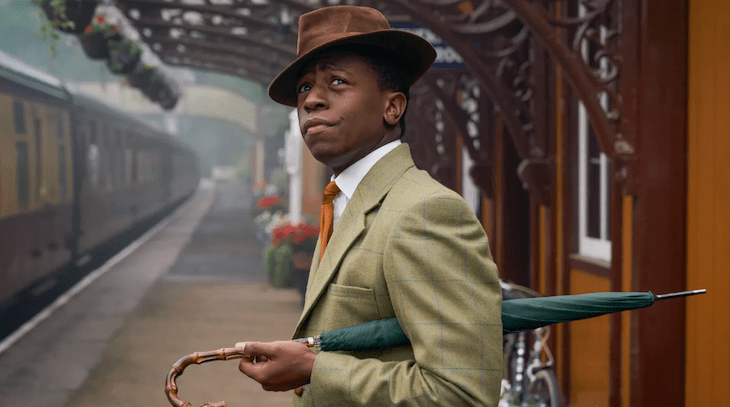
At last, the BBC has been forced to admit what even the dogs on the street know to be true: that the corporation is guilty of ‘shoehorning’ diversity into its television drama output, in series such as Shetland and This Town, and making them feel ‘preachy’ and ‘inauthentic’ as a consequence.
Productions which distort history deliberately and cynically are even more exasperating
A large swathe of the viewing public believe that the BBC tries too hard to represent diverse groups in its drama, according to a report commissioned by executives, involving a survey of 4,500 adults. Irritation is most pronounced in the area of historical dramas, with feedback indicating the biggest offenders to be a 2023 Agatha Christie mystery starring a black actor and laden with ‘anti-colonial struggles’, a production of Great Expectations starring a mixed-race actress as Estella, and an episode of Doctor Who in which Sir Isaac Newton was also depicted as mixed race. As the report concludes: ‘What needs to be avoided is ethnic diversity which looks forced and tick box, and we found our interviewees of colour as emphatic on this point as those who were white.’
Some will protest that this is a fuss over nothing. Dramas aren’t real life or purport to be historical documentaries. They’re literally made-up. And indeed, the report tries to make the case for the BBC’s hyper-tokenist approach on the ground of artistic licence. ‘In Doctor Who, if we can ask viewers to believe that the central character is an extra-terrestrial being who can re-generate into a range of a different actors… a mixed-race Sir Isaac Newton seems much less of a stretch.’
In an alternate universe, a different kind of Newton could indeed be feasible and legitimate. Yet science-fiction aficionados wouldn’t notice if this was but a one-off, just as we didn’t notice back in 1988 when, upon its launch, Red Dwarf had an over-representatively diverse cast. And this was when Britain was indisputably more racist. Audiences didn’t bellyache back then because this trend wasn’t the mandatory and ubiquitous norm everywhere on television.
Rather than just being any old kind of frivolous entertainment, historical dramas carry a significance and responsibility not borne by other forms of make-believe. While the audience does indeed expect dramatic licence, and allow for screen adaptations to deviate from novels which might have inspired them, they also expect and assume these programmes to be set against a background faithful to historical reality. This is why, going back to the chiming clock in Shakespeare’s Julius Caesar and evidenced more recently in the verbal atrocities of Downton Abbey (‘step on it’, ‘I’m just sayin’’, etc), anachronisms are so offensive to the sensibilities and to one’s intelligence.
Productions which distort history deliberately and cynically are even more exasperating. In living memory, this first became evident in the film Robin Hood: Prince of Thieves (1991), in which Morgan Freeman was shoehorned in to play a Moor. It’s not that medieval England didn’t have any inhabitants of African origin, it’s just that their numbers and influence would have been miniscule. But that film was released at the height of political correctness, the chief parent of wokery, and Hollywood was already desperate in its quest for more diversity. The audiences could see through it, too.
Likewise, when history was subsequently and wantonly falsified in Michael Collins – the IRA didn’t use car bombs in the 1920s – or Braveheart – with howlers too numerous to mention – savvy viewers knew what was afoot. The demonisation of Ulster Protestants in the first movie appealed to a bewilderment of and hostility to these people prevalent in the 1990s, while Braveheart was a crass appeal to the stirrings of nationalism in Scotland.
The over-representation of ethnic minorities on television and on theatre, and especially at the Royal Shakespeare Company, exists today for precisely the same reason. It has little or nothing do with artistic merit, or even artistic licence, and instead derives from political motives and crude, utilitarian exigency: the desire to make television ‘reflect society’ and the desire to place to the fore more benign and more numerous representations of ethnic minorities. The BBC regards its drama output as a tool of effecting social change first, a conduit with which to entertain and amuse second.
People are right, and have a right, to be annoyed about ‘mere fiction’. A nation’s history is integral to its sense of self, and its degradation as represented in historical drama alarmingly mirrors the way it is debased in schools. The revelation last November that children in Scotland were being taught that the Picts were black was but the latest case-study of the manner in which history is being deliberately falsified in schools to suit the prejudices and political agendas of progressives today.
Some may welcome this latest report by the BBC. But things will only ever improve when our culture and its preachy, monomaniacal custodians also change.



Comments