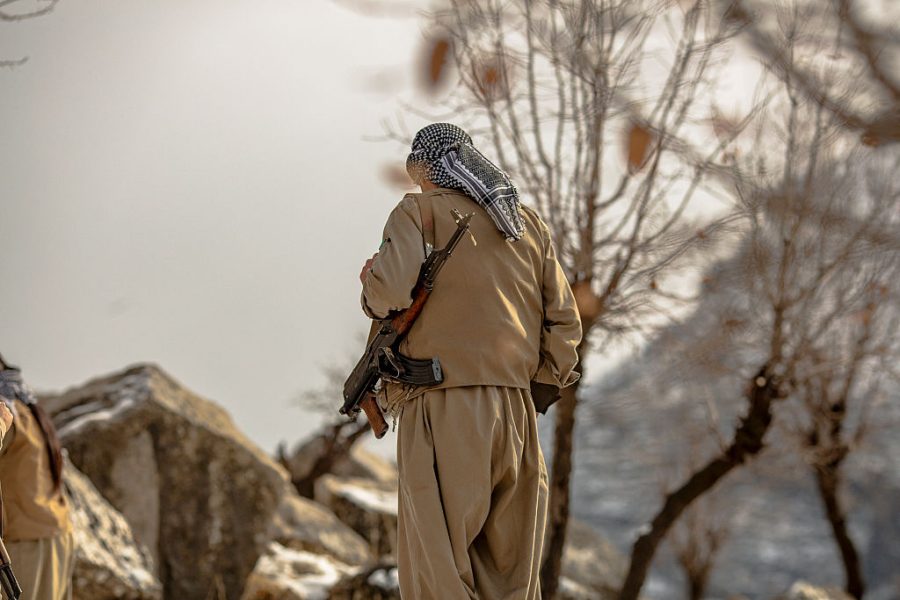
The US and Israel rapidly established air superiority over Iran in the first days of the war now under way in the Middle East. Regimes, however, cannot be destroyed from the air. President Trump clearly has no intention of committing a large ground force to Iran. If Washington and Jerusalem are serious in their stated ambition of destroying the 47-year-old Islamic regime in Tehran, then they are in obvious need of allies on the ground. A number of credible reports in regional media in recent days have identified a relationship of cooperation between the US and Israel and a number of armed Iranian Kurdish groups located in the Iraq-Iran border area.
A recent article on the al-Monitor website suggested that fighters of these organisations may deploy across the border in the coming days. Subsequent statements by President Trump and other senior officeholders have lowered expectations regarding imminent action in this regard. But the original reports concerning contacts and cooperation were confirmed by my own sources in this area.
The Iranian Kurds are centrally concerned with the extent to which their allies are serious
So who are the organisations in question, and what might they be able to achieve, should American and Israeli support for them prove real, serious and durable?
The presence of armed Iranian Kurdish organisations in the border area is not new, though before the last couple of weeks they received hardly any attention in the West. I have visited the bases of several of these groups in the border area in two reporting projects in 2018 and late 2022, and am in regular contact with senior members of a number of them. My 2018 visit included an occasion on which I accompanied a patrol by the armed PDKI group in the border area, in order to photograph an IRGC installation on the Iranian side.
These groups have not been engaged in open insurgency against the Iranian regime in recent years, but they have not been silent, either. All of them have been sending fighters and cadres over the mountains into Iran, seeking to recruit new followers, build networks and engage in educational and political work. These activists did not seek to clash with the regime’s forces but would defend themselves if confronted. It should be noted that with the exception of one of them, these groups do not advocate ‘separatism’, or secession from Iran. Rather, they favour various forms of Kurdish autonomy within a federal Iran.
The most significant of the groups, all of which have been mentioned in recent days as part of the emergent alliance with the US, are PJAK (The Kurdistan Free Life party), the PDKI (Democratic party of Iranian Kurdistan), the PAK (Kurdistan Freedom party) and Komala. President Trump recently spoke with Mustafa Hijri, the veteran leader of the PDKI. These groups differ significantly from one another in their intentions, outlook and relative capacities.
PJAK is probably the strongest and best organised. It is the Iranian Kurdish franchise of the PKK (Kurdish Workers’ party). As such, it has behind it the skills and the redoubtable guerrilla methods and practices developed by the PKK in 40 years of sustained insurgency against Turkey. These methods and this organisation formed the backbone of the Syrian Democratic Forces, which formed the key US ally in the war against ISIS in Syria.
PJAK are reckoned to have around 3,000 fighters available. They follow the strict, near-monastic rules of the PKK, according to which cadres and militants are forbidden from marrying or owning property and devote their entire lives to the organisation. These methods, whatever one’s view of them, serve to produce a hardened and deeply committed core of fighters and organisers.
The PDKI is the most long-standing of the Iranian Kurdish groups, tracing its lineage back to the leadership of the short-lived Republic of Kurdistan established on Iranian soil in 1946. It has long been engaged in activity against the Tehran regime, which assassinated leading members of the party in Vienna in 1989 and Berlin in 1992. Politically, it is pro-western, and maintains links to the ruling Kurdish Democratic Party (KDP) in northern Iraq.
The PAK is the only one of the parties in question which supports complete separation from Iran and the establishment of a Kurdish state. Small and very focused on military activity, it is also the only one of these groups to have engaged in active insurgency against the regime during the unrest in January of this year. I was present at a PAK base on the border on 14 November 2022 when the regime carried out a ballistic missile attack on a neighbouring PDKI position. I witnessed the PAK fighters, men and women, as they rapidly evacuated their positions according to a planned drill, redeploying into the surrounding hills. Their physical fitness, organisation and discipline were impressive.
Komala is a veteran leftist nationalist Kurdish party, with its roots in the far left. It has been subject to the usual discordant tendencies of that end of the political spectrum. It is the smallest of the four groups mentioned here, with the smallest armed wing. From my knowledge, however, Komala has a capable and highly educated leadership, including a number of sophisticated, English-speaking younger cadres.
These are the four key Iranian-Kurdish armed organisations with whom Israel and the US appear now to be engaged in a tactical partnership against a common enemy – the Islamic regime in Tehran. For reasons that I won’t detail here, I believe that the Israeli and US support for and engagement with these groups is of fairly recent vintage, dating back not more than half a decade in the Israeli case and even less in the American. What might such a partnership be intended to achieve?
These groups will have no interest in deploying beyond areas of Kurdish population. With the backing of US and Israeli air power, and the likely assistance of special forces on the ground, however, it is quite feasible that they could take control of parts of Kordestan province and neighbouring areas adjoining the border, leading to the establishment of liberated zones, which could then be expanded. Arab rebels in northern Syria established such zones in the first phase of the Syrian civil war without western air cover. They formed the basis for the eventual victory of the Syrian insurgency.
This is a plausible mission for these organisations, with a good chance of success if properly undertaken. A question remains, however, regarding the seriousness and likely longevity of the American and Israeli commitment. Are Jerusalem and Washington now committed to a strategy of assisting proxy insurgent forces on the ground in Iran, with the long-term goal of destroying the Iranian regime? If so, this probably won’t be over quickly and will require a serious and sustained maintaining of support to allies on the ground. It can be done, but it will take time and commitment.
The Iranian Kurds are no doubt centrally concerned with the extent to which their allies are serious. At the same time, they will be aware that the current moment represents an opportunity unlikely to come again after the many years in which they doggedly maintained their efforts against a brutal regime, under-resourced and entirely ignored by the world. They are unlikely to refuse the offer of help. They will nevertheless approach the proffered hand with justified trepidation, given the past. Either way, for the Iranian regime to be defeated, action on the ground is essential.

Comments