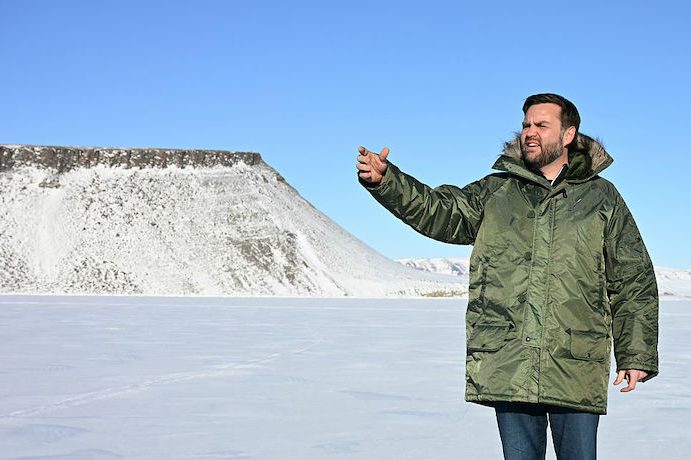
It was the Viking, Erik the Red who, in AD 986, first saw Greenland’s potential. He wanted to colonize his newly-discovered island, and in a blatant piece of tenth-century spin-doctoring hit on a wizard wheeze to encourage other Norse people to come to this bleak, icy and remote corner of the unknown world:
“In the summer, Erik left to settle in the country he had found, which he called Greenland, as he said people would be attracted there if it had a favorable name.“
More than a thousand years later, President Donald Trump is proposing something similar.
“It’s a large real estate deal. Owning Greenland is vital for US security… and economic security… It’s an absolute necessity and I cannot assure you that we would not use military or economic coercion.“
Denmark’s ownership of Greenland is itself a piece of bare-faced colonialism
That may sound outlandish. But Trump’s ambition isn’t new. America has controlled Greenland before: during World War Two, it became a de facto US protectorate. The US has also previously sought to buy Greenland; in 1946, it offered $100 million in gold bullion; around $7 billion in today’s money.
For now, Greenland belongs to Denmark. But Denmark’s ownership of Greenland is itself a piece of bare-faced colonialism, as a glance at their policy of forced assimilation in the 1940s and 50s makes clear. As a result, the Danes are much resented by most Greenlanders.
Greenland has been moving towards independence almost as long as it has been a colony of Denmark. They were granted Home Rule in 1979. This was expanded to full self-rule with the 2009 Self-Government Act – legislation that also handed Greenland the right to declare independence. Today, Denmark retains control only of defense, foreign affairs, and monetary policy. The 2023 Greenlandic constitution explicitly commits the island to independence; and in his 2025 New Year speech, Greenland’s prime minister, Múte Egede, called for an end to “the shackles of colonialism” and a future shaped by Greenlanders themselves.
The final umbilical cord linking Greenland to Denmark is the annual block grant of 3.9 billion kroner (roughly $388 million), making up about 19 percent of Greenland’s GDP. But to put that in perspective, it is less than the amount annually spent by the US on the city of El Paso, Texas. And it is minuscule compared to the mineral wealth Greenland could one day command in partnership with a deep-pocketed ally, of whom there are at least three: America, China and Russia.
China, in particular, has shown intense interest. At one point, Beijing proposed a $2.5 billion investment in a Greenlandic mine (more than the island’s entire GDP), which would have brought in 5,000 Chinese workers. Then they proposed massive infrastructure investments, including a deep-sea port and two international airports. These would require capital which would leave Greenland beholden for all time. Denmark and the US, unsurprisingly, blocked these plans.
So why are the great powers so keen to own Greenland? Natural resources are a big reason why. The great powers’ unashamed lust for Greenland’s rare earths is but one element of a global race to control the production of the strategic minerals which are essential components of batteries, phones, electric vehicles and all modern computing devices. It’s about silicon, germanium, phosphorus, boron, indium phosphide, gallium, graphite, uranium, copper, lithium, cobalt and nickel, among others. He who controls their production holds the key to the digital globe.
Odd as it may sound, it’s also about Taiwan. Taiwan manufactures over 60 percent of the world’s semiconductors and more than 90 percent of its most advanced chips. If China were ever to carry out its threat to invade Taiwan (which some observers think may be imminent, perhaps encouraged by Donald Trump’s daring raid on Venezuela), it would gain near-total control of the global microchip supply. Do we really want to be dependent on China for every phone, computer and electric vehicle produced in the West?
The US needs to develop chip-making capabilities comparable to Taiwan’s. To achieve this it needs reliable sources for the 50 or so critical minerals required. And Greenland holds concentrated quantities of 30 of them, amounting to a considerable chunk of the world’s total rare earth reserves. But the reality is that with a population of just 57,000 – many of them Inuit fishermen and hunters – Greenland lacks the industrial infrastructure to extract these minerals. Both China and the US would be keen to fill that gap.
Another great attraction of Greenland is its strategic position. As the ice melts – at a rate of as much as 270 billion tons per year – several strategic sea routes are being opened up. The world is waking up to the potential strategic value of Greenland, the largest non-continental island on Earth. Greenland controls the top end of the Greenland-Iceland-UK Gap. This area is crucial to NATO submarine surveillance and was vital in resupplying Europe during World War Two. It also hosts the Thule Air Base (now renamed Pituffik Space Base), an essential part of US air defense and missile early warning systems. Any Russian missile strike on the US would pass directly over Greenland. Since 2017, Thule has housed a key ballistic missile detection system, with nearly $4 billion in upgrades recently approved.
The increasingly ice-free Northwest Passage skirts Greenland’s shores. There’s even talk of a deep-sea port to serve the emerging Northern Sea Route or Northeast passage), either in Iceland or – just possibly – in East Greenland. In 2019, Mike Pompeo called Arctic sea lanes the “21st-century Suez and Panama Canals.” If the US controlled Greenland, it would control access to these routes as well.
So yes: Greenland’s strategic value to the US is unambiguous, and Washington is determined to keep rivals at bay. In October 2024, the US and Greenland issued a joint statement pledging deeper cooperation on many of these critical issues. While an outright purchase may be politically impossible, other options exist. These include a Compact of Free Association, similar to agreements the US has with other strategically placed Pacific nations. These can deliver economic and security benefits to both parties. Trillions of dollars of Wall Street investment in mineral extraction would surely follow.
Trump’s call to ‘buy’ Greenland sounds outlandish, but beneath the bombast may lie the bones of a deal
Trump’s call to “buy” Greenland sounds outlandish – even offensive – as with so much of his rhetoric. But beneath the bombast may lie the bones of a deal: one that could benefit the predominantly Inuit population, while delivering enormous strategic and commercial gains to the United States.
In its 1,000-year recorded history, Greenland has been a Viking colony, an abandoned Inuit wilderness, a territory traded between powers, a wartime protectorate, a Danish province, and now an autonomous country edging towards independence. Whatever comes next, Greenland must find a way to harness its vast resource wealth while preserving its fragile culture and ecology. Greenland cannot be sacrificed to short-term capitalism – but it can, and must, find a way to benefit from it. If managed with wisdom and care, the coming years could bring not only prosperity to Greenlanders, but a global model of sustainable extraction and indigenous self-determination.
America, China and Russia may want Greenland. But perhaps Greenlanders need them just as much?



Comments