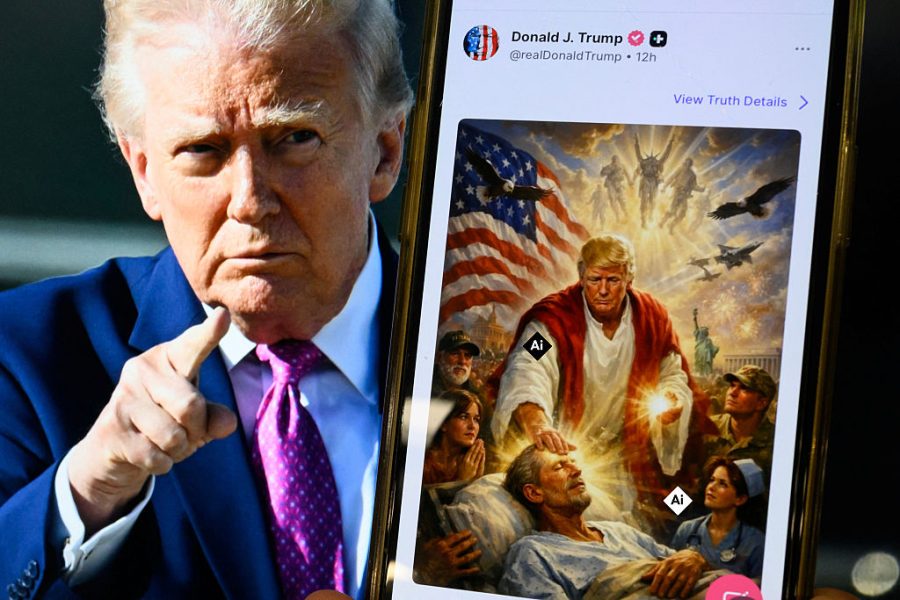
They told us religion would fade. That as the 21st century matured – more educated, more technological, more ‘enlightened’ – faith would retreat politely from public life. God would be, at most, a private hobby.
As the war of words between Donald Trump and Pope Leo XIV is proving, these people couldn’t have been more wrong. We are no longer secularising. If anything, this – alongside other recent world events – shows we are re-Christianising. And nowhere is that more evident than among the very generation that was supposed to abandon faith altogether.
Across both Britain and America, Gen Z is showing signs of renewed interest in Christianity. The long decline has stalled. Churches report a noticeable influx of younger faces. Student Christian groups on campus are, by many accounts, finding a new seriousness and confidence. In Britain, Bible sales have risen by more than 130 per cent since 2019. In the United States, nearly 20 million copies were sold last year alone, with sales climbing steadily for several consecutive years. At a time when overall book sales are flat or declining, scripture is booming.
Religion has returned – leaner, sharper – as a balance on global power
Perhaps it’s no wonder that after decades of being told that truth is subjective, morality is negotiable, and identity is self-constructed, many young people are discovering that such freedoms are, in practice, exhausting. A faith that makes objective claims about good and evil, sin and redemption, offers something the modern world struggles to provide: coherence. Which brings us, improbably, to Donald Trump and Pope Leo XIV.
Trump has been rapidly diverging from a Christian moral framework in recent weeks – dropping ‘f-bombs’ in public posts and trampling on the doctrine of the Imago Dei. He has relished in threats to bring ‘hell’ to Iranian people, warning that ‘an entire civilisation will die’. This is worlds away from the ‘just war’ framework in which the faith imposes limits on what can be said within a conflict.
In recent days, Trump has escalated his attacks on the Pope, who has criticised his rhetoric. He dismissed the pontiff as ‘weak’ and attempted to brush him aside with the usual arsenal of mockery and insult. It is a familiar strategy and one that has often proved politically effective in the past. But here it reveals a serious miscalculation on the part of the American president.
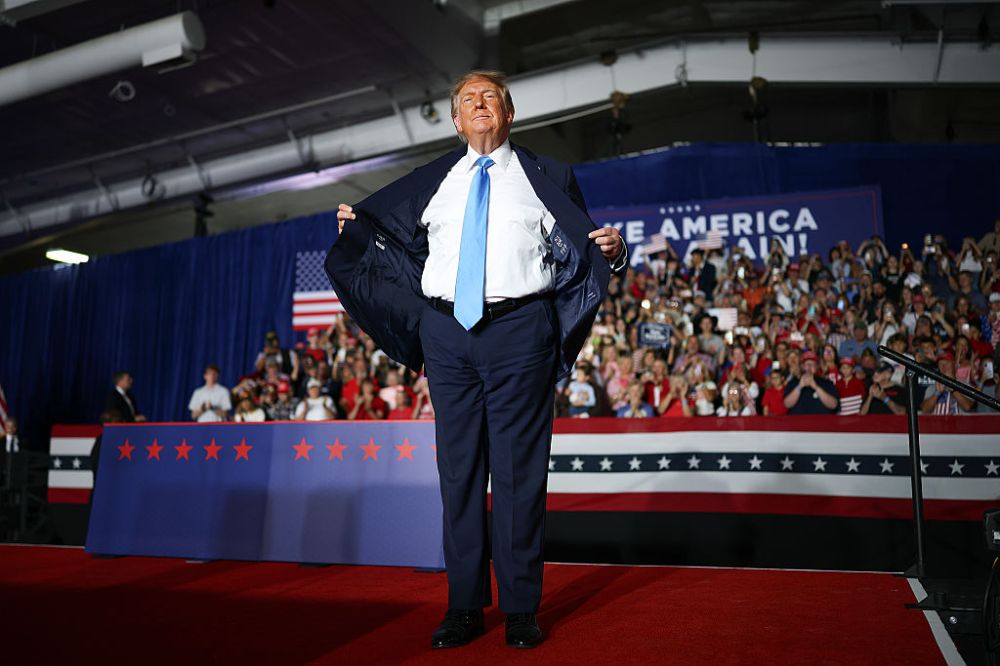
Trump has long commanded deep loyalty from his base, including millions of Christians who supported him – often for serious moral reasons, including the protection of unborn life, the defence of children from gender ideology, the safeguarding of religious liberty. Yet in attempting to bat away religious criticism by ridiculing its most prominent voice, he appears to have underestimated something fundamental. Their faith does not ultimately answer to him.
The Pope, for his part, has not returned fire in kind – but nor has he retreated. Instead, he has issued a simple statement: ‘God does not bless any conflict.’ This, in itself, is perhaps an insufficient summary of the ‘just war’ theory – an over-simplification pointed out readily by US vice president J.D. Vance. It’s clear in scripture that God does bless some conflict. But the Pope’s point is resounding to those opposed to the Iran war: He doesn’t bless this one.
This is more than a spat between the Pope and the president. It is the reappearance of religion as a serious force in geopolitics. What we are witnessing is the collision of two kingdoms: one driven by power, the other by principle.
For all the talk of secularisation, liberal democracies have not outgrown the need for moral limits. They have simply outsourced them – often to institutions they no longer quite believe in. But a growing number of people are reclaiming those religious frameworks as foundational and true, leading to a tension between the politicians and the people.
Trump is accustomed to opposition that can be measured – votes, ratings, approval numbers. But moral claims are a different game. They are not subject to negotiation – you cannot bargain with the idea that every human life has inherent dignity, or deflect the charge that threatening civilians violates something deeper than international law.
The same young Christians who care deeply about protecting unborn life or defending children from puberty blockers are also increasingly alert to questions of war, rhetoric, and justice. The same belief in human dignity applies universally – and not just to American lives, but to all human beings, divinely created.
In that sense, it is entirely consistent to have supported Donald Trump in 2024 on recognisably Christian grounds – and to criticise him now on precisely the same basis. What Pope Leo XIV has done by leading the opposition to Trump’s rhetoric is force that consistency into the open.
For younger voters, weary of the moral improvisation of modern politics, the appeal of Christianity lies in its refusal to bend. Its ethical claims do not change with the news cycle or flex with polling data. It offers, for better or worse, a fixed point in a culture of flux.
The great irony is that this moment was supposed to be impossible. Religion was meant to wither into irrelevance. Instead, it has returned – leaner, sharper, and as significant as ever – as a balance on global power. Trump will not bend to most opponents. But will he bend to God?




Comments