
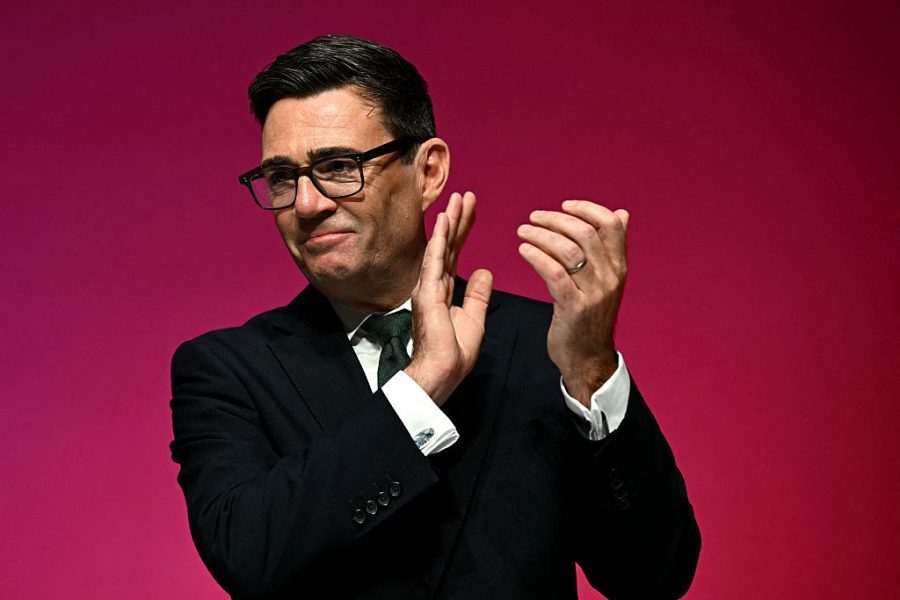
Should you be in the market for scorn towards Andy Burnham’s conference speech, there is plenty of it out there, including – shameless plug – my op-ed in the Daily Mail on the Prime Minister’s wish to make the state a vehicle for sentimentalism. But there are a few points largely overlooked in the Right’s response that should be kept in mind.
The first is that, while his speech was essentially a reheat of the speeches he gave during his 2015 leadership campaign, the perspective sketched out will sound new to voters who have only ever known cautious, triangulating, managerial Blairism of both the Labour and Tory varieties. Of course, the reason they have never experienced a soft-Left government is because the British political system has safeguards in place to prevent the soft-Left from coming to power. They are called ‘elections’.
We’re still not sure who the Right’s leader is between Nigel Farage and Kemi Badenoch
However, after three decades of red and blue New Labourism, and with Britain no longer able to generate 1990s levels of prosperity, the soft Left finally has its opening. They will fail because what they believe in doesn’t work and what works they refuse to believe in, but they hold the levers of power and will get to play with them for a few years. Some of what they do will prove popular because while they scorn populism in their opponents their economic prescriptions are mainly of the ‘tax the rich, not the pensioners’ variety. As anyone who has endured a James O’Brien phone-in will confirm, there is a midwit vote out there.
Point number two: the Prime Minister having set out his approach to politics, attention is drawn to the vacuum on the other side. Burnham says the state is the great enabler and that by guiding the economy it can deliver for the common good. Do his opponents have a theory of the state and its role? Are they for Thatcherism, or common good conservatism, or national populism? The Left is rewriting the social contract while the Right is busy calling things ‘woke’. If you’re going to say Burnham’s way is wrong, the obvious follow up questions are why and what does the Right way look like?
Third, emotion has its place in political life. With apologies to Ben Shapiro, facts might not care about your feelings but the British public does. Most voters experience politics on an instinctual or impulsive level rather than as a rational dispute over philosophy or policy detail. They have gut reactions and form judgements based on them. While it can be overdone and ring inauthentic, a leader unable to engage the electorate’s emotions – hopes, fears, prejudices – is talking over rather than to them. Burnham’s speech will have gone down well with Good Morning Britain and Loose Women viewers. His opponents need to speak to these voters, too.
Fourth, and for now, finally: the Prime Minister’s chief electoral advantage is that his rivals are divided almost evenly between two parties with significant crossover but no prospect of a merger. We know what Andy Burnham believes, and though wrong-headed, there is at least something there. We don’t know what the leadership of the Right believes because we’re still not sure who their leader is between Nigel Farage and Kemi Badenoch. Were Burnham to call a snap election for six weeks from now, there would be two contests, one to lead the country and another to lead the Right. Only one of those battles matters to the electorate and the other can very easily be characterised as navel-gazing self-indulgence.
Andy Burnham’s Labour is beatable but these are just four of the reasons why, as things stand today, the Right is not yet well-placed to do so.





Comments