For the archaeologists used to working on major infrastructure jobs, it was a small dig, over in four weeks. Yet Peter Crawley, in charge of excavating the ground ahead of a new local housing project near Thetford in Norfolk, had a hunch it might be important. His team at Pre-Construct Archaeology did a metal-detector survey, and he was proved right. But not in ways he had expected.
Curved sheets of corroded green bronze emerged from the soil, packed together in a space no larger than a side table. They lifted the heap in a block of sandy earth. CT scanning at Addenbrooke’s Hospital revealed an extraordinary sight: a compact mass of metalwork, and the unmistakeable shapes of a boar’s head and the central bosses of shields. Underneath was what raised the find into the magical. There was least one fighting horn, known to archaeologists as a carnyx. Featured in Roman-era records, the objects themselves are exceedingly rare. This one is the most complete ever found.

What happens next? Who owns the hoard? When will it be displayed? What was a carnyx, and why do we know so much about them but, until recently, have so few to prove they even existed? What does any of this have to do with Boudica?
Archaeologists await the outcome of an inquest. This will almost certainly declare the find legally treasure. It will be valued and ownership established, and in all likelihood will be acquired by the museum in Norwich. Then full conservation of the fragile remains can begin, with scientific studies supported by Historic England that will run on for years.
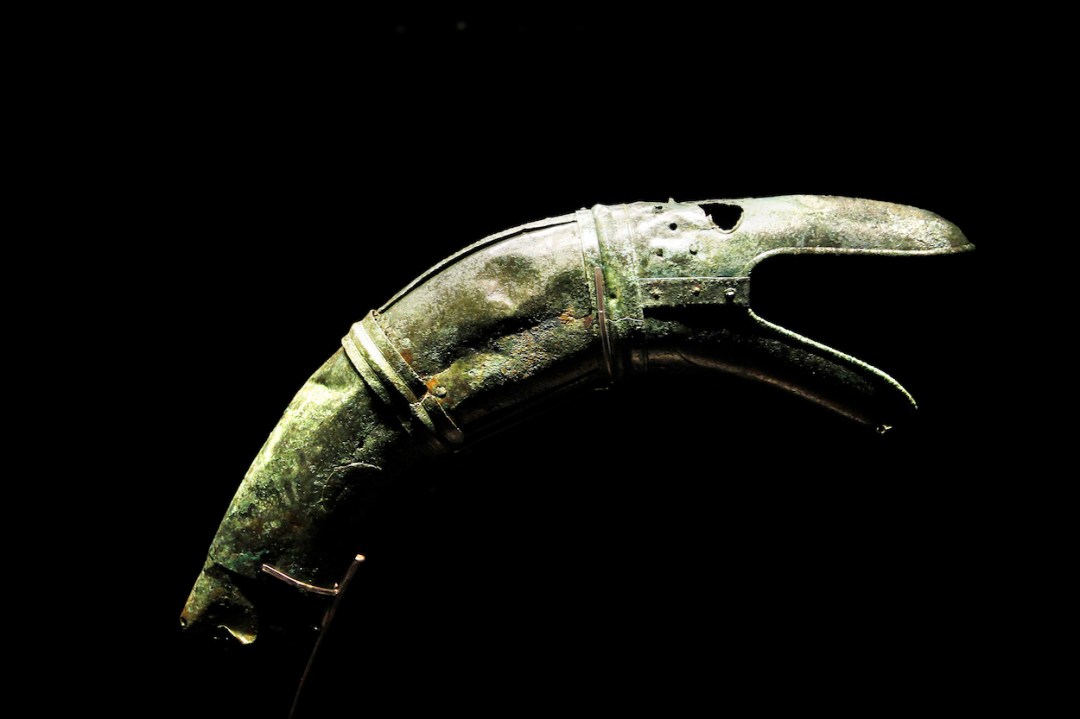
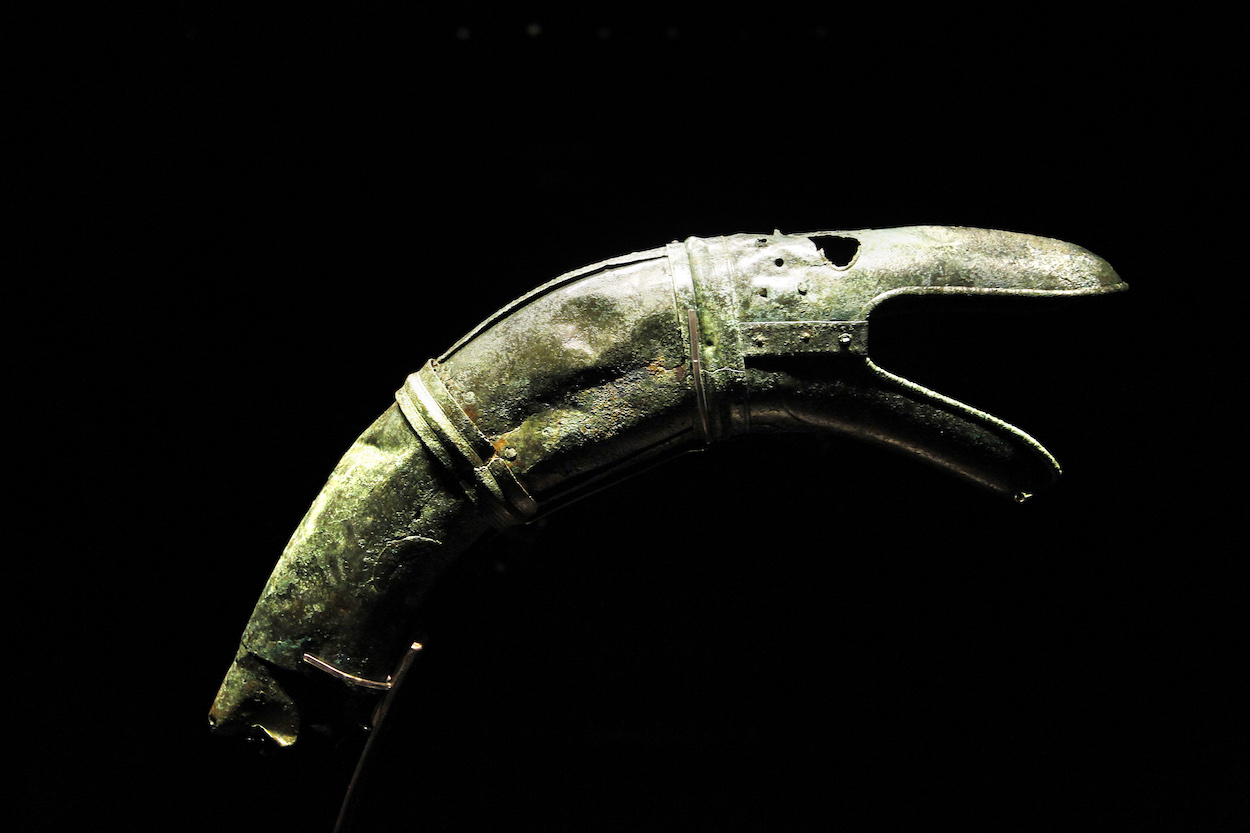
A carnyx was a distinctive instrument with a horizontal mouthpiece at the end of a long, vertical tube opening into an elaborate bell, typically a stylised boar’s head sculpted from an assemblage of hammered bronze or brass sheets. The Norfolk cache has two tubes and mouthpieces, so at least two carnyces are represented, and at present it’s not known which pipe, if either, fits the head. That has eyes and flapping ears, but it’s all mouth, a screaming maw with things to say. The curving neck is backed with a crest sporting Celtic triskeles.
The other pieces include a decorated boar’s head from a flag standard, the first found in Britain and a spectacular find in itself, five shield bosses nested like a pile of bowler hats, and an as yet unidentified strip of iron.
That European tribes wielded these towering, blaring horns was known long before any were found in modern times. From around 300 BC to AD 300 they are depicted in art – on monuments such as Trajan’s column in Rome, pots, metal objects and coins. For Romans, they were a symbol of mystery and brutality, makers of discordant cacophonies midst the shouting and tumble of conflict. ‘For there were among them such innumerable horns,’ wrote Polybius in 225 BC of a battle between Romans and Gauls, that combined with shouting, ‘the noise seemed to come not from human voices and trumpets, but from the whole countryside.’
Only two were known from Britain before. The first, found in 1768 near Lincoln, seems to have been complete apart from missing its bell. In a pioneering if unrepeatable scientific study of the metal, Sir Joseph Banks, the famed botanist, melted it down into ingots. The second carnyx has a happier history, though it was only recognised for what it was nearly 150 years after its discovery in 1816. It came from a bog at Deskford in north-east Scotland, and survives as just the bell, a bulging boar’s head in local early Celtic style. Until recently it was the best example of its kind.
For the first time it will be possible to create an accurate playable replica carnyx
That changed dramatically in 2004. During excavation of a first-century-BC temple at Tintignac in southern France, seven carnyces were found in a huge deposit of metalwork that also contained swords, helmets, sculpted animals, a cauldron and more. Six of the horns have boar’s heads, and the new information helped archaeologists identify a few small carnyx fragments from other, older finds.
They remain scarce partly because metal can be recycled, and once-significant items later become valuable scrap. How they were treated is also a factor. No complete carnyx is known: they were taken apart, broken up and buried in what archaeologists believe to have been acts of ritual destruction, in a manner that suggests they yet retained some kind of power.
For Tim Pestell, senior curator of archaeology at Norfolk Museums Service, it is the entirety of the new find that makes it so important. All the parts are there. For the first time it will be possible, he says, to create an accurate playable replica: ‘to hear what a carnyx really sounded like’.
There’s no record of Boudica or her armies using these horns. But the find was made in her tribe’s territory. Its late BC or early AD date, we can imagine, allows for the chance she saw it. Wherever she now lies, in years to come her ghost might recognise the sound blasting out above Norwich Castle, a wail of native resistance to an invading empire.






Comments