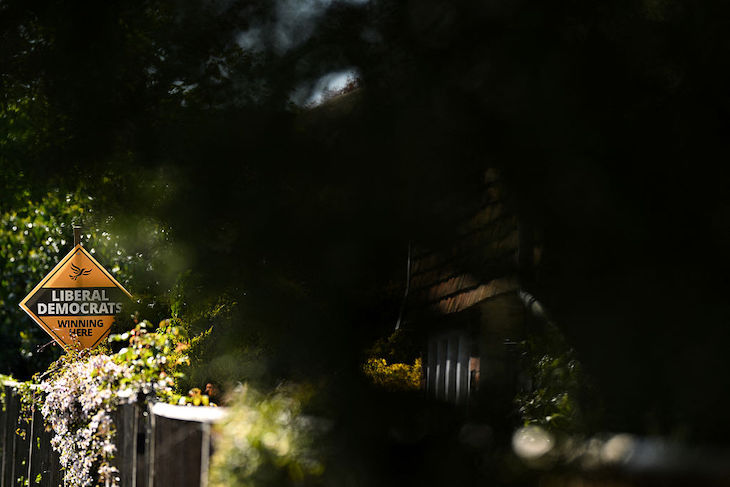
It is a beautiful, sunny Saturday morning in south-west London, and Sir Ed Davey is rallying the troops. The Lib Dem leader is hoping his party can dislodge Labour and take over Merton council next week. Having got a few snaps alongside activists and Wimbledon MP Paul Kohler, (Sir Ed had to ask for a “senior woman” to make sure the picture was not too male and pale,) he told Coffee House: “We’re going to make gains across the country from both Labour and the Conservatives. So, in a funny sort of way, Merton is a sort of symbol of that, of our progress.”
“In three years, Tunbridge Wells has gone from a safe Tory seat to being Lib Dem vs Reform,” local MP Mike Martin explains
Davey is right that we are in an interesting bit of the capital for those waving orange diamonds. With parts of the patch in Tory-facing Wimbledon, and others more Labour-friendly, it serves as something of a bellwether – a test of where the Lib Dems can win and who they can beat.
Modelling from the London School of Economics suggests that south-west London is going to remain a Lib Dem stronghold. The party is predicted to get 49 per cent of the vote in Richmond upon Thames and 47 per cent in Kingston upon Thames. The projections also show a 21 per cent share in Southwark and 36 per cent in Sutton. In Merton, where Sir Ed was campaigning on Saturday, the party is expected to get 31 per cent of the vote. Pollster and Conservative peer Lord Hayward has said that overall the Lib Dems will gain around 150 seats.
Perhaps it’s the weather, but the mood amongst activists in south-west London is certainly upbeat, with Labour clearly in the crosshairs. Two of those preparing to go out canvassing complain to me that their opponents are spreading the rumour that the Lib Dems want to cut the freedom pass, which allows older travellers or those with disabilities free access to London public transport. The Lib Dems insist that is not the case and are clearly annoyed at the suggestion. It certainly seems that Labour, usually so dominant in London, are starting to panic.
Winning council seats really matters to the Lib Dems, because “if we get in, people can see what we do,” says Sir Ed. “And then it shows, gives us credibility under first pass the post system, that we can win.”

Councillors make up the core of their activist base and often take great pride in their status as community champions. Sir Ed thinks that Kemi Badenoch’s previous comments about a Lib Dem “being somebody who is good at fixing their church roof,” were “quite sneering, actually…We’re proud of that. Listening to people, hearing their concerns, rolling up your sleeves, and going fixing stuff, is, I think, what local government should be about, and it plays to our strengths.”
He filmed the party’s election broadcast on a church roof in response.
The reality, though, is that the political climate has got somewhat more complicated for the Lib Dems. They took soft Tory votes with aplomb in the 2024 general election but now need to move beyond that.
Almost everyone I spoke to, in some way or another, acknowledged the new multi-party reality of British politics. Sir Ed referred to “the right-wing split,” by which he means the Conservatives vs Reform, and “the left wing split with the far-left Green Party.” He believes “there’s a huge opportunity for us, and we’re determined to take that. And I think that’s why people will be surprised.”
The fight to the right is taking place in areas like Kent. “In three years, Tunbridge Wells has gone from a safe Tory seat to being Lib Dem vs Reform,” local MP Mike Martin explains. “The Tories have totally disappeared; Labour couldn’t even get enough candidates together; and the Greens don’t have any traction.”
Similar thoughts were articulated by Tim Farron. The former party leader doesn’t have elections in Cumbria where he is an MP, so he is “helping in Scotland, Birmingham, Preston and Newcastle.” Farron reports that “all seems positive. Tories nowhere, Labour toxic, where we are working, we are mostly winning!”
Nobody would expect any MP or activist to say anything different when speaking to a journalist, of course. But the Lib Dems’ firm sense of positivity and energy is hard to deny.
Sir Ed has become (in)famous for his attention seeking stunts while out on the campaign trail. That morning in Colliers Wood, there was, thank goodness, not a wetsuit to be seen. So, in these extremely serious times, are the stunts finally coming to an end?
For starters, Sir Ed does not like the term “stunts”, referring to them instead as “visuals”. He argues that “the visuals that I’ve been doing, I think, respond to the issues.” The day before this trip, he had been dancing with a 103-year-old lady to highlight the issue of social care – “the biggest financial issue on councils.” Another day, he was up on a roof fitting solar panels “because guess what, cost of living and energy bills is an issue, and we were showing, this is how you can cut your energy bills”.
Much speculation ahead of polling day has focussed on the rise of the populist parties; Reform and the Greens, at the expense of Labour and the Conservatives. Which is fair enough. The Lib Dems, though, are determined that when the results come out, they will be a key part of the story.
If they do make the gains they expect and Sir Ed Davey goes from splashing around in lakes to delivering another strong set of results in an increasingly chaotic political environment, it would be a genuine achievement. One that might just set his party up for years to come.





Comments