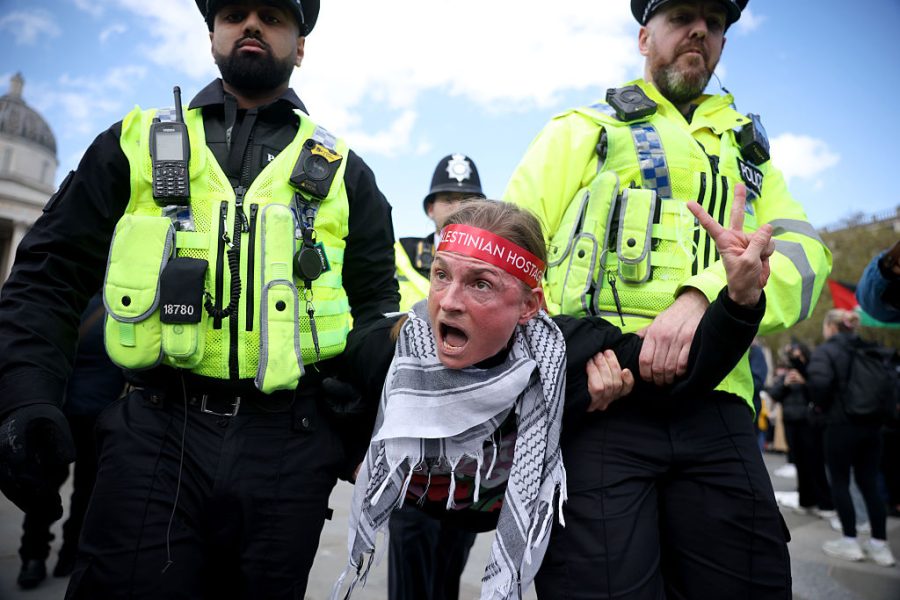
Next week, the Court of Appeal will hear Home Secretary Shabana Mahmood’s appeal against a High Court decision that the proscription of Palestine Action last summer was unlawful. The case will be hugely consequential. Earlier this month, more than 500 people were arrested at a Palestine Action demonstration. In total, more than 2,700 people have been arrested for expressing support for the group since they were banned in July last year by Mahmood’s predecessor Yvette Cooper. Prosecutions against these individuals were put on hold following the High Court’s judgment in February.
I have previously argued that the High Court’s decision was both unfortunate and unwise. Palestine Action had been involved in a number of activities, including damaging aircraft at RAF Brize Norton using paint and crowbars and attacking defence firms that provide services and supplies to support UK defence enterprises.
The High Court acknowledged that the group was not simply engaged in peaceful protest. Nonetheless, the judges found against the Home Secretary on two grounds.
We should not conflate Palestine Action’s activities with peaceful protest and freedom of speech
First, they concluded that she had not acted consistently with her published policy on proscription because she had regard to the significant ‘disruptive benefits’ that banning Palestine Action might provide (a factor which was not included in the policy). The judges accepted that this conclusion ‘may appear to rest on a very narrow basis’ given that the Home Secretary had also concluded that the group was an organisation engaged in terrorism. However, they determined that this rendered her decision unlawful.
The High Court also found that the ban was disproportionate under human rights law because Palestine Action’s activities had ‘not yet reached the level, scale and persistence’ that would justify proscription under terrorism legislation.
The judgment has been the subject of some criticism in legal circles. Mark Elliot, a professor of public law at the University of Cambridge, suggested that the High Court’s approach was ‘surprising’. He noted that the Home Secretary was likely to argue that the court failed to ‘ascribe appropriate respect to her political judgement’.
Respected legal commentator Joshua Rozenberg has highlighted the court’s ‘shaky legal reasoning’ and speculated that it may have been concerned about the impact of a huge number of prosecutions which could put undue pressure on our crumbling criminal justice system. Quite rightly, Rozenberg also stated that if the High Court’s judgment is upheld, it would make it more difficult for ministers to ban other terrorist organisations in the future.
Gabriel Tan argued on the Administrative Court blog that some of the High Court’s reasoning was ‘unconvincing’. He stated that it ‘adopts a highly artificial view of public authority decision-making’.
Unlike the court, the Home Secretary has both political and practical responsibility to secure public safety. The fact that the High Court determined that only a ‘very small number’ of the group’s actions ‘have amounted to “terrorist action” within the statutory definition’ should have been immaterial. Once it accepted a clear risk of further terrorist activity, the question should have been left to elected politicians and parliament. They, after all, will face the consequences if things go badly wrong.
In a case which was heard shortly after the events of 9/11 (Secretary of State for the Home Department v. Rehman), Lord Hoffmann highlighted that in matters of national security, the cost of failure can be high and that the judicial arm of government needed to respect the decisions of Ministers of the Crown on such issues. He said:
It is not only that the executive has access to special information and expertise in these matters. It is also that such decisions, with serious potential results for the community, require a legitimacy which can be conferred only by entrusting them to persons responsible to the community through the democratic process. If the people are to accept the consequences of such decisions, they must be made by persons whom the people have elected and whom they can remove.
The risks of terrorism have hardly decreased since that judgment was delivered.
It is right that the courts should stop executive overreach. Nevertheless, once the High Court accepted that Palestine Action was an organisation ‘that promotes its political cause through criminality and encouragement of criminality’ – including acts of terrorism against British national security infrastructure – that should have been an end to the matter. The judges should not then have sought to second-guess the dangers identified by the Home Secretary.
The threadbare nature of Britain’s military has been put in the spotlight by the conflict in Iran. It is impossible for us to know how trivial damage to aircraft at RAF Brize Norton, or to submarine parts in Glasgow, is to the UK defence effort. But to some extent, that is precisely the point. Palestine Action cannot know what impact their terrorist actions might have on British national security, and one might reasonably conclude that they likely do not care. We should not conflate their activities with peaceful protest and freedom of speech. That is an insult to groups which act lawfully and responsibly.
Unlike normal criminal law, terrorism legislation is specifically designed to prevent and disrupt dangerous terrorism-related activities before they happen. Where a group engages in attacks on UK national security infrastructure, a clear line has been crossed.
The Court of Appeal now has the opportunity to put things right. It should uphold the ban on Palestine Action.





Comments