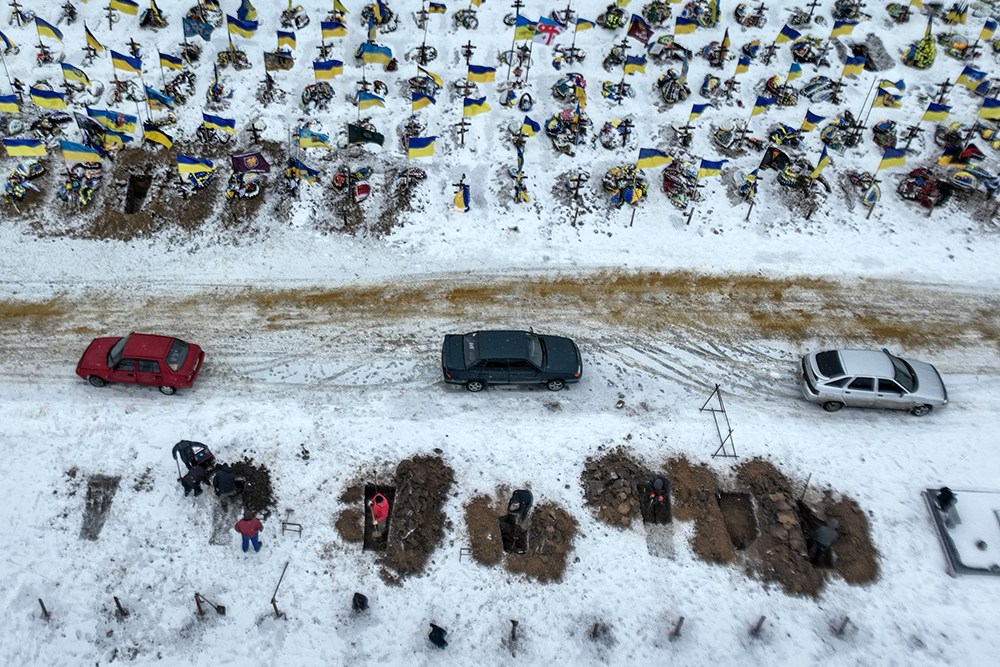


Reporting of the war in Ukraine suffers from the tendency of journalism to exaggerate a trend. The most recent one has been Ukraine’s success in drone attacks on key energy and strategic sites deep inside Russia. These are indeed innovative and prodigious. The Russian summer offensive has also failed to break through. This leaves too little room, however, to cover fully the dramatically worsening plight of Ukrainian civilians. Olga Rudenko, editor-in-chief of the Kyiv Independent, said this week: “Even if you think you’re used to everything, you are not.” Russia has switched tactics from big, one-off aerial bombardments to almost continuous drones. In Kyiv one day last week, the air-raid sirens signaled 13 different attacks. My courageous friend Rose Cecil, who is “in theater,” spoke to me recently, mentioning a colleague whose train journey from Kyiv to Odessa was stopped ten times by raid warnings. Towns such as Kramatorsk and Zaporizhzhia which, when I visited them earlier in the war, were already difficult, are now virtually impossible. Civilians – people on buses or bicycles, or in schools or supermarkets – are deliberately targeted. Many are fleeing, though the Russians lack the power to take the territory vacated. The wonderfully efficient petrol stations, usually called by the unfortunate acronym of WOG (West Oil Group), which also serve as local grocers, are targeted, as is the private postal and delivery service, Nova Poshta, and pretty much anything that moves. These horrors do not make people demand peace, because, as Rose puts it, “they know what’s waiting for them” if any deal secures Russian occupation. But it is shocking how little protest western governments make about the scale of Vladimir Putin’s brutality, that glories in breaking every law of war. Last week’s visit to Moscow by the CIA director, John Ratcliffe, has comforted few. Ukrainians remember his predecessor’s similar visit in 2021 to persuade Russia not to invade their country. Perhaps emboldened, Putin launched his “special military operation” in February the following year. Putin’s total war is the greatest total atrocity since 1945. Yet the West sees it as somehow containable.

I spent a few days of leisure in York last week. It is a proper, complete, microcosmic city – a concept familiar in Italy, rare in England. It has everything – cathedral (the Minster) obviously, and several outstanding medieval churches; city walls; two rivers; a Mansion House; Assembly Rooms; a Merchant Adventurers’ Hall; a Philosophical Society; a splendid railway station and railway museum; a university, county museum and gardens; a debtors’ prison (and even a women debtors’ prison). So we looked forward to the York Gallery. It has 136 high-quality pictures presented in the 1950s by F.D. Lycett Green, of the Yorkshire industrial family, which amount to a representative narrative account of European painting from the 14th to the 19th century – again, microcosmic, a mini National Gallery. This generosity made the York Gallery prouder, more visited, more educative. Today, however, only a tiny fraction of the Lycett Green gift is on display – about half of one of the gallery’s six or so rooms, plus a few pictures on the stairs. The rest consists of temporary exhibition space, a dreary collection of modern pots, a “Wall of Women” which will eventually fulfill the museum’s “ambition to create a gender-equal collection” and the winners of an art prize in which, a notice burbles: “The everyday is subtly ruptured – domestic and urban space destabilize, moments of control fracture, and brief interruptions reveal wider social conditions… the legacies of colonial histories… how meaning is constructed, unsettled and reformed…” The prize “connects local context with global exchange, positioning art as a site of reflection, resistance and change.” Certainly a site of consumer resistance: we left. Alas, poor York, which deserves so much better.
On Sunday, we went to Antonia Fraser’s birthday lunch in the country. She is 94. Her first book, King Arthur and the Knights of the Round Table, was published in 1954. Her most recent, The House that Spoke, appeared last year. Hers is almost a record longevity of publication by a single living author. My researches suggest Antonia is outpaced only by P.G. Wodehouse, whose first novel appeared in 1902 and whose (non-posthumous) last came out in 1974. My wife counterclaims with Barbara Cartland – first book, 1925; last book, 1997 – but I argue Dame Barbara doesn’t count. Her total lifetime output was 723, and her “Pink Collection” of 160 more books was published posthumously. In what sense did she write them? Like Rosa Dartle, “I only ask because I wish to know.” Antonia tells me she now writes verses. She declaimed a birthday one for the guests. If she publishes them next year, she will equal Plum.
Several writers/speakers – Justin Marozzi, Tom Mangold, Iain Dale – confirm a previous piece I wrote about “book clubs” trying to take money off authors. Marozzi became suspicious of two invitations using the not-quite-appropriate expression “I have a bone to pick with you” over his book about Islam and slavery, one from Maha Shakir of Safar Book Club, Dubai, the other from Piper Ramsey-Sumner, of the Theological Book Club in Tallahassee. One friend, Andrew Mitchell, who is also an MP, was even abused. When he declined the “Spotlight slot” of a London book club, its organizer, seeking between £150 and £350, demanded money with menaces: “Why don’t you want to support the community, Sir Andrew?” Iain Dale says of the scam in general: “I wonder how many first-time authors part with their money, thinking it’s perfectly normal.”
Cheering news in the week when Andy Burnham at last reaches the dispatch box and promises to “bring back hope.” At Edenbridge and Oxted Agricultural Show, the Sir Winston Churchill Memorial Trophy for the best display was won by the main-arena display of mounted and unmounted packs of hounds.





Comments