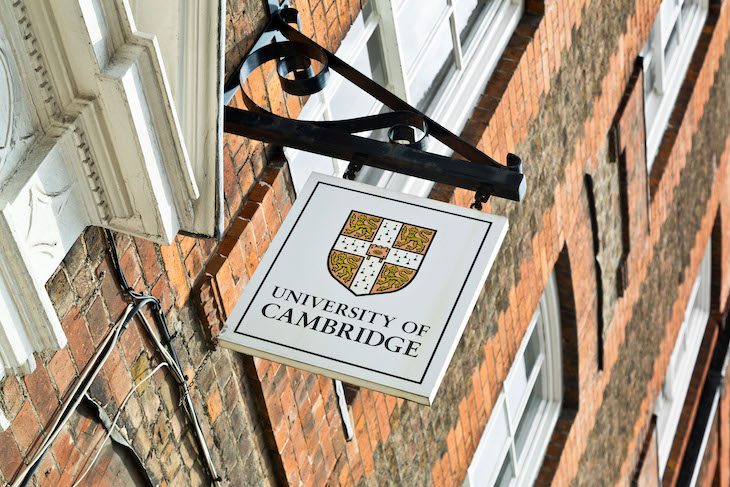
An academic project hosted by Cambridge University platforms creationism, the belief that the world was created by God in seven days. It promotes an academic paper demanding that schoolchildren be taught to “actively resist” the science of evolution.
It is the latest sign of fundamental problems at Cambridge’s education faculty, the same department which hired Jason Arday
At Charles Darwin’s old university, where a college is named after him, Darwin’s discovery is now described by one Cambridge researcher as an example of “potential challenges posed by Eurocentric monoculture.”
It is the latest sign of fundamental problems at Cambridge’s education faculty, the same department which hired Jason Arday.
The project which platforms the creationist claims, the Islamic Educator Learning Community (IELC), is led by Cambridge’s assistant research professor of education, Farah Ahmed, a former activist in the since banned terror group Hizb ut-Tahrir. Ahmed’s extraordinary CV, and her long record of grossly bigoted, extremist and separatist views, were revealed by a 2002 pamphlet exposed by The Spectator on Tuesday.
IELC is “hosted by” and “partners with” a university body called the Cambridge Teacher Research Exchange, Camtree. Camtree is a project of Hughes Hall, the Cambridge University college where Ahmed is a governing fellow. Ahmed is also an “affiliate” of Camtree.
IELC publishes on its website, with a Camtree address, a paper on “Islamic scientific critical consciousness” which asks: “Does the common modern biological assumption that humans have common ancestry with other life forms conflict with [Islamic] religious beliefs about God creating Adam and Eve?”
The author of this paper, Usama Javed Mirza, was at the time a researcher at Cambridge University’s faculty of education and at Ahmed’s IELC. He still is, according to his LinkedIn entry.
The paper says that “countering colonial hegemony in science education for Muslims” could include “identifying gaps in fossil records to make the case that the evidence of humans descending from apes is inconclusive.”

It adds that “fitna” (trial or temptation) “may occur, for example, when a Muslim student in the science classroom begins to believe that humans emerged on Earth without any role played by the Creator.”
It says that fitna “boil[s] down to two beliefs being inculcated in students that are problematic from an Islamic standpoint,” namely that “the meaning of existence is socially constructed as an evolutionary response. There is no afterlife or soul; and the universe exists by chance, and runs according to mindless laws of physics…. To counter these hegemonic ideas, it is not enough just to intellectually dispel them. Rather… it is necessary to also instil within students a capacity to actively resist the influence of this monoculture.”
On Tuesday, in the wake of the Jason Arday scandal, The Spectator revealed that Ahmed had been given the prestigious assistant professorship. We noted that in a 2002 pamphlet, republished in 2017, she attacked ‘western education’ as a ‘threat’ to Muslims, condemned democracy and integration, and criticised British schools for teaching that child marriage is wrong. Like the paper’s author, Mirza, Ahmed has also said that modern science is a problem, because in the “teaching of evolution, Muslim children will be exposed to ideas that contradict Islam.” She said in 2010 that she was no longer a member of Hizb ut-Tahrir and did not agree with “all” its views.
After that story created a storm, the education faculty took decisive action. It removed the names of all its staff from its website, presumably to stop anyone who doesn’t know about web archive tools checking to see if they’ve hired any more wrong’uns (spoiler alert: they have.)
Other action has been less forthcoming. The faculty clearly hopes to ride this one out, issuing a statement that it is “committed to academic freedom and freedom of speech within the law.” Well, we must reluctantly agree that Ahmed – benefiting from the democracy she condemns – should have the freedom to say that English is “one of the most damaging subjects” a school can teach, or (while teaching at Cambridge) write that Muslim students shouldn’t have to worry about “gaining literacy and numeracy and other disciplinary skills demonstrated through qualifications.”
But that’s quite different from believing that Cambridge University should fund her to promote her ideas to the future leaders of the country.
Still more indisputable is that a university subject, even one as debased as Education at Cambridge, should not promote baseless, anti-scientific twaddle in the name of academic research.
But it does.



Comments