I returned from holiday to find parched lawns and a deliciously cool babbling brook where the road had been. Up the hill stood signs warning motorists that work was in progress, and the source of the leak was surrounded by temporary barriers. The scene was quiet and peaceful, dappled by sunlight on flowing water, and entirely undisturbed by human effort.
The hosepipe ban takes a problem the government has created and tells us it’s ours
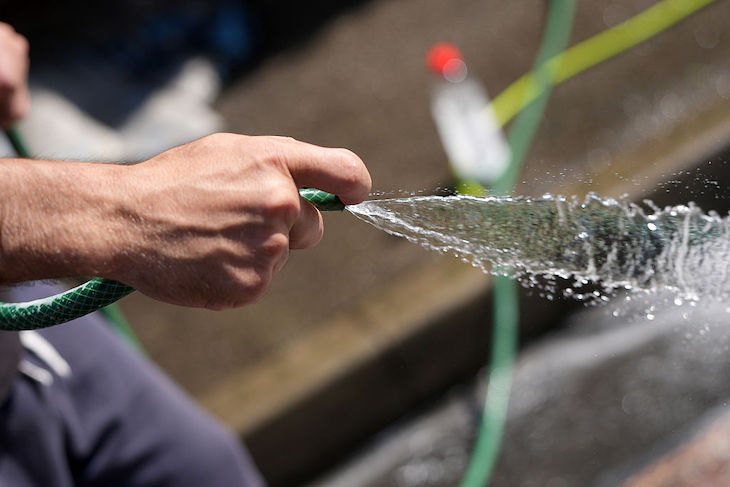
My village is currently subject to a hosepipe ban, like much of England. Coming home yesterday I rescued my wilting hollyhocks – which are drought-tolerant plants – with a hosepipe, and I am willing to do so again. I am happy to leave the sprinkler in the shed and let the lawn parch, but not to watch plants die while a river of drinking water runs down my road. Conserving water is entirely reasonable, but carrying it in a bucket rather than using a hose is not a sacrifice I owe to a state working hard on my behalf.
In the early days after privatisation, the newly formed water companies allowed the amount of drinking water that simply poured out through leaks to rise, reaching a high of something like a hundred litres per person per day. Early regulatory changes spurred them to cut it sharply but for the past twenty years further improvements have been relatively small. The brook now running down my street is a literal one, but for each of us there’s one that’s invisible yet just as real, amounting to 46 litres every day.
“Nothing is more destructive of respect for the government and the law of the land than passing laws which cannot be enforced,” wrote Einstein about America’s Prohibition. Every law that asks to be ignored diminishes respect for the state and cheapens the expectation that rules are meant to be followed.

Shoplifting has become expected; even minor supermarket items now carry those dreary symbols of crime’s normality, security tags. Phone theft goes routinely unpunished. A state that criminalises watering your hollyhocks while shrugging at bicycle theft (to say nothing of complacency in the face of far worse crimes) corrodes its own foundations.
The last major reservoir built in England was Carsington Water, in 1992. Official figures say the UK’s population has grown by some 12 million since then, almost 11 million of that being in England. Havant Thicket in Hampshire is finally under construction – which is welcome, and further proof that our failure to build was a choice, not inevitable. Greenpeace – not an institution known for underplaying environmental worries – estimates that a hosepipe ban across England and Wales would save 577 million litres a day. Water companies lose almost five times that amount through leaks.
Water companies do not operate in a free market but an artificial one. Rules are set by the state, consumers have little or no choice. To build reservoirs and fix leaks is difficult, and costs water companies in a way that imposing hosepipe bans does not. We have designed a market where regulated monopolies find it most cost-effective to run out of what they exist to supply.
The behaviour of the water companies demonstrates the revealed preference of the system we have designed for them: rationing rather than resilience. The failure belongs to our government and our civil servants and our regulators. They create perverse incentives and stand back as we experience the predictable bad outcomes. Drought is natural and unavoidable: a system unable to withstand it is not. The hosepipe ban takes a problem the government has created and tells us it’s ours.
The maximum penalty for breaching a hosepipe ban is £1,000 but it’s a paper threat, and in 2022 seven of England’s fifteen water companies – covering 31 million people – said they’d never fined anyone. In 2025, Southern, Yorkshire, Thames and South West Water confirmed that, despite the intervening years having featured the worst drought in decades, nothing had changed and they’d not issued a single fine between them. The incentives, once more, are perverse. Those who stick rigidly to the bans experience a cost. Those who ignore the law experience none.
If you were trying to design systems to erode trust in society, to undermine a sense of community, to chip away at respect for the law and confirm the expectation of government incompetence, this would be a fine approach. Our England is a garden, and such gardens are not made by singing ‘Oh, how beautiful!’ and sitting in the shade.
There remains much that is beautiful about our country, much that is lovely and kind and worth preserving – even much that is competent. But a brown lawn beside a road running with drinking water isn’t the unavoidable consequence of a hot summer but the entirely unnecessary result of flawed public policy. And a government that cannot keep water in its pipes should not lecture its citizens about watering their roses.




Comments