
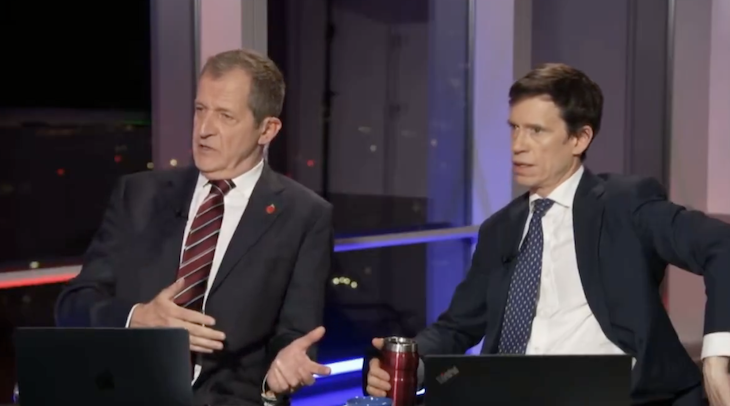
As per J. M. Barrie, one either believes in fairies, or they don’t. I take a similar approach to Rory Stewart. To his legions of Rest is Politics listeners, the ex-Tory MP, bedroom-squatter, and Afghanistan-botherer is a sage – as right-wing a voice as their timid and tiny middle-class minds can handle, successfully neutralised by co-hosting with 45-minute enthusiast Alistair Campbell. But to me he is a charlatan: another over-educated Balliol boy with a far higher opinion of himself than his public record merits. The example of his Dominic Cummings comments is a case in point.
He is a charlatan: another over-educated Balliol boy with a far higher opinion of himself than his public record merits
For those unfamiliar, a Stewart rant from June last year about the former No. 10 adviser is currently doing the rounds on Twitter. In it, the Temu Lawrence of Arabia accuses Cummings of all manner of sins: being a child, a conspiracy theorist, a serial name-dropper who makes a deal about having seen classified information to cosy up to Silicon Valley tech bros and the Emiratis. In his moralising, Stewart specifically hones in on a comment Cummings had made about elites in the UAE not sending their children to Britain over fears of radicalisation.
Being Gary Linker’s anointed ‘Middle East Expert’, Stewart naturally felt able to dismiss this suggestion as nonsense. To suggest Britain might have a problem with Islamic extremism – or that Cummings might have a point – would be far too likely to scare the listeners, an unnecessary reflection of the reality of Britain today that would upset those tuning in from Verbier and Tuscany. But the inconvenient truth for Stewart is that Cummings – not for the first time, m’lud – was right.
The Financial Times has reported that the United Arab Emirates has removed the UK from its list of student destinations eligible for subsidies. The decision is apparently ‘linked to anxiety in the UAE over what it sees as the risk of Islamist radicalisation on UK campuses’, with an Emirati source quoted as saying that they ‘don’t want their kids to be radicalised on campus’. A particular point of contention is Labour’s failure to proscribe the Muslim Brotherhood. Stephen Daisley has more.
When this was suggested by Cummings, it was easily dismissed. When it crops up in the Davos paper of record, it is rather more difficult to brand it misinformation, fake news, conspiracy theorising or whatever else is this week’s luvvie term du jour. Accordingly, Stewart has apologised. Alas, an ‘emergency podcast’ is not thought to be incoming.
What is surprising about this whole affair is not that Cummings was right and Stewart was wrong. Nor is it that the UAE considers Britain a hotbed of radicalisation – hardly surprising, with our recent record. What is remarkable is that anyone still takes Stewart seriously. He is the same galaxy brain who predicted that Kamala Harris would win the presidency by a landslide; the same supposed man of principle who flounced out of parliament when the Conservative party had the temerity not to make him prime minister. His only redeeming feature as a public figure is his willingness to take one for the collective team and serve as his podcast’s second-worst host.
Stewart is a midwit’s idea of a clever person: sufficiently posh, diffident and CV-ed to convince that he speaks from a position of authority, but without any proven record of accuracy. Those listening to his podcast are far greater victims of misinformation than the supposed ‘low-information voters’ that they so palpably loathe. Anyone sufficiently sadomasochistic to be a Rest is Politics subscriber should save their money, and tune into Cummings’s recent Quite Right turn instead. They might be shocked to find they actually learn something. It is time they stopped believing in fairies.




Comments