
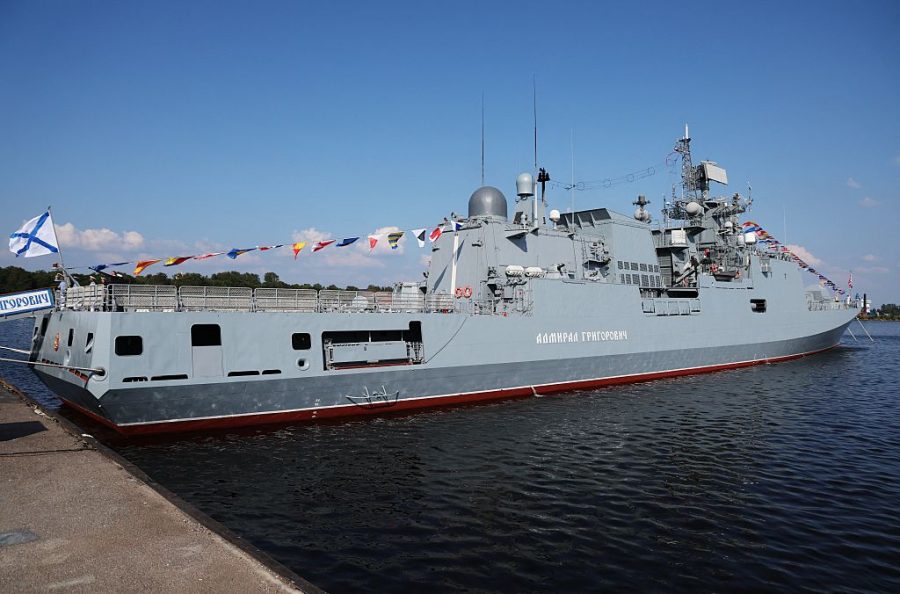
As the fallout from Keir Starmer’s defence funding row continues, Britain has been served a timely reminder of the importance of being prepared for a fresh escalation of tensions with Russia. A Russian warship, the Admiral Grigorovich, fired warning shots at an unarmed British civilian yacht in the Channel shortly before lunchtime yesterday.
The circumstances around the incident – which took place 20 nautical miles off the Isle of Wight, outside British waters – remain somewhat unclear. The owners of the 40-foot British yacht, Jane and Alan Kelvey, claim they came no closer than 500 metres (0.3 miles) to the 409-foot Admiral Grigorovich. The Russian warship then sounded its horn a number of times before firing its guns, they said. The couple, who were en route to France at the time, claim they ‘didn’t do anything wrong’ and that allegations they were on a ‘collision course’ with the ship were ‘simply not true’. The Admiral Grigorovich, the Kelveys claim, was not broadcasting its GPS position at the time of the incident.
British military sources seem somewhat unperturbed by the incident
The Russian Ministry of Defence, however, claims that the Kelveys’ yacht, Bright Future, was heading ‘dangerously close’ to the Admiral Grigorovich. Despite trying to get its attention with flares and horn blasts, the yacht, Moscow claims, actually got as close as 150 metres to the warship, at which point ‘the frigate’s commander decided to fire preemptively at the vessel’s course with small arms’.
It is worth saying that British military sources seem somewhat unperturbed by the incident, categorising it as ‘nautical’ rather than an escalatory event by Russia. A Ministry of Defence (MoD) spokesperson added that the shots fired by the Admiral Grigorovich ‘were not aimed at the vessel and were an attempt to prevent a possible collision’.

Nevertheless, this incident has significance thanks to recent events. Over the weekend, Royal marines borded and seized a tanker, the Smyrtos, in the Channel that formed part of Russia’s ‘shadow fleet’ of ships transporting sanctioned Russian oil around the world. An Indian national has been arrested on suspicion of sanctions offences in connection with the ship’s seizure.
While the MoD has stated it does not believe that the Admiral Grigorovich’s actions are linked to the seizure of the Smyrtos, a Nato source told the BBC last week that the warship had been in the Channel for several months escorting shadow fleet vessels. The Admiral Grigorovich is armed with Kalibr cruise missiles, torpedoes and anti-aircraft artillery; the ship was being monitored by the British navy’s patrol vessel HMS Mersey. It clearly wasn’t lurking just outside British waters on a pleasure cruise.
With no injury or loss of life sustained by the crew of either the Bright Future or the Admiral Grigorovich, it appears that neither the British military nor the government will escalate this into a full diplomatic incident with the Kremlin. This approach falls broadly into line with that taken by Britain and its allies monitoring Russian naval activity in the Atlantic and High North in recent years: let them know their activity, legal or not, is being watched, but don’t unnecessarily provoke or escalate.
On Sunday, First Sea Lord General Sir Gwyn Jenkins revealed that the navy spent more than a third of its time last year responding to Russian undersea threats. Incursions by Russia into British waters had risen 30 per cent in the last two years, he confirmed.
The threat to Britain from Russia at sea is by no means imaginary. That includes a risk to our merchant ships – more so after the Smyrtos’s seizure – as well as civilian vessels, our undersea cables and oil pipelines. Yesterday’s incident between the Bright Future and the Admiral Grigorovich appears small and isolated; next time may be different.






Comments