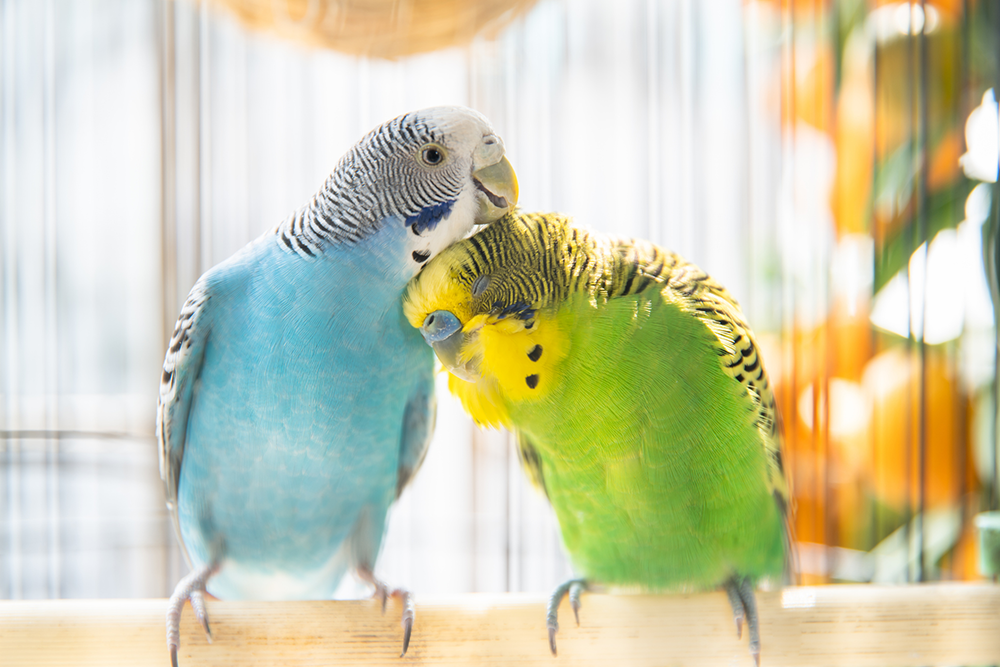
Geoff Capes, two-time winner of The World’s Strongest Man competition, weighing in at 27 stone, was a budgie fancier. He kept them, bred them and was even president of the Budgerigar Society in 2008. The fascination started for him when he was a copper in the 1960s and came across a budgie in the house of someone he arrested. The villain entrusted Capes with six of the birds. Capes was smitten. We don’t know what happened to the criminal.
In our modern world of cockapoos and designer dogs, the budgie – which was wildly popular in the 1950s and 1960s – could do with a comeback. Our lives would be better with them. They hark back to a simpler time when pets were pets and not designer accessories.
Budgies are native to the grasslands of Australia. In the 1840s, they started to be exported to us in exchange for prisoners. They were fortunate to find safety in Britain because the aboriginal name for budgies is ‘good meal’. Budgies could be roasted if caught, struck down by spears or boomerangs. A tree-ful would provide a good feast.
They quickly caught on as pets, but not any old pet. As whippets were to northern working-class folk, the budgerigar was to working-class Londoners. Their appeal was partly one of convenience. Even if you lived in cramped accommodation, you could keep budgies in a cage. They also have a friendly and pliable nature, which means they are good at learning tricks. Winston Churchill taught his budgie to carry the salt spoon down the dining table, much to the delight of his grandchildren. And, of course, budgies have the ability to mimic speech. With a bit of coaching, even the most reluctant bird can be taught all kinds of swear words. This probably didn’t help the snobbish backlash against them. In Agatha Christie’s 1961 play The Rats, a budgie features as the ultimate non-U symbol.
Budgies were an important part of the cultural life of cockneys. Street markets would be packed with bird-sellers and the sound of their birds’ songs was a backdrop to everyday life. Budgies warble, chirp, trill and whistle when they are happy. And they do it quietly, unlike parakeets, which can be quite unbearable with their screeching.
My father was a cockney. We rose up a bit from that; the family moved from a very tough place to a nice little house in the suburbs. But Dad couldn’t quite let his roots go, so we always had a budgie at home. The problem is that birds become very fixated on a single member of any household and are very protective of them. Silky was besotted with Dad. He’d sit on Dad’s glasses as he walked around the house, chirping away (that’s Silky, not Dad). In the evenings he’d take a peck from my father’s full whisky glass and would then lay on his back and sleep in my dad’s hand. (Incidentally, Churchill’s budgie also enjoyed sharing his master’s whisky.)
But to the rest of the family, Silky was a monster. We could only handle him if we wore a sturdy leather glove. Otherwise, he’d draw blood. He had a particular loathing for my mother, who would take refuge in the kitchen when he was in a spiteful mood. When Silky died, Dad was silent for a few days, mourning his friend.





Comments