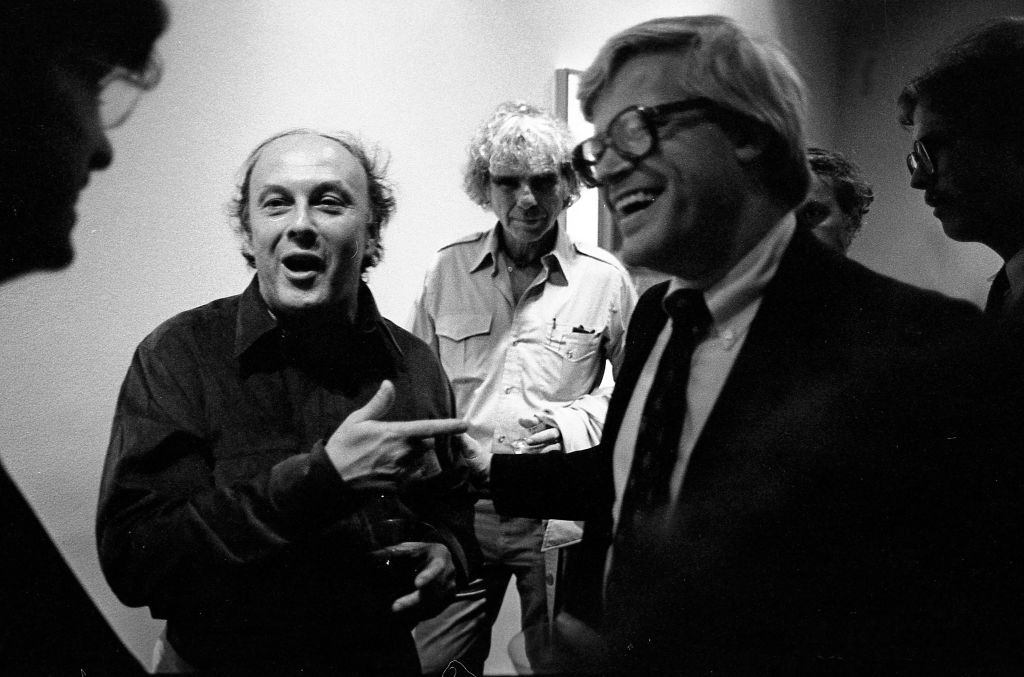
The current exhibition at Dulwich Picture Gallery, Portrait of a City: A Century of American Photography, displays work by 38 American photographers. Twenty-four of them, 63 per cent, are of Jewish heritage. Yet most visitors would not know this after leaving the exhibit.
The Jewish background of five of the photographers is mentioned by the museum. For several others, no biographical information is provided. When biographical context is given, the omission of the photographer’s Jewishness is more striking. This is particularly so in the case of Bruce Davidson, who is given one of the exhibition’s four rooms for his Subway series, made between 1980 and 1985.
While making these photographs, Davidson visited elderly Holocaust survivors. He later recalled that, after seeing them, ‘I would see the packed cars of the subway as cattle cars, filled with people, each face staring or withdrawn with the fear of its unknown destiny.’
The Dulwich photographs all come from a single collection: that of the Savings Bank Foundation DNB, a Norwegian philanthropic foundation. This is not an exhibition with a specifically Jewish focus. But the prominence of Jewish photographers in American photography over the past century is a notable fact.
Reviewing the exhibition in the Guardian, Charlotte Jansen wrote: ‘All the greats are here: Ilse Bing, Mary Ellen Mark, Diane Arbus, Saul Leiter, Richard Avedon, among others.’ Not mentioned is that all five of these photographers are Jewish. The Guardian was not alone in this. Neither the Observer, the Financial Times, nor any other review I found online, mentioned this dimension of the exhibit.
Writing about New York photography, the art historian Max Kozloff observed: ‘We’re largely dealing with a picture archive of an American city visualised by Jews, to which a few distinguished Gentiles have contributed.’ In 2002, Richard Woodward argued in the New York Times that this was ‘too remarkable and contentious a topic to be ignored by scholars much longer.’ He was right: the disproportionate prominence of Jewish photographers deserves examination.
There is, of course, no biological reason why Jews should be better photographers. But it does not follow that Jewish heritage is therefore irrelevant. Photography was a comparatively new field, and as the photographer William Meyers has noted, it lacked the entrenched social barriers that excluded Jews from other elite professions and institutions. Alfred Stieglitz, although raised in an irreligious family, understood such exclusion when his father was denied membership of the Jockey Club. This may help explain the attraction to Jews of pursuing photography.
Some photographers resisted being described as Jewish photographers. Morris Engel, whose work appears in the exhibition, worried that the label might pigeonhole him or distort the meaning of his work. Many women and gay artists have expressed a similar preference and wanted to be known simply as artists. Yet museums and galleries routinely discuss identity when it helps us understand an artist’s work and context. The Jewish contribution to photography can be acknowledged without chauvinism or anti-Semitism.
Others embraced the distinction. William Klein argued that there were two kinds of photography: ‘Jewish and goyish’. He described photographers such as Diane Arbus and Weegee as ‘funky’, in contrast to photographers such as Edward Weston, ‘who go out in the woods’. For Klein, the former meant street life, faces, crowds, blur, grain, confrontation and ugliness; the latter suggested work that was contemplative and removed from the mess of human life.
Garry Winogrand offered another provocative formulation: to be a great photographer, he said, one had to be Jewish. As Woodward explained, Winogrand used ‘Jewish’ to mean nervy, ironic, disruptive of artistic norms and proudly outsider. A photographer of any background who possessed those qualities could, in his terms, be Jewish.
Such generalisations invite counter-examples, but they should not simply be dismissed. The sense of Jews as outsiders looking in seems to be the key explanation. The exhibition includes Roy DeCarava, the great black photographer, whose biographical note says that he wanted to portray ‘black people… in a serious and artistic way.’ It contrasts his work with that of Helen Levitt and Aaron Siskind, who documented Harlem ‘as outsiders’. That observation, while correct, does not tell the full story. Jewish photographers such as Levitt and Siskind did not only photograph Harlem as outsiders, they photographed everywhere as outsiders.
Whatever the reason for the prominence of Jewish photographers, given the small proportion of Jews in the American population and their substantial representation in this exhibition, the subject might reasonably have merited a sentence in the gallery’s displayed material.


Comments