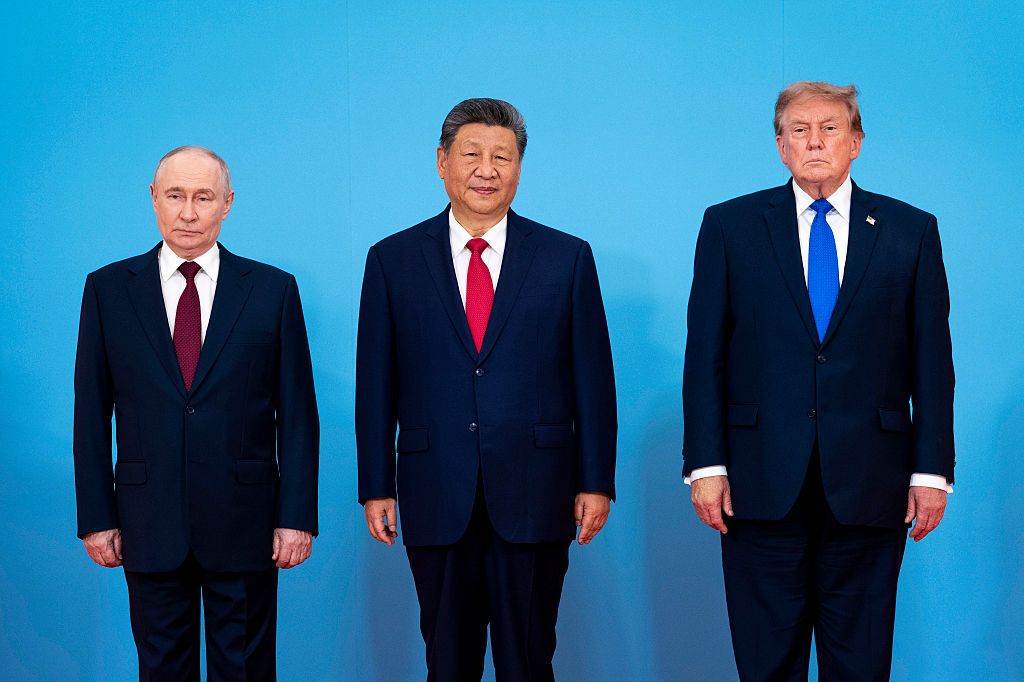
Big international summits tend to be flat affairs in terms of newslines – even when you throw in the dangerously powerful combination of Donald Trump, Xi Jinping and Vladimir Putin. And this week’s “tri-lat” between the leaders of the US, China and Russia in Shenzhen didn’t exactly throw up endless surprises.
As expected, the presidents talked about nuclear proliferation and arms control – which was admittedly something new for the Chinese Communist party. Beijing has a mere 600 nuclear warheads, compared with roughly 5,000 each for Russia and the United States, and China has never been part of the New START treaty framework.
But there’s nothing tremendously shocking about world leaders issuing a shared declaration that “a nuclear war cannot be won and must never be fought,” even if it comes against a backdrop of Russian officials repeatedly suggesting that a tactical nuclear strike over Ukraine is not out of the question.
Symbolism is the key to these jamborees
But no formal statements or pledges were made about Ukraine or Iran, the two most destabilizing wars of our time. Trump said he and Xi had agreed to keep the Strait of Hormuz open, and Putin noted that the US and China shared with him an interest in ending the war he started.
But symbolism is the key to these jamborees, and Putin got the validation he by all accounts so desperately craves by standing alongside the two greater world superpowers. The trilateral has served to confirm Moscow’s preferred narrative about the post-post-Cold War order: that we are now in a multipolar world in which American exceptionalism is no longer the rule.
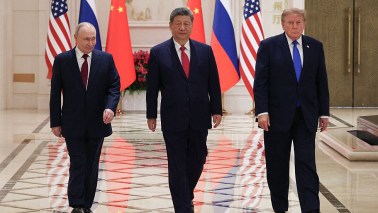
Xi said all the correct things about great-power “harmony”; that the conversations had been “constructive”, and the need for the three powers to establish new channels for dialogue. Now the US and China can go back to waging economic warfare on each other. The three powers promised to work together to bring down the price of petroleum products, but the market reaction to that news was muted at best.
The next key meeting will be the G20 in Florida on December 14, which may tell us more about the state of US-China relations. It will be held at one of the President’s golf courses – Trump National Doral in Miami – so we can expect more Trumpian diplomatic flourishes.
But the coming days may reveal how Team Trump’s wrangling with Putin over the Ukraine war is going. European grandees are of course horrified at being largely frozen out of the process, and relieved that China appears to support, more or less, the EU’s line on whatever peace deal is eventually struck.
The President’s son-in-law, Jared Kushner, and Steve Witkoff have been busy on this front too. At the Coalition of the Willing summit in Berlin on the same day as the Shenzhen meeting, they stressed that Trump wanted Europe “by his side” on Ukraine and would not impose any unilateral resolution. Kushner even hinted that Russia may be more comfortable with an Article 5-style security arrangement for Ukraine.
But it’s almost impossible to imagine any kind of peace deal being struck without the Europeans, Britain and the Ukrainians feeling left out and aggrieved. For a flavor of that, see most of the shocked reactions to Trump greeting Putin as “my friend.” “God, protect us from such friends,” tweeted the Polish Prime Minister Donald Tusk. “I think Putin will be even more emboldened after today’s meeting,” said Danish Prime Minister Mette Frederiksen. “He looks happy. Unfortunately, that is not a good sign for world peace. That is not a good sign for Ukraine.”
But as far as Trump, Kushner and Witkoff are concerned, justice and peace are not interchangeable terms, and even a flawed resolution to the conflict is better than none. Whether they next adopt the same approach to Iran remains to be seen.
This article appeared in Freddy Gray’s Americano newsletter. Sign up here.


Comments