When thousands gathered in Trafalgar Square last week to break their Ramadan fast, we were told this was Britain at its best. The message was that the UK is diverse, tolerant, and confident enough to make space for public expressions of faith. Islamic prayers were performed openly and unapologetically. Mayor of London, Sadiq Khan, took part, and Labour MPs, including Keir Starmer and Stella Creasy, defended the event vigorously on the grounds of a person’s right to freely express their religion.
The asymmetry could not be starker. Britain tolerates public religion – but only in some forms
But if this acceptance of those with deeply-held religious faith is truly a hallmark of Britain – and if we are indeed a country where people are free to pray openly in public – then it is a principle honoured with remarkable selectivity.
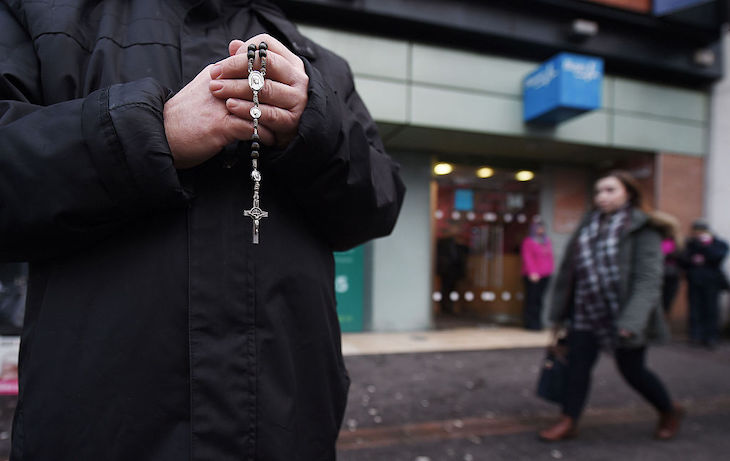
While Muslims are welcomed to pray loudly and openly in large groups in the centre of London, under the “buffer zone” legislation championed in 2024 by MPs, including Stella Creasy, those who pray publicly in the street outside abortion clinics – even if they do so alone, and even if they pray silently in their own minds – could swiftly find themselves in trouble. Under Section 9(1)(a) of the Public Order Act, if their presence is perceived merely to ‘influence’ someone considering going into the abortion clinic, they are likely to be arrested. Individuals have been questioned, fined, and dragged through court after standing, thinking, in a public space within 150 metres of an abortion facility.
Take Adam Smith-Connor. The Christian army veteran and father of two was tried, found guilty, and ordered to pay £9,000 after he paused across the road from an abortion facility in Bournemouth. Adam had lost a child some twenty years earlier to an abortion. It was a decision he deeply regretted. And so, in November 2022, he stopped for just a few minutes in a public area outside a clinic to pray for his unborn son. He didn’t talk to anyone, other than an officer who asked him to leave. He simply stood by a tree, obscured from view to most people, and prayed silently.
Adam’s conviction marked the first time a person had been penalised under British law after praying since the conviction of Oliver Plunkett, the last Catholic martyr, in 1681. Adam’s legal battle is ongoing. An appeal is expected later this year. But even if he wins, the four-year legal battle he has faced has been punishment in itself.
He isn’t alone. Isabel Vaughan-Spruce – a Christian volunteer from Birmingham with a long history of supporting pregnant women in need – awaits trial for the same “offence” after standing silently, praying imperceptibly, bothering nobody.
The asymmetry could not be starker. Britain tolerates public religion – but only in some forms.
Supporters of the buffer zones insist these laws are not about stamping out Christianity, but about protecting women from harassment. They argue that even silent prayer can “influence” a woman’s decision whether or not to access an abortion service. But this defence collapses under scrutiny. Longstanding laws already exist to prevent women from experiencing any form of harassment. It is not the role of the State to determine what factors, however peaceful, should influence a major personal decision such as having an abortion.
If standing in the wrong place and silently praying can be deemed a form of unlawful “influence”, then we have crossed a serious line. Whether or not you are breaking the law appears to be based, no longer on what you do in public, but on what others believe you might be thinking. That is a principle with no natural limit.
Britain has long prided itself on protecting not only popular speech, but unpopular conviction. That tradition is under threat when the state decides which beliefs are acceptable, which are not, and where you are allowed to express what you believe.
The anti-Christian bias of the British establishment now seems undeniable.
Religious freedom is a right, not a political prop. Britain cannot claim to be liberal while tolerating some expressions of faith in public and suppressing others. The asymmetry of protection – Islamic expression in Trafalgar Square embraced, Christian prayer outside an abortion clinic penalised – is a norm we might expect abroad, not at home.
If Britain is to remain a free nation, it must treat all faiths equally. Silence is not a crime. Prayer is not a threat. Liberty demands no less than tolerance for those who want to pray in public – wherever they want to do so.
Comments