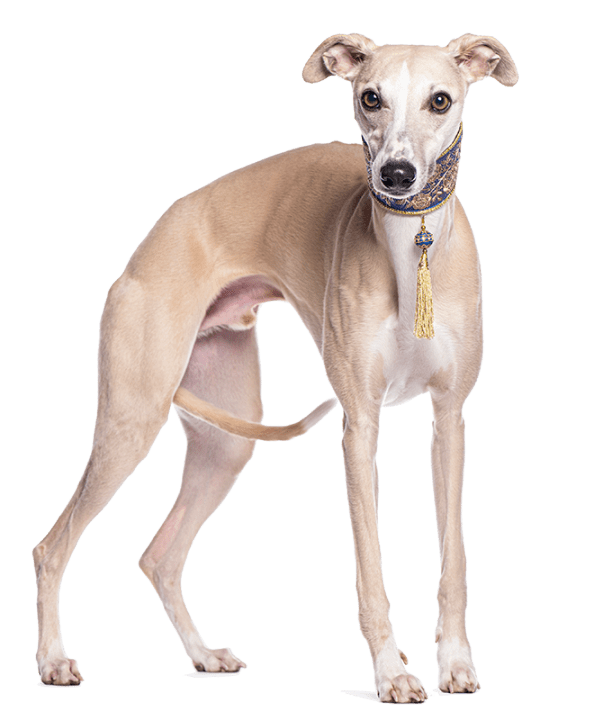


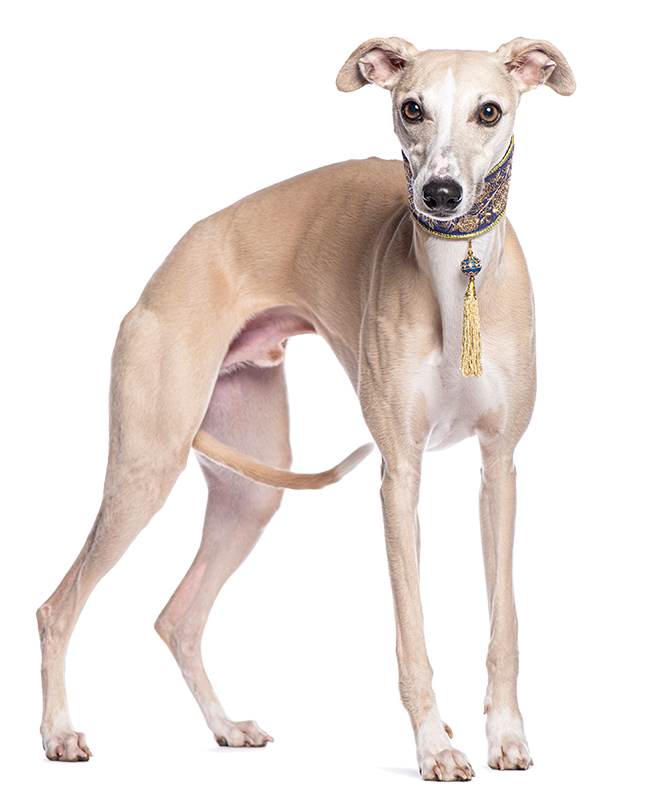
‘Whippets are simply ducal,’ a grand friend pants at me in her drawing room when I ask her why she owns one. Certainly not a Regency duke, I mutter, looking at the fawn skeleton lying in wait on the brocade sofa. Because to me, whippets aren’t posh, just as Michael Heseltine isn’t fooling me all these years later. Rather, I find them sinister: the endless jutting ribs, the paper-thin coat, the incessant shaking.
But I know I am not in good company. Whippets, the Ozempic-coded dog of our age, have been taken up by high society in their droves. You can’t move for magazine features detailing their storied owners: Robin Birley, of course, whose whippets eat breakfast at 5 Hertford St, or Rose, Lady Cholmondeley, who keeps hers whizzing around the Palladian porticos of Houghton Hall in Norfolk.
Other moneyed grandees to have brought the breed into the damask-lined zeitgeist of ‘interiors’ Instagram include mug-millionaire Emma Bridgewater and Victoria Stapleton, founder of the cashmere empire Brora, whose whippets have, for the last decade or so, appeared in carefully curated ‘quiet luxury’ reels where the dog is indistinct from the brindle-tone cashmere. Zoom in, and you may even spot the biggest giveaway of all: a whippet crest on a signet ring. Oh, and they don’t smell – or maybe they do, but only of Diptyque.
This is all before you get to art. Bohemians such as Lucian Freud and Brian Sewell were enamoured of these so-called ‘velcro dogs’ known for their ‘loyalty and affection’ (but what dog, I ask you, isn’t?). Crucially though, whippets such as Freud’s Pluto may have appealed to artists for their Ikea qualities: one stagger around the block before lunch in the garden at the Chelsea Arts Club and said whippet will simply flat-pack down and snooze for the entire affair like a Billy bookcase before you get the Allen key out.
Even better, they may snore through the sitting of a portrait. Regarding portraits, whippet enthusiasts will often barrage you with the dinner party lecture of ‘whippets in art through the ages’. ‘So elegant, so equine,’ they murmur while they trip over the pronunciation of Eugène Delacroix, who painted apparently gorgeous whippets, or bore you with the appearance of ancient sighthounds (wrongly presumed to be whippets) in -Graeco-Roman art.
Such inflated snobbery is curious given the breed’s beginnings. The whippet, as classified by Britain’s Kennel Club in 1891, was originally known as the ‘poor man’s racehorse’. Bred to be smaller than their larger racing cousins, greyhounds, whippets were originally 19th-century miners’ dogs, loved for their diminutive size and agility and designed to participate in ‘rag races’.
All of which leads me to Hannah Spencer, the Green MP for Gorton and Denton, and her four rescue greyhounds. For Spencer, who began her political career campaigning on behalf of rescue greyhounds at the Belle Vue race track in Manchester, has clumsily elided class politics with dogs. In a recent spat with Lisa Nandy, Labour’s Culture Secretary, Spencer railed against Nandy’s defence of greyhound racing, fulminating that: ‘Nandy just continuously offends people by saying that working-class people don’t care about dogs or each other. It is a caricature and it is very offensive.’
But perhaps we should thank Spencer. For by accident rather than design, she has lit upon one of the preoccupying questions of anxiety in this country, namely: how does class map on to canines?
Stroll around Kensington Gardens and you will see that the old rules no longer apply. Yes, labradors, and in fact any gun dog, are still terminally U, redolent as they are of both the stucco-fronted townhouse and the country pile, but we knew this. The royals, in our Andrew Mountbatten–Windsor era of feudal confusion, give us mixed canine messages. Queen Camilla has a Jack Russell, the Waleses keep cocker spaniels (the poor benighted breed now for ever tainted by James Middleton) and the Sussexes once had a rescue beagle.
Whippets, the Ozempic-coded dog of our age, have been taken up by high society in their droves
Nothing is as it seems; we are untethered from our canine signifiers. Pedigree is out, rescue is in, and anyone from a marquess to a miner can enjoy an evening at the dogs.
So it is that I return to the social conundrum of the whippet. A dog for our ages, designed for the social media carnival of fat-jab-dulled bottoms and breasts.
Yet the whippet has achieved something rather radical: the jump from the cramped terrace of a northern mining town to the lavish surroundings of the grandest houses in the country, or the pages of our broadsheets where fashion editors boast of being ‘whippet mothers’.
Perhaps it is their fabled speed that has given them their ability to whizz past us in a social rag race. But know this, whippies: you won’t be sleeping on my sofa.




Comments