
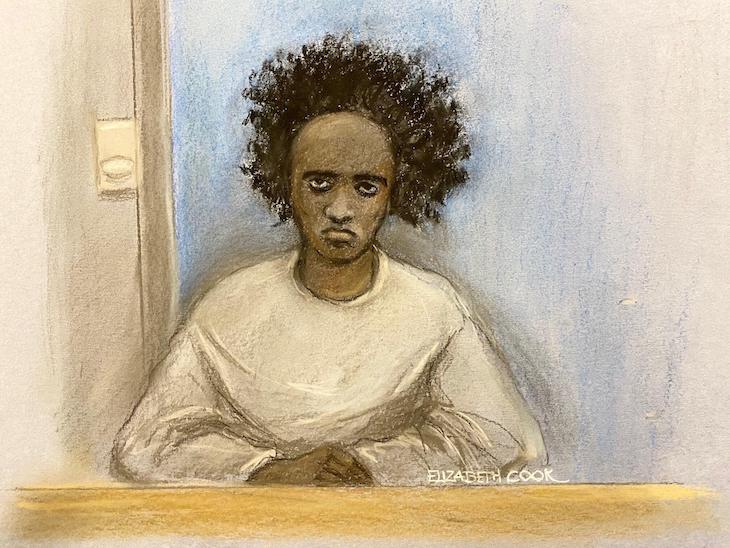
Axel Rudakubana’s mother and father failed as parents – and they failed the three innocent girls who were murdered in the Southport attack. They could – and should – have prevented their son from going to the dance class where he killed those children. That is the verdict of the Southport Inquiry, which released its first report into the killings this week.
Others have gone further: Conservative leader Kemi Badenoch says Alphonse Rudakubana, Axel’s father, and his mother, Laetitia Muzayire, should be deported.
Rudakubana’s mother and father must shoulder some of the blame for failing to intervene. Yet those who condemn Rudakubana’s parents ought to stop and ask themselves what would they have done with a son like Axel Rudakubana?
Deporting Axel Rudakubana’s mother and father might make us feel better, but it will do nothing to face up to the failings that led to Southport
Of course Rudakubana’s parents should have acted differently. Alphonse Rudakubana deliberately withheld evidence about what his son was up to. He knew about the knives and the ricin. He knew Axel Rudakubana was planning an attack. The Inquiry’s chair, Sir Adrian Fulford, says that ‘Axel Rudakubana’s parents (and particularly Alphonse) created significant obstructions to constructive engagement with Axel Rudakubana by the various agencies that were involved’.
Why didn’t they act? Fulford says they had a ‘misguided and irresponsible motivation’ for not speaking out. In the Times, Alice Thomson suggests that soft parenting might be to blame.
But Rudakubana’s parents did try and get help. They called the police about their son – whom they lived in fear of – on several occasions. In one incident, Rudakubana poured oil on his father’s head and told him: ‘If you get me out of here, this house, it may take a day, it may take a week, maybe a month, maybe years, I will kill you and trust me I will kill you’.
It’s easy to say that Rudakubana’s parents should have called the police again in the weeks, or even hours, before the attack. Even if they had done so, would the authorities have responded robustly enough to prevent the attack and stop Rudakubana from carrying out his threat against his father? The bureaucratic incompetence that has emerged from the Inquiry makes one at least question that would have happened. Is this why Rudakubana’s parents made the fatal decision to stay silent as 29 July 2024 drew closer?
No one ever wanted to assume responsibility for Axel Rudakubana. ‘Witnesses in appropriate positions were asked who was responsible for Rudakubana’s risk. There was no consistent response,’ the Inquiry report says.
When Rudakubana was referred to Prevent in 2019, Lancashire Constabulary’s so-called ‘Community Safety team’ washed their hands of him. Prevent failed to do its job. Forensic Child and Adolescent Mental Health Services (FCAMHS) closed Rudakubana’s case in spite of the evidence. Lancashire County Council’s (LCC) Children’s Social Care (CSC) repeatedly ‘stepped down’ Rudakubana’s case. This mish-mash of acronyms and byzantine public sector agencies left cracks large enough that Rudakubana fell through.
This doesn’t get Rudakubana’s parents off the hook for those occasions where they didn’t engage with those in authority who were trying to help. But it’s easy to cast blame when we’re not the ones living under the same roof as a person like Axel Rudakubana.
Axel Rudakubana’s father ultimately took the fateful decision – whether through fear of his son or a refusal to confront reality, or perhaps a combination of both – to turn a blind eye to what was going on in his home. In his evidence to the Inquiry, he said this:
‘I became conditioned to Axel Rudakubana’s behaviour and I allowed him to abuse and assault me, and to cause damage at home, without response, because this was the only way of getting through the day. Axel Rudakubana’s outbursts would blow over quite quickly and would be followed by a period of relative calm. I am ashamed that this was my response and I felt demeaned, but I did not know what else to do’.
Rudakubana made his parents’ lives hell, yet he was – and is – their son. They were blinded to what should have been plain to see to a dispassionate observer: that Axel Rudakubana was a deeply dangerous, violent and troubled man.
Parenting him, Fulford said in a notable understatement, had been ‘challenging’. It was a challenge that clearly that they were not up to. They needed help and they didn’t get it.
The lives of those three young girls could have been saved if Rudakubana’s parents had only done something. Yet before the attack, and even when the warning lights were flashing red, Rudakubana’s parents feared that their son would be taken away from them. In the light of what Rudakubana went on to do, that sounds painfully naive. But their fear was one that other parents will recognise.
Giving evidence during the Inquiry last year, Alphonse Rudakubana cried as he apologised. ‘The love I had for him overrode [my] good judgement,’ he admitted.
It’s not a defence of Rudakubana’s parents to pause and consider what an impossible dilemma they were in: their son was a violent monster who made their lives a living hell. But he was still their son.
Alphonse Rudakubana was blind to the truth about his child. He isn’t the first, and won’t be the last parent for whom that blindness leads to terrible consequences.
This is why, when we point the finger of blame for Southport, it must not land entirely on Rudakubana’s parents but on this agencies and police officers whose job it is to do what parents can’t always do: to be dispassionate and confront reality. Deporting Axel Rudakubana’s mother and father might make us feel better, but it will do nothing to face up to the failings that led to Southport.





Comments